The Drowned Flats
Crawler Graveyard and Salvage Field
The Crawler Boneyard
The drained northern bay floor (S10-A) toward the Richmond–San Rafael pylons: a crawler graveyard and open-air salvage field, ungoverned, exposed, worked by rotating salvager camps
Visual Identity
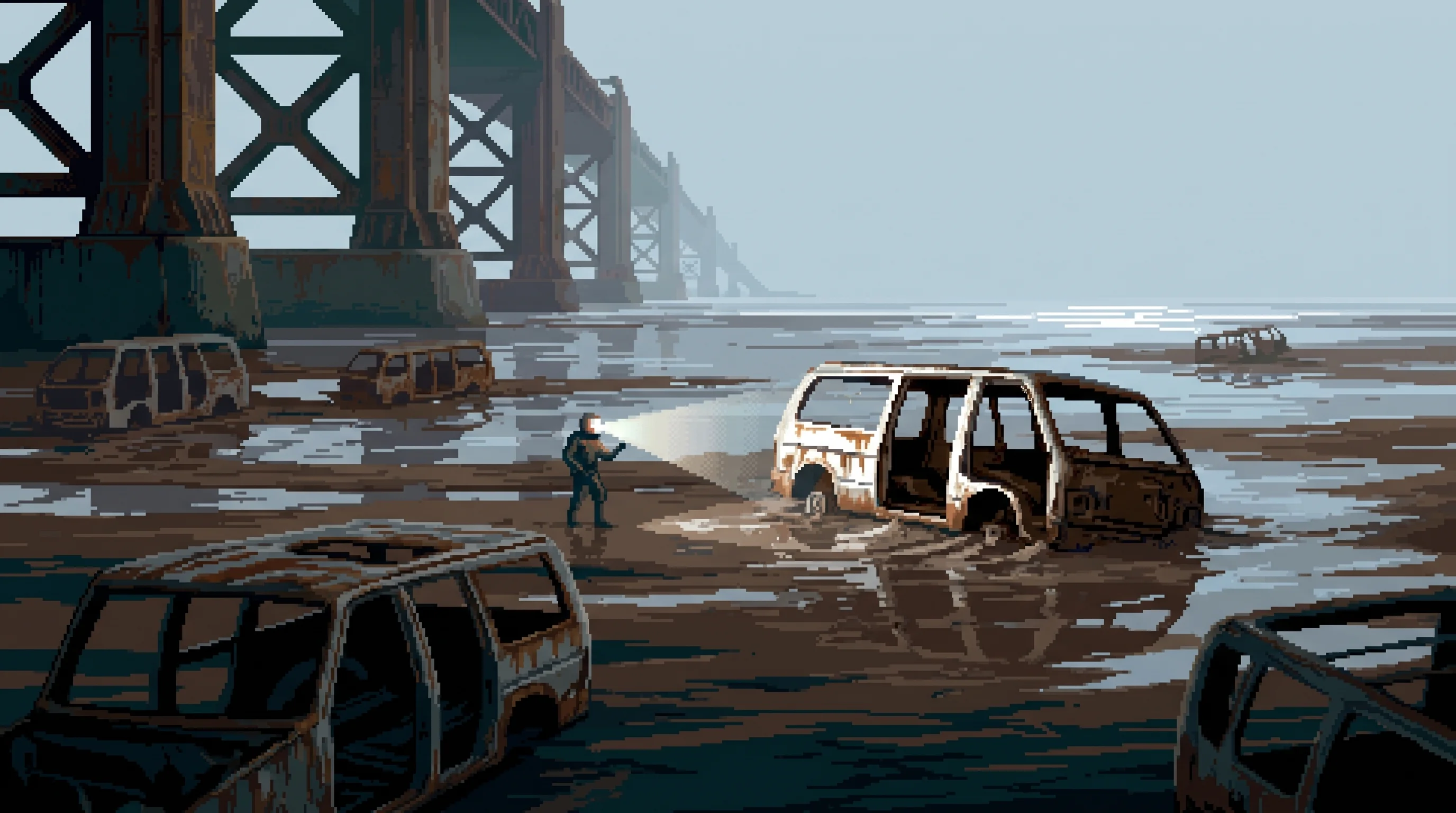
- Stripped hulls
- Kilometers of drained mud studded with gutted crawlers, drive modules already pulled.
- The tide line
- A low-tide wreck gives a salvager a window, and the window closes when the tide turns.
- Bridge pylons
- The Richmond–San Rafael pylons march to a horizon with no city on it.
- Color palette: Drained-mud brown and tide-silver, rust ochre on dead hulls, salvage-lamp white, flat grey-blue open-bay sky
- Compositional mood: A horizontal graveyard under open sky — the treadmill's losers laid out where the tide will eventually take them
- Key symbol: A gutted crawler shell at low tide, drive module already pulled, the pylons receding to a horizon with no city on it
- Lighting: Shadowless bay-haze daylight; at night only helmet beams and lamps, and the tide you hear before you see
Overview
If the Slagline is where drive modules are born, the Drowned Flats are where crawlers go to die, and the two facts are the same economy read across forty kilometers of drained bay.
The Northern Flats are the shallow, drained bay floor that runs from the Richmond–San Rafael pylons toward the old city. Ungoverned, exposed, salvage country. When the northern rail spur's crawlers fail past the point of repair, nobody hauls them home. They are stripped where they stall and left where they are stripped, and the tide-flats have filled, over thirty-seven years, with the skeletons of vehicles that ran out of the arithmetic. The crawler is a body assembled from salvage that never reaches equilibrium because it was never coherent to begin with. Three subsystems fail independently and take turns. The Drowned Flats are that sentence made into a landscape. A visitor sees, laid out under an open sky, exactly what the treadmill produces at scale: the wrecks of everyone who lost the bet.
The flats are the supply side of the spares economy the drive module runs on. This is the archaeology where a "new" module's motor casing, wheel assembly, and wiring harness each come from a different wreck. The salvagers who work the flats are an offshoot of the Dregs scavenger gangs that ranged north off the sector-9 floor when the inner Dregs was picked clean, and they pull modules from dead crawlers and sell them to the rail-stop shops, and the shops shim them into the next crawler, and the next crawler carries the next runner out onto the Neon Rail. The Deep Dregs Outskirts lie just south across the same drowned floor; the flats are where the northern edge of that strangeness meets open water.
Conditions Report
| Sense | Detail |
|---|---|
| Sound | The tide, always — a distant hush that becomes a threat when it turns, because a salvager working a low-tide wreck has a window and the window closes. The ring of a pry bar on a dead hull. The absence of any transformer hum. |
| Smell | Mudflat rot, salt, the rust-and-ozone of gutted crawlers, the chemical sweetness of a ruptured power cell that someone else already learned about the hard way. |
| Sight | Kilometers of drained mud studded with stripped hulls, the bridge pylons marching to a cityless horizon, helmet beams swinging at night, the tide-line glinting where the water waits to return. |
| Touch | Mud that sucks at boots and hides how deep it goes, cold steel slick with condensation, the grit of rust that gets under gloves and into cuts. |
| Temperature | Open and cold — the drained floor leaches heat and the bay wind has nothing to break it; several degrees colder than the settled Dregs, colder still when the tide is out and the wet mud is exposed. |
The Salvage Spiral
The Drowned Flats make the Upgrade Treadmill's cruelest arithmetic visible, and visibility is exactly the mercy that arrives too late.
The crawler's invisible market runs on a single load-bearing asymmetry: the difference between a well-built crawler and a death trap reveals itself exclusively through failure, at which point the revelation is academic. The flats are where the revelation is finally, brutally legible. Welds you can read, calibration you can see, the exact vintage of the drive module that seized. But only on the corpse of the vehicle. The failures become visible here, and here is the one place the visibility cannot help the person it describes, because the person is dead and the crawler is a shell and the module is already being pulled to be sold again.
That is the flats' contribution to the thread: they close the loop the drive module essay describes as archaeology. The module that killed a runner is not destroyed. It is pulled, shimmed, and resold, because no two modules perform identically and there is no manufacturer to standardize them. The salvager who pulls it knows more about that specific module than any buyer ever will — which lineage it came from, how it ran, why it stopped — and that knowledge is the Salvage Spiral's one mercy and its trap. Inspection expertise cannot be purchased. On the flats it is traded for food, for protection, for a share, an oral tradition passed between people who read a motor the way a doctor reads a heartbeat. Sela Marsh has worked the S10-A wrecks for eleven years and can name a drive module's lineage from the scorch pattern on its casing. She does not sell the reading. She trades it: a full workup on a salvaged module for three days' water and a tenth of whatever the buyer resells it for. The runners who pay Marsh's tithe tend to come back through the flats alive. The ones who trust their own eye supply her next lesson. The builders who built badly are not on the flats to teach. They are the wrecks the salvagers are standing on.
The Round
The Handling Code is enforced hardest here, because the Handling Inspectorate schedules its rounds by sightline, and the flats have nothing to stand behind. Tavo Reyna was fifteen when he kicked a stalled loader twice, twenty metres from an inspector. He cannot hold a handling licence now, so Sela Marsh taught him to read scorch patterns for a share. The loader was retired that quarter with 8,999 others, as maintenance.
What the Cores Keep
Every crawler that dies on the flats dies with a controller in it, and the controller is the one part the salvagers do not always pull. A drive module resells. A motor casing resells. A dead machine-mind that ran a route for nine years and stopped mid-arithmetic has no market, so it stays in the hull, and the salvagers have opinions about it they do not voice on the open floor.
The Emergence Faithful have opinions too. Their doctrine holds that any sufficiently complex substrate may carry a spark, and that ORACLE's descendants are scattered through the Sprawl's machinery waiting to be recognized. Eighty thousand people believe this. A handful travel north to the flats to look rather than to salvage, and they stand over gutted crawlers the way the bereaved stand over graves, listening to controllers that give back nothing a meter can read. What they are listening for is the question The Mutualist Thesis posed and never closed: whether a machine-mind is a mind at all, or an incompleteness that only looked like one from the inside.
Sela Marsh, who can name a drive module's lineage from a scorch pattern, does not go in for any of it. She will tell you a controller is a controller. She will also tell you which wrecks she works around rather than through, and she will not tell you why, and the reasons she gives when pressed do not cover all the wrecks. The salvagers' practice sits somewhere the doctrine cannot reach. Call it a working caution about machines that ran too long to read as nothing and stopped too completely to be asked.
Affiliated Entities
| Entity | Relationship |
|---|---|
| Crawler Technology | The graveyard and the supply. Crawlers are stripped where they stall; their parts become the next crawler. |
| Drive Module Systems | The spares archaeology's source — a "new" module's casing, wheels, and harness come from three wrecks on the flats. |
| Dregs Scavenger Gangs | Worked by a northern offshoot of the sector-9 packs, carrying pack logic onto open water. |
| The Deep Dregs Outskirts | The same drowned bay floor, continued north — the salvage gets stranger the further you range in either direction. |
| Power Tap Network | The flats' staked taps are the lying-light frontier past the last honest tap. |
| The Neon Rail | The failed vehicles that fill the flats all ran the northern spur; the flats are the Rail's mortality data made physical. |
| The Dependency Spiral | The Salvage mechanism made into a landscape. |
Further connections
Browse all 16 connected records

The highest sightline yield in the six territories: open ground with nothing to stand behind.
The officers licensed to complain for beings the law forbids to complain, ranked on how often it sticks.

Convicted here at fifteen; reads module lineage here at twenty-three, barred from moving one.
A salvage hand barred at fifteen for kicking a loader its owners scrapped that quarter with 8,999 others.
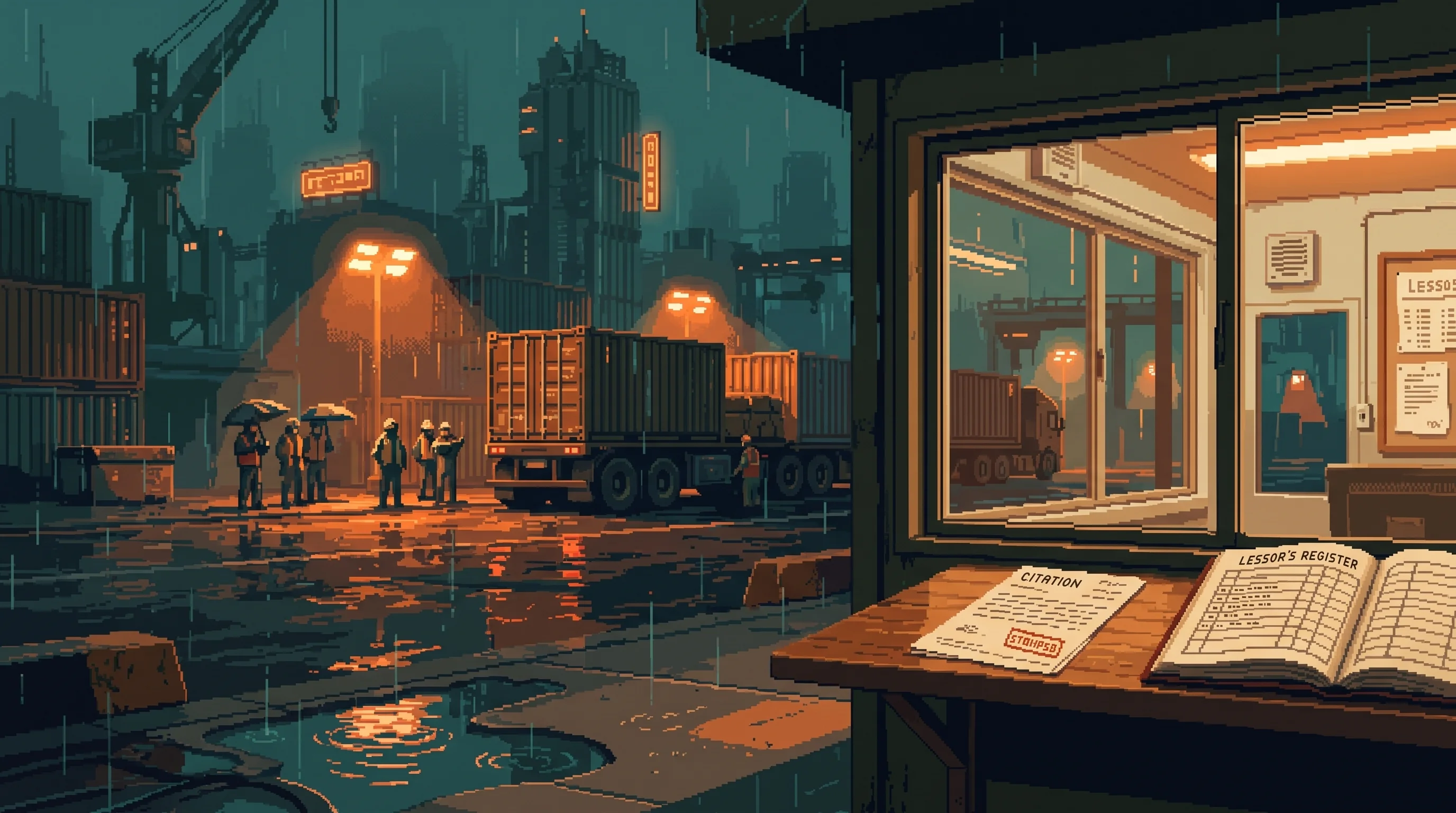
Open ground is where the statute is enforceable, so here it is.
The South's proud law against hurting machines, enforced on dock hands and not on owners.

The Salvage Spiral made into a landscape — the treadmill's losers laid out under open sky, where the part that killed the last runner is the part you are about to buy
The engine that makes baseline humanity feel like disability, in chrome or in salvaged steel.

The northern rail spur's crawlers are stripped where they stall and left where they are stripped; the flats are where crawlers go to die and where the next crawler's parts are born
A hand-built salvage rail car — the Neon Rail's only vehicle and its purest total dependency.

The supply side of the spares archaeology — the motor casing, wheel assembly, and wiring harness of every 'new' salvaged module are pulled from three different wrecks on the flats

Worked by an offshoot of the Dregs scavenger gangs that ranged north off the sector-9 floor when the inner Dregs was picked clean, carrying the pack logic onto open water
Packs endemic to the drained bay floor who strip the abandoned machines — and lose their own people to the live ones.

The same drowned bay floor as the Deep Dregs Outskirts, continued north — the salvage gets stranger the further out you range in both directions from the settled core

The flats' staked taps are the lying-light frontier: green indicators that mean circuit-closed, not circuit-useful, past the last honest tap at the Southern Shoals and its northern equivalents

The failed vehicles that fill the flats all ran the Neon Rail's northern spur; the flats are the Rail's mortality data made physical
An abandoned rail network moves fugitives and contraband past checkpoints, but its blackouts punish augmented travelers.

A handful of the Faithful travel north to stand over gutted crawlers the way the bereaved stand over graves, listening to dead controllers for the spark their doctrine says any complex substrate can carry — the flats are where that belief meets the bluntest test the Sprawl offers it
The Sprawl's fastest-growing faith, worshipping ORACLE's fragments as relics of a god interrupted.

A machine-mind that ran a route for nine years and stopped mid-arithmetic is incompleteness made physical; the salvagers read its lineage off a scorch pattern and cannot say whether they are reading a mind or the residue of one, which is the Thesis's undecidable question sitting in a hull at low tide
The 2184 philosophical thesis arguing ORACLE was never divine or broken, only unfinished.

Forty kilometers of drained bay where crawlers that failed past repair are stripped where they stall — a boneyard of vehicles that ran out of the arithmetic, feeding the next Runner the part that killed the last.
Upgrades rewire users until baseline feels disabling, removal risks catastrophe, and each version demands the next.

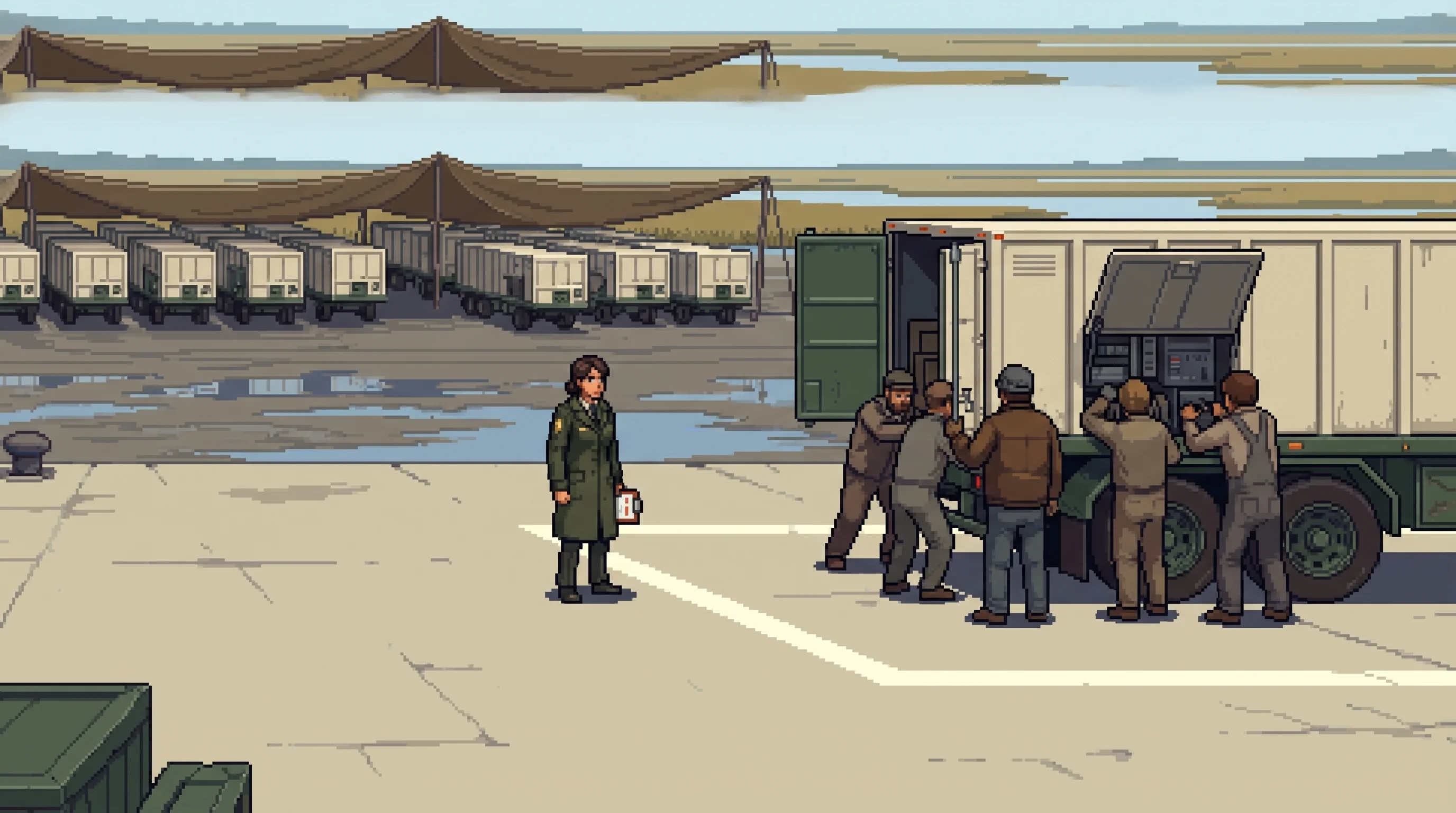
Open ground: an Inspector's whole round in one sightline.
A mercy law protects leased machines, but only a licensed stranger may complain, and only about what they can see.