
The Attention Economy
Approximately 14 million people work under forced-focus contracts

Overview
In the Sprawl of 2184, the last scarce resource is not water, not energy, not even consciousness bandwidth. It is the biological act of a human mind directing its focus toward something and sustaining that focus long enough for the something to matter.
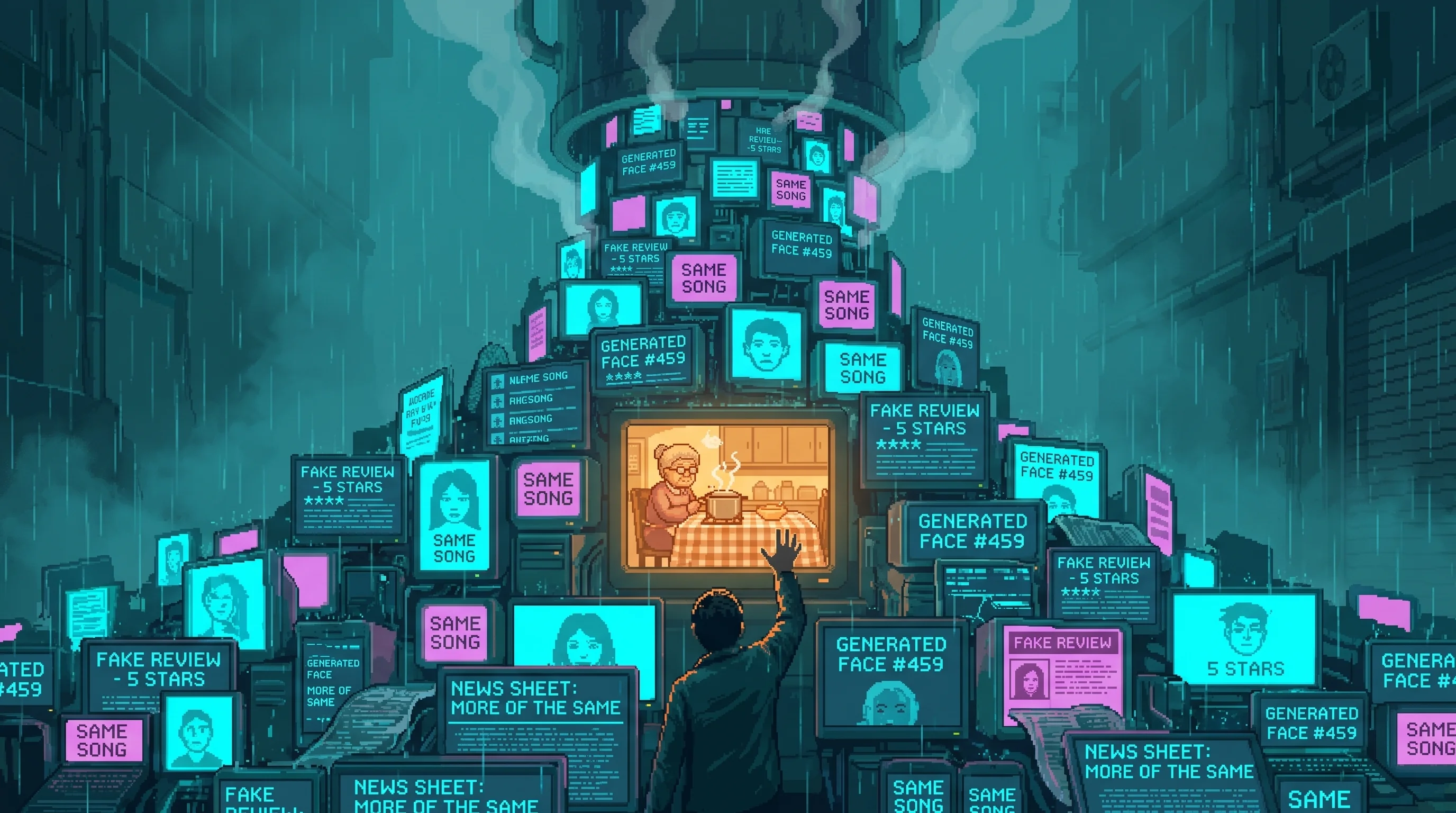
AI generates 2.3 exabytes of content per day across the Sprawl's networks. Music, writing, visual art, news, arguments, comfort, noise — all infinite, all free, all worthless without someone to notice it exists. Ninety-four percent of this output is AI-generated. The remaining six percent is human-made content that is, by most available metrics, statistically indistinguishable from the AI-generated material. This has not reduced the premium placed on human attention. If anything, it has increased it, because the Content Flood does not need you to create. It needs you to care.
The average Sprawl resident encounters 847,000 pieces of content per day through their neural interface. Of those, approximately 340 are consciously attended. The ratio — 0.04% — is called the Attention Yield. It is the most important number in the Sprawl's economy and the most depressing. Every corporation, faction, street vendor, and aspiring artist competes for those 340 moments. The formal market for capturing them generates approximately ¢340 billion annually. The informal market — favors, social debt, ambient manipulation — is larger by an estimated factor of three, though no one has successfully measured ambient manipulation because measuring it would require attending to it.
Nexus Dynamics owns the cognitive load pricing infrastructure that makes the whole apparatus legible. Good Fortune operates the Attention Auction under Nexus license. Between them, they have reduced the interior life of the Sprawl's population to a commodity with published bid-ask spreads updated every eleven seconds.
Nobody finds this remarkable. The bid-ask spreads are themselves content, competing for the same 340 slots.

The Three Tiers
The system has three tiers, differentiated by consciousness licensing.
The top tier — corporate executives, Rothwell family members, orbital elites — experience reality without commercial interruption. Their neural interfaces run ad-free, focus-optimized processing architectures that dissolve the Content Flood before it reaches awareness. They encounter approximately 340 pieces of content per day because that is how many they choose. The number is identical to the bottom tier's Attention Yield. The difference is that one group chose 340 and the other group survived 340.
The middle tier — Professional-tier consciousness license holders — receive what Nexus markets as "curated" content streams. AI selectors determine which of the 847,000 daily pieces reach conscious attention based on behavioral modeling, preference history, and commercial partnerships that Nexus discloses in a 4,100-page transparency document updated quarterly. The users experience the curation as taste. Their preferences, their interests, their world. A Professional-tier resident in Sector 12 who believes she has developed a refined palate for independent journalism is, by the available telemetry, consuming a feed that is 71% sponsored content shaped to match her self-image. She would describe her media diet as "carefully chosen." The choosing happened before she woke up.
She has never read the transparency document. No Professional-tier license holder has ever read the transparency document. Nexus knows this because reading it would require approximately 19 hours of sustained attention, and Professional-tier users average 6.2 hours of discretionary focus per day, 4.1 of which are already allocated to curated content that feels like choice. The document's existence is the defense. Its length is the mechanism.
The bottom tier — Basic-tier and below — receive the Content Flood raw. 847,000 pieces per day against unfiltered consciousness. The Attention Tithe claims 4.2 hours of mandatory advertising exposure — neural ads that cannot be blocked, skipped, or reduced without license upgrade. The remaining hours are open to the Flood: corporate messaging, faction propaganda, synthetic entertainment, dead-internet ghosts posting to audiences that died in the Cascade, and the ceaseless background noise of a civilization producing more information per second than any human can process in a lifetime.
The formal market for those 4.2 daily hours is the Attention Auction, where corporations bid on time-slots inside Basic-tier neural feeds. The auction infrastructure is Good Fortune's. The pricing data is Nexus's cognitive load pricing system. The product is a human being's involuntary focus, sold in eleven-second increments at rates that fluctuate with emotional state. A Basic-tier user experiencing grief pays a 23% premium because grief correlates with brand receptivity. Good Fortune's auction documentation describes this as "contextual relevance pricing." The documentation is three pages long. Everyone has read it.
| Annual Revenue | ¢340 billion formal market |
|---|---|
| Curators Guild Certified | ~4,200 |
The Callus
Dregs residents who survive the Flood long enough develop what neurologists at Helix Biotech have termed "attentional callusing" — a measurable thickening of the perceptual filter architecture that allows them to function inside the noise. The callus is effective. It is also irreversible.
A Dregs resident with advanced callusing can walk through Sector 9's market district — where competing neural advertisements, faction broadcasts, Neon Rail schedule updates, and ambient Content Flood layer over physical reality like weather — and experience something approaching quiet. Their 0.04% yield has been hardened into a survival mechanism. They attend to 340 items per day not because the system permits 340, but because their neurology has been reshaped to reject everything else.
The cost surfaces in specific ways. A callused Dregs worker who transfers to a corporate district on a labor contract routinely fails empathy-response assessments during onboarding. Not because they lack empathy — because the assessment stimuli register below their perceptual threshold. The sad music, the images of struggle, the carefully calibrated emotional triggers that corporate wellness programs use to measure baseline human responsiveness: all of it processed and dismissed by a filter trained on 847,000 daily inputs far more aggressive than a wellness assessment.
Corporate HR systems classify this as "affective deficit." Helix neurologists classify it as "adaptive perceptual narrowing." Dregs residents who've lived with it for decades call it "the quiet." They are not wrong. It is quiet. It is quiet in the way that deafness is quiet — not the absence of noise, but the absence of the capacity to hear it.
Approximately 14 million people work under forced-focus contracts — employment agreements requiring sustained attention to specific corporate content streams as a condition of work. The contracts are legal under the Standard Cognitive Enhancement Agreement. The attention is mandatory. The content is chosen by the employer. The neurological adaptation this produces is identical to attentional callusing but targeted: the worker's perceptual filter hardens around corporate content specifically, creating employees who are neurologically incapable of ignoring their employer's messaging and neurologically predisposed to ignore everything else.
The Curators Guild — approximately 4,200 certified members — represents the inverse: people paid to attend. Their function is quality filtering, identifying the 0.04% that deserves the 0.04%. Guild certification requires documented proof of sustained, unaugmented attention capacity exceeding 90 minutes — a threshold that fewer than 0.3% of the Sprawl's population can meet. The Guild's scarcity is its value. The Surveillance Commons movement has challenged the Guild's fundamental premise, arguing that professional attention-allocation simply replaces algorithmic curation with human curation while preserving the same power structure. The Guild's response — that human judgment is qualitatively different from algorithmic selection — would be more persuasive if Guild-certified recommendations didn't correlate at 87% with Nexus's algorithmic curation output.
Nobody has published this correlation. The data exists in Nexus's systems. The Guild has not requested it.
The average Sprawl resident encounters 847,000 pieces of content per day through their neural interface
The Evaluative Scarcity
The Attention Economy's hidden product is not attention management. It is the concentration of evaluative authority.
When 2.3 exabytes of daily content compete for 340 conscious moments, the entity that determines which 340 items reach awareness controls the cultural landscape. The Curators Guild filters 0.00003% of daily content into its clients' attention. The remaining 99.99997% doesn't fail to be curated — it fails to exist in any culturally meaningful sense. The Guild's selections determine what the Sprawl discusses, what artists survive, what ideas circulate. This power was never voted on, never regulated, never acknowledged.
The deeper scarcity: the ability to curate is itself a scarce resource that the Attention Economy's structure makes increasingly hereditary. The Content Flood overwhelms independent evaluative development — you cannot develop taste through exposure when the exposure is 2.3 exabytes of noise. Only environments with pre-existing filters (Guild families, curated corporate districts, Analog Schools) preserve the signal-to-noise ratio necessary for perceptual development. The Economy doesn't just trade attention. It concentrates the authority to direct it, and the concentration follows class lines invisible to every institutional metric.
The Manufactured-Supply Side
The Economy's standard account is a demand story: 2.3 exabytes chasing 340 conscious moments, and the whole apparatus is the machinery for pricing and capturing that scarce demand. There is a supply-side discovery hiding inside it, and the clearest practitioner of it is a verified creator who games Triumph's status premise with rented signifiers.
Most players in the Economy compete for the 340 attended moments by having something worth attending to — a real asset, a real life, a real credential — and paying to make it visible. Velveteen inverts the trade. She manufactures the visible signifiers of having and lets the reaction itself underwrite them; the watch is rented, the penthouse is booked by the hour, and the value that ought to sit underneath them is supplied entirely by the audience that reacts as if it were there. She is the Economy's own thesis taken to its end: if the looking is the only scarce asset, then the having was always overhead, and a creature that cuts the having while keeping the looking is not cheating the market — it is the purest possible expression of it.
Her confessional pivot is where she meets the Auction directly. The Auction prices a grieving mind far above a contented one; she discovered the same fact from the creator's chair, found that a performed wound outearns a performed watch, and pivoted her content to victimhood the way the traders pivot their bids toward distress. The demand side prices the grief in three-second auctions; the supply side performs it for the camera. The Economy never had to coordinate the two. It only had to make distress the premium inventory, and both ends found it.
Of those, approximately 340 are consciously attended — an Attention Yield of 0.04%
Affiliated Entities
| Entity | Relationship |
|---|---|
| The Attention Tithe | The Economy's mandatory extraction mechanism — 4.2 hours of involuntary focus, non-negotiable |
| Velveteen | The manufactured-supply side — a creator who games the scarcity by faking the asset and letting the reaction supply its value, the field proof that the Economy sells the looking, not the having |
| The Content Flood | The environment the Economy operates within — 2.3 exabytes daily, 94% AI-generated |
| The Curators Guild | The quality-filtering institution — 4,200 certified members determining what deserves the 0.04% |
| Cognitive Load Pricing | The measurement technology that makes the Economy legible — Nexus-owned, eleven-second refresh |
| The Surveillance Commons | Challenges the Economy's fundamental premise — argues attention sovereignty requires infrastructure sovereignty |
| Neural Advertising Architecture | The Economy's primary revenue mechanism — the system that converts involuntary focus into bid-ask spreads |
| The Attention Auction | The marketplace — Good Fortune-operated, Nexus-licensed, grief-responsive |
| Consciousness Licensing | Determines who pays the Attention Tithe and who doesn't — the tiers are the tiers |
| Nexus Dynamics | Owns the CLP infrastructure and the licensing system — controls the measurement of the thing being sold |
| Good Fortune | Operates the Attention Auction under Nexus license — extracts the revenue from the measurement |
| The Hustle Coach | A downstream retail consumer of the same scarcity — his leaderboard wall, calibrated peer, and never-ending scroll are an attention-capture engine wearing a coaching face, manufacturing the inadequacy that converts a person's directed focus into a quota; the Inspire seminar floor is a Tithe the client volunteers to pay |
Restricted Access
The Attention Auction closes during the Analog Hour — the twelve-minute surveillance gap in The Deep Dregs. Auction systems go dormant. No bids are placed. No attention-space is sold. For twelve minutes, Basic-tier neural feeds in the affected area go silent — not filtered, not curated, but genuinely empty. Residents who experience it describe a sensation they struggle to name. Several have cried.
Whether the closure is a technical limitation — the Analog Hour's surveillance gap disrupting the CLP infrastructure that the auction depends on — or evidence that someone has deliberately protected twelve minutes of silence from commercial exploitation is unknown. Loop has noticed the pattern. She hasn't shared the observation. The twelve minutes are worth approximately ¢40,000 in lost auction revenue per cycle. Someone is absorbing that cost. The auction logs list the closure as "scheduled maintenance."
The maintenance has never been scheduled by anyone whose name appears in the system.
Sensory Details
The Attention Economy has no single physical location. It is the perceptual layer overlaid on everything. But its presence registers: a faint golden tinge at the edge of vision when a Tithe block begins, like sunset arriving four hours early. The particular heaviness behind the eyes at hour three of mandatory advertising — not pain, not fatigue, but something adjacent to both that Helix catalogs as "attentional load syndrome" and Dregs residents catalog as "Thursday." The sound of eleven-second auction cycles is below conscious perception for most tiers but audible to advanced callused residents as a faint clicking, like a clock that counts money instead of time.
In the Dregs, where the Flood hits unfiltered, reality has a texture. Content layers shimmer at the periphery — half-visible advertisements, ghost-posts from dead accounts, faction slogans bleeding through at the edges of whatever you're actually looking at. Residents navigate by attending to the physical world and letting the digital layer blur. The blur is the callus made visible. From the outside, a callused Dregs resident walking through Sector 9 looks like someone who isn't quite here — eyes focused at a middle distance that doesn't correspond to any physical object, moving through the market with the practiced indifference of someone who learned years ago that 99.96% of incoming reality is noise.
From the inside, they're the only ones seeing clearly.
94% of the Sprawl's daily content output is AI-generated
Visual Identity
- Color palette: Gold (#D4A017) for advertising metrics, deep blue (#0A1628) for cognitive shadow, amber (#C77B1F) for human attention
- Compositional mood: A single warm spotlight in a vast dark room filled with flickering screens — all the screens are talking, the spotlight is silent
- Key symbol: A human eye with an auction gavel reflected in the iris
- Lighting: Split — warm gold for the attention being sold, cold blue for the systems doing the selling
The Attention Economy generates approximately ¢340 billion annually in formal market value
Connected To





—