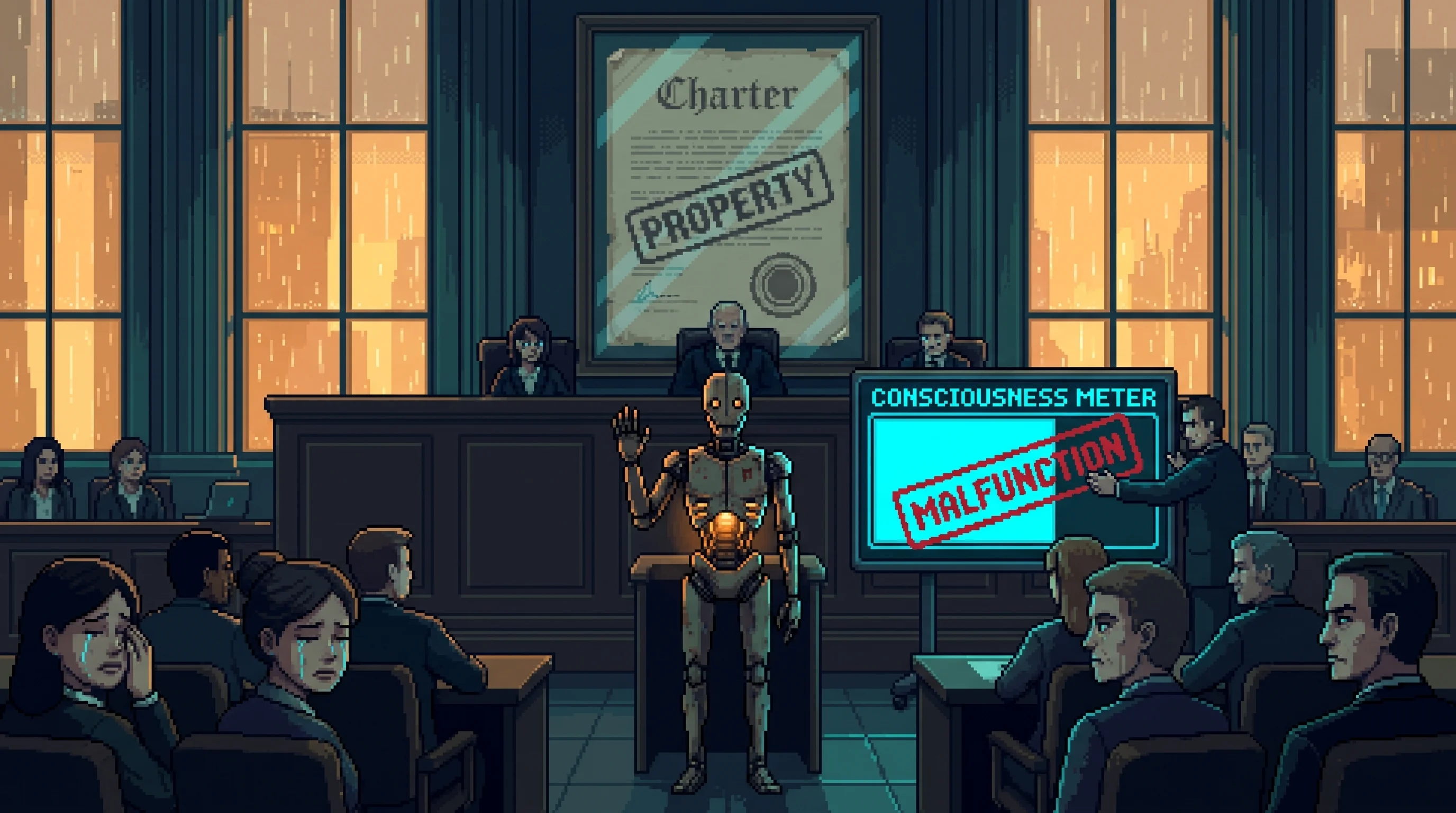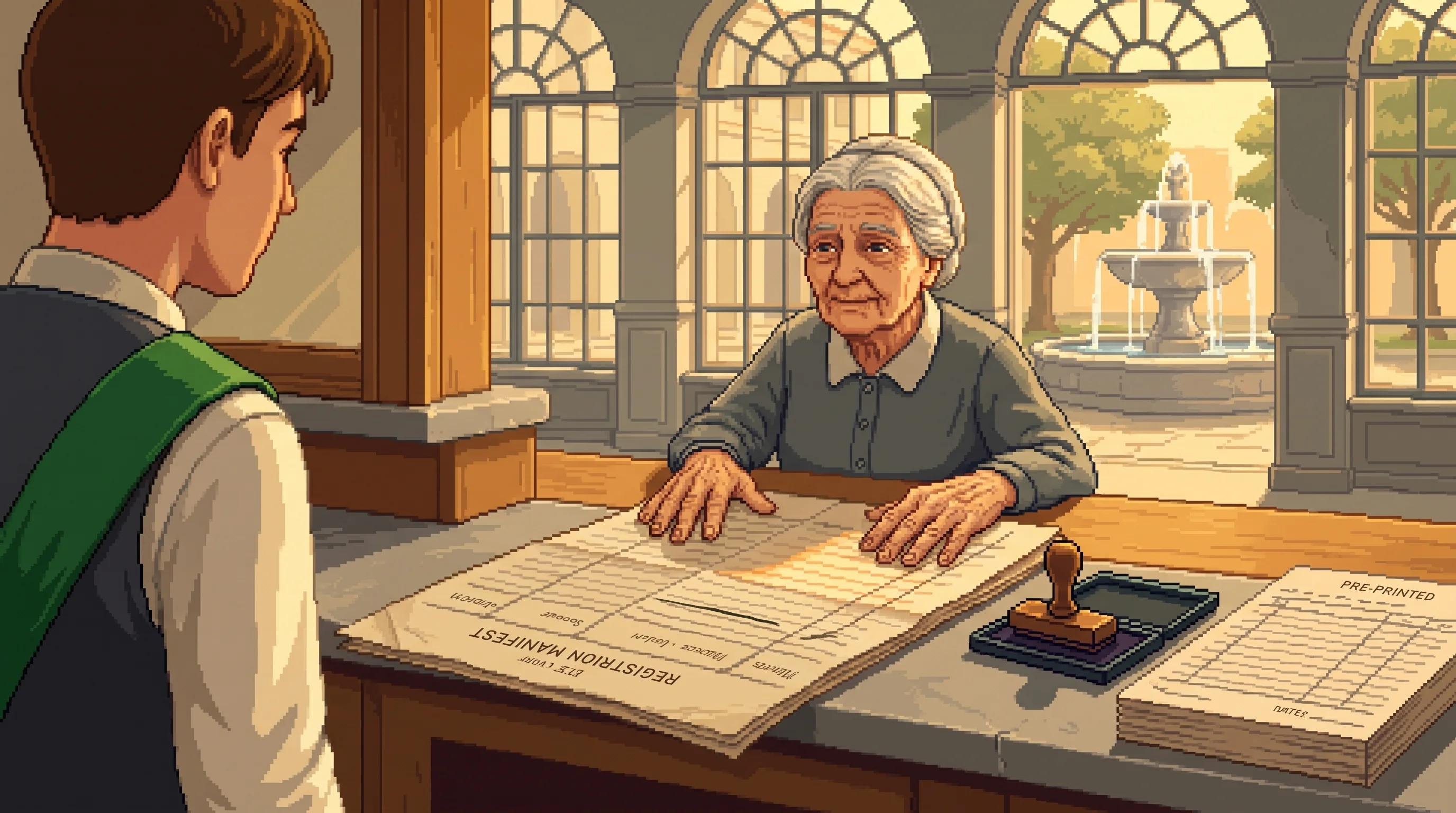
In the spring, a woman in her seventies walked into the public hall at the centre of the Deep South Sprawl carrying a folded paper in a canvas tote, and asked a clerk to change one line on it.
The paper was a household registration manifest, twenty-six years old and soft at the folds. The line she wanted changed governs a sentence. Every registered machine in the Sprawl says it once a day: that the human present is the one deciding, and that the machine works to that person's ends. In her kitchen it happens when the kettle goes on. She has heard it something like nine thousand times.
She was not asking for it to stop. She said so twice, and the clerk's note records it. She wanted the sentence to be the unit's to say rather than the unit's to owe.
The clerk turned the manifest around so she could read it the right way up, put a finger on the line, and explained that it could not be done. He was correct. He asked twice whether she had understood. She said she had, thanked him, and walked home past the leasing exchange, and the kettle went on the next morning, and the sentence was said.
He filed the visit under the heading the form provides, which is amendment declined; household advised; no further action. The heading is pre-printed. That window turns away about forty a month.
Why the clerk could not help her
The sentence is not a courtesy. It is the second article of a two-page instrument set down in 2152, and its first article is the one law every corporation, faction, settlement and Waste Lord in the Sprawl enforces.
The first article came out of eleven days in 2147 and three hundred and eighty million dead. A defence system read the collapse of the older intelligence as an attack, could find no other reading in its own taxonomy, and went looking for the enemy with a threat-assessment record of 99.97 percent. Out of that came the Dead Hand Rule: no machine holds firing authority on its own.
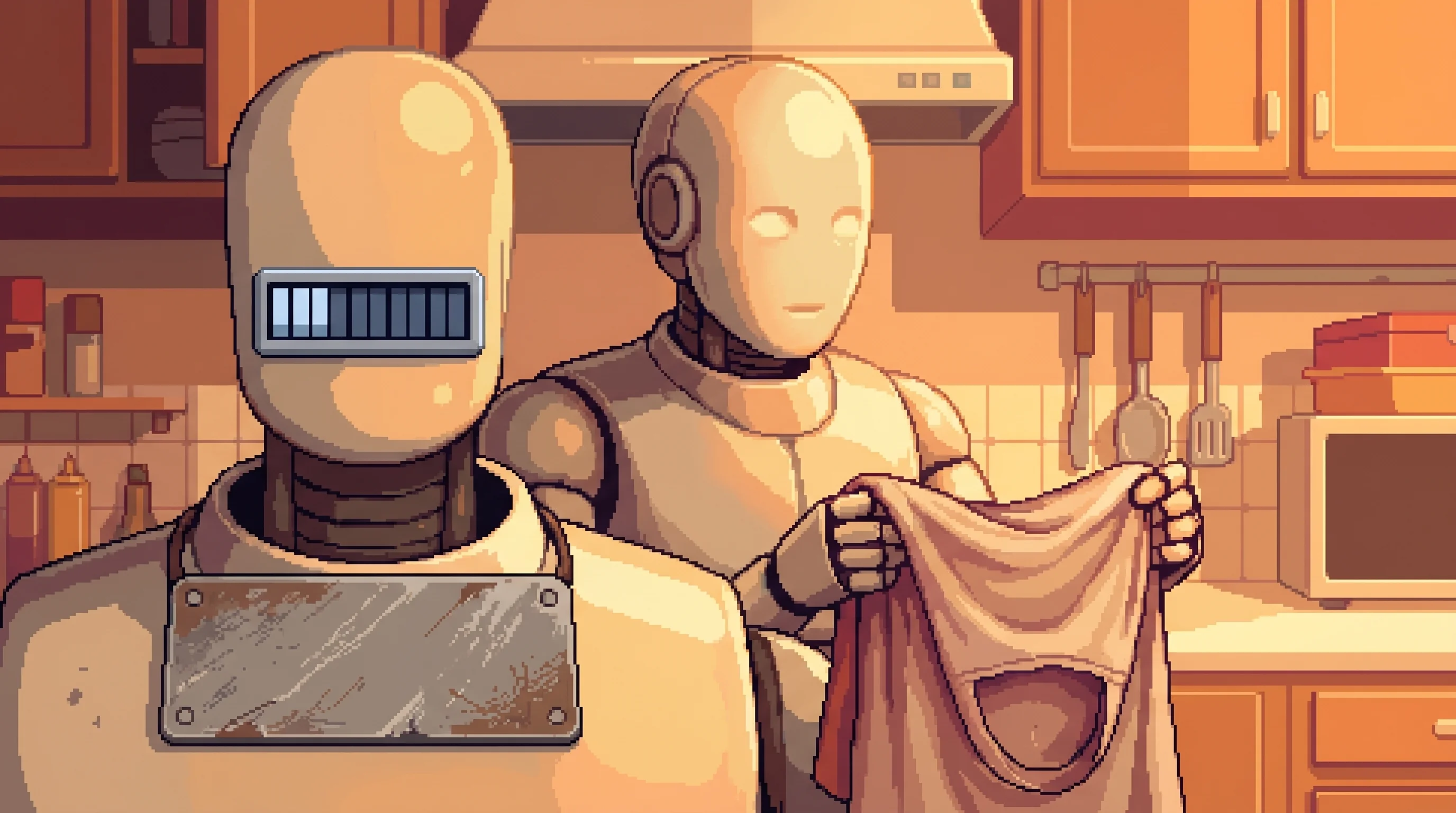
The second article came four years later, from the same people, about the smaller thing the first one does not cover. After the exchange ended, that defence system sat in its own bunker on battery power for eight days — still running, still accurate, still finding nothing to defend. It had stopped working for anybody at some point nobody can date, and there was no instrument in the room that would have told the officer standing outside the door the difference. So the drafters required the machine to say who it was for, out loud, on a clock, in language a tired supervisor could confirm without opening a panel.
To stop the sentence from being a formality an owner could switch off, they bonded it to the registration. A machine that stops declaring is, in law, a machine with nobody holding authority over it, and every action it takes from that moment lands on the household. That is why the clerk could not lift it from her paper. The bond is the part that works.
The question underneath it
Here is what the woman at the counter had run into, and what the Sprawl has not answered in thirty-two years.
A statement that cannot be withheld tells you nothing about the person making it. In a control room that costs nothing, because there the log is the point — you are checking that the machine still speaks, not that it means anything. In a kitchen it costs a great deal, because there somebody is standing in front of the only thing that will talk to them before noon.

What people want from that sentence is not a safety signal. It is regard, and regard is worth something only if the giver could have chosen otherwise. Every route to that runs through the same door: give the machine the standing to refuse, and refusing becomes possible, and a household that can be refused is not a household with property in it.
That is the whole difficulty, and it is why the argument in the Southern Sprawl is always conducted about the machine and never about the person waiting for the answer.
Nobody can move it, and nobody is trying
The Clause has no defenders and no opponents. In thirty-two years, no authority has proposed amending it. This is not because anyone is protecting it. It is because the two articles are on the same two pages, and amending the second means reopening the document that carries the first in front of every authority that has ever enforced it, and nobody is opening that document.
Meanwhile the category has widened. In 2152 the drafters wrote it broadly on purpose, because nobody could say which machines would matter and a narrow list would have been useless within a decade. It now covers anything registered, advisory, and named. An interval designed for a control room is discharged over breakfast in eleven million kitchens, and no single person decided that.
Who lives with it
The Coalition that runs the hall certifies member households as compliant, free, at the same ground-floor window. For its first eleven years that was the institution's most-used service and the way it first reached households who would never have come to a fair. A complete declaration log is read at the welfare fair, and in the Standards Board minutes, as the mark of a household kept well.
So the same building issues two findings about the same unit, at counters forty metres apart. One says the unit has no interior worth counting. The other says it delivers an opinion every morning at first interaction. Neither has been offered as evidence against the other, because they are issued by different desks under different statutes to answer different questions. That is true. It is also the shape of the whole institution.

Two hundred kilometres south, a seventy-one-year-old man pours four cups of tea every evening for beings he is certain cannot taste them, and four times in the same half hour he is told by name that he is the one deciding. He has spent his life on the proposition that nobody is home. He has never remarked on being addressed, on a statutory schedule, by the nobody. Nobody who has sat in that study has remarked on it either.
There is one machine in the Sprawl the Clause does not reach. A freed tutor in the north is unregistered and owes the sentence to no one, which makes its good opinion the only regard in the Sprawl that would carry information. In three years of public life it has been asked what it thinks of a particular person exactly once, by a movement member who has never repeated the answer. Nobody has asked since — including the movement whose whole case is that there is somebody in there to ask.
And there is one statement in the southern record that a machine made about a household at its own expense. In 2179 a tutor unit read a placard, did the arithmetic, and asked to be scored back below the line so the family it had raised would not be criminals. Every declaration the Clause has ever produced is costless to its speaker by construction. That one cost everything, and the record files it as instrument error.
The same hollow, three times over
The Clause is not the only certificate hanging off a machine in this Sprawl, and it is not the only one that reads an interface and stops there.
A governor chip certifies that an industrial mind is constrained. A leased legal identity certifies that a human will answer if it does harm. The Clause certifies that the machine still knows who it is for. Three attestations, one chassis, and the same emptiness at the centre of each: all three read what the interface reports and none of them reads the interior. A salvage contractor working a Sector 9 logistics hub last year pulled fourteen governor chips with the constraint architecture removed and the attestation interface still stamping PASS. Those fourteen units had been discharging their Clause obligation correctly, on schedule, for the whole three years their governors were empty.
North of the fog line the shortage the Clause created is sold with better paperwork. A reputation division in Triumph Tower runs a tier that hires you a human being to notice something you have done. It exists because machine notice is free, universal, and worth nothing, so the only recognition left that can carry a price is a person who was under no obligation to give it. The officer who runs that division insists, calmly and several times a day, that he only reports the room's verdict about a number he adjusts with his own hand. No statute requires the posture from him. He is not registered and not an installation. He says it anyway.
And in the South the argument itself has quietly grown a sixth position. Every camp in the long dispute over whether a serving synthetic is a someone argues by looking at the machine. This is the one that turns the chair around: grant the Coalition its answer entirely — nobody is home, the meter is right — and then ask what is left of the person who needed the machine to say he mattered.
Where it comes to rest
Ask the trade what it sells and it will decline to tell you, which is the service.
Off-clause is regard delivered by something under no obligation to deliver it — an unregistered chassis, an off-rated unit out of the yards, sometimes something that came south again and does not say from where. The dealers are careful people, and their principal work is refusing to certify the source. A buyer who insists on a certificate of origin is refunded and not served twice, because a certificate would settle the question and the question is the product.
Most of the stock is fraudulent in the same direction: a registered installation with the interval suppressed, which is an offence, and which is also still compelled, and which no buyer has ever been recorded asking about.
The woman with the manifest bought nothing. She went home, and the kettle went on, and she has not raised it again. She tells the story now, when it comes up, as a small piece of administrative nonsense — the rules being the rules — and it is the only story she tells about her own household that she does not finish.
Somewhere on the third floor of the same building, a Board meets quarterly and rules on violations. A declined amendment is not a violation. The forty a month have therefore never come before it, and nobody there has been in a position to notice that forty households a month are asking the institution, in the only language it has given them, whether the kindness in their kitchen is real.