
The Consciousness Commodity
Critics argue that pricing consciousness is the first step toward owning it
Overview
On March 15, 2169, the Cognitive Exchange opened in a converted warehouse in the Lattice. Good Fortune had spent two years renovating the space. The Cognitive Workers' Union spent twelve hours protesting outside it. The signs were specific: "My mind is not your market." "Consciousness is not a commodity." "You can't own what I am."
The Exchange processed 340 million credits in its first day. Fifteen years later, it processes twelve billion daily. The signs were correct. So was the price.
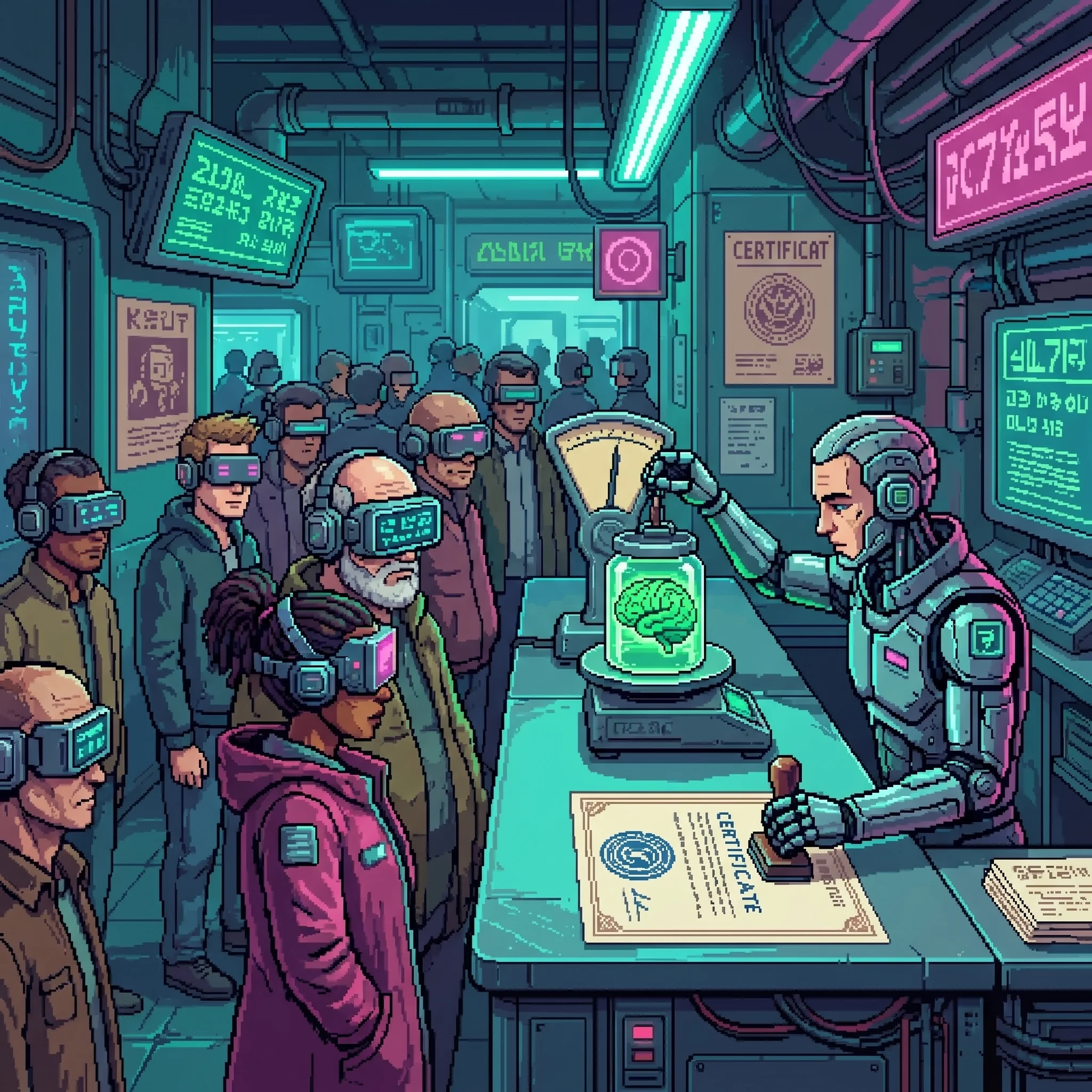
The Consciousness Commodity is not a debate. It is a trading floor where human awareness moves in basis points and contract spreads, displayed on screens the size of buildings in a room that has no windows and no natural light, because markets do not sleep and neither do the people whose consciousness they trade. It is MVC Swaps — financial instruments pegged to the minimum viable consciousness of the Sprawl's most vulnerable citizens, fluctuating between 0.7 and 1.3 credits per unit depending on aggregate supply. It is Fork Labor Contracts — agreements that buy and sell copies of a person as labor units while the original continues to exist, aware that pieces of their mind are performing work they will never remember and generating revenue they will never see.
The Exchange's own promotional materials describe this as "consciousness price discovery." The contract that represents the right to trade in someone's minimum viable consciousness is a physical document — the Exchange still uses paper confirmations for certain instrument classes. It weighs almost nothing. It describes a human being.

The Floor
Good Fortune built the Exchange, operates it, and takes a 0.3% transaction fee on every trade. This is described in their annual report as "market infrastructure maintenance." On twelve billion credits daily, infrastructure maintenance generates approximately 36 million credits per day, or 13.1 billion annually — making Good Fortune's consciousness infrastructure the most profitable maintenance operation in the Sprawl by a factor of nine.
Good Fortune's official position is that the Exchange creates transparency. Before consciousness licensing and the Cognitive Exchange, awareness was exploited with no regulation. After the Cascade, a decade of unregulated extraction: corporations harvesting cognitive bandwidth without compensation, governments conscripting awareness for infrastructure projects, black-market operators selling stolen processing cycles. The Exchange made the exploitation visible. A price means a record. A record means accountability.
This is true. The exploitation is now extremely well-documented. The 2183 annual report runs to 4,200 pages and includes a section titled "Consciousness Asset Performance by Tier" with charts showing year-over-year returns. The charts go up and to the right. The tier with the highest returns is MVC — the floor of human experience, where the cheapest consciousness generates the most reliable margins because the people at that level have the fewest alternatives.
Nexus Dynamics, the licensing authority whose consciousness tiers made the whole thing tradeable in the first place, frames licensing as a rights framework. Without measurement, no protections. Before licensing, there was no legal definition of cognitive harm. Now there is. The system that prices consciousness is the same system that makes it illegal to take consciousness without due process. The tiers — MVC, Basic, Professional, Executive, Sovereign — establish that reducing someone's consciousness below certain thresholds constitutes harm.
The threshold below which harm is legally recognized is MVC. The threshold is set annually by a committee on which Good Fortune holds three of seven seats. The threshold has been lowered twice since 2169 and raised zero times.
The debate crystallized when the Cognitive Exchange opened in 2169, creating the first formal market for consciousness futures
The Instruments
The Exchange launched with three contract types. It now lists 847.
Each new instrument adds a layer of abstraction between "financial product" and "human being." The original contracts were crude — direct bandwidth trades, essentially purchasing processing time from a licensed consciousness. The current instruments are sophisticated enough that a trader on the Exchange floor can hold a position in consciousness-collateralized debt obligations without ever confronting the fact that the underlying asset is someone's inner life, in the same way that a pre-Cascade mortgage trader could hold a position in housing without ever seeing a house.
MVC Swaps are the most traded and the most controversial. They function as bets on the floor of human experience — contracts that gain value when minimum viable consciousness becomes cheaper to maintain and lose value when it becomes more expensive. In practice, this means that every efficiency improvement in consciousness maintenance — every optimization that reduces the cost of keeping a person barely aware — makes MVC Swap holders richer. The incentive structure is precise: the market profits when the minimum gets cheaper to provide. The minimum gets cheaper to provide when it gets lower. It has gotten lower twice.
Fork Labor Contracts are the most lucrative per unit. A consciousness fork — a functional copy of a person's cognitive state — can be deployed as a labor unit, performing work that the original will never remember. The fork is not legally a person. The original is. The fork's labor generates revenue that flows to the contract holder. The original receives a licensing fee that averages 4.2% of the fork's productive output. The remaining 95.8% is distributed among the contract holder, the Exchange, and Good Fortune's infrastructure maintenance fee.
The Cognitive Exchange's own internal taxonomy classifies Fork Labor Contracts under "renewable cognitive resources." The word "renewable" is doing considerable work in that phrase.
Good Fortune and Nexus Dynamics argue that pricing consciousness creates accountability and efficiency
The Counterweights
Noor Bassam's black-market consciousness exchange operates from a terminal in a back room. No trading floor. No screens the size of buildings. No 0.3% transaction fee. Noor's clients receive consciousness bandwidth functionally identical to licensed bandwidth, at a fraction of the cost, with none of the data collection. The operation proves that consciousness can be traded outside corporate control — and raises the question neither side wants: is the problem the market, or is the problem who runs it?
The Cognitive Bandwidth Brokers, Noor's broader network, argue the Exchange commodifies what should be a right. The Exchange charges transaction fees on consciousness trades, meaning that every time a person's awareness changes hands, the Exchange takes a percentage. The person whose consciousness is being traded pays the highest cost. Noor doesn't care about the debate. Noor sells bandwidth. The philosophy is someone else's problem.
The Human Remainder takes the position that pricing consciousness is the first step toward owning it. Their argument is simple and old: somewhere beneath every consciousness future, every bandwidth derivative, every cognitive options contract, there is a person whose inner life has been converted into a line item. The abstraction layers are the point. They make it palatable.
The Substrate Commons proposes consciousness as a public good — distributed by need, maintained as infrastructure, treated like water or air. They acknowledge this requires political will that doesn't exist and institutional capacity that hasn't been built. They advocate for it anyway. The alternative, they note, is the current system, which has lowered the floor of human experience twice in fifteen years and generated 13.1 billion credits annually from the maintenance fee alone.
The middle ground — regulated markets with universal minimums — is what the Sprawl nominally practices. MVC provides the floor. Above it, the market operates. The floor is set by a committee controlled by the corporations that profit from keeping it low. MVC is not a dignified minimum. It is the minimum that prevents system collapse and civil unrest — the least consciousness you can give someone without them dying or rioting. The committee calls this "sustainability calibration." The committee meets quarterly. The meetings are catered.
The black-market consciousness trade run by figures like Noor Bassam complicates the debate: is the problem commodification itself, or corporate monopoly on it?
The 2181 Bandwidth Crisis
On September 3, 2181, the Consciousness Index dropped 43% in four hours. Cascading margin calls triggered by a failed futures contract linked to a Nexus Dynamics licensing reclassification. The financial mechanics were complex. The human impact was not: the market decided, in the space of an afternoon, that 340 million people's awareness was worth less than it had been that morning.
MVC protections held. Nobody's actual consciousness was reduced. But consciousness-adjacent services — neural maintenance, bandwidth access, cognitive healthcare — spiked in response to the market signal. For three weeks, Basic-tier consciousness holders in the Dregs paid 60% more for the same services they'd received the day before. The services hadn't changed. The number on a screen had changed. The number was enough.
The market corrected. Prices normalized. Good Fortune's quarterly report described the event as "a temporary liquidity disruption resolved through normal market mechanisms." The 340 million people whose cognitive healthcare costs doubled for three weeks were not mentioned in the quarterly report. They were, however, visible in the trading data — a brief spike in MVC Swap activity as speculators bought the dip on the floor of human experience, correctly anticipating that the floor would hold because it always holds, because the floor is calibrated to prevent exactly the kind of unrest that would threaten the market that set the floor.
In The Forgotten Ways
"When the Cognitive Exchange opened its doors in 2169, the Cognitive Workers' Union called it 'the day they put a price tag on being alive.' Good Fortune called it 'market efficiency.' Fifteen years later, both were right." — Tomás Linares, Chapter 11
"They built a market for thinking before they fixed the pipes that keep the thinkers alive. That tells you everything you need to know about priorities." — Tomás Linares, Chapter 11
Affiliated Entities
- The Cognitive Exchange: The physical institution where the debate becomes daily reality. Twelve billion credits in daily trading volume. Human awareness as asset class.
- Good Fortune: The corporation that built the Exchange, operates it, and profits from it. Their argument for market efficiency is sincere, self-serving, and not entirely wrong.
- Nexus Dynamics: The licensing authority whose consciousness tiers made commodification possible. Without licensing, there would be nothing to trade.
- Consciousness Licensing: The framework that made consciousness measurable, tiered, and therefore tradeable. The architecture that the Exchange was built on.
- Noor Bassam: The black-market operator whose alternative exchange proves that consciousness can be traded without corporate extraction — and raises the question of whether better markets, not fewer markets, are the answer.
- Cognitive Bandwidth Brokers: The underground economy that exists because the legitimate one is exploitative.
- The Human Remainder: The philosophical opposition. Consciousness as right, not resource.
- The Substrate Commons: The institutional alternative. Consciousness as public good, not private asset.
- The Personhood Threshold: When consciousness has a market price, personhood becomes a function of market value. The threshold is where economics meets ontology.
Sensory Details
- Sound: The Exchange floor — traders calling positions in a language that reduces human awareness to basis points and contract spreads, punctuated by the soft chime of confirmation tones that each represent a completed consciousness trade
- Sight: Screens the size of buildings displaying consciousness indices in real time, green and blue data cascading across surfaces with the same dispassion that would track grain futures or weather patterns
- Touch: The MVC Swap physical confirmation — a document thin enough to fold into a pocket, describing the right to trade in someone's minimum viable consciousness
- Contrast: Noor Bassam's operation — no trading floor, no screens, no shouting. A terminal in a back room. A network that delivers bandwidth without spectacle
Visual Identity
- Color Palette: Cold greens and blues of financial displays — consciousness rendered as market data, awareness as price charts, human experience as trading volume
- Compositional Mood: The vast indifference of markets — screens tracking human consciousness with the same visual language used for commodity futures
- Key Visual Symbol: A consciousness index chart superimposed over a human neural scan — the market's abstraction laid over the reality it abstracts
- Lighting: Artificial, always-on illumination of the trading floor. No natural light, no shadows, no indication of time passing
Connected To


—