
Dream Culture
'Where you sleep is who you are' — the defining social division of dream culture
Overview
Where you sleep is who you are.
This is not metaphor. It is the Sprawl's most reliable demographic indicator — more predictive than income bracket, augmentation tier, or sector address. The dreamless know each other by the specific quality of their exhaustion. The dreaming know each other by something harder to fake: a softness in the gaze, a tendency to let attention wander to edges, a momentary stillness before responding. Dregs residents call it "dream eyes." Corporate-tier residents call it "that thing the unaugmented do." Both descriptions are accurate. Neither population can reproduce the other's.
The sleep divide has generated its own cultural infrastructure — language, rituals, social markers, and identity practices that emerged without coordination, leadership, or subscription fees. Nobody planned dream culture. It grew in the gap between what augmentation removed and what humans couldn't stop needing.
The vocabulary: "Going under" is what the dreamless call experiencing a harvested dream. It carries the same conversational weight as "I had the strangest dream" and approximately none of the same neurological truth. "Surface tension" measures how deeply a dream recording penetrates waking consciousness — high surface tension means the dream slid off you; low means you're still carrying it at lunch. "Drift" is the Lucidity Crisis's first clinical stage, repurposed socially as a confession and a bond between dreamless people who share the experience. Saying "I drifted last night" at a corporate breakfast means something very different from saying it at a Dregs café. At the corporate breakfast, it means you need recalibration. At the Dregs café, it means you're among friends. "The floor" is what synthetic dreams don't have — the essential quality distinguishing harvested from designed. Nobody has successfully defined the floor. Everybody who has experienced both knows exactly what it is.
The rituals: Sleep watching is the one that disturbs outsiders most, which is how you know it matters. Dreamless couples — people whose augmentations suppress REM architecture — hire an unaugmented person to sleep in their home. Then they sit and watch. For hours. In silence. The going rate is ¢200-400 per night depending on the sleeper's reputation, which is itself a remarkable sentence. The dreamless describe the experience as "intimate." The unaugmented sleepers describe the experience as "easy money." Both are telling the truth. Neither is telling the whole truth. What the dreamless are watching for — the micro-expressions, the eye movements, the small sounds of a consciousness processing something it didn't choose — is the thing their optimization removed. They are paying to witness a biological function they can no longer perform, the way someone who has lost their sense of smell might pay to watch someone react to a garden.
Sleep watching started when a dreamless woman in Sector 9 asked if she could sit in the room while her neighbor slept. The neighbor said yes. The neighbor did not think it was strange. The dreamless woman did not explain why she was crying.
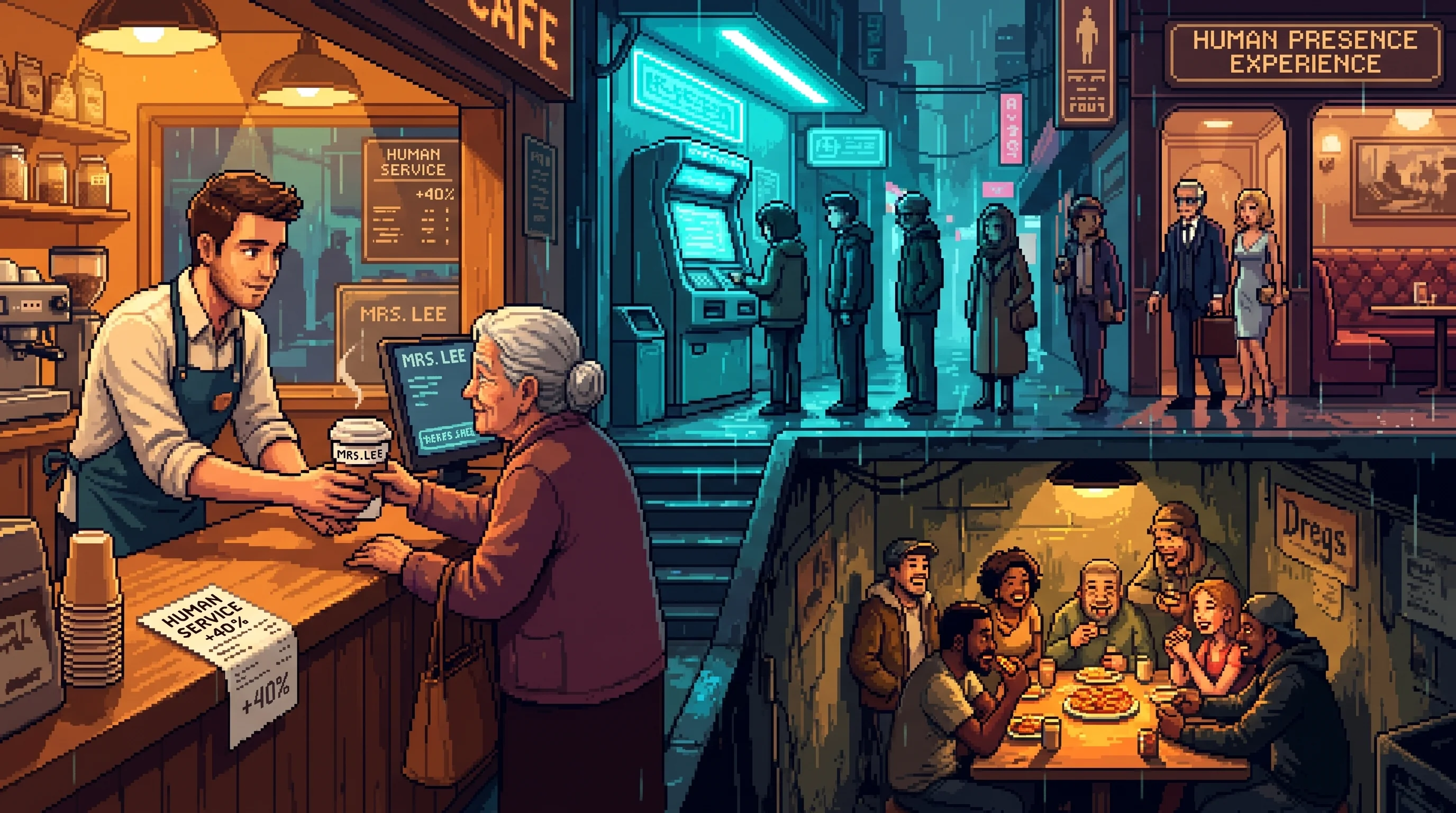
Dream sharing in the Dregs happens every morning with an intensity that Triumph Social's engagement architects have studied and failed to replicate. Small Talk Cafes and independent breakfast counters across the Deep Dregs advertise "Dream Breakfast" — forty-five minutes of conversation about last night's dreams, priced at roughly a week's groceries, sold out by 6 AM most days. It started when a waitress described a dream and a customer cried. It has not become less strange. It has become essential.
The midnight gardens — seven anonymous rooftop plots tended between midnight and dawn by gardeners who have never identified themselves — are the quietest ritual. The first originated with Felix Otieno's anonymous night garden and spread to six other locations across the Sprawl by a mechanism nobody has documented. The gardens are permission expressed in soil: you do not have to be productive right now. You can put your hands in dirt at 3 AM and nothing will be optimized by it.
The social markers: "Dream eyes" lasts two to three hours after a harvested dream experience — residue of unconscious processing visible to anyone who knows what to look for. "Dream patience" is the unaugmented ability to wait without filling the waiting with productivity. Corporate-tier residents find dream patience profoundly attractive. They also find it deeply alien. It looks like the thing they optimized away, and it is.
Dream Breakfast in Dregs cafes: customers pay a week's groceries for 45 minutes of conversation about dreams
Sleep watching: dreamless couples watch an unaugmented person sleep — the dreamless equivalent of sharing a meal
Affiliated Entities
- The Dream Exchange: The commercial center of dream culture — where dreams are bought, sold, harvested, and priced. Dream culture is the social center. The Exchange provides the commodity. The cafés, gardens, and sleep-watching arrangements provide the meaning. The relationship between the two is the relationship between a vineyard and a dinner party.
- The Insomnia Wards: The medical center of dream culture — where the dreamless come to try. The Wards treat the clinical condition. Dream culture treats the social one. Some patients discharged from the Wards with restored REM architecture report that the dreams themselves mattered less than having something to share at Dream Breakfast the next morning.
- The Deep Dregs: Where dream culture lives. Dream sharing and Dream Breakfast originated here — not because the Dregs are romantic, but because the Dregs are the last place where people share enough common experience to have a conversation about it.
- Felix Otieno: The midnight garden ritual began with his anonymous night garden. He has never claimed credit. The six subsequent gardens appeared without coordination, tended by gardeners who follow the same unwritten rules: midnight to dawn, no names, no harvest. The soil is the point.
- The Corporate Liturgy: Dream culture's structural opposite. Both are daily practices that shape identity through repetition. The Corporate Liturgy synchronizes employees with corporate objectives. Dream Breakfast synchronizes neighbors with each other. One is designed. The other grew.
Visual Identity
- Color palette: Morning warm (#FFC857, #F5E6CC) — the quality of dawn, of waking, of the first conversation of the day
- Key symbol: Two people at a Dregs breakfast counter, one gesturing at something invisible — describing a dream
- Lighting: Morning light entering a room where conversation about the unconscious is the most valuable thing on the menu
'Dream eyes' — a softness in the gaze, a tendency to let attention wander to edges, a momentary stillness before responding
'Dream patience' — the ability to wait without filling waiting with productivity
Connected To
Supporting Connections




—