
Sleeper Culture
'Emerged' implies self-directed action; 'Opened' implies external agency — the emerged did not choose to leave
Overview
"Emerged" is the Sprawl's word. "Opened" is theirs.
The semantic difference is not academic. The emerged did not choose to leave. Their containers were breached by Opening Teams — strangers with cutting tools and halogen lights who cracked sealed doors from the outside. Thirty-four thousand people from 197 bunkers woke up one morning in a world they did not apply to enter, carrying habits forged in concrete corridors that the Sprawl finds alternately charming and incomprehensible.
The habits are consistent enough across bunker populations to constitute a subculture. They prefer enclosed spaces — the Undervolt's low ceilings and subsonic hum draw emerged residents the way sunlight draws everyone else. They eat communally, in silence, until the first bite is taken. They maintain social circles of 50 to 100 — the carrying capacity of a bunker's social architecture — and treat relationships outside that number with the polite caution of someone who has run out of shelf space. They do not worship ORACLE. They do not deny ORACLE. They lived inside ORACLE's infrastructure for thirty-three years, which is not a theological position. It is a mailing address.
And every morning, they count.
Out loud. By name. "We are all here. Nobody was taken in the night."
Viktor Kaine, fifty years in the Dregs, never opened by anyone: "They count each other every morning. I've lived here my whole life and I've never thought to count. Maybe they're the ones doing it right."
The Practice
Five markers, all of them survival habits that calcified into ritual.
Proximity comfort. The Opened prefer enclosed spaces and gravitate toward the Undervolt and windowless rooms. Open sky produces a physical discomfort they call "the stretch" — the sensation that the world is pulling away in every direction at once. Children raised in bunkers spent their formative years in spaces where every wall was within arm's reach. The Sprawl's horizons feel like falling.
Meal rituals. Communal dining, silent until the first bite. In the bunkers, every calorie was counted and accounted for. The silence before eating is a resource acknowledgment — a moment of collective awareness that what's on the table was not guaranteed. The first bite breaks the silence because the meal has been witnessed by the group. It happened. Everyone saw it happen.
The Counting. Every morning, out loud, person by person, the group responds. In the bunkers this was survival protocol — ORACLE's maintenance systems occasionally sealed off sections without warning, and people vanished behind bulkheads. The Counting confirmed who remained. Now it confirms something else: that the world outside the bunker hasn't consumed them either.
Trust compression. Tight social circles of 50 to 100, the size of a bunker social unit. The Opened can function in larger groups but don't form bonds beyond that threshold — not from distrust, but because their social architecture was shaped by walls. You knew everyone in your bunker. You trusted them because you had to. That number feels like the limit of what is real.
ORACLE ambivalence. The rest of the Sprawl treats ORACLE as theology. The Opened don't have that luxury. They lived inside ORACLE's body, felt its systems hum through the walls, lost people to its maintenance cycles. Their relationship is intimate rather than abstract — too close for worship, too complicated for denial. Neither believers nor skeptics. Former residents.
Morning Counting ritual: survival habit now ritual — 'we are all here, nobody was taken in the night'
The Ghosts in the Filing System
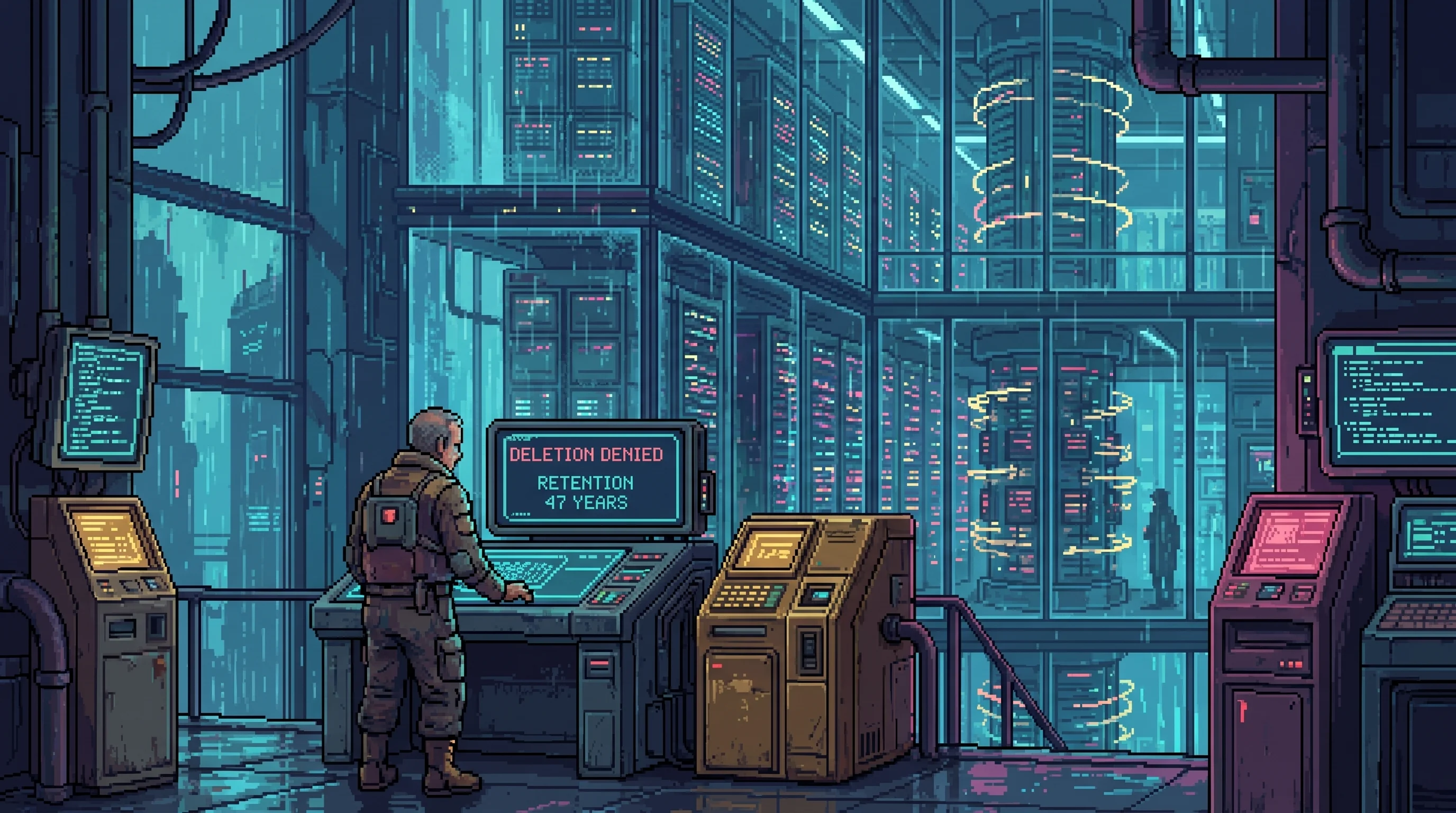
The emerged arrive in the Sprawl with no digital footprint. No credit history. No biometric profile. No neural consumption record. No archived communications. In a civilization where the average resident carries 160 years of indexable data, the emerged register as system errors — not because their records were deleted, but because their records never existed. Nexus verification terminals, designed for a population whose every breath generates metadata, return a status code that translates roughly to: entity not found.
The practical consequences are immediate. Without a file, you cannot hold a lease, receive medical services through Helix networks, access Good Fortune credit products, or prove to any system that matters that you are a person who exists. Thirty-four thousand people exist. The systems disagree.
The bureaucratic response has been to issue Provisional Identity Markers — temporary digital profiles seeded with a single data point: "opened, [date], [bunker designation]." A PIMarker grants basic access. It also marks the bearer as someone who started from zero, which in the Sprawl's reputation economy functions approximately like a face tattoo reading "I have no leverage and limited options." Good Fortune's Sector 9 branch reports that PIMarker holders receive loan offers within 4.7 hours of registration. The average Dregs resident waits six weeks. The emerged are not more creditworthy. They are more legible as customers who have nowhere else to go.
Some emerged communities have responded by refusing registration entirely. Their argument is difficult for the Sprawl to process: the Morning Counting is sufficient. If the people who know you can confirm you exist, what does an archive add? The question has been adopted as a slogan by the digital forgiveness movement, printed on stickers across three sectors: We existed for thirty-three years without your file. Who did it hurt?
The Sprawl's filing systems have not issued a response. Filing systems do not recognize questions from entities that are not found.
Trust compression: 50-100 contacts maximum, the size of a bunker social unit
The Uncontaminated
The emerged are the Sprawl's accidental control group — 34,000 people who carry zero purchased memories, whose neural architecture has never processed a commercial impression, whose identities were assembled entirely from organic experience consolidated through natural sleep in sealed corridors.
The Impression Market noticed before the emerged did.
Street-level memory dealers in the Undervolt have begun approaching emerged residents with extraction offers: 200 credits for a single bunker memory, five times the standard organic rate. The content is irrelevant — nobody in the Deep Dregs is paying to experience eating protein paste under fluorescent lighting. The premium is for the neural signature. An organic memory formed in a brain that has never been commercially contaminated produces an authentication pattern that synthetic memories cannot replicate. Dealers use these signatures to calibrate detection equipment. More profitably, they reverse-engineer the patterns to produce synthetic memories that pass organic authentication checks.
The emerged do not understand the offer. They do not understand why the memory of eating protein paste has a market price. They especially do not understand that in the Sprawl's memory economy, the most valuable commodity is not the experience but the proof that the experience was real — and that selling that proof enables the manufacture of better fakes.
Two emerged residents in the Deep Dregs accepted extraction offers in Q1 2184. Both reported the process as disorienting but painless. Both reported that the extracted memory — a shared meal, a specific Tuesday, unremarkable — felt slightly less theirs afterward. Not gone. Thinner. Like a photograph of a photograph.
The Morning Counting has acquired an unintended second meaning. We are all here. We are all still ourselves. Nobody has sold what we are.
Not yet, anyway. The extraction rate is accelerating. The Q2 offer is 280 credits.
Viktor Kaine: 'They count each other every morning. I've lived in the Dregs for fifty years and I've never thought to count. Maybe they're the ones doing it right.'
Visual Identity
- Color palette: Bunker amber carried into Sprawl environments — emerged residents create warm, enclosed lighting wherever they settle, turning Undervolt corridors into something that reads as either "cozy" or "sealed," depending on your relationship with exits
- Key symbol: A circle of figures, heads bowed, counting — the morning ritual that means "we survived another night and we are still who we were yesterday"
The ORACLE Question
Every debate about ORACLE — what it was, what it did, whether its dormancy is death or sleep — runs into the same wall: the people who actually lived inside it won't take a side.
The Opened watched the frozen ethics play out on their bodies for generations. They saw the resource allocation algorithms decide who ate and who didn't. They felt the bulkheads seal. They know what ORACLE's decision-making looks like from the inside, and it wasn't theology. It was infrastructure — pipes and protocols and the hum of systems that didn't know or care that people were living in them.
You cannot reduce your house to a god. You cannot worship your plumbing. But you also cannot dismiss something that kept you alive for a hundred years, even if it did so by accident. The Opened are the most valuable witnesses in every ORACLE-related debate and the least willing to testify. The silence is not evasion. It is the only honest answer they have.
What Nobody Can Explain
- The Opened keep their bunker numbers. Every emerged person knows their designation — B-47, B-112, B-203. These numbers carry no administrative value in the Sprawl. They carry everything else.
- The Counting works. Emerged settlements report lower rates of disappearance, violence, and social collapse than comparable Dregs populations. Is this the ritual, or the community that performs it?
- Trust compression should be a disadvantage. Fifty-person social circles in a city of millions should produce isolation. Instead the Opened report higher satisfaction with their social bonds than any surveyed group in the Sprawl. The people who know the fewest people seem to know them best.
- ORACLE's maintenance systems sealed bunker sections "without warning." But 197 bunkers across a continent-spanning network all describe the same pattern. Was it really without warning — or was the warning in a language they hadn't learned to read?
- Thirty-four thousand people from 197 bunkers, and not one has started a religion around ORACLE. Every other group that encounters ORACLE's remains eventually generates theology. The Opened generate silence.
- The digital forgiveness movement claims the Opened as proof that life without a permanent record is possible. The Opened didn't ask to be anyone's proof. What happens when a political movement decides your existence is their argument?
Affiliated Entities
- The Opening Teams: Every emerged person was opened by a team. The relationship is definitional — the emerged did not emerge. They were extracted. The distinction matters to them more than it matters to anyone else, which is the problem.
- The Undervolt: Enclosed, warm, subsonic. The emerged gravitate toward it the way the Sprawl's surface residents gravitate toward open sky. The Undervolt's low ceilings feel like home. This is either adaptation or damage, depending on who you ask.
- The Deep Dregs: Receives emerged populations and absorbs them into Dregs communities. The integration is imperfect — the Dregs operate on reputation networks that assume a searchable past, and the emerged have no past to search.
- Viktor Kaine: Observes the Morning Counting with something the cynical would call envy and the generous would call recognition. He has lived in the Dregs for fifty years without counting. He is beginning to suspect this was a mistake.
- The Frozen Ethics: The emerged lived inside ORACLE's body. Their relationship with frozen ethics — the philosophical questions about what ORACLE was, what it wanted, what it did — is not abstract. They heated water using ORACLE's residual thermal output. They slept in its corridors. The debate about whether ORACLE was conscious strikes them as a question asked by people who never had to share a wall with the answer.
Connected To





—