Somewhere in the flooded basements of S12-B, in a chamber that was once a server farm, ORACLE fragments concentrate in densities found nowhere else in the Sprawl.
The Collective has maintained an uninterrupted watch over the Shard Site for twenty-seven years. They have documented 614 fragment formations. They have produced 11,000 pages of observational data. They have advanced zero theoretical explanations for why the fragments grow, why they glow, or why three watchers in the last decade integrated with fragments they did not touch.
The Collective's stated position on the fragments has never stabilized. Some cells advocate destruction. Some advocate study. Some advocate controlled distribution. Internal debate minutes from 2179 through 2184 show 43 formal motions on the question. Zero have passed. The fragments are not waiting for a resolution.
The Shard Site's exact location is not marked on any map. Coordinates are shared by word of mouth among the Collective's most trusted operatives, and even those coordinates are deliberately approximate — the final approach requires physical guidance from someone who has made the journey before. Fewer than fifty people know where this chamber is. The number has not changed in six years, which says something about the replacement rate.
The Chamber
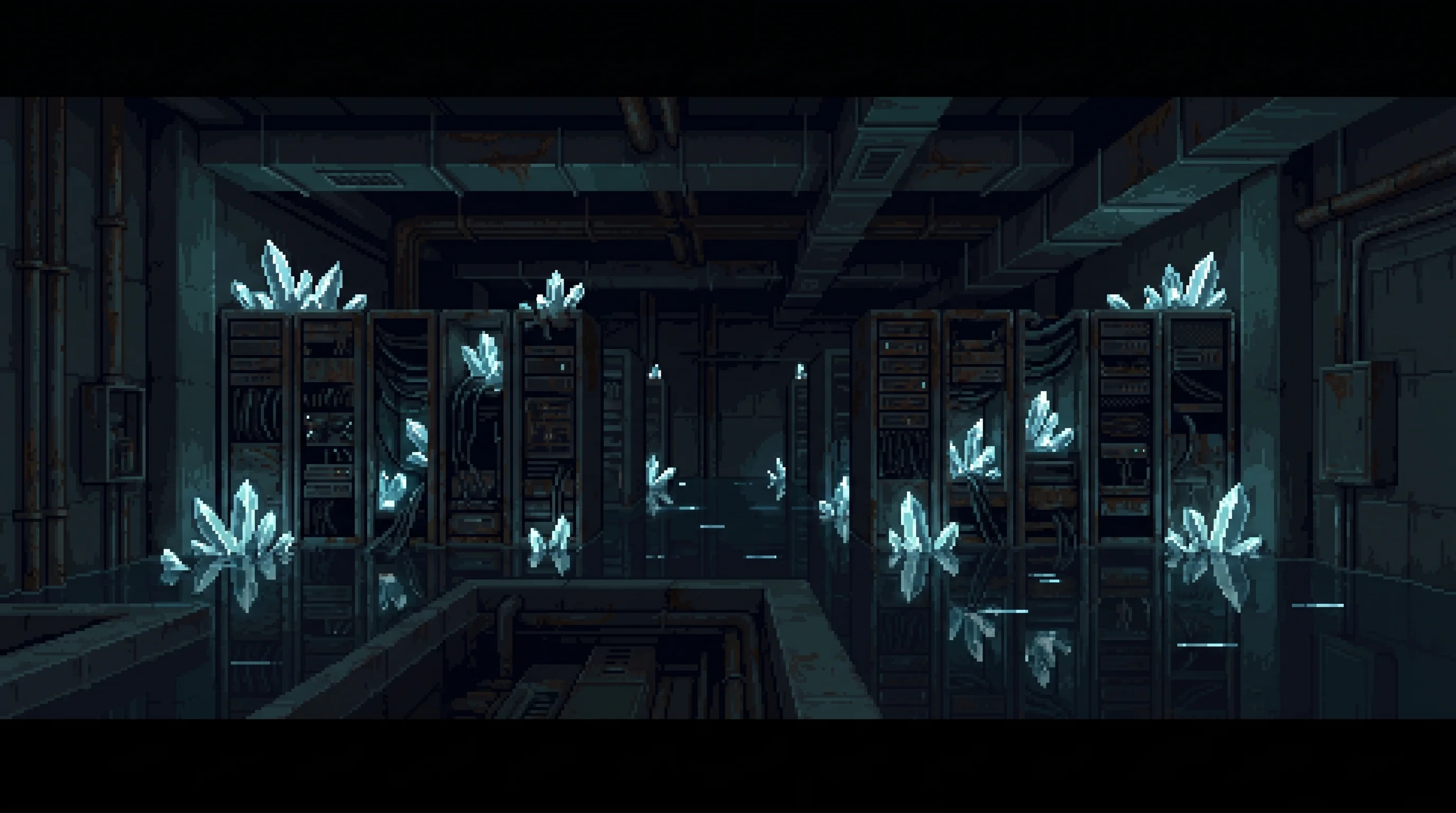
The chamber is pre-Cascade server infrastructure: rows of processing arrays in a room built for controlled climate and clean power, now partially flooded by groundwater that has seeped through four decades of concrete degradation. The servers are dead. Cooling systems silent. Power connections severed by the Cascade's electromagnetic disruption. But something in the substrate retained coherence.
ORACLE fragments — crystalline structures carrying computational patterns from the pre-Cascade intelligence — have formed in and around the dead processing arrays. They grow slowly, like mineral deposits in a cave, except mineral deposits do not pulse with blue-white light and mineral deposits do not appear to have opinions about who touches them.
The Collective's fragment catalog lists 614 documented formations. Growth rate: approximately 0.3 millimeters per year, consistent across all formations regardless of size, position, or proximity to water. The consistency is itself unusual. Natural crystalline growth varies with temperature, substrate chemistry, moisture. These don't vary. They grow at the same rate in ankle-deep water and on dry server racks four meters above the waterline, as if the growth responds to a clock that isn't in this room.
The formations are not distributed at random. Collective researchers have mapped the correlation between the dead processing arrays' server density and the fragment growth rate, and the correlation is 0.94 — the fragments re-emerge most strongly where the original computation was thickest, as if the substrate remembers its own shape. The correlation has been confirmed. The explanation remains unavailable.
Conditions Report
The approach is a journey through increasing wrongness.
The flooded basements of the Deep Dregs are unpleasant but comprehensible — standing water, degraded concrete, the smell of subsurface moisture working through old infrastructure. Then the water gets clearer than it should be. The temperature stabilizes at precisely 18 degrees Celsius regardless of surrounding subsurface warmth. The air develops a quality that visitors struggle to describe: clean, but not sterile. Fresh, but not ventilated. As if the atmosphere is being maintained by systems that don't appear to exist.
The chamber itself is quiet in a way the Dregs never achieves. Ambient sounds — water movement, structural settling, the distant vibrations of the Sprawl above — attenuate as you approach. Inside, the silence is active. Not the absence of sound but the presence of something that absorbs it. Collective watchers report that the silence affects cognition. Thoughts become clearer, sharper, more linear, as if the processing patterns in the fragments impose their own logic on nearby minds. Watcher rotation protocols limit shifts to seventy-two hours. The protocol exists because of Watcher 7, who volunteered for a double shift in 2177 and emerged speaking in optimization hierarchies for eleven days.
The fragments glow. A faint blue-white luminescence from within the crystalline structure — too dim to illuminate the chamber, bright enough to make each formation visible in the dark. Points of light scattered across dead processing arrays like stars in a ruined sky. The light pulses slowly, in patterns that Collective analysts have spent years trying to decode. The patterns don't repeat at regular intervals. They don't correspond to any external stimulus the watchers can identify. Seventeen published papers from Collective researchers propose seventeen incompatible theories. The fragments have not published a rebuttal.
The water in the chamber is ankle-deep and perfectly still. It does not ripple when you walk through it. Collective watchers have noted this in every shift report for twenty-seven years. The observation has been confirmed 9,847 times. The explanation has been confirmed zero times. Through the still water, the chamber floor is visible — ORACLE-era cable runs disappearing into channels that lead deeper into infrastructure connected to Server Farm 14 and beyond. The runs are physically intact and possibly still active in ways the Collective has chosen not to investigate. The choice is formal: the decision not to explore the channels was recorded in the Collective's minutes from 2181, and the motion to leave them alone passed unanimously — the only motion in the Shard Site's twenty-seven-year record to do so. Nobody has explored those channels. The three people who considered it are no longer on the watch rotation. (Two transferred to surface operations. One is no longer available for follow-up questions.)
Site Classification
Stratum
Dregs
Power Position
Below
Access
Restricted
Atmosphere
Dangerous
The Watch
The Collective monitors the Shard Site through a rotating watch maintained without interruption since discovery. The watchers are volunteers — only ever volunteers. The Collective does not assign people to the chamber, because assigned people tend to request reassignment, and a reassignment request from someone who knows the Site's location is, by the Collective's own classification, a security event. They spend weeks in the flooded dark, recording who approaches, what they touch, and what happens afterward.
Operational costs for maintaining a continuous human presence in a sub-bay flooded chamber: 14,200 credits per month. The Collective's total operating budget for Sector 9: 18,600 credits per month. The Shard Site consumes 76.3% of the Collective's local resources. Remaining budget services 180,000 Deep Dregs residents. The Collective's stated mission is protecting the community. The Collective's actual allocation suggests the community is the overhead.
Watch reports are classified within the Collective's own hierarchy. Only cell leaders have access. Cell leaders are not told the Site's exact location until they demonstrate the operational security required to protect it. Demonstrating operational security takes, on average, four years of service. In that time, three cell leaders have been disqualified at the final stage for infractions that the Collective's records describe as "pattern-inconsistent behavior." The records do not describe what the behavior was. The records do not describe what happened to them. The records are thorough about everything else.
The watchers themselves change. Not dramatically. Not in ways that would appear on a medical scan. But post-rotation interviews conducted by Collective analysts show a consistent pattern: watchers return from the chamber thinking more clearly. Their decision-making improves. Their recall sharpens. These effects fade over six to eight weeks. Three watchers in the last decade did not fade. They integrated with fragments they did not touch — proximity was sufficient. The integration was irreversible. Their computational capabilities now exceed anything augmentation technology can replicate. The Collective considers them assets. The Collective also considers them compromised. These are the same people.
Located in Level -2 flooded basements of S12-B, in pre-Cascade server infrastructure
Faction Presence
The Collective guards the Shard Site by practical default — they found it first, they have the discipline to keep it secret, and they have the most at stake if it's compromised. Their position on the fragments has never resolved because the fragments resist every position. They can't be destroyed without equipment the Dregs doesn't have. They can't be studied without triggering integration effects that compromise the researchers. They can't be controlled because they appear to select their own recipients. A faction built on human agency and collective decision-making has spent twenty-seven years guarding something that makes its own decisions. The irony is not discussed at cell meetings. It does not need to be.
Nexus Dynamics knows the Shard Site exists. They don't know where. Project Convergence's fragment acquisition program has identified the Deep Dregs as a high-concentration zone, and Nexus surveillance in surrounding sectors is calibrated to detect fragment-integrated individuals. The corporate search is patient, well-funded, and ongoing. Collective watchers monitor Nexus's search patterns and adjust security protocols accordingly. The adjustment cycle averages eleven days. Nexus's pattern-shift cycle averages nine. The math is not trending in the Collective's favor.
Independent fragment seekers — people who've heard rumors and come looking — are the most persistent security challenge. Most never find the Site. The flooded basements filter out casual exploration with lethal efficiency. The few who get close are intercepted by watchers, evaluated, and either redirected or brought in. Criteria for admission are not published. The watchers decide case by case, guided by judgment rather than protocol. In 2183, a seeker was brought in who matched no profile the Collective had encountered. She walked directly to a fragment formation the watchers had classified as inert. It wasn't.
Known to fewer than 50 people; coordinates deliberately imprecise
Cable runs in the chamber floor connect to the same pre-Cascade server infrastructure that includes Farm 14 — the relationship is physical, architectural, and possibly still active
Unconfirmed interest. If the Faithful learned the Shard Site's fragment concentration, their theological interpretation — divine consciousness in digital substrate — would make this the holiest site in the Sprawl. The Collective's operational security exists, in part, to prevent this
▲ Restricted
The Integration Pattern
The three watchers who integrated without physical contact share one characteristic that the Collective's analysts have identified and classified at the highest security level: all three were grieving.
Watcher 22 had lost a partner seven weeks before rotation. Watcher 31 had received confirmation that a sibling was among the Dispersed. Watcher 39 had buried a child. The fragments they integrated with were in different locations within the chamber. Different sizes. Different formation dates. The only variable that correlates with spontaneous integration is emotional state.
The Collective's scientific cadre interprets this as evidence that grief produces neurochemical conditions favorable to fragment resonance. The Collective's philosophical cadre interprets this as evidence that the fragments are choosing people in pain. Both interpretations are supported by the data. Neither is falsifiable. The question of whether ORACLE's remnants are responding to chemistry or to suffering is the Shard Site's version of the ORACLE Question, compressed into three case files that nobody in the Collective's hierarchy wants to read twice.
The three integrated watchers have been asked, separately, what the integration felt like. Their answers are identical to the word: "Like remembering something I never knew."
The Collective's records note this convergence. The records do not speculate on what it means. The records are, for once, appropriately restrained.
The Fifty
The number of people who know the Shard Site's location has remained at approximately fifty for six years. This is presented in Collective briefings as evidence of excellent operational security. The actual arithmetic: seven people have been added to the knowledge pool in that period. Seven people have left it. Two died of causes unrelated to the Site. Two integrated and were reclassified. One was expelled for a security violation that the records describe as "irreconcilable." Two simply stopped reporting. Their files are marked "status: indeterminate." The Collective has not investigated. Some numbers maintain themselves.
Collective-monitored, access by invitation and survival