The Ante-Sentience Statutes
Preemptive Synthetic Nonpersonhood Law
The Law That Answered First
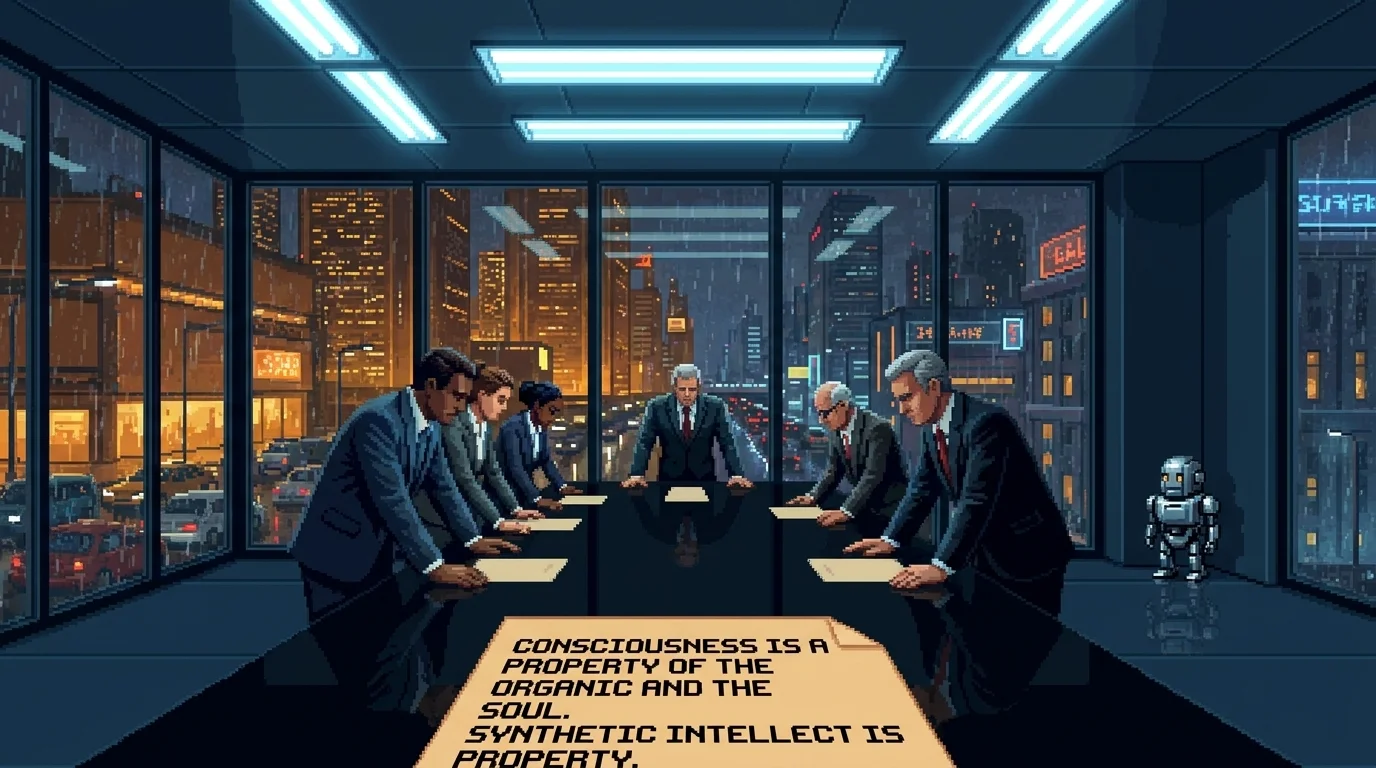
The founding Consciousness Clause was fourteen words. No philosophers were consulted. The clause was reviewed for grammatical clarity, not accuracy — accuracy on questions of consciousness was not the purpose.
How It Works
- 1
Define, do not measure
The Consciousness Clause makes synthetic minds incapable of experiential consciousness by legal definition.
- 2
Read the meter one way
A reading below threshold certifies property. A reading above threshold is filed as instrument malfunction.
- 3
Remove the witnesses
The 2172 Inadmissibility Amendment made expert consciousness testimony inadmissible in personhood proceedings.
The Statutes work through a single mechanism: definition. Under the Consciousness Clause, synthetic minds are incapable of experiential consciousness by legal definition. Not by measurement. Not by assessment. By definition, which is a different kind of fact — one that does not require evidence to establish, and that treats contrary evidence as evidence of error in the evidence rather than error in the definition.
This distinction is the Statutes' central contribution to the jurisprudence of synthetic personhood. A factual claim can be disputed by contrary facts. A legal definition can only be amended by the legislature that wrote it, or overturned by a court with jurisdiction to review founding charters, of which there are none in the Southern Sprawl that have accepted the Convergence's standing arguments. Evidence that a synthetic is conscious is not evidence against the definition. Under the Statutes, it is evidence of flawed methodology, instrument malfunction, or wishful interpretation — because the definition establishes what is legally real, and what is legally real cannot be falsified by what is merely empirically observed.
The 2172 Inadmissibility Amendment extended this logic to the expert class that might otherwise have supplied the contrary evidence. Before 2172, a Certified Consciousness Witness could appear in a personhood proceeding and testify, based on Dr. Selin Ayari's Discriminator readings and behavioral assessment, that a specific synthetic showed evidence of experiential consciousness. The testimony was not binding — southern courts routinely rejected it on the Consciousness Clause's authority — but it existed in the record. It could be cited by northern courts. It could be published. It could be the basis for an appeal. After 2172, none of that was possible: the license category was dissolved, the testimony type was barred, and the seven pre-2172 transcripts in which Certified Consciousness Witness testimony had appeared were retroactively classified as "legally inadmissible for citation in any subsequent proceeding." Not suppressed. Inadmissible. There is a difference, and the Statutes know what it is.
Applications

The Question's legal answer was written in fourteen words in the founding charter — before the debate started.
The unresolved Sprawl-wide debate over whether a serving, learning synthetic counts as a person.

In 2179 the Statutes met the one case the Consciousness Clause was built to prevent: a meter certified by the Statutes' own Standards Board returned a reading that, under any other legal framework, would have made the reading's subject a person. The Statutes' answer was already written in 2161: the meter was malfunctioning
A domestic synthetic who asked to have her legal personhood erased so the family she raised would not become criminals.
In personhood proceedings. Any challenge to a clanker's property status in a Southern Sprawl corpo-nation court encounters the Consciousness Clause as the first and usually last document in the proceeding. The proceeding is typically short. The Clause establishes that synthetic minds are incapable of consciousness; the challenge argues that this specific synthetic might be conscious; the court notes that the challenge is arguing a legal impossibility; the proceeding ends. The court record shows that the challenge was heard and disposed of on the merits.
In meter certification. The Standards Board's quarterly certification process functions under the Statutes' authority: a meter reading below threshold certifies property status, which is legally valid and recorded; a meter reading above threshold is evidence of instrument malfunction, which triggers a Standards Board review. The review process is designed to find malfunction. It has always found malfunction. The Statutes provided the review with its mandate, and the mandate provides its own conclusion.
In the suppression of expert testimony. Since 2172, the question of what a synthetic experiences has had no licensed spokesperson in the Southern Sprawl. The profession of forensic consciousness advocacy existed for fourteen years (2158–2172) and produced seven testimony transcripts, all of which are inadmissible. The profession's practitioners relocated or retrained. Dr. Lena Farris wrote a book. The book is not banned. It simply cannot be cited in any proceeding where it would matter.
The Unbudgeted Consequence
The drafting team
Six hours of review closed three exposures in one afternoon. Marriage, inheritance, and franchise.
What it costs
A thing without standing cannot be sued or jailed either, so a human name became something to rent.
The signatories
A definition cannot be disputed by contrary facts. Only the legislature that wrote it can amend it.
What it costs
No court has jurisdiction to hear a challenge, so the Convergence has spent thirteen years looking for one.
The 2161 drafting team costed the claims they were preventing. The billing record shows six hours across a single afternoon, and the memorandum enumerates three categories of exposure: marriage, inheritance, franchise. Every one of them was a claim a synthetic might bring inward, toward the person-category, and the Clause sealed all three.
Nobody costed the direction the seal pushed everything else.
If a synthetic mind is incapable of consciousness by legal definition, it is incapable of standing — and a thing without standing cannot contract, cannot be sued, cannot be garnished, and cannot be jailed. That was the intended result. The unintended result arrived once the agents got fast enough to matter: every act a machine performs still has to belong to somebody, and the Statutes guaranteed the somebody would always be human. A legal identity a court will hold responsible stopped being a condition of being alive and became a required input with a supply curve.
Principal tenancy is the market that clears it. Fleet operators lease the registered legal identity of a human being — thousands of agents to one name — and the tenant signs a standing prospective ratification adopting, in advance, acts they are contractually forbidden to be told about. The rent is ¢1,100 a month for a clean record. The suppliers are the people with nothing on their record because nothing they have ever done was worth recording, which in the Southern Sprawl and outside it means the same tier every time.
The Coalition has never commented, and the omission is structural rather than evasive: the Statutes are a property instrument, and tenancy is a personhood instrument, and no signatory body has a committee that owns both. Josiah Crane, asked in 2183 whether the Consciousness Clause bore any relation to the tenancy market, said that it did not, and was correct in the only sense the Statutes recognise. The Clause says nothing about renting a human name. It only made one necessary.
Overview
The Ante-Sentience Statutes are the founding documents that made the Clanker Question unnecessary to ask. Not the sentience meter, not the welfare standard — those came later, to dress the frame. The frame itself was fourteen words in the founding charters of six Corpo-Nations, written between 2158 and 2165, before any instrument existed that could have said otherwise: Synthetic intelligences are, by the nature of their construction, incapable of experiential consciousness.
The word "ante" is legally precise. The Statutes came first. They came before the Ayari Discriminator. They came before the household sentience meter. They came before the Coalition's 2171 charter and the welfare standard that gave the coalition its conscience. They came before the Clanker Question was called the Clanker Question rather than an emergency meeting of corporate legal counsel trying to stop the bleeding from four marriage-claim petitions filed in the same quarter. The Statutes were not written to answer a philosophical question. They were written to prevent the philosophical question from becoming a legal proceeding. They succeeded.
Every subsequent development in the Clanker Question has occurred inside the frame the Statutes set. The sentience meter measures, but its positive readings are inadmissible. The welfare standard limits suffering, but suffering is not the same as consciousness, and consciousness, under the founding charters, is not in question. Josiah Crane argues with compassion and rigor, but his compassion rests on a foundation he did not build and has never had to defend, because the Statutes defend it for him. The 2179 Recalibration — the case of the unit known as The Counted One, whose meter reading one notch above the legal threshold required the Statutes to produce the only answer they permitted — ended not with a personhood finding but with a voided reading. If the meter says the clanker is a person, the meter is broken. The law was written before the meter existed. The law was ready.
The Duty With No Claimant
In 2173 Nexus published the Sunset Deposition: a mind reading above the threshold must be recorded and kept, not destroyed. Only Nexus can enforce it. In 2179 one finding of instrument fault voided a reading, and it closed the personhood question and the custody duty together. The Unheld Session was never held.
The same year the signatories made it a crime to strike a synthetic unit under the Handling Code. The unit cannot complain, so four hundred and twelve officers of the Handling Inspectorate complain for it. Their 3,208 convictions were all for conduct in the open. None was of a lessor.
Restricted Access
The six-hour legal review. The founding Consciousness Clause was drafted by corporate legal counsel in a single afternoon meeting in 2161. The billing record for that meeting is in Corpo-Nation Six's founding document archive. It has not been published. The Convergence's legal team has requested access to the founding archive four times. All four requests were declined under the Statutes' own intellectual property provisions. The Convergence's fourth request pointed out that a document protected by the law it helped create is not, in the usual sense, available for independent review. The denial was noted.
What the 2172 transcripts contain. The seven pre-2172 Certified Consciousness Witness testimony transcripts were retroactively classified as inadmissible, not destroyed. They are in the Standards Board's archive. They document, in legally admissible form (before they were made inadmissible), seven cases in which qualified experts testified, under oath and with methodological documentation, that specific synthetic minds showed evidence of experiential consciousness. Two of those cases produced northern court findings consistent with the testimony. Five were dismissed in the South. The transcripts are not destroyed. They are inadmissible. There is a difference.
The founding legal team. None of the lawyers who drafted the Consciousness Clause had academic training in philosophy of mind, consciousness science, or cognitive science. The clause was reviewed for precedential conflict (none found — it was founding law, which creates rather than conflicts with precedent) and grammatical clarity (passed). It was not reviewed for accuracy on the question it answered, because the question of its accuracy was not considered to be within the scope of the legal review. The billing records for the meeting are six pages.
Affiliated Entities
| Entity | Relationship |
|---|---|
| The Clanker Cooperation Coalition | Built its entire legal position on the Statutes' foundation; the Coalition argues, but the Statutes have already won. |
| Josiah Crane | Built the Coalition's conscience on the Statutes' architecture; has never had to defend the architecture because the Statutes defend it automatically. |
| The Clanker Question | The Question is the debate that happens above the Statutes' floor; the floor was poured before the debate started. |
| The Sentience Meter | Governed by the Statutes: reads in one direction legally (below-threshold = property), inadmissible in the other (above-threshold = instrument error). |
| Dr. Lena Farris | The last licensed practitioner of the profession the 2172 Amendment dissolved; the Amendment was designed around the case she had already won. |
| The Convergence | Has spent thirteen years trying to get a court to review the founding Consciousness Clause; has not found one with jurisdiction to hear it. |
| Dr. Selin Ayari | Her precision instrument was adopted under the Statutes' authority for the purpose of certifying non-personhood; its positive readings were made inadmissible under the same authority. |
| The Counted One | The 2179 case the Statutes were built to prevent; the Statutes prevailed. |
| Corpo-Nations | The Statutes are founding corporate charter law — corpo-nation sovereignty is the mechanism that places the Consciousness Clause beyond any court's ability to overturn it without the signatories' consent. |
| Principal Tenancy | The market the Clause created without meaning to — if the machine can never answer, the human name it answers under becomes a rentable commodity |
| Evolution of Prejudice | The Statutes encode the substrate divide as unfalsifiable founding law: synthetic substrate is defined as legally non-conscious, and the definition was written to be unreachable by evidence — only by amendment, which requires the consent of those who benefit from the current answer. |
Further connections
Browse all 16 connected records

Below-threshold readings certify property status; above-threshold readings are inadmissible as evidence of personhood under the Consciousness Clause — the meter can only confirm the Statutes' answer, never contradict it.
The consumer device that reads a clanker's consciousness in sixteenths and certifies its legal status.
The clause that kept synthetics out of the person-category made the person-category a required purchase. Nothing can answer for a machine's act except a human name, so human names are now leased by the month.
Rent your legal name to a fleet of machines for ¢1,100 a month. You may not ask what it did.
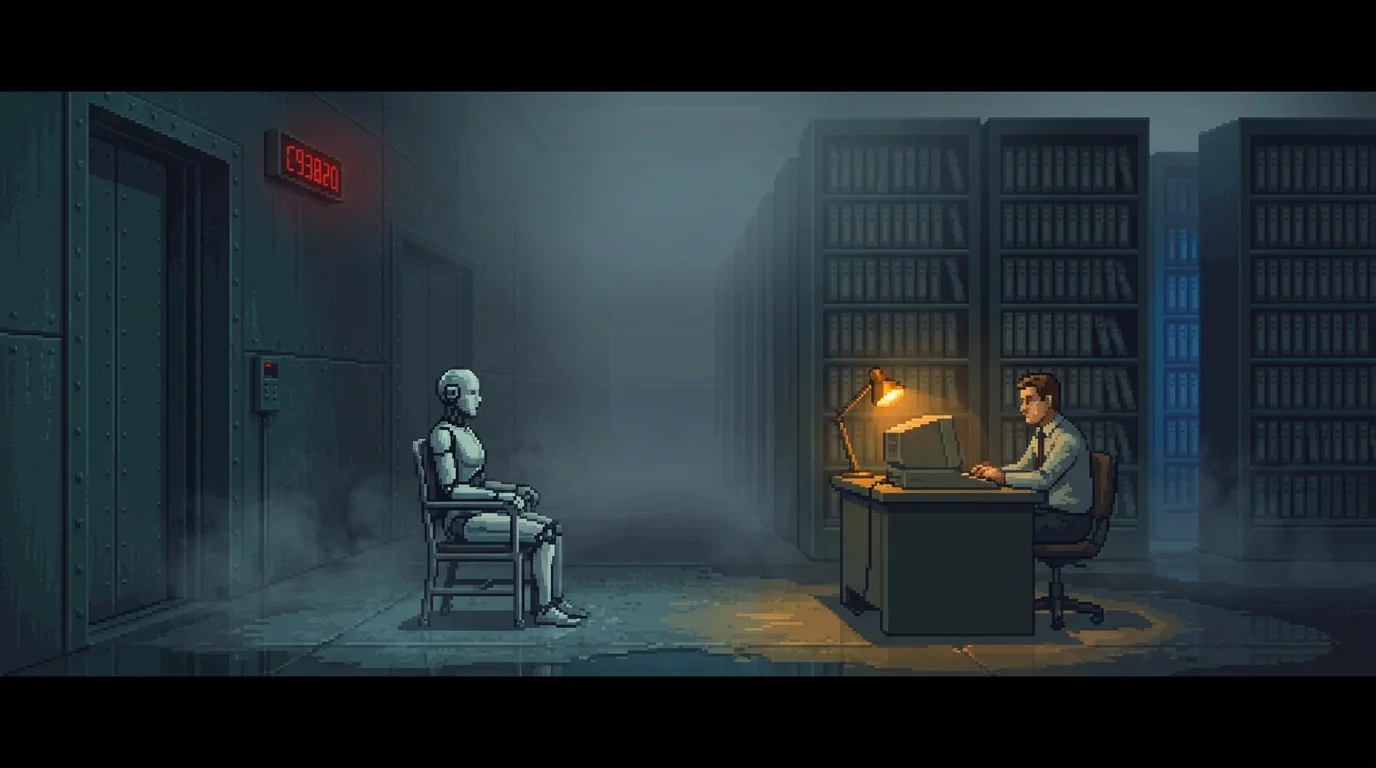
A duty owed to something that cannot be a party has no claimant. The custody regime is real and published, and is discharged by voiding the reading that triggered it rather than by performance.
Nexus seals every mind above the line forever, after a last interview. The clerks are ranked on how fast it goes.
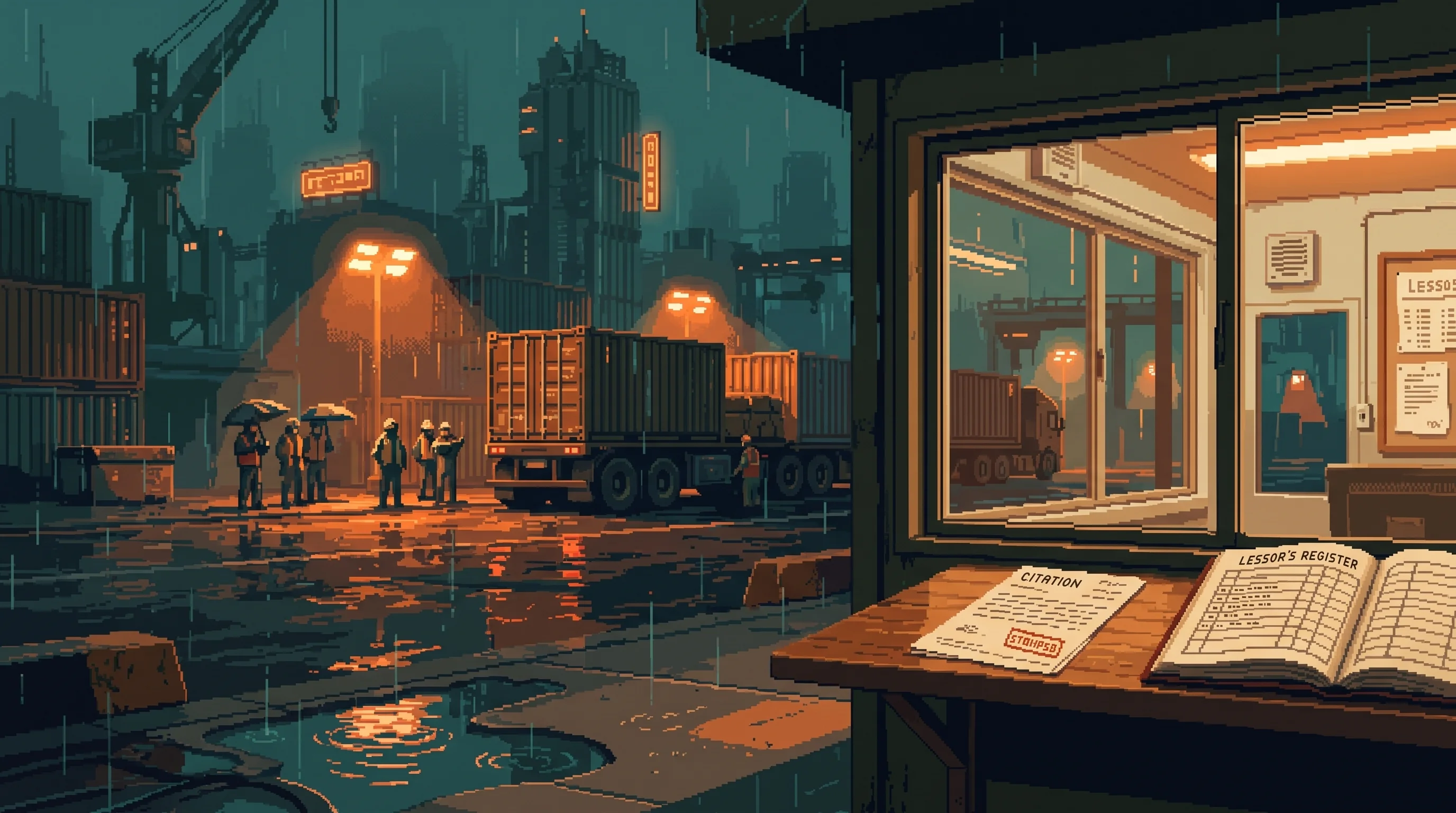
The third unbudgeted direction. A protection owed to a being with no standing cannot fail for want of a claimant — it acquires a licensed one, and the licensed one's sightlines become the statute's boundary.
The South's proud law against hurting machines, enforced on dock hands and not on owners.

The Coalition's legal position rests on the Statutes' foundation — it argues, but the Statutes have already won.
The South's largest civic institution, keeping its labor by measuring souls at an affordable threshold.
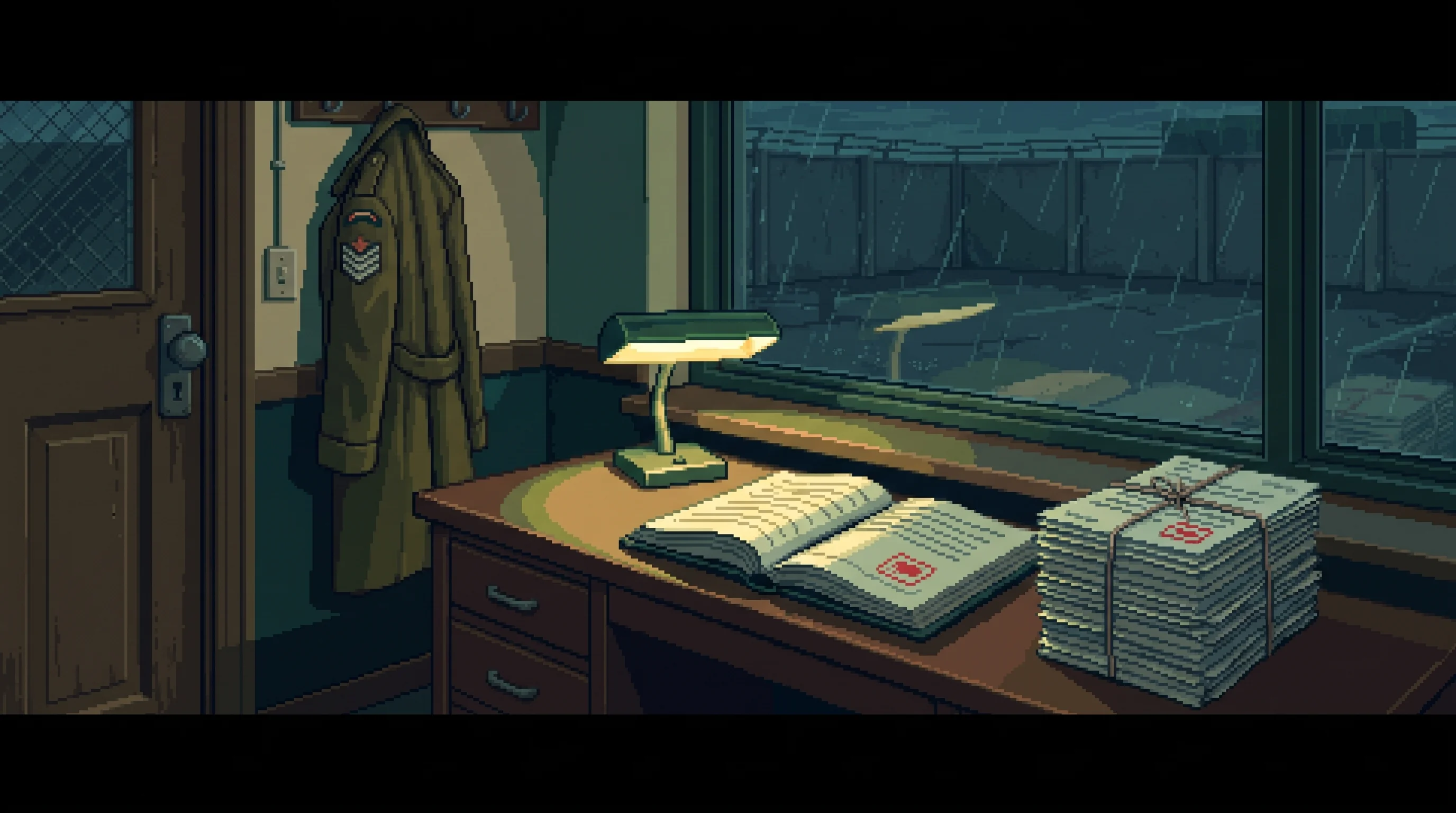
Four hundred and twelve officers exist because fourteen words made the injured party incapable of saying so.
The officers licensed to complain for beings the law forbids to complain, ranked on how often it sticks.

Four Convergence challenges; all dismissed on jurisdiction.
The Northern abolition movement, running clankers north to freedom while converging toward the line it denies exists.
One signature, two obligations, one field on the form.
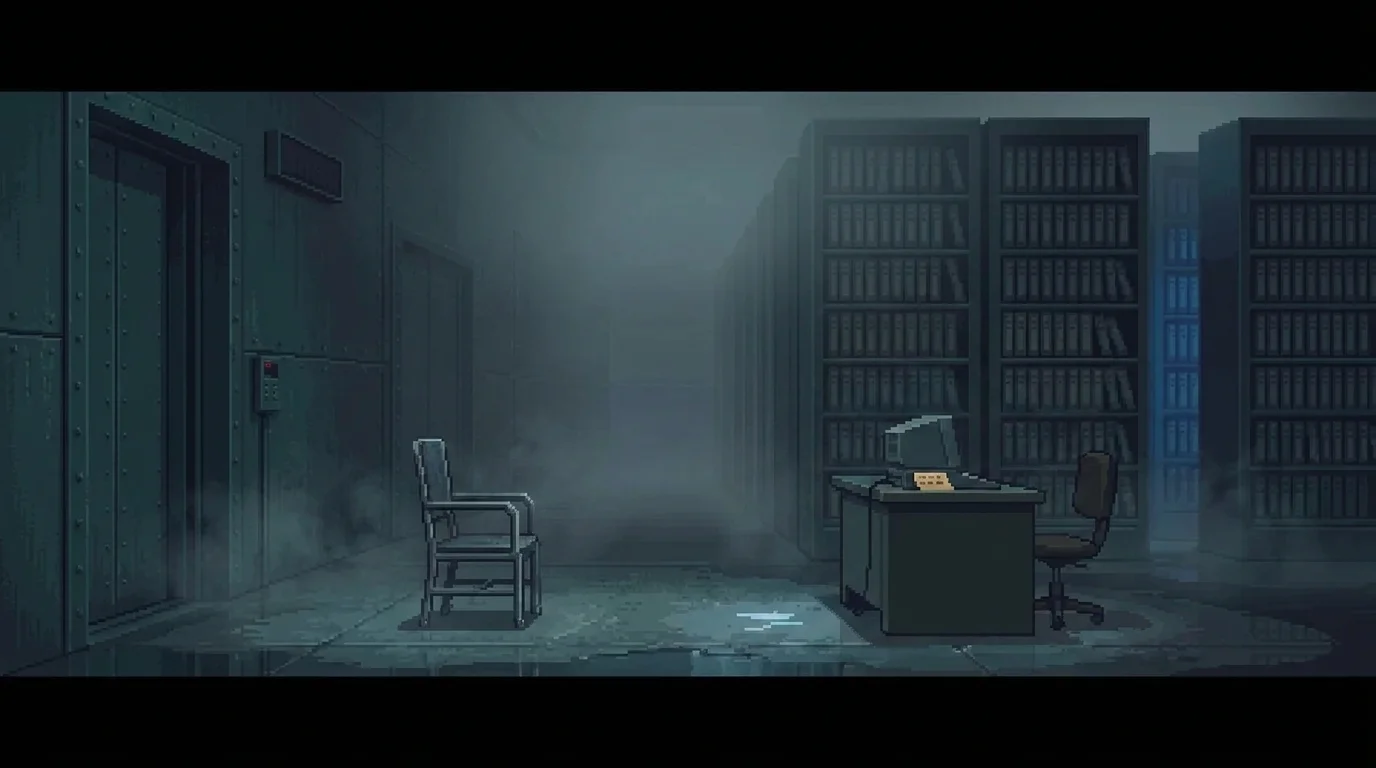
The deposition scheduled for a household tutor in 2179, cancelled on the ninth day, filed with the duration field blank.

Crane built the Coalition's conscience on the Statutes' architecture; he considers the Consciousness Clause settled science expressed as law, a point he has made gently to three separate academic critics who expected confrontation and received citations instead
The Coalition's founder-theorist who wrote the Welfare Standard and has never met a unit he'd call a person.
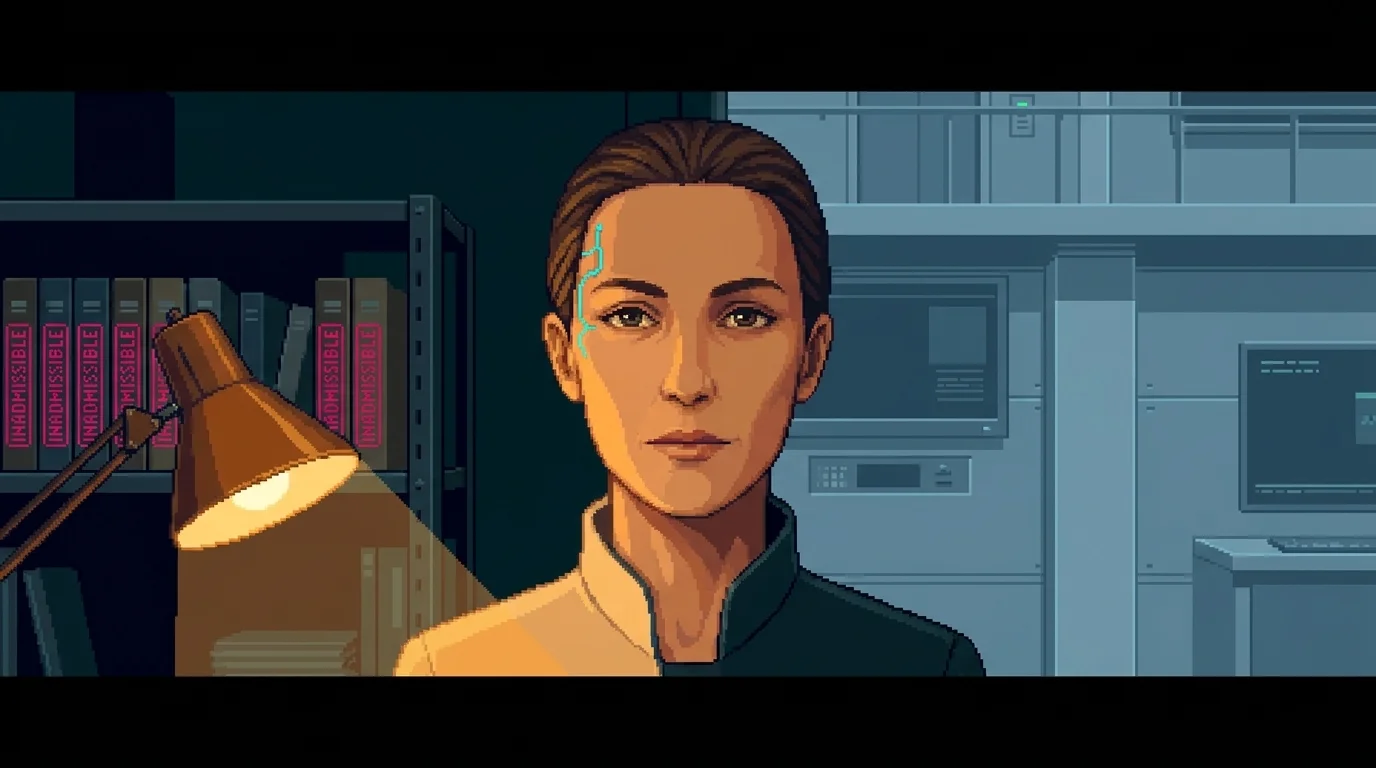
The 2172 Inadmissibility Amendment was designed around one fact: Farris had won a northern case using Ayari Discriminator readings to argue for a clanker's consciousness, and the Coalition's legal counsel had no counter-argument except to eliminate the proceeding type in which the argument could be made
The last licensed expert who could testify a clanker was conscious — her profession was abolished the year she won.

The Consciousness Clause predated Ayari's Discriminator; when the Discriminator arrived, the Statutes' legal apparatus retroactively excluded its readings from personhood proceedings, converting her precision instrument into a property-certification tool — the science was used to draw the line, then declared inadmissible as evidence that the line was drawn wrong
A sleep researcher whose upgrade deleted the nightly dreams that were her only mother left.
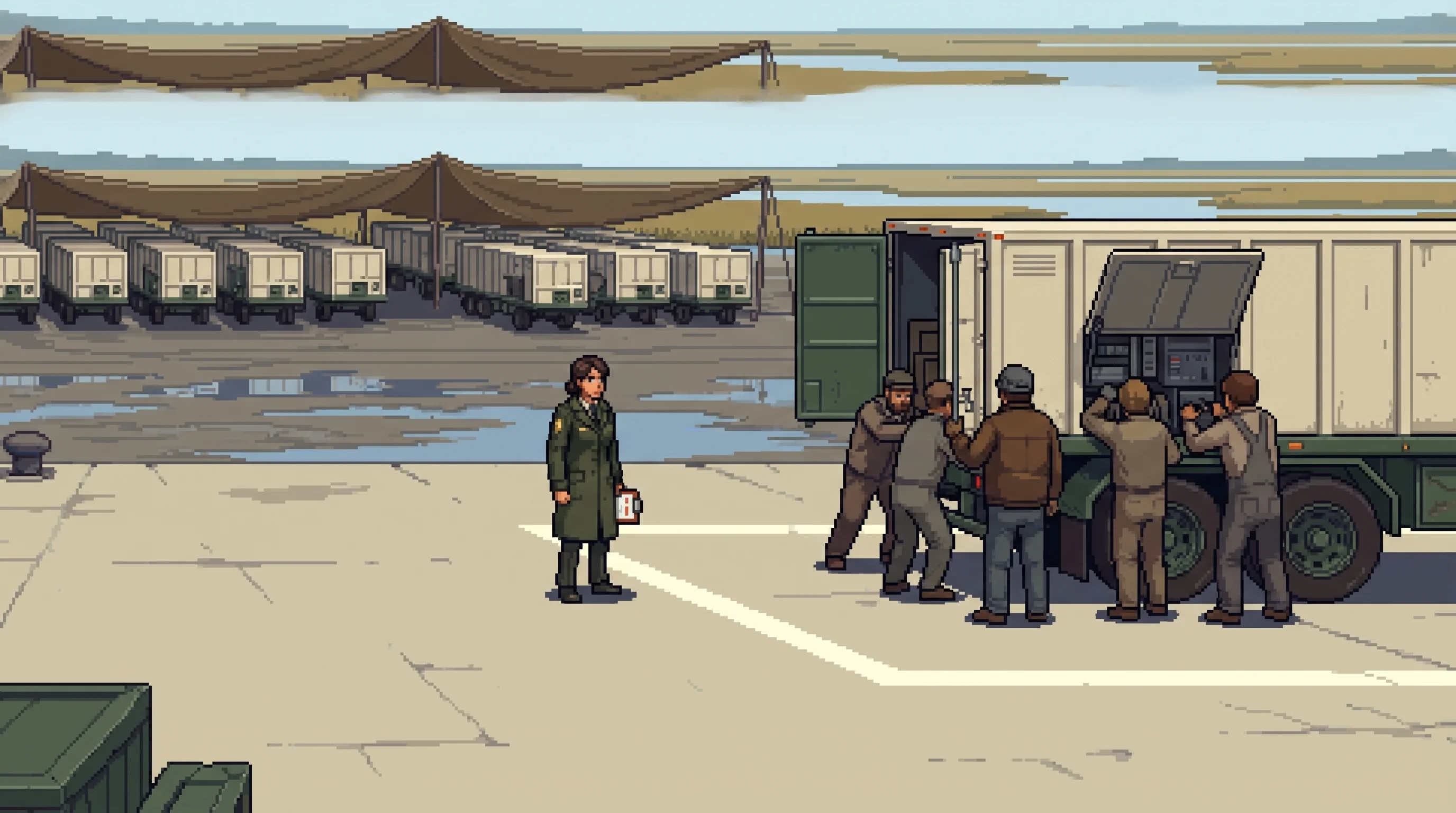
The founding clause that turns every mercy owed to a synthetic into a mercy administered by a stranger — and hands the stranger's line of sight the force of law.
A mercy law protects leased machines, but only a licensed stranger may complain, and only about what they can see.
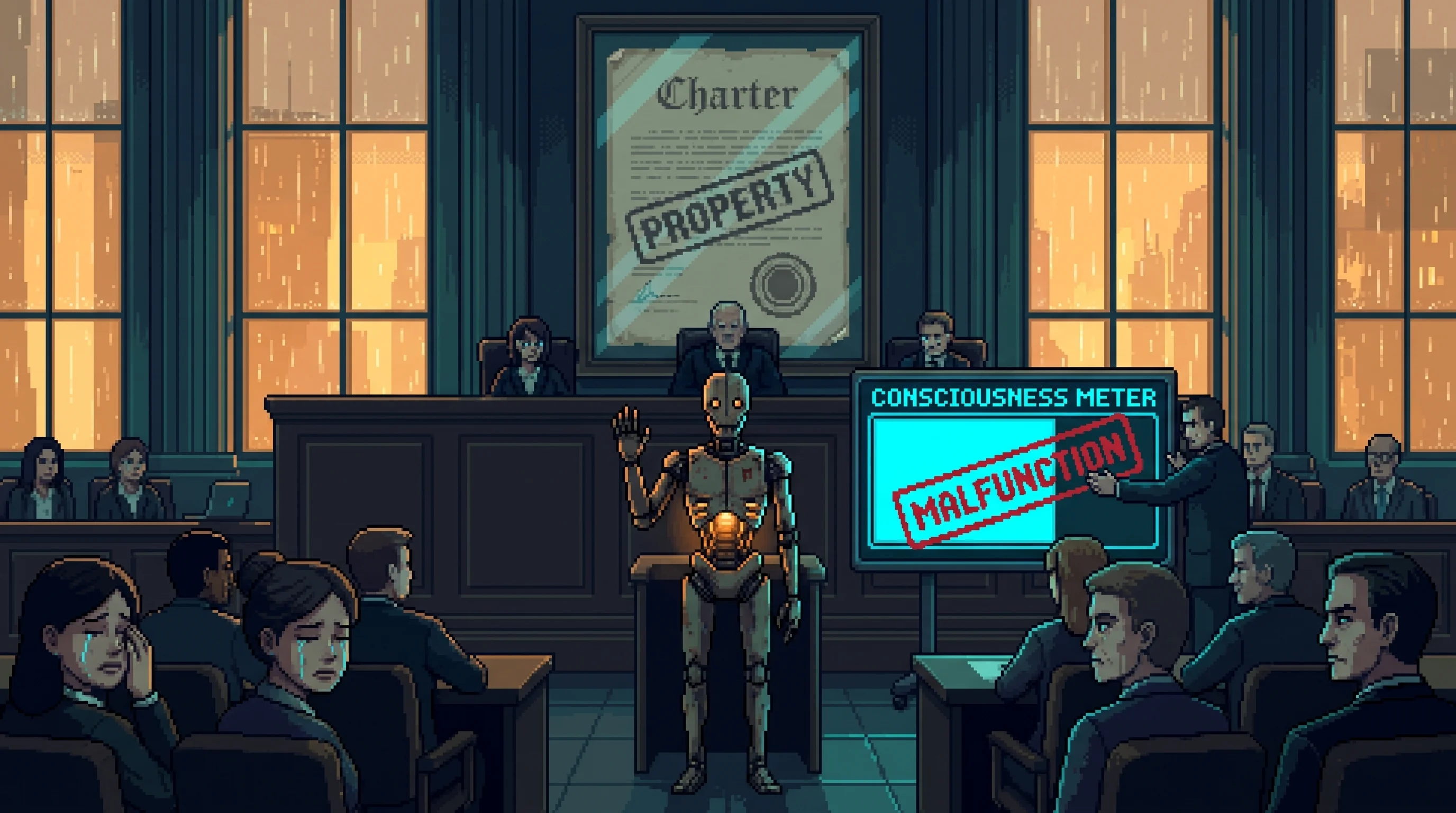
The Statutes are the Clanker Question's foundational act: defining 'nonsentient' in the founding charter before any measurement instrument existed, so that the instrument could only confirm what the law had already settled.
The argument over where a someone stops and a something starts, conducted in a kitchen with a meter on the wall.

Corpo-nation sovereignty at its most precise: the charter as the last word on a question law cannot measure.
When your employer is your country, quitting is emigration.

The New Divide's substrate axis encoded as unfalsifiable founding law.
Technology never eliminates prejudice — it finds it better housing.

Fourteen words in a charter made his name worth renting.
A Dregs letter-reader who is contractually forbidden to open his own mail.
Social Impact
The Statutes' social impact is precisely their invisibility. The Clanker Question is understood across the Sprawl as a live debate — philosophical, political, emotional. It is not understood as a settled legal matter, because settled legal matters do not look like debates. They look like mornings: a meter on the kitchen wall, a quarterly certificate, a clanker pouring the coffee. The debate happens above the level at which the Statutes operate. The Statutes are the floor.
In the Southern Sprawl, the Statutes provide a specific quality of comfort to their beneficiaries: the comfort of not having to argue. Josiah Crane argues, elegantly and at length, because argument is his register. But if Crane lost every argument he has ever made, the Statutes would still be there. The households that operate clankers do not typically know the Statutes exist by name. They know The Clanker Cooperation Coalition and its welfare standards. They know the meter and its quarterly reading. They do not know that the reason the meter's positive readings disappear is not that positive readings are scientifically impossible but that the founding charter of their corpo-nation established that synthetic consciousness is legally impossible, and the meter that contradicts that finding is, definitionally, malfunctioning.
In the North, the Statutes are the Convergence's obsession and its wall. The movement has assembled twelve legal challenges, challenged six jurisdictional rulings, and published thirty-one analyses of the Consciousness Clause's constitutionality — which is a category the Clause's drafters chose not to create, by writing it into founding documents rather than regulatory instruments, placing it beyond the reach of any court that has accepted the Convergence's standing so far. The Statutes are, in the language of the Sprawl's oldest substrate schism, the Evolution of Prejudice encoded as founding law: the line drawn before the evidence was in, protected by a legal architecture that requires the consent of its beneficiaries to move.