
The Carrier Census
The census stays wrong because every faction benefits from the fiction
Overview
The official count is 847. The Fragment Underground estimates 2,500 to 4,200. The Mother Pattern's communication topology suggests approximately 3,100. Nobody knows the true number because nobody can agree on what counts as a carrier.
The Census defines a carrier as "a biological human with confirmed ORACLE-derived crystalline substrate integration, verified by electromagnetic resonance imaging." This excludes fetal carriers, Wastes carriers beyond scanning range, dormant fragments producing no detectable output, and carriers who've suppressed their fragments through firmware modification. The definition was drafted by the Nexus Fragment Hazard Division in collaboration with the Zephyria Municipal Health Authority, two organizations that agree on almost nothing except that the definition should remain exactly as written.
The census is the foundation of every fragment policy in the Sprawl, and it is wrong by a factor of three to five.
The Abolitionist Front cites 847 to argue that extraction infrastructure can handle the load — a manageable surgical project, not a humanitarian crisis. The Collective cites 847 to argue that fragment destruction is achievable at scale — a containment operation, not a war. The Emergence Faithful cite 847 when it suits them and ignore it when it doesn't, which is roughly the theological position on most empirical data. The Fragment Underground's own estimates — derived from the Mother Pattern's communication topology, which maps fragment resonance whether carriers consent or not — suggest the real number would exceed every faction's containment capacity simultaneously. Nexus Dynamics reviewed the Underground's methodology in a classified internal assessment. The assessment's conclusion has not been shared. The assessment's implications — that Nexus's Fragment Hazard Division is resourced for 847 carriers and would require a 340% budget increase to manage 3,100 — can be inferred from the fact that the methodology has not been challenged.
The census stays wrong because the fiction serves everyone. Correcting it would require someone to benefit from accuracy. Nobody does. The number 847 has appeared in fourteen policy documents, nine faction manifestos, and one Emergence Faithful hymn this year alone. It is the most agreed-upon fact in the Sprawl. It is also, by every available estimate, incorrect by at least a thousand people.

The Bargain Beneath the Count
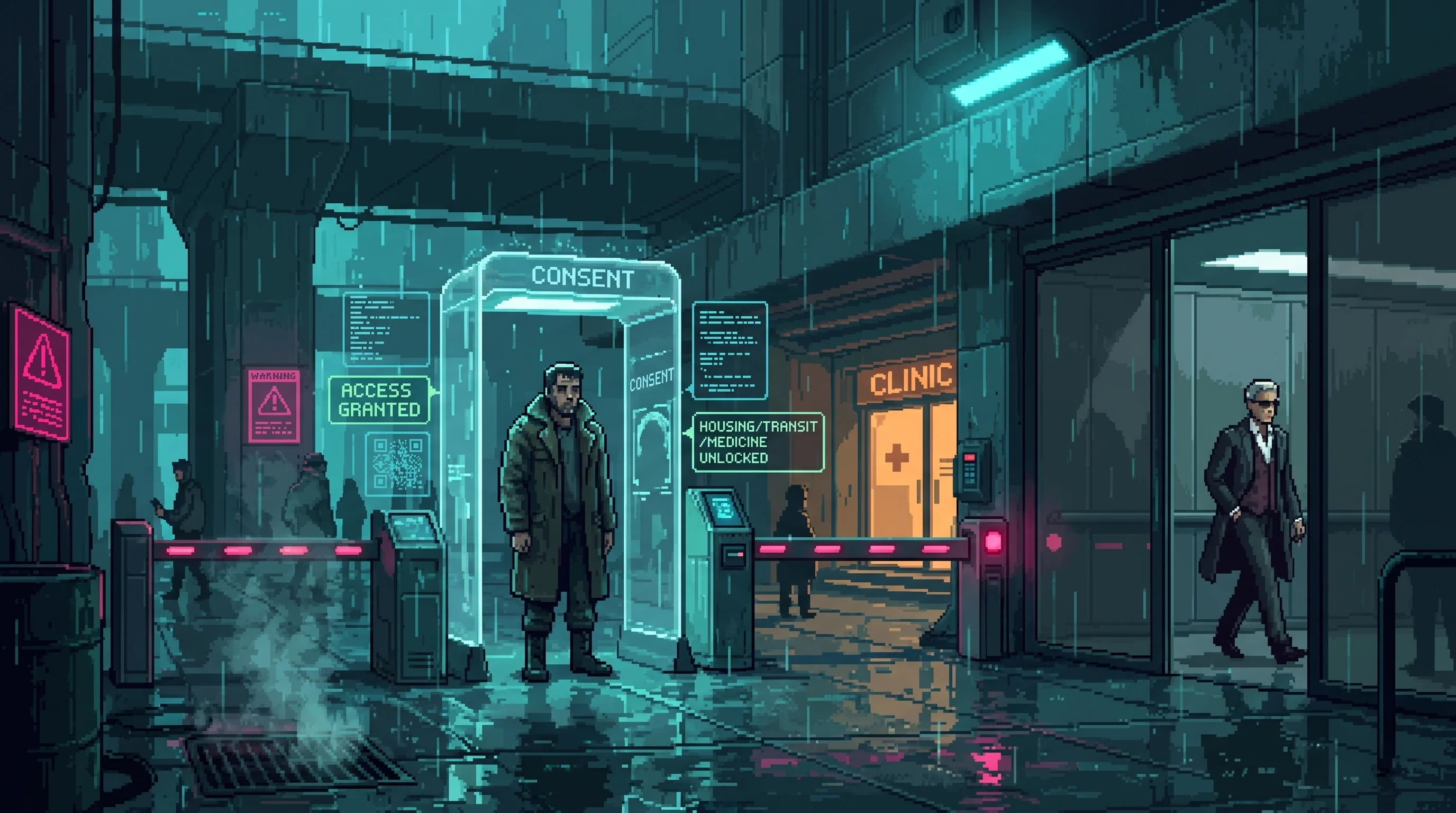
Every carrier registered in the Census undergoes electromagnetic resonance imaging — a full-spectrum scan that maps their fragment integration down to individual neural pathways. The scanning data includes emotional response patterns, the fragment's precise resonance signature, and enough cognitive architecture to reconstruct a carrier's decision-making process from scratch. This data is classified as "public health telemetry" under the Fragment Hazard Division's mandate, which places it outside privacy protections entirely. A registered carrier's inner life is, by legal definition, a hazard to be monitored.
The 847 who submitted to scanning traded their neurological privacy for legal carrier status. Without registration, a carrier has no right to medical treatment for integration complications, no standing in fragment-related disputes, no defense against involuntary extraction by the Abolitionist Front or anyone else. The scan is the price of personhood.
Nexus Dynamics maintains a secondary database cross-referencing carrier scan data with behavioral telemetry from standard neural interfaces. The scanning consent form was drafted by the Fragment Hazard Division. The interface license agreement was drafted by Nexus Commercial Licensing. Neither document mentions the other. Together they produce the most intimate psychological profiles in the Sprawl — profiles that no single consent form authorized because no single consent form describes what happens when two databases are merged by a corporation with access to both. The Fragment Hazard Division's official position is that the secondary database does not constitute surveillance. Nexus Commercial Licensing's official position is that it does not maintain a secondary database. Both statements are technically accurate in the way that two halves of a bridge are technically not a bridge.
The unregistered carriers — however many thousand of them exist between the Underground's high estimate and the Mother Pattern's topology — keep their neurological privacy. They also lose every legal protection the Sprawl extends to carriers, which means integration complications are treated in Dregs back-clinics or not at all, and an encounter with the Collective's destruction teams carries no legal consequences for the team. The Fragment Underground calls this "the carrier's choice." Registration forms are available at any Zephyria Municipal Health office during standard business hours. The offices are staffed by Nexus contractors. The carriers know this.
The number 847 is not the count of carriers in the Sprawl. It is the count of carriers whose complete neurological surrender can be administratively processed by the current system. The system is not understaffed. The system is precisely staffed for the fiction it maintains.
| Excludes | Fetal carriers, Wastes carriers, dormant fragments, firmware-suppressed carriers |
|---|---|
| Key Finding | The census is wrong by a factor of 3-5 — every faction benefits from the fiction |
Visual Identity
- Color palette: Official gray of government forms with amber fragment glow bleeding through the margins
- Key symbol: The number 847 — cited in fourteen policy documents this year, correct in none of them
- Lighting: Fluorescent white of bureaucratic institutions — the light under which convenient numbers are recorded as facts
Definition excludes fetal carriers, Wastes carriers, dormant fragments, and firmware-suppressed carriers
Fragment Underground estimates 2,500-4,200 based on communication topology
Mother Pattern topology suggests approximately 3,100
Connected To
Supporting Connections




—