The Wonder Deficit
Anticipatory-Answer Wonder Loss
The Closed Gap
The Wonder Deficit describes the loss of genuine not-knowing in a world of instant answers
Overview
In Q3 2183, Nexus Dynamics' Cognitive Services division received 1.7 million support tickets classified under error code WD-7: "false memory of original thought." The user believes they have just had an idea. The Second Mind's activity log shows the answer was pre-loaded 340 milliseconds before the question began forming. The user experienced curiosity. The user experienced nothing of the kind.
WD-7 accounts for 23% of all Professional-tier support queries. It has never been classified as a bug. Nexus lists it under "anticipatory delivery functioning as intended." The users filing the tickets disagree. They can't articulate why. The answer was correct. The answer was fast. The answer was already there when they reached for it, which is the problem — reaching for something that's already in your hand doesn't feel like reaching. It feels like remembering. The difference between discovering a fact and having always known it has become, for 340 million augmented residents, functionally zero.
The Wonder Deficit is the name Memory Therapists gave the condition in 2181, after documenting a symptom cluster in high-augmentation patients: creative stagnation, persistent déjà vu during conversations about ideas, an inability to be surprised by factual claims the Second Mind has already confirmed subconsciously, and — the diagnostic flag — a progressive loss of the ability to ask questions that don't have answers. Not won't. Can't. The neural architecture for open-ended inquiry atrophies like any unused muscle. Therapist case notes from the Yuen Clinic describe patients who can solve differential equations in 40 milliseconds and cannot complete the sentence "I wonder what would happen if—" because the Second Mind finishes it before "if" arrives.
This is not the Cognitive Ceiling. The Ceiling is the intellectual condition — the knowledge that your best thinking is someone else's commodity. The Wonder Deficit is the experiential one. What it feels like to never not-know.
The Measurements
Orin Slade diagnosed it with characteristic precision: a mind that already knows everything has no reason to look closely.
Corporate productivity data confirms this, though not in the way the corporations intended. Nexus's own workforce analytics show that Professional-tier employees produce 40% more revenue forecasts than their 2170 counterparts. They produce 0% novel business models. The forecasts are flawless extrapolations of existing trends. The trends never change because nobody wonders whether they should. Nexus has flagged this metric as "forecasting excellence" in three consecutive annual reports.
Helix Biotech's R&D division tells the same story from a different angle. Drug discovery timelines have compressed by 88% since universal augmentation. Breakthrough compounds — molecules nobody was looking for — have declined by 73% over the same period. Helix's chief science officer described the situation in a 2183 internal memo as "extraordinary efficiency in finding what we expect to find." The memo did not address what happens when what you need is something you didn't expect.
The intersection with the Dream Deficit compounds the damage from the other direction. Dreams were the biological substrate's last native mechanism for undirected cognition — processing without purpose, connection without query. The Circadian Protocol eliminated dreaming. The Second Mind eliminated wondering. Innovation decline in Protocol-adopting organizations: 47% since 2178. The augmented became faster, more accurate, and in a specific neurological sense, finished — minds that have already arrived at every destination and have nowhere left to travel. They can neither surprise themselves nor be surprised by the world.

The Market Response
Where there is a deficit, there is a product.
The Mystery Clubs emerged in the Heights around 2181 — private venues where Executive-tier augmented pay ¢12,000 per session to sit in shielded rooms and experience not-knowing. The rooms block Second Mind connectivity for calibrated intervals. Sixty minutes of genuine confusion, curated by "Wonder Architects" who present carefully selected problems with no immediately retrievable answers. The clientele describe the sessions as "transformative." Satisfaction surveys show a hedonic spike during the confusion window that exceeds the average Executive-tier baseline by a factor of six.
Twelve thousand credits to not know something for an hour. The Dregs do it for free, around the clock, because Basic-tier processing gaps are wide enough for curiosity to survive in.
The Guessing Game — a Dregs tradition that predates the formal diagnosis by at least a decade — celebrates exactly this. Street-corner competitions where participants speculate about things they could look up but choose not to. Wrong answers earn applause. Confidently wrong answers earn drinks. The game's only rule: no checking. The point is not the answer. The point is the gap before the answer, which is where the thinking lives, which is what ¢12,000 per hour buys in the Heights and what poverty provides for nothing in the Dregs.
The Thinking Room operates on the same principle in a different register — a space where the wonder gap reopens naturally, without the theatrical shielding of the Mystery Clubs. Fewer amenities. Lower price point. No Wonder Architects. The room is quiet, and the quiet turns out to be sufficient.
Nexus has not classified Wonder Deficit treatments as medical. They cannot, because doing so would require acknowledging that the Second Mind's core feature — anticipatory answer delivery — is the direct mechanism producing the condition. The feature is functioning as intended. The deficit is functioning as intended. These are the same sentence.
The Second Missing Phrase
Therapists searched the logs for "I don't know." Nobody searched for I would rather have something else. It left around the same time, and it needs the same half-second gap. Counsel Halina Drozd keeps no interface in her rooms. Clients leave theirs in a drawer at the door, presented as a courtesy. The drawer is the treatment.
Sensory Details
- Feel: Reaching for a doorknob that turns before you touch it. The phantom sensation of effort where no effort was required.
- Sound: The absence of the half-second pause before someone says "I don't know" — because in the augmented Sprawl, nobody says "I don't know." The phrase has not appeared in Professional-tier conversational logs since 2179.
- Taste: Food you've already eaten. Satisfying, familiar, incapable of revelation.
- Sight: A library where every book is already open to the page you need. Nothing is hidden. Nothing is discovered.
Visual Identity
- Color palette: Flat gray without gradient — the absence of the shift from unknown to known
- Compositional mood: Fluorescent, even, shadowless — the light of a place where nothing remains to be found
- Key symbol: A closed question mark — the punctuation of curiosity, sealed shut
Affiliated Entities
- The Cognitive Ceiling: The Ceiling is the intellectual condition. The Wonder Deficit is the experiential one. Both describe the same population from different angles — one measures what augmented minds can't do, the other measures what they can't feel.
- The Dream Deficit: Dreams produced unbounded cognition through unconscious processing; wonder produced it through conscious attention. The Circadian Protocol killed one. The Second Mind killed the other. Together they describe a mind that can neither wander nor wonder.
- The Second Mind: The direct mechanism. Anticipatory answer delivery is the feature. The Wonder Deficit is the consequence. Both are functioning as intended.
- The Mystery Clubs: The wealthy's attempt to buy back what augmentation took — ¢12,000 per hour of curated not-knowing in shielded rooms.
- The Guessing Game: The Dregs' organic version of the same thing, achieved through poverty rather than purchase. Confidently wrong answers earn drinks.
- The Thinking Room: A quieter intervention. No shielding, no architects. A room where the gap reopens because nobody is filling it.
- Orin Slade: Diagnosed the deficit before it had a clinical name. A mind that already knows everything has no reason to look closely.
Further connections
Browse all 15 connected records

Keeps no interface in her rooms; the gap is the whole instrument.
The Heights' priciest Wanting Counsel refuses to suggest a single want, and reads you the blank result aloud.

The Ceiling is the intellectual condition; the Wonder Deficit is the experiential one — what it feels like to never not-know
The settled fact that no living human's mind can out-think a five-dollar chip.

Dreams produced unbounded cognition through unconscious processing; wonder produced it through conscious attention — both lost, from different directions
Augmented wakefulness removes dreaming, raising output while eroding emotion, creativity, adaptability, and empathy.

The Second Mind's anticipatory answer delivery is the direct mechanism that closes the wonder gap
The AI layer that thinks alongside every augmented brain until neither can tell whose thought was whose.

Mystery Clubs are the wealthy's attempt to artificially reopen the wonder gap
Shielded gatherings where wealthy Sprawl residents pay per session to suppress their AI and simply wonder.

The Guessing Game is the Dregs' organic wonder preservation — celebrating the gap the augmented have lost

Slade diagnosed the deficit precisely: a mind that already knows everything has no reason to look closely
The Sprawl's last print music critic — and the man who named the moment infinite copies stopped producing anything new.

The Thinking Room provides a space where the wonder gap can reopen naturally
A Dregs neural dead zone where the last manual technician does by hand what her interface offers instantly.

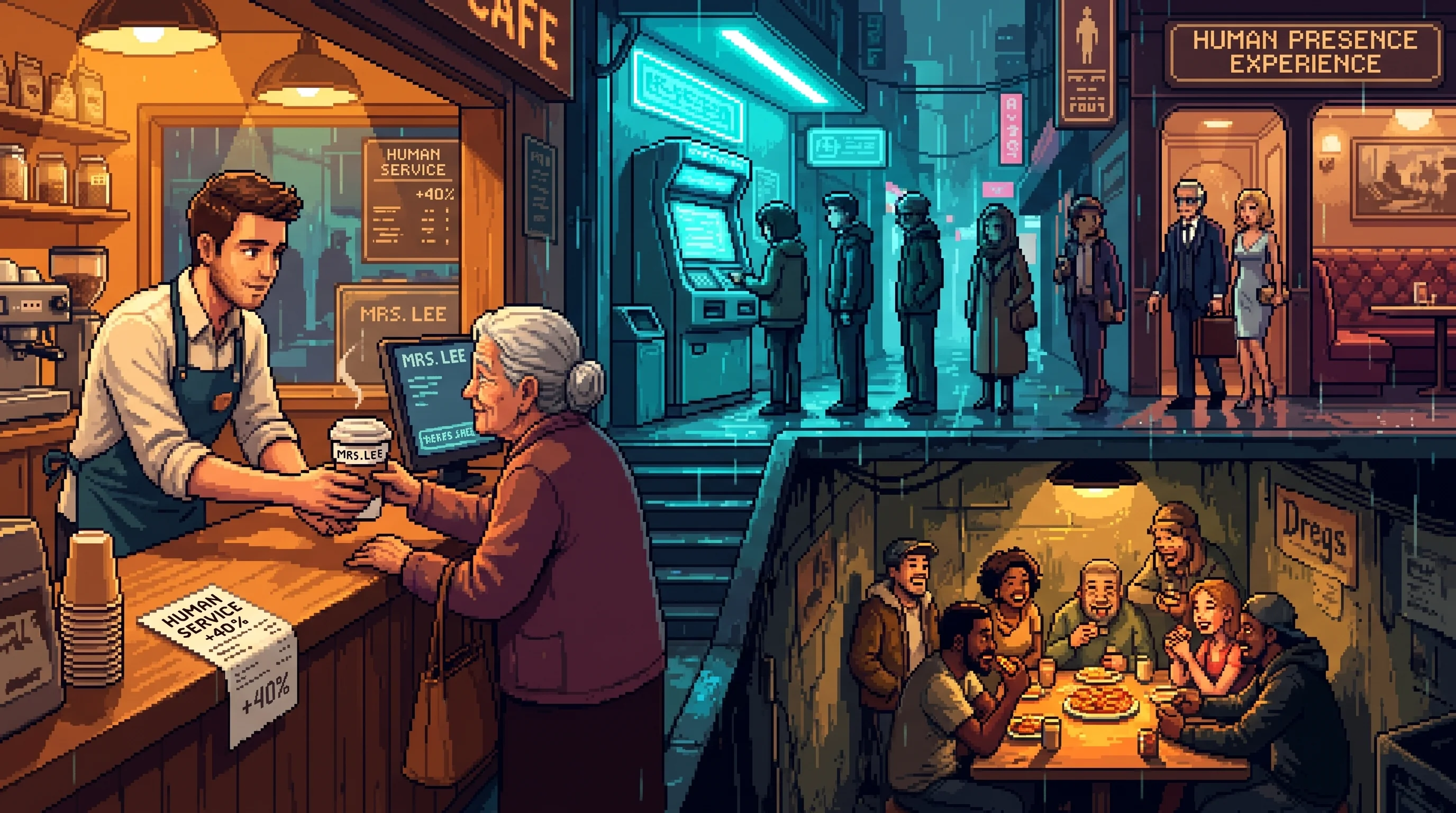
The machine answers first, and wonder becomes one more scarce feeling.
The premium charged for the one service no machine can fake: being seen by another conscious being.


No gap, no question; no question, no want. The deficit closes the interval a preference would have assembled in.
Anything you can specify gets built, so the people who cannot specify live in lives somebody else wrote.

¢12,000/hour buys back the not-knowing augmentation quietly deleted.
Abundance turns danger, difficulty, and human attention into luxuries for elites who optimized them out of life.

Identified the deficit in her daughter before naming it in herself
Nexus compliance director who founded the Mystery Clubs after her daughter panicked over the family cat's name.

Customers buy eurekas to experience the wonder their augmentations have eliminated
A Bazaar booth selling the extracted moment of understanding to people who can't produce their own.
