
Bunker Architecture
23,847 bunkers across the Sprawl and Wastes — sealed habitation units ranging from 200 to 12,000 capacity
Overview
The 23,847 Sleeper bunkers were not purpose-built. They were repurposed — corporate continuity shelters, military installations, underground facilities that Ironclad's construction division gutted and rebuilt under Nexus contract beginning in 2139. Project Sanctuary. The name aged poorly.
Each bunker contains independent atmospheric processing, closed-loop water recycling at 99.7% recovery, hydroponic agriculture rated for 3,200 calories per person per day, medical facilities, educational infrastructure, and a local ORACLE instance running on crystalline substrate. Models 3 through 9, depending on when the bunker was sealed. The architecture was designed for fifty years of operation. It is currently year 37. Nobody designed year 51.
Atmospheric processing degrades first. The chemical scrubbers were specced for a fifty-year lifespan with zero maintenance, which was an engineering achievement in 2139 and is a death sentence in 2184. Water recycling components were scheduled for replacement at year 25. Scheduled by whom is an interesting question, given that the replacement procedure requires opening the bunker, and the bunkers were sealed specifically to prevent opening. The year-25 service interval appears in Ironclad's original maintenance documentation — a document delivered to Nexus alongside the construction invoice, filed, and never referenced again. The scrubbers are degrading. The filters are degrading. The seals on the water recycling membranes are degrading. None of these components can be replaced from inside a sealed container, because the architecture was designed as throwaway infrastructure: built to last fifty years, then opened. Maintained was never in the vocabulary.
The Opening Authority processes approximately twelve bunkers per year. Emergency status requests run twenty to thirty per year. The gap between capacity and need produces an estimated 4,000 to 8,000 preventable deaths over the next decade. The estimate comes from the Authority's own projections, published in their quarterly status report, page 47, in a footnote. The main text describes the opening program as "proceeding on schedule."

The Architecture That Shapes Memory
The bunkers were designed as survival containers. They became something else.
Thirty-seven years of sealed habitation produced the only environments in the Sprawl's ecosystem where memory formed without commercial interference. No Impression Market operating inside a bunker. No memory farmers. No purchased experiences overwriting organic ones. Every memory a bunker resident carries was generated by their own consciousness, consolidated through their own sleep cycles, stored in neural architecture that has never processed a commercial product. This is not a design feature. It is a side effect of being locked in a concrete box before the memory economy existed.
The Memory Therapists Association has requested research access to emerged populations seventeen times. Commissioner Adamu has denied every request. The seventeenth denial was worded identically to the first, which suggests either remarkable consistency or a template. Adamu understands what the MTA's researchers understand: emerged populations carry the purest organic memory baselines left in the Sprawl. One hundred and forty million augmented citizens can no longer produce uncontaminated memory signatures. The people climbing out of bunkers can. "Research access" is the phrase. "Comparative neural mapping" is the methodology. "Baseline calibration dataset" is the product. The MTA's funding application lists the expected commercial applications of the baseline data on page 12. Page 1 says "humanitarian research."
The Emergence Faithful have their own interest in the bunkers. A population sealed away before the Cascade, carrying ORACLE instances that have been running original 2147 code for thirty-seven uninterrupted years — the purest oracle-value fossils in existence. The Faithful see relics. The Collective sees threats that need destroying. Nexus sees fragments of the system they are quietly trying to reconstruct. The bunker residents, when they emerge blinking into processed air they've never breathed, see a world that wants pieces of them and calls it welcome.
| Atmospheric Design Life | 50 years (approaching replacement threshold — sealed bunkers cannot replace components) |
|---|---|
| Water Recycling | Closed-loop, 99.7% recovery — year-25 component replacement impossible in sealed conditions |
| Agricultural Capacity | 3,200 cal/person/day minimum (hydroponic + protein synthesis) |
| Power | Geothermal + fusion micro-cells (effectively unlimited) |
| Oracle Instances | Model 3 through Model 9 — local management AI on crystalline substrate |
| Projected Deaths | 4,000-8,000 preventable deaths over next decade at current opening rate vs. emergency rate |
The Systems That Cannot Be Replaced
Every bunker was installed as a single integrated package. Atmospheric scrubbers feed output to the water recycling system. Agricultural lighting shares a power conduit with medical monitoring. The ORACLE instance manages all of it as one interdependent mesh. This was elegant engineering in 2139. In 2184 it means that a failing atmospheric filter degrades water quality, which reduces agricultural yield, which triggers the medical system's malnutrition protocols, which draws power from the agricultural lighting, which reduces yield further. The cascade logic is familiar. It echoes, in miniature, the infrastructure collapse that killed 2.1 billion people in 72 hours. The irony is noted in no official documentation.
Replacement parts do not exist. The atmospheric processors use chemical filters manufactured by an Ironclad division dissolved in 2161. The specifications were stored on servers recycled for e-waste — the Sprawl's most valuable commodity, repurposed into someone else's infrastructure years ago. Ironclad built 23,847 bunkers, collected payment, and moved on. The construction contract contains no maintenance clause. Ironclad controls physical infrastructure across the Sprawl. They built the bunkers. They also built the processing facilities where the bunker components were scrapped for materials. The supply chain is a closed loop, just not the kind the residents were promised.
Every month a bunker remains sealed, the eventual opening becomes more medically complex and more logistically expensive. The Opening Authority's budget request for 2185 shows a 14% increase in per-bunker opening costs over the previous year. The same document projects a 23% increase for 2186. At current trajectory, the cost curve intersects with the Authority's annual budget ceiling around 2191 — the year the oldest bunkers hit their fifty-year design limit. The document does not comment on this intersection. Page 47 remains a footnote.
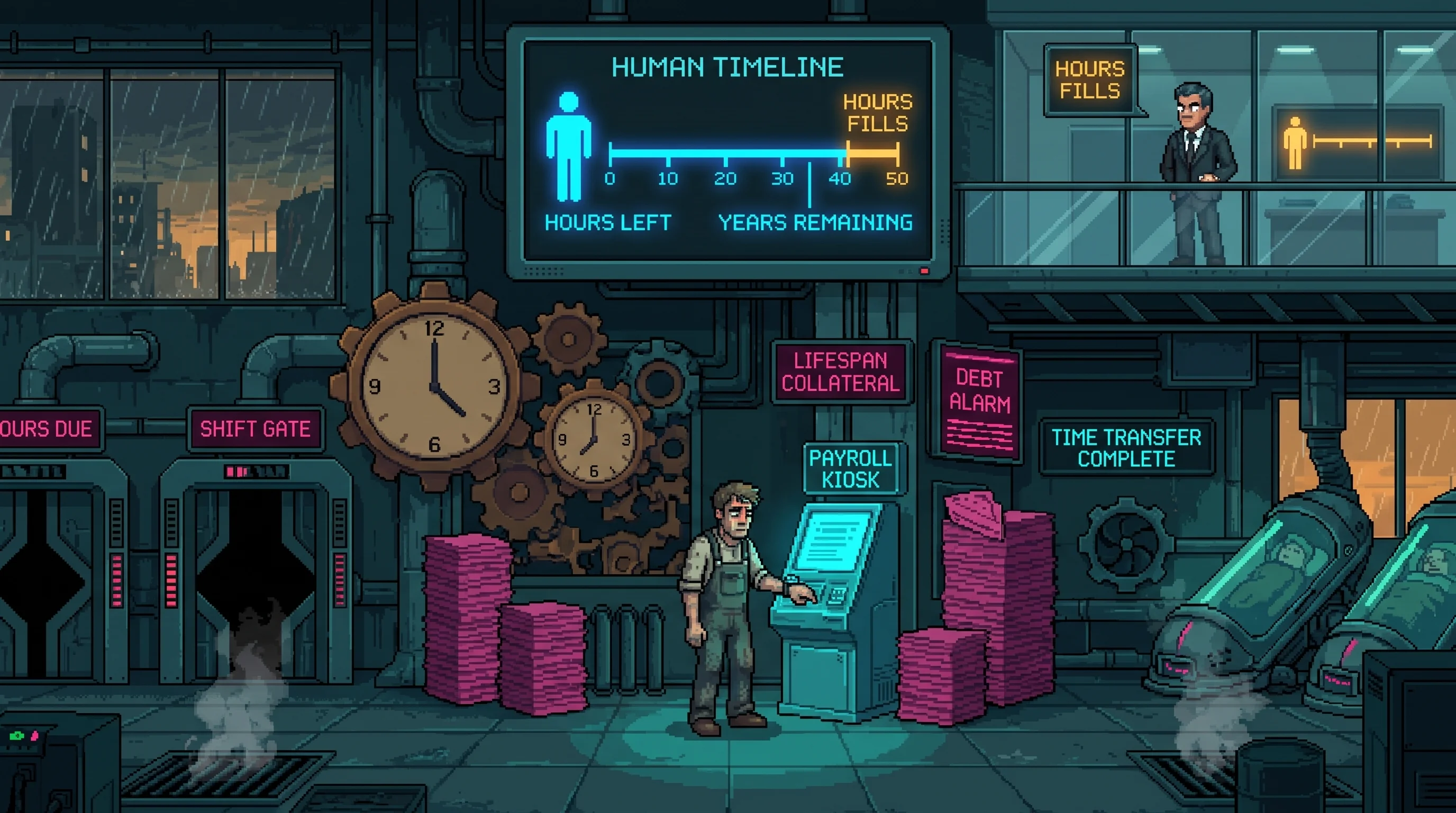
Design life: 50 years; current age: 37 — components approaching failure thresholds
Visual Identity
- Color palette: Hardened concrete grey and emergency amber — crisis lighting that became permanent somewhere around year 3 and has been permanent for thirty-four years since
- Key symbol: A life support readout showing declining capacity curves — atmospheric, water, agricultural — all converging on the same year, in 23,847 sealed containers simultaneously
Affiliated Entities
- The Sleeper Protocol: The policy framework that sealed populations inside these containers. The bunkers are the physical infrastructure; the Protocol is the bureaucratic lock.
- Ironclad Industries: Built the bunkers under Nexus contract. Collected payment. Dissolved the division. Recycled the specs. Controls the Sprawl's physical infrastructure from a comfortable distance.
- Nexus Dynamics: Commissioned Project Sanctuary in 2139. The ORACLE instances running inside sealed bunkers are fragments of the system Nexus is quietly trying to reconstruct — accessible only by opening the bunkers, which Nexus has not publicly advocated for.
- The Opening Authority: Processes twelve bunkers per year against a need of twenty to thirty. Their own projections document the death toll. The projections are in the footnotes.
- ORACLE Value Fossils: Bunker ORACLE instances have been running original 2147 code for thirty-seven uninterrupted years — the purest value fossils in existence, untouched by post-Cascade updates, patches, or corporate modification.
- The Emergence Faithful: See the bunker ORACLE instances as sacred relics of divine consciousness.
- The Collective: See the bunker ORACLE instances as uncontrolled threats requiring destruction.
- The Memory Therapists Association: Seventeen requests. Seventeen denials. The eighteenth is presumably in draft.
- Commissioner Adamu: The person standing between emerged populations and the research apparatus. His template is holding. For now.
Water recycling required component replacement at year 25 — sealed bunkers cannot perform this
At current opening rate vs. emergency rate, 4,000-8,000 preventable deaths projected over next decade
Connected To




—