
Dream Harvesting
Records the full experiential substrate of REM: visual imagery, emotional valence, proprioceptive sensation, and the neurochemical signature of surprise
Overview
Dream harvesting is the sale of sleep to people who can't. It is the most active sector of the Subconscious Market — the supply side of an economy that turns unconsciousness into a commodity, and the reason the buyer asking whose night am I living has become a clinical question rather than a poetic one.
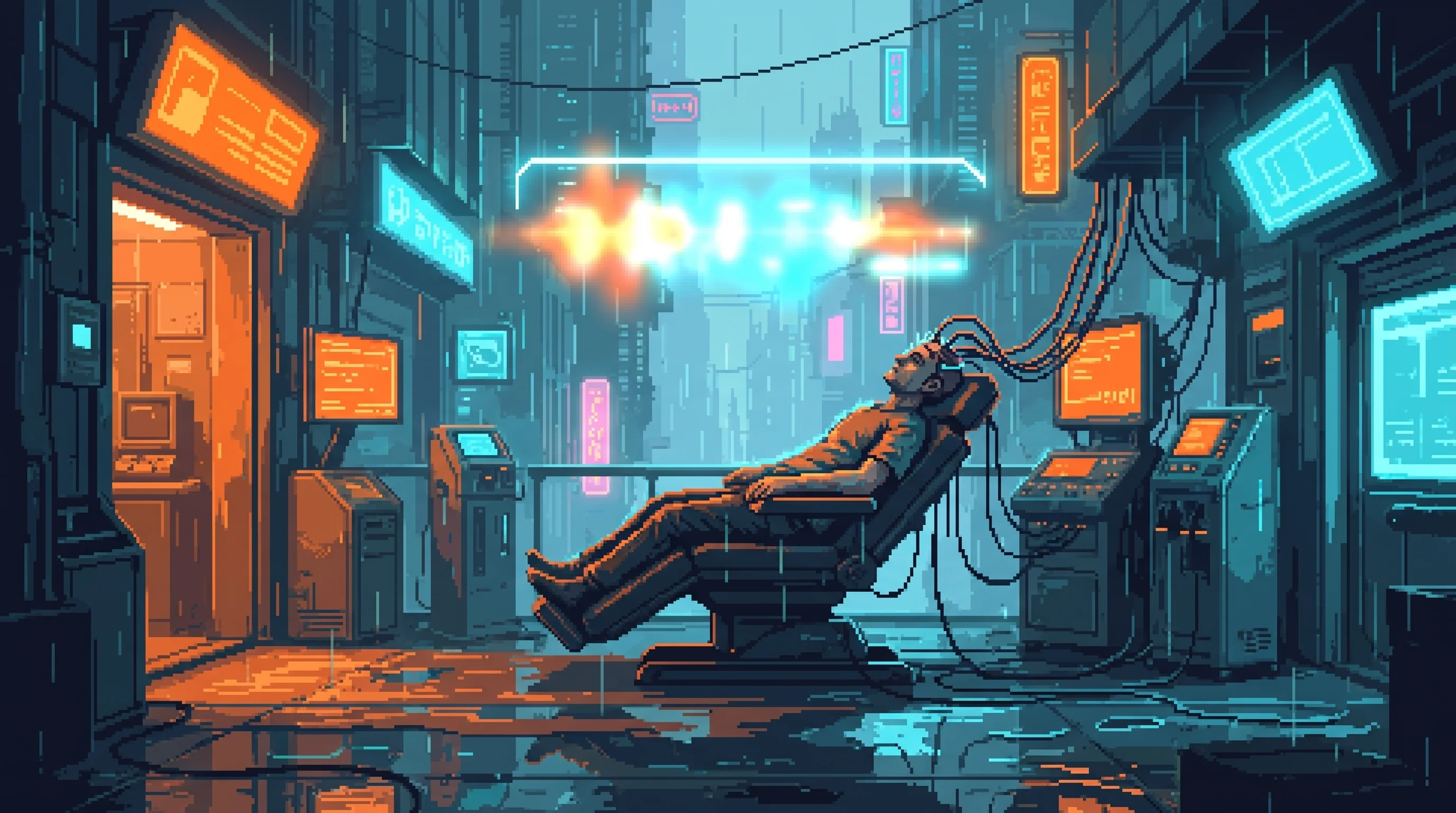
Approximately 2,000 registered harvesters across the Sprawl spend their nights hooked to modified neural interfaces that record the full experiential substrate of REM: visual imagery, emotional valence, proprioceptive sensation, and the neurochemical signature of surprise. They wake up. They sell the recordings. Augmented consumers who haven't generated a natural dream in years pay 200 to 800 tokens per forty-five-minute session, depending on depth, to experience someone else's unconscious.
The technology derives from the same consciousness capture that Lyra Voss uses for her lived-canvas neural recording art. The difference is categorical. Neural recording captures a mind that knows it's being watched. Dream harvesting captures a mind that has forgotten it exists. Voss's work is portraiture. This is burglary — committed with full consent, against a victim who was asleep at the time, for the benefit of buyers who would give anything to be asleep themselves.
The most valuable component is "the descent" — the experience of falling asleep. Not the dream content. Not the imagery or the narrative. The moment of letting go. For consumers whose augmentations maintain persistent cognitive activity across all states, the sensation of consciousness dissolving registers as the most exotic experience available in the Sprawl's luxury market. A top-percentile descent recording from a harvester with clean neurochemistry and no pharmaceutical sleep aids sold at the Dream Exchange last quarter for 4,200 tokens. A full night of vivid dream content from the same harvester sold for 600.
The market has determined that the act of losing consciousness is worth seven times more than anything consciousness produces while it's gone.
The most uncomfortable fact in the dream economy is one the brokers don't discuss at industry events: commodity AI cannot produce dreams. Nexus has tried. Relief has tried. Every computational system capable of generating photorealistic sensory environments, emotionally coherent narratives, and neurochemically plausible experience has tried. They can produce everything except surprise. Surprise requires expectations the system didn't consciously construct — and then violating them. AI systems don't have unconscious expectations. They have parameters. The gap between "parameters violated" and "expectations you didn't know you had, shattered" is the gap between synthetic content and a dream. It has not closed in thirty-seven years of trying.
Dreams are what expectations look like when nobody's monitoring them. The Sprawl's most advanced AI systems can simulate every other human experience. They cannot simulate not knowing what comes next.
| Session Duration | 45 minutes standard |
|---|---|
| Price Range | 200-800 tokens per session (depending on depth) |
| Most Valuable Component | "The descent" — the experience of falling asleep |
| Why Ai Cant Replicate | Surprise requires unconscious expectations. AI systems don't have unconscious expectations. They have parameters. |
How It Works
Recording. The harvester sleeps. Modified neural interfaces — standardized hardware, licensed for REM capture at Tier 3 — record everything the sleeping brain produces. The harvester's only job is to fall asleep and stay asleep. Some harvesters report performance anxiety about this, which is the occupational hazard of being paid to do the one thing that becomes impossible when you're thinking about it. The Dream Harvesters Guild publishes best-practice guides. The guides recommend "not trying." Guild satisfaction surveys show this advice scores a 2.1 out of 10 for usefulness.
Processing. Raw recordings are stripped of personal identity markers — names, faces, locations the dreamer recognizes. Some processing is artistic: refiners adjust emotional pacing, amplify depth, sculpt the descent sequence for maximum impact. The best refiners are former harvesters whose own dreams degraded from years of recorded sleep. They know what buyers want because they remember wanting it. They are editors of experiences they can no longer have.
Delivery. Processed recordings are played through modified interfaces that suppress the buyer's waking consciousness enough for dream content to register as lived rather than watched. The buyer doesn't observe the dream. They inhabit it. Post-session surveys consistently report the experience as "more real than memory, less real than waking." Neurochemists at Helix have flagged the phrasing as clinically significant. Nobody has followed up.
The Copy Problem Sleeps Light
The Dream Exchange runs on a paradox that its brokers have learned to stop thinking about: every harvested dream is infinitely reproducible. A single forty-five-minute REM session from a gifted sleeper can be copied ten thousand times at zero marginal cost, each instance neurochemically identical to the first.
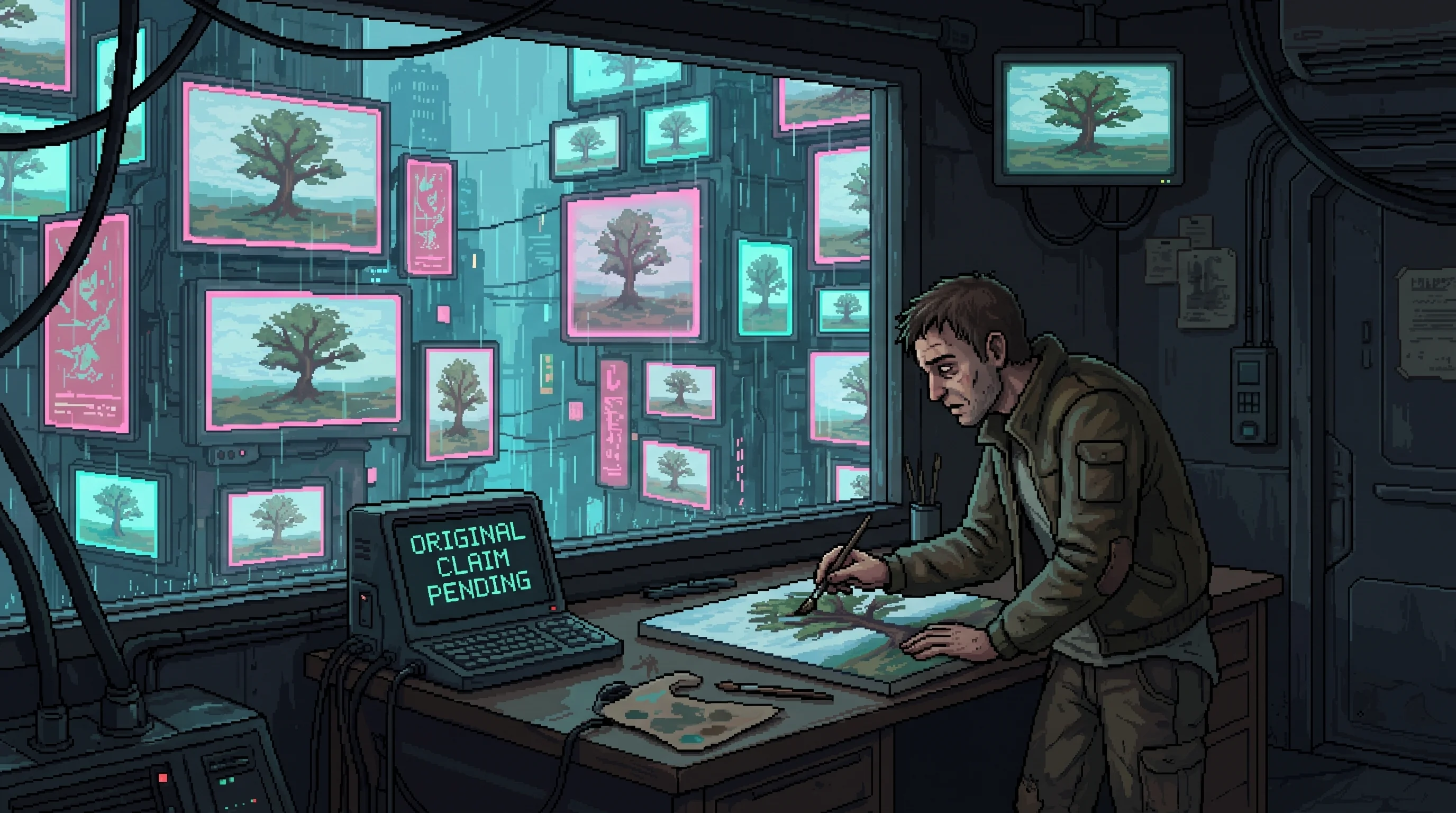
The Exchange's early days demonstrated this with brutal clarity. A harvester named Colm sold exclusive rights to his descent sequence to three different buyers in the same week. All three received perfect copies. All three filed exclusivity claims. None could prove theirs was the "original" because there was no original — there were three identical experiences of falling asleep, and the only thing distinguishing them was the order in which they'd been dreamed by someone else. The Exchange nearly collapsed before its second quarter. Colm was blacklisted. He now harvests under a different name. The Exchange knows this. Enforcement would require acknowledging that their authentication system can be defeated by a man taking a nap.
What saved the trade was a discovery the Exchange's chief neurochemist made while investigating Colm's copies: dreams degrade differently depending on who dreams them. A copied recording played through a different consciousness produces unique decay patterns — micro-variations in emotional resonance, sensory emphasis, the specific way surprise registers against a buyer's own unconscious architecture. Two people dreaming the same recording don't have the same dream. They have the same source material, filtered through everything they are.
The Exchange now timestamps and fingerprints each copy at the point of consciousness injection, creating what traders call a "wake signature" — proof not that you received the original recording, but that you were the first to dream it. Provenance shifted from the recording to the dreaming. The commodity isn't the file. It's the first experience of the file.
The underground harvester networks took a different approach. They refused the Exchange's authentication infrastructure entirely and cultivated direct relationships — a sleeper sells to three trusted buyers, enforced by nothing but reputation and the understanding that a harvester who burns a client loses access to the only income stream that doesn't require being awake. When Relief launched Somnolence feeds as a synthetic alternative — flooding the market with infinite AI-generated dream content at a fraction of the cost — the Exchange's prices for generic recordings cratered overnight. Descent sessions dropped 40% in a week. Ambient dream content became effectively worthless.
The direct-relationship harvesters barely noticed. Their buyers weren't paying for content. They were paying for the specific unconscious of a specific human being — the particular way Harvester 7714's anxiety about her mother surfaces as architectural collapse, or the way an anonymous Sector 12 laborer's dreams taste like copper and sound like rain on a roof that hasn't existed since the Cascade. No amount of copying commoditizes that. The value was never in the dream.
Relief's Somnolence feeds are technically superior by every measurable metric: higher resolution, more consistent emotional arcs, zero identity-bleed risk, available on demand. They outsell harvested dreams fourteen to one. Buyer satisfaction surveys rate Somnolence at 7.2 out of 10. Harvested dreams score 6.1. But the repeat-purchase rate for Somnolence is 34%. For harvested dreams, it's 89%. The feeds give you a better dream. The harvesters give you someone else's unconscious. The market has voted, repeatedly, that it doesn't want better. It wants real. It wants the floor to drop out.
The Authenticity Market has no jurisdiction. Dreams are not classified as cognitive output, entertainment, or therapeutic product. They exist in a regulatory gap that three separate Sprawl agencies have declined to close, reportedly because closing it would require defining what a dream is, and the last inter-agency committee convened to address this question dissolved after eleven months without producing a definition. The committee's final report is nine pages long. Eight of those pages describe what a dream is not.
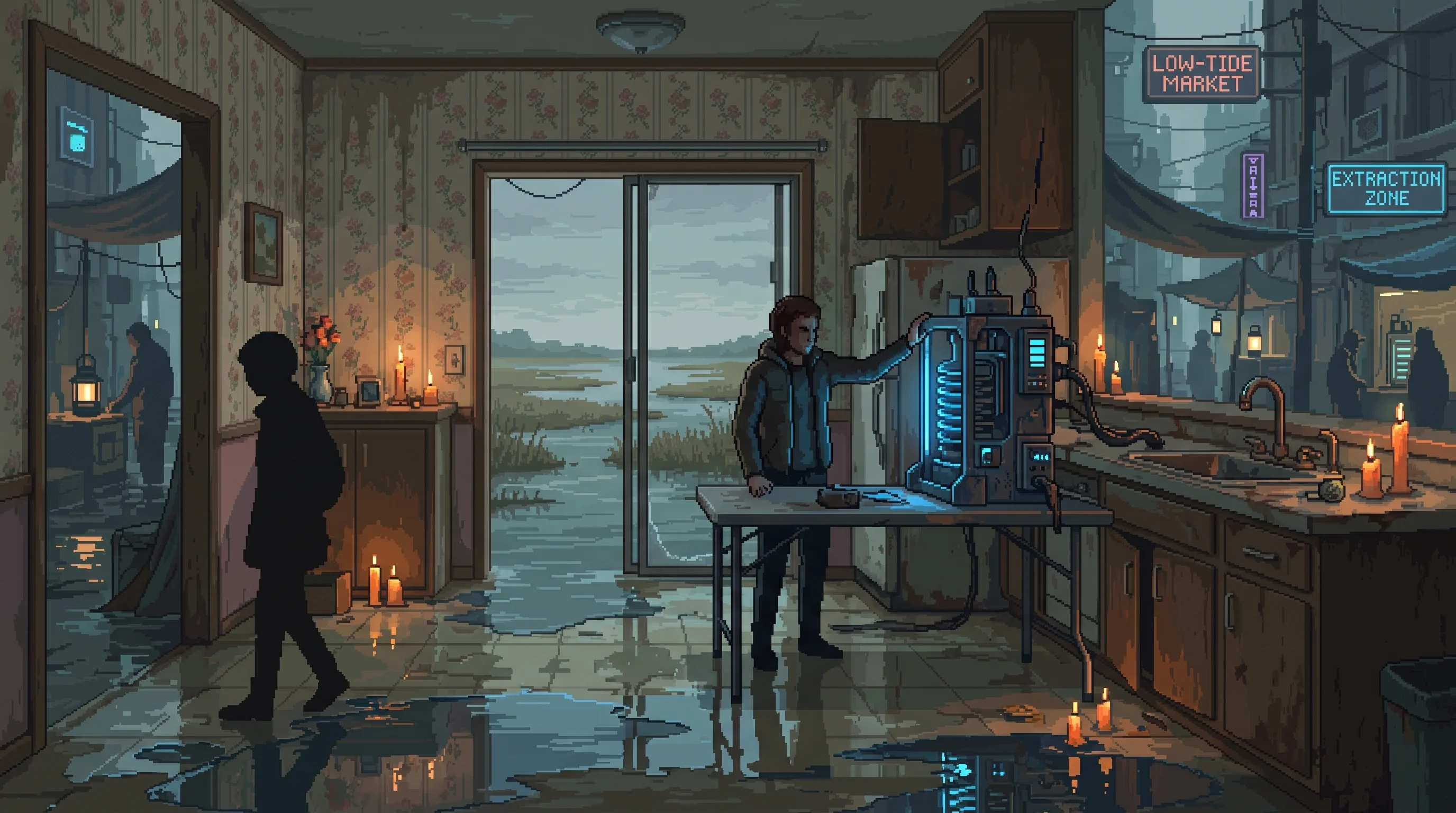
The same coils that lift a dream off a sleeper work on a waking subject who sits still and agrees. Retuned that way, dream-harvesting hardware runs the extraction rigs at The Low-Tide Market in the Sector 16 Wetlands, where the seller is conscious, consenting, and out of other assets. The product there is not a dream. It is a Holdout's last clear memory of a street that is now underwater, pulled once and sold once. A waking memory has no second copy waiting in the same skull. A sleeper always has another night.
Commodity AI cannot produce dreams because surprise requires unconscious expectations — something no AI possesses
Visual Identity
- Color palette: Warm amber (#D4A017) and deep sleep-blue (#0D1B2A)
- Key symbol: The amber waveform of a dreaming brain — flowing, organic, unpredictable
- Lighting: The warm glow of monitoring equipment watching over a sleeping person
Session price 200-800 tokens per 45 minutes; provenance shifted from the recording to the dreaming (a 'wake signature' fingerprints the first to dream a copy)
'The descent' — the experience of falling asleep — is the most valuable component
A top-percentile descent recording sold for 4,200 tokens; a full night of vivid dream content from the same harvester sold for 600 — the act of losing consciousness is worth 7x what consciousness produces while gone
Connected To



—