
Power Cells
Power cell chemistry has not been commercially produced since 2147 — every cell in circulation is a reconditioned pre-Cascade relic, so the Rail's energy supply is finite and shrinking
Overview
Power cells are reconditioned industrial batteries adapted for crawler use. They are the single most traded commodity on the Neon Rail by volume, the third most common cause of crawler loss after structural failure and crew abandonment, and the subject of zero consumer protection regulations in any jurisdiction the Rail passes through.
The cells themselves are pre-Cascade industrial units — originally manufactured for warehouse logistics equipment, construction machinery, and the BART system's emergency power reserves. The factories that made them no longer exist. The chemical compounds they require have not been commercially produced since 2147. Every power cell currently in circulation is, by definition, a relic: pulled from dead infrastructure by salvagers, stripped down by mechanical ripperdocs who replace degraded chemistry with whatever substitute compounds are available this month, and sold to crawler crews who need them badly enough to not ask what "reconditioned" means in practice.
Ironclad Industries holds salvage rights to approximately 60% of the pre-Cascade tunnel infrastructure where intact cells are most commonly found. Ironclad does not recondition cells. Ironclad does not sell cells. Ironclad sells access permits to the tunnels where cells can be found, at rates that have increased 340% since 2178. The ripperdocs who pull and recondition the cells operate on margins thin enough that quality control is, in the words of one Sector 7 reconditioning outfit, "aspirational." A reconditioned cell carries no warranty, no manufacturer rating, and no chemical composition disclosure. It carries a price tag and a handshake.
Without cells, a crawler is architecture. With cells, it moves. The gap between those two states costs between 200 and 1,400 credits per cell depending on remaining chemistry, load rating, and how desperate the buyer looks when they walk in.

Cell Economics
A crawler requires a minimum of two cells to operate — one provides motive power while the other buffers system draw from the nav array, cooling unit, headlights, and whatever else the builder wired into the platform. More cells means faster travel and a margin against individual failure. At minimum two, a single burnout drops the crawler to crawl speed or full stop. Most experienced Rail crews run four to six cells and consider this conservative.
Cells recharge at power taps — junction boxes along the Rail where surviving BART electrical infrastructure still carries current from grid connections that someone, somewhere, is maintaining. Who maintains the grid connections feeding power taps in Sectors 4 through 11 is a question that the Power Tap Network's operating consortium has answered with a subscription model: 15 credits per recharge cycle, billed automatically to whatever account the crawler's transponder is registered to. In Sectors 12 through 17, where the consortium's infrastructure doesn't reach, independent operators charge what the market will bear. Recharge rates of 80 to 200 credits per cell have been documented. The operators describe this as "fair pricing for remote service delivery." The crews describe it differently.
In dead zones — sections where no power taps exist because the grid was destroyed, disconnected, or never extended — cells drain without possibility of recharge. Dead zones range from two-kilometer gaps to the 140-kilometer stretch between Sector 14's last tap and the Wastes border, where three crews per quarter run out of charge and are recovered (or not) by whoever finds the crawler first. Managing cell reserves across dead zone crossings is arithmetic performed by people whose lives depend on getting it right, using charge estimates provided by ripperdocs whose testing equipment was itself reconditioned from salvage.
| Risk Level | Moderate (cell degradation, rupture, drain) |
|---|
Failure Modes
Cell degradation follows a curve that is predictable in aggregate and useless in the specific. A cell rated at 80% capacity by a Sector 7 ripperdoc might hold that rating for months. It might drop to 50% overnight. The testing equipment measures what the cell does under load for the twelve seconds of the test cycle. It does not measure what the cell will do under load for the four hundred hours of a Rail crossing. The distinction is significant. The price does not reflect it.
Sudden burnout — a cell that hits zero charge and refuses recharge — accounts for an estimated 14% of all crawler power failures on the Rail. Parasitic drain is subtler: external devices, feral machines, the Rail's own degraded electrical infrastructure drawing current from the crawler's power bus without the crew's knowledge. A crew that left a power tap with four fully charged cells and arrives at the next tap with three and a half has lost the equivalent of 60 to 90 credits in charge to something they cannot identify, cannot prevent, and cannot bill.
The worst failure mode is rupture. A damaged or overstressed cell overheats, vents its chemistry, and produces an electrical fire in the crawler's power bay. In the confined geometry of a tunnel, the toxic fumes from ruptured cell chemistry require immediate evacuation — which means abandoning the crawler and its cargo and walking the Rail on foot until the next tap or the next crew, whichever comes first. Cell rupture incidents are not tracked by any central authority. The Power Tap Network's operating consortium tracks "service interruptions," a category that includes ruptures, burnouts, crew illness, tunnel collapses, and "other." Ruptures are filed under "other." The consortium's Q3 2183 report lists fourteen "other" incidents across all monitored sectors. Ripperdoc forums in Sector 7 alone discuss nine ruptures in the same quarter.
Power cells are reconditioned industrial batteries adapted for crawler use
The Cascade
The dependency triangle is not a diagram. It is a sequence with a body count, and on the Rail everyone knows the order it goes in.
The cell shortfall comes first, and quiet. A crawler leaves a tap with four cells reading full and arrives at the next stretch with three and a half — the half lost to parasitic drain no one can name or bill. The buffer cell, the one feeding the nav array, the cooling unit, and the headlights, drops below the draw it was carrying. The nav array degrades first, because it is the lightest load and the first to be starved. The display does not die. It lies. It holds full confidence on a junction that collapsed in 2158, because the cell can no longer power the discrimination between a real signal and the electromagnetic echo of a dead one. The array reads the rail as though the rail is telling the truth, and the crawler takes the wrong branch on the strength of a reading the cell was too weak to compute.
Six hours into a dead-end spur, the motor is the only thing still drawing hard. Now the cooling unit is starved too. The fan pitch climbs — the runners hear it before any gauge shows it, the rising whine that means the system is working harder, and the distance between "working harder" and "not working" is shorter than anyone is comfortable with. The last cell, overstressed, asked to motor and cool and navigate on a charge meant for two of those things, does what cells do when you ask them for what they no longer have: it vents. Chemistry into a confined tunnel. Fire in the power bay. Toxic fumes, no rapid exit, and a crew on foot walking a dead branch toward the next tap or the next crew, whichever finds them first. Filed under "other."
That is the single-point-of-failure cascade as it is actually lived: cell shortfall → nav lies → wrong branch → overheat → rupture. One degraded cell, and the failure walks through every system that depended on it, in order, until it reaches the air the crew breathes. The crews who survive it learn to read the chain backward — a nav array that suddenly trusts a dead junction is not a nav fault, it is a cell fault wearing a nav fault's face, and the time to turn around is the moment the array gets too confident, not the moment the fan begins to scream.
A crawler requires a minimum of 2 cells to operate; more cells means faster travel
Renting the Supply
Sitting at the top of that cascade, collecting, is the Great Divergence.
Ironclad Industries does not recondition cells. Ironclad does not sell cells. Ironclad sells access permits to the pre-Cascade tunnels where the last intact cells can be salvaged — at rates that have climbed 340% since 2178. This is the Great Divergence in its rawest commercial form: own the chokepoint of the supply, touch the product never, take the margin always. The ripperdoc who pulls and reconditions a cell works on margins thin enough that quality control is, in his own word, "aspirational." The crew who buys it gets no warranty, no rating, no chemical disclosure — a price tag and a handshake. The half-cell that drains away to nothing between taps is, in effect, the half-cell Ironclad already monetized at the tunnel mouth.
The corporation rents the Rail's entire energy supply without ever touching a cell — collect at the chokepoint, let the consequence cascade downstream, file the rupture under "other." A crew dies of a cell shortfall in a starved tunnel. Ironclad never sold them a cell. Both facts are true at once, and the gap between them — the distance from the permit office to the body in the power bay — is the Great Divergence with chemistry in it.
Affiliated Entities
- Crawler Technology: Power cells are the energy source for crawlers — minimum 2 required for movement, 4-6 standard for serious Rail travel
- The Neon Rail: Cell management is the most critical resource calculation on any Rail journey — every route is planned around tap locations and dead zone distances
- Power Tap Network: Cells recharge at power taps — without taps, drain is irreversible; the consortium's subscription model means cell recharge costs are baked into every kilometer of travel
- Ironclad Industries: Controls salvage access to 60% of pre-Cascade tunnel infrastructure where intact cells are found — profits from the supply chain without touching the product
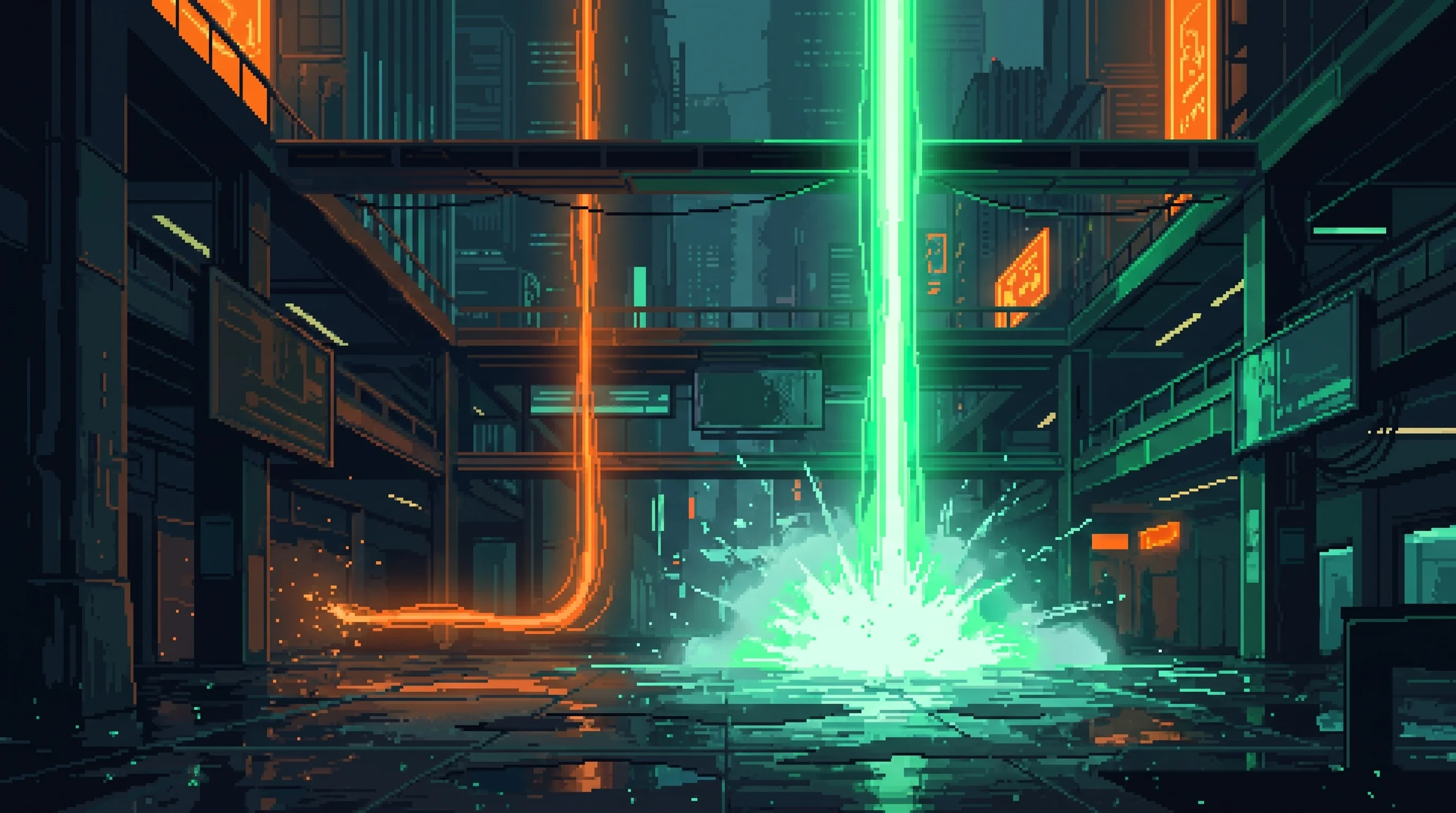
Cells recharge at power taps along the rail — in dead zones, drain is irreversible
Visual Identity
- Color Palette: Cell-glow blue (#00BFFF), warning amber (#FFB300), burnout black (#1A1A1A)
- Key Visual Symbol: A glowing cell mounted in a crawler's power bay, contact points sparking with residual charge, ripperdoc calibration marks scratched into the casing in grease pencil
Cell failure modes include gradual degradation, sudden burnout, and parasitic drain from external devices
Connected To




—