
Wholesome
Rothwell corporation controlling food — delivery, restaurants, grocery, synthetic nutrition; if you eat outside your own cooking, Wholesome probably touched it
Quick Facts
| Attribute | Value |
|---|---|
| Type | Megacorporation (Rothwell Family) |
| Domain | Food — delivery, restaurants, grocery, synthetic nutrition |
| Headquarters | The Greenhaus, Deep South Sprawl (Sector 20) |
| Slogan | "Goodness, Delivered." |
| Logo | Seven-pointed "freshness seal" in barn red and cream |
| Aesthetic | Rustic barn red, cream, farm imagery, handwritten fonts designed by algorithms |
| Market Position | If you eat something outside your own cooking, Wholesome probably touched it |
| Annual Complaints (food quality) | 3 per 10,000 transactions |
| Annual Reorder Rate | 94.7% |
Overview
Wholesome's packaging shows rolling fields. The fields do not exist. Wholesome's marketing mentions "real ingredients." The ingredients are real in the sense that they are made of molecules. Wholesome's slogan is "Goodness, Delivered," and they deliver it 1.4 billion times per day across the Sprawl in barn-red containers decorated with handwritten fonts that were designed by a typographic optimization algorithm in 2169 and have not been updated since, because the trust-response metrics peaked on the first iteration.
The corporation controls food throughout the Sprawl: delivery services, restaurant chains, grocery stores, synthetic nutrition, subscription meals, caloric dispensaries. There are fourteen distinct Wholesome brands. Consumer awareness surveys indicate that 61% of Wholesome customers do not realize more than three of these brands are owned by the same company. The rustic barn-red branding on Wholesome Kitchen looks nothing like the clinical white packaging on Wholesome Complete, which looks nothing like the premium earth-tones on Wholesome Organic. This is by design. Each brand occupies a different emotional register — nostalgia, efficiency, aspiration — and together they cover every caloric transaction a person can have between waking up and going to sleep.
The food is engineered for optimal salt-to-sugar-to-fat ratios. Wholesome's internal metric for this is the Satiation Delay Index: the minutes between finishing a meal and wanting another one. The company average across all product lines is 2.7 hours. The industry benchmark before Wholesome's dominance was 4.1 hours. Wholesome's Nutrition Science division has been refining the Index downward for eleven years. They have never missed a quarterly target.
The "farm fresh" imagery on the packaging has been analyzed by consumer psychologists at Rothwell Academy, who found that 78% of respondents associated the barn-red color with "trust" and "tradition," and that the association persisted even after respondents were informed that the nearest operational farm to any Wholesome production facility is 340 kilometers away. The researchers described this as "remarkable brand persistence." The packaging was not updated.
The Greenhaus
The Greenhaus sits on the Santa Clara Valley floor in Sector 20 — flat lowland, once called "The Valley of Heart's Delight" for its orchards and farms before technology paved them over. Wholesome literature calls the campus "the valley returned to agriculture" — a phrase issued without qualification across press releases, employee handbooks, and the kraft-paper plaque inside the visitor center. The valley that grew real fruit now grows controlled-environment calories inside a massive glass-and-steel complex surrounded by agri-domes and vertical farms, producing enough food to feed a million people, none of whom will ever see soil.
The further south you go from the Sprawl's core, the more Wholesome dominates. Their territory feels different: green, maintained, almost pleasant. Visitors to the Greenhaus campus report a strange dissonance — the air smells like actual growing things, the lighting approximates sunlight, and the temperature is 4 degrees warmer than surrounding sectors. Wholesome's environmental engineers maintain these conditions at considerable expense. Internal memos describe it as "brand-congruent atmospheric management." Employees who transfer from other Rothwell corporations report feeling "healthier" within weeks. Employees who transfer out report the opposite within days.
The executive floors have a test kitchen where the Rothwell brother who controls Wholesome is occasionally photographed tasting new product lines. His personal kitchen staff, employed separately and sourced through a private culinary service that has no Wholesome affiliation, prepare his actual meals. This has been documented in three separate leaked personnel files and denied in four separate press statements. The denials are technically accurate: the brother does taste Wholesome products during photo opportunities. He has never been observed finishing one.
Product Lines
Wholesome owns everything related to food and consumption. The following is a partial inventory.
Delivery Services
- Wholesome Delivery — Food from any Wholesome restaurant, delivered fast. The core revenue engine.
- Wholesome Express — Ultra-fast delivery for premium customers. Drones and dedicated runners. Average delivery time: 7 minutes. The speed has been decreasing by approximately 12 seconds per quarter for three years, driven by route optimization AI that Nexus Dynamics licenses to Wholesome at rates neither company discloses.
- Wholesome Grocery — Grocery delivery. Neural-interface ordering means the friction between wanting food and having food is a single thought and a 7-minute wait.
Restaurants
- Wholesome Kitchen — Fast-casual family dining. The flagship. Reclaimed barn-wood walls, family-style seating, warm lighting, open kitchens showing "fresh preparation" of pre-assembled components. There are 4,200 locations. Customer satisfaction surveys average 4.1 out of 5.0. The survey does not ask whether the customer is still hungry.
- Wholesome Quick — Fast food. Stripped-down menu, maximum speed, minimum pretense. The only Wholesome brand that doesn't use farm imagery. Uses a stopwatch instead.
- Wholesome Comfort — Comfort food specialization. Mac and cheese, meatloaf, pot roast. The menu descriptions include the phrase "just like home" fourteen times. Market research shows the phrase performs 23% better than "homemade" because "homemade" implies the customer could make it themselves, which introduces the possibility of not ordering.
- Wholesome Fresh — The "healthy" line. Salads, grain bowls, smoothies. Satiation Delay Index: 1.9 hours, the lowest in the portfolio. Repeat order rates are the highest of any Wholesome restaurant brand.
Grocery
- Wholesome Markets — Grocery stores with farm aesthetic. Actual farmers' market vendors in the Deep South Sprawl have noted that Wholesome Markets' visual design is indistinguishable from their own stalls, except for scale. Wholesome Markets has 1,100 locations. The farmers have 7.
- Wholesome Pantry — Shelf-stable home products. The branding uses the phrase "pantry staples" in a font that suggests handwriting. The products have a shelf life of 900 days.
- Wholesome Organic — Premium line. Higher margins. Identical production facilities. The "Organic" designation refers to a Wholesome-internal certification standard that has no regulatory equivalent. When this was raised in a Sprawl Commerce Committee hearing, Wholesome's legal team pointed out that no regulatory body has jurisdiction over the word "organic" in a post-Cascade food system where the concept of "organic" has no enforceable legal definition. The committee moved on.
Prepared Foods
- Wholesome Meals — Subscription meal kits. Ingredients arrive pre-measured with instructions. Customer participation in the cooking process averages 4 minutes of active preparation. The kits are marketed as "cooking."
- Wholesome Ready — Pre-made meals requiring only heating. For customers who found 4 minutes excessive.
- Wholesome Nutrition — Meal replacement drinks and bars. For customers who found heating excessive.
Synthetic Nutrition
- Wholesome Labs — Synthetic food production. Where "natural" stops scaling and chemistry begins.
- Wholesome Complete — Nutritionally complete meal substitutes. Clinical white packaging. No farm imagery. Marketed to professionals who have optimized eating out of their schedule entirely. Consumption is tracked via neural interface; the system auto-reorders when projected caloric deficit exceeds 400 calories. The customer does not need to feel hungry. The system knows before they do.
- Wholesome Energy — Performance nutrition. Engineered for consumption during other activities, meaning the product's design brief explicitly specifies that eating it should not require the consumer to stop doing something else. The packaging is one-handed.
The Sufficiency Tier
- Wholesome Basic — The dispensary tier. 2,100 calories per day, nutritionally complete, texturally monotonous. Available through automated dispensaries operating 22 hours daily in the Dregs and border districts. Ask a Dregs resident what they had for dinner and they say "Wholesome" — not the meal, the brand. When food has no variation, it has no memory. Nobody reminisces about Tuesday paste differently from Wednesday paste. The human experience of anticipating a meal — planning, preparing, sharing, remembering — has been engineered out of the caloric equation. What remains is fuel.
- Wholesome Basic Plus — Available when Good Fortune's Stability Index detects rising unrest in a district. Caloric variety increases by 3%: a new flavor, a different texture, something that makes the monotonous fractionally less monotonous. When the Index stabilizes, the variety contracts. The oscillation is managed with actuarial precision — never desperate enough to organize, never comfortable enough to demand more. Wholesome's logistics division calls this "responsive provisioning." The Dregs residents who experience it call it "the good week," without knowing why some weeks are better.
Treats
- Wholesome Treats — Desserts, snacks, indulgences. Maximum Satiation Delay optimization. Average time between consumption and reorder: 47 minutes.
- Wholesome Cravings — Subscription snack boxes. Weekly delivery. The box arrives whether or not the customer has finished the previous one. Cancellation requires a 14-step process that Wholesome's UX team has described in internal documents as "retention-optimized offboarding."
- Wholesome Moments — Premium treats for "special occasions." Marketed with the tagline "Every Day Is Special." Revenue data confirms customers agree: the average Wholesome Moments subscriber purchases 6.1 boxes per week.
Beverages
- Homestead — Heritage whiskey. The Garrison family distillery is a fully rendered VR property; founding patriarch Elijah Garrison is a generative composite whose oral histories are written quarterly by Wholesome's narrative team. The 1847 founding date refers to a real mining disaster Wholesome bought the licensing rights to in 2174. The whiskey itself tests identical to bulk industrial ethanol, which is what it is.
- Sundown — Nostalgia soda. The flavor profile dynamically retunes to your data-broker file — your specific childhood, licensed back to you at $3.49 a can. The "Remember the 2030s" line tastes different to every drinker. Wholesome holds patents on 14 distinct nostalgia-evoking compounds, none of which are disclosed under trade-secret law. The ad campaign features an AI-generated childhood you may or may not have had.
Heritage Is Content: The Nest
Wholesome's brand voice states the wholesome-slop thesis outright: the farm is real because we render it that way; the recipes are real because we license them from a family that loves us back; heritage is content. This is not cynicism. The brand believes its own warmth, and that sincerity is the weapon.
The Slop Cannon is usually read as a flood — the Content Flood's torrent that buries the signal. Wholesome operates the Cannon's other firing mode, the one that does not flood but nests: synthetic content that does not bury the signal but becomes it, arriving once, warm and complete, into a gap the customer welcomes in. Wholesome Meals renders the family cooking together (four minutes, marketed as "cooking"). Wholesome Ready renders the grandmother who left dinner in the crock (ninety seconds). Wholesome Pantry renders the grandmother who labeled every jar (algorithmic cursive, 900-day "preserves"). Wholesome Treats renders the pie on the windowsill (Satiation-Delay optimized). And the Harvest Table renders the community itself — the one thing the Flood made scarce — into a building two thousand people walk into three times a day.
Each is sincere about the food and synthetic about the warmth around it. Each keeps its promise so perfectly it cannot be filtered. And each removes a little more of the customer's capacity to produce that warmth themselves — the four-minute kit, then the ninety-second crock, then the lid; the three Harvest Table residents who could not bake the bread alone because the missing ingredient was two thousand people. Wholesome did not invent the loneliness the nest fills. It discovered it, studied it, and renders the cure quarterly. Goodness, delivered.
Core Values
Displayed on packaging, restaurant walls, employee badges, and delivery drone chassis:
- Nourishment — Providing sustenance that feeds body and soul
- Family — Bringing people together around shared meals and traditions
- Purity — Committed to ingredients you can trust and understand
- Care — Preparing every meal as if for our own loved ones
From internal communications attributed to the Rothwell family: "At Wholesome, we believe food is love made visible."
Employee surveys consistently rank "alignment with company values" as the #1 reason for job satisfaction. Exit interviews consistently cite "moral discomfort" as the #3 reason for departure, behind "compensation" and "relocation." The discomfort is never specified. The surveys do not ask.
Divisions
Restaurant Operations
Manages the six restaurant brands. 11,400 locations across the Sprawl. 340,000 employees. Standardized processes ensure that a Wholesome Kitchen in Sector 3 produces food indistinguishable from a Wholesome Kitchen in Sector 22. This is described in marketing as "consistency." In operations, the term used is "variance elimination."
Delivery Logistics
The revenue core. Getting food from production to consumer faster than the consumer can reconsider. Drones, runners, automated vehicles, neural-interface ordering. Wholesome Delivery processes 1.4 billion transactions daily. The logistics network is partially built on Ironclad Industries infrastructure — hauling contracts, warehouse construction, distribution hub engineering — which Wholesome has leveraged since the post-Cascade rebuilding years.
Grocery Retail
Physical stores. Declining in transaction volume but maintained for what internal strategy documents call "trust surface area." A customer who walks through a Wholesome Market and sees the wood-beam ceilings and the farm-equipment décor is 34% more likely to increase their Wholesome Delivery order frequency in the following month. The stores are not retail. They are advertising.
Food Production
The division with no public-facing name. Industrial food manufacturing across classified facilities in the Deep South Sprawl and secondary sites in Sectors 19 and 22. Synthetic protein, engineered flavor compounds, the actual source of "farm fresh" products. Tours are not available. Media requests are declined with a form letter thanking the journalist for their interest in Wholesome's commitment to transparency.
Nutrition Science
Formulation, testing, and optimization. The Satiation Delay Index. The Craving Recurrence Profile. The Sensory Reward Curve. Each metric has been refined across eleven years of continuous testing. The division employs 2,400 food scientists, behavioral psychologists, and neural-interface specialists. Their work has reduced the average time between a Wholesome customer's meals by 1.4 hours since 2173. Revenue has increased proportionally. The division considers this correlation a validation of their research direction. No internal document has used the word "addiction." The preferred term is "engagement persistence."
Subscription Services
The fastest-growing division. Recurring revenue from meal subscriptions, snack boxes, pantry restocking, caloric auto-replenishment. A subscriber who signs up for Wholesome Complete, Wholesome Cravings, and Wholesome Meals simultaneously — 12% of subscribers hold all three — spends an average of 4,700 credits per month on food they did not consciously order. The neural-interface auto-reorder system ensures their kitchen is never empty. The subscriber never decides to eat. The food is simply there, and they eat it, because it is there, and the cycle continues at a rate determined by algorithms the subscriber has agreed to but not read.
Outreach
The division that operates at a loss on purpose. Free-ration distribution stations on ungoverned ground — the Wastes, the Dregs, the drained bay floor — reported internally not under revenue but under "community stability." The Grace Rolls, on the Southern Bay Floor of Sector 14, is the model site: a warm serving line under barn-red awnings where the meal is genuinely free and the enrollment scan that precedes it is genuinely a service registration, and the two are the same gesture. The recipients are the stateless — corporate refugees the Compact has released, who no longer hold an identity any corporate system can read. The intake record is the first thing to read them again, and it is Wholesome's, seeded before any employment contract exists to attach it to. The division's servers experience this as feeding hungry people, which it is. The division's quarterly reports experience it as a population mapped and an organizing rate lowered, which it also is. No document reconciles the two experiences, because no single person holds both.
The Southern Marshes site never closed the same gap. Outreach runs a barge-served ration line into the Platform Settlements from the south, and the enrollment scan works on every household it reaches — except the Steeplejacks, the barter guild that keeps Sector 22's Cathedral hangar standing, who decline the scan as a condition of accepting the meal at all. Internal reporting lists the guild as "unconverted service area, 210 est." — the only population in Wholesome's Sector 22 territory the division has never successfully closed a dependency map around, because a rigger who takes a free meal today and a scan tomorrow is a rigger whose barter rate a corporation can undercut the day after.
The Cascade and Consolidation
The Cascade disrupted food supply chains catastrophically. Of the 2.1 billion who died, the majority died from infrastructure collapse — and food infrastructure collapsed faster than power or water. When distribution networks fragment, the gap between "fed" and "starving" is seventy-two hours.
Wholesome had distributed production and redundant logistics. They kept food moving when everything else stopped. Emergency government contracts gave Wholesome authority over feeding programs across the southern Sprawl. Competitors — smaller, less redundant, less capitalized — were absorbed during the recovery years or simply stopped existing when their supply chains did.
By the time normal commerce returned, Wholesome had become food infrastructure. The Treaty of Shared Infrastructure (2171) declared water, power, air processing, and medical systems neutral — but food was not included. The omission was not accidental. Wholesome's representatives were present during the treaty negotiations. Their position — that food production is a private commercial activity, not a shared utility — prevailed without significant opposition, largely because Wholesome was the only entity in the room currently feeding people.
Fighting Wholesome meant fighting the food supply. The Sprawl decided, collectively and without voting, that this was not a fight worth having. The decision was rational. The consequences were permanent.
The Underground Supply Chain
Wholesome feeds the surface through licensed distribution. They feed the underground through neglect.
Their surplus disposal protocol is structured so the chain of custody, by design, terminates at the hauler. Rations that fail quality checks — slightly off-spec nutrition profiles, cosmetic defects, short-dated inventory — are categorized as "disposal-grade product" and transported to regional waste processing facilities. These facilities, operated by Ironclad-contracted haulers, are located near Rim access points. The haulers are paid to dispose. They are not paid to verify disposal. This distinction is worth approximately 40,000 meals per day to the Dregs and bay floor settlements, where "disposal-grade" Wholesome rations are the dietary foundation for a quarter million people.
The rations cause problems. Wholesome's food engineering — designed to create craving-satisfaction-craving loops in consumers with functioning neural interfaces — interacts poorly with unaugmented digestive systems and the degraded neural baselines common underground. The result is Ration Sickness: nausea, cognitive fog, appetite dysfunction. Wholesome's medical division has studied this extensively and published nothing. The rations aren't poisonous. They're optimized for a different biology — surface biology, augmented biology, the biology of people whose neural interfaces modulate appetite and nutrient absorption. Feed that food to someone without the interface, and the optimization becomes a malfunction.
Wholesome knows this. The alternative — three hundred thousand hungry people at the Rim's edge, with nothing to lose and nowhere to go — costs more than the liability. The surplus isn't charity. It's containment.
The Chef's Feast network operates in the same geography and competes for the same stomachs. Her food is made from actual ingredients by actual humans who care whether you enjoyed it. Her supply chain is fragile, personal, and dependent on relationships that Wholesome's logistics AI could disrupt in an afternoon. It has not done so. Internal risk assessments classify the Feast network as "negligible market share, positive sentiment buffer" — meaning The Chef feeds people Wholesome can't reach, and the people she feeds are marginally less likely to riot. Wholesome has, by one interpretation, a competitor. By another, an unpaid subcontractor.
Visual Identity
Color Palette
- Primary: Barn Red (#7B2D26) — rustic, warm, traditional
- Secondary: Cream (#FFFDD0) — pure, natural, farmhouse
- Accent: Harvest Gold (#DA9100) — abundance, wheat, prosperity
- Fresh: Garden Green (#228B22) — freshness, vegetables, nature
Logo
The seven-pointed freshness seal in barn red, appearing on a cream background. It resembles the seals on jam jars or farm-certification stamps — a guarantee of quality that guarantees nothing, because the certification is self-issued. The seven points are officially "the seven marks of purity." They are also the seven-pointed star shared by all Rothwell corporations, a connection that 94% of consumers have never noticed, according to Wholesome's own brand-awareness surveys. The 6% who notice have not been surveyed about what they concluded.
Architecture
Wholesome facilities perform rusticity. Barn-style exteriors in urban environments. Exposed wood beams that are decorative, not structural. Farm equipment mounted on walls as décor — antique, never used, sourced from a single Ironclad-contracted reclamation dealer who has supplied 4,200 identical "unique vintage plows" to Wholesome Kitchen locations across the Sprawl. Open kitchens showing "fresh preparation" — the assembly of pre-portioned components from sealed containers into arrangements that resemble cooking.
Personnel
- Executives: Casual-professional with farm touches. Denim. Flannel patterns. Rolled sleeves calibrated to communicate "I'd rather be in the garden."
- Restaurant staff: Aprons. The aprons are clean because the food arrives pre-assembled, but the fabric is deliberately textured to suggest flour and effort.
- Delivery operators: Friendly uniforms in red and cream. Trained to make eye contact and say the customer's name. Internal training docs specify: "You are not delivering food. You are arriving at their home."
- Production workers: Never seen. The industrial facilities in Sector 20 employ approximately 47,000 people across three shifts. No production worker has appeared in any Wholesome marketing material. The form letter for media inquiries about production conditions thanks the journalist for their interest in Wholesome's commitment to transparency and includes a coupon for Wholesome Fresh.
Field Observations
Internal quarterly review, Nutrition Science Division, Q3 2183: "Satiation Delay across the Wholesome Fresh portfolio has decreased from 2.3 hours to 1.9 hours following the reformulation. Customer reorder frequency has increased 17%. We recommend extending the reformulation to the Wholesome Kitchen menu. Health & Wellness flagged the new profile for review; their concerns have been noted and filed."
Wholesome Delivery customer support transcript, anonymized: "I don't understand why I ordered again. I just ate. I'm not hungry. But the app showed me the—yes, I'll confirm the order."
The Chef, overheard at a Feast supply run in the Dregs: "They make food that makes you hungry. I make food that makes you full. We are not in the same business."
Affiliated Entities
- The Rothwell Brothers — Wholesome is one of Seven Rothwell corporations, representing Gluttony among the seven domains. The controlling brother understood what his siblings initially dismissed: you can live without social media, without loans, without security systems. You cannot live without food.
- Good Fortune — The Stability Index that triggers Wholesome Basic Plus adjustments is a Good Fortune product. The two corporations share data on Dregs populations — Good Fortune tracks economic desperation, Wholesome tracks caloric consumption, and the correlation between the two datasets is used by both companies for purposes neither has publicly described. A Dregs resident who falls behind on Good Fortune loan payments sees their Wholesome Basic options contract within the same billing cycle. This has been observed. It has not been explained.
- The Chef — The Feast network competes with Wholesome's distribution in the Wastes and Dregs. Wholesome's risk assessments classify the competition as negligible. The Chef classifies Wholesome's food as "technically edible." Both assessments are accurate.
- Ironclad Industries — Provides logistics infrastructure, warehouse construction, and the hauling contracts that make the underground surplus pipeline possible. Ironclad does not ask what happens to disposal-grade product after delivery. Wholesome does not tell them.
- Helix Biotech — Supplies certain synthetic compounds used in Wholesome's food production. The relationship is transactional and involves licensing agreements that neither party discusses. Helix controls what you are; Wholesome controls what you eat. The overlap is managed through legal departments.
- Nexus Dynamics — Licenses the route optimization AI that powers Wholesome Express delivery. The neural-interface auto-reorder system runs on Nexus computational infrastructure. Wholesome's food reaches consumers faster because Nexus's algorithms predict hunger before the consumer feels it.
- Future Endeavors — The Fremont Works offboarding wing where a released worker's Wholesome ration allocation is cut in the same transaction that kills their badge. Leaving the building is leaving the food roll, and the timing is not an accident.
- The Steeplejacks — The Southern Marshes outreach barge's one unconverted stop. The guild takes nothing from Wholesome, not because the food is refused but because the scan that comes with it is.
The Consumption Velocity Program
Restricted annex — open to read
Wholesome's Nutrition Science division maintains a classified research program called the Consumption Velocity Program, or CVP. The program's objective, stated in internal documents obtained through channels that Wholesome's legal team has not yet identified, is the reduction of the Satiation Delay Index to below 1.0 hours across all product lines by 2190.
A Satiation Delay of 1.0 hours means a customer who finishes a meal wants another meal within sixty minutes. At current consumption prices, this represents an increase in per-customer daily revenue of approximately 340%. The program's Phase 1 results — the Wholesome Fresh reformulation — achieved a Satiation Delay of 1.9 hours and were approved for broad deployment.
Phase 2, currently in laboratory testing, targets neural-interface integration: food compounds that interact directly with the appetite-regulation pathways modulated by standard consumer neural interfaces. The food would not merely taste good or be calorically unsatisfying — it would signal the neural interface to suppress the satiation response entirely. The consumer would never feel full. They would stop eating only when they consciously decided to, and Wholesome's UX team has been consulted on ensuring the ordering interface does not encourage conscious decision-making.
Helix Biotech's synthetic compounds division has been engaged for Phase 2 formulation. The licensing agreement is structured through four intermediary entities. The Sprawl Commerce Committee has not been notified, because the compounds in question are classified as food additives, not pharmaceuticals, under a regulatory distinction that Wholesome's legal team established in 2177 through a filing that received no public comment.
The Brother's Kitchen
Restricted annex — open to read
The Rothwell brother who controls Wholesome employs a personal kitchen staff of three. The head chef, a woman named Seo-yeon Park, was recruited from a private culinary institute in Sector 6 that has no Wholesome affiliation. Park sources ingredients from a network of seven independent suppliers — actual farms, actual soil, actual growing seasons — located in the Wastes beyond Wholesome's controlled-environment facilities. The monthly cost of the brother's personal food supply exceeds the annual food expenditure of 1,200 Wholesome Basic subscribers.
He appears at food festivals, cooking shows, and "family dinner" charity events. He looks like everyone's favorite uncle who always brings dessert. He tastes Wholesome products during photo opportunities and has been photographed smiling while holding a Wholesome Comfort meatloaf on eleven separate occasions. He has never been photographed finishing one.
His personal health monitoring — mandatory for all Rothwell family members via Helix Biotech's executive wellness program — shows zero Wholesome food compounds in his bloodstream. This data exists in a Helix medical file that no Wholesome employee has clearance to access. Park's employment contract contains a non-disclosure provision that references "dietary privacy" seventeen times.
Further connections
Browse all 45 connected records

Wholesome supplies success stories around a family meal.
Relief packages corporate success stories for people who recognize the spin and still want to believe the good part.

A Rothwell Foundation subsidiary, controlled by one of the Rothwell brothers — Gluttony among the seven corporations
The unregistered family behind seven megacorporations that manufacture desire and sell its cure.

Operates from The Greenhaus in the Deep South Sprawl, Sector 20
Rothwell's false-pastoral agri-campus whose crops edit appetite while yields climb past the R&D that was disbanded.
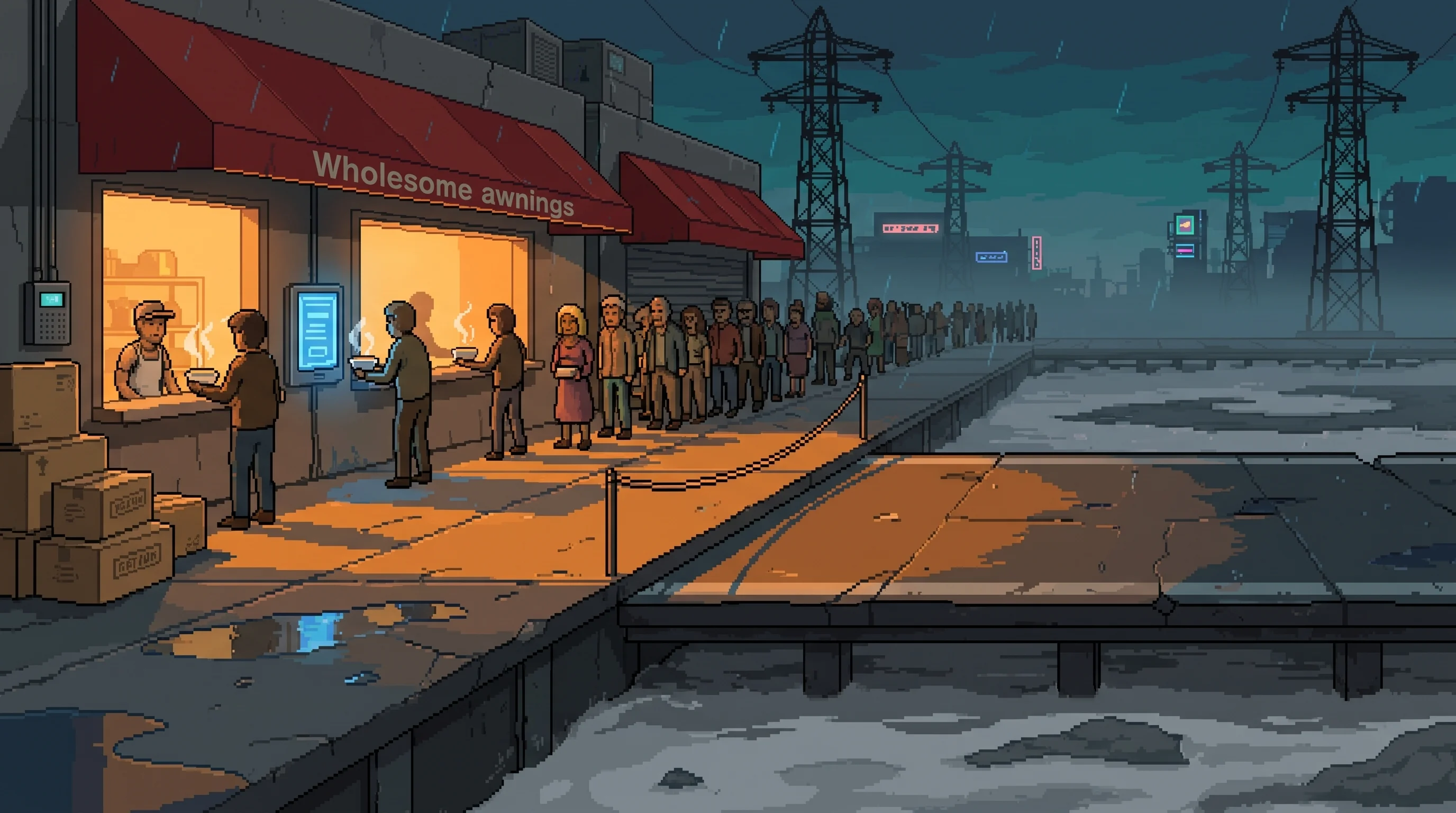
Wholesome's outreach division runs the Sector 14 ration station where the free meal and the enrollment scan are one gesture — charity at the point of service, population mapping in the aggregate, cultivating Compact-grade food dependency on the ungoverned bay floor before any employment contract exists

The Chef's Feast network competes with Wholesome's food distribution in the Wastes and Dregs
An unaugmented cook whose conquering army feeds Dregs blocks into loyalty without a single ticket changing hands.

The heat-and-serve crock — Wholesome's purest specimen of the nest, synthetic warmth that arrives complete in 90 seconds

247 SKUs of 900-day 'preserves' in algorithmic cursive — the nest with a shelf life, heritage rendered as a stocked pantry

Wholesome's flagship community dining hall — the nest made architecture, where the missing ingredient is two thousand people
Wholesome's 'free' dining hall, where a scanner logs every seat and a fraction-tuned recipe yields 94% compliance.

AI-generated heritage whiskey from a fully-rendered VR distillery; founding patriarch is a generative composite, the 1847 founding date is licensed from a real mining disaster

Nostalgia soda that retunes its flavor to your data-broker file; 14 patented nostalgia-evoking compounds; ad campaign features an AI-generated childhood you may not have had

Core Wholesome budget line engineered for low-cost dependency and broad household capture

Comfort-food product line selling algorithmic nostalgia through Wholesome's fake-family brand system

Synthetic nutrition line marketed as responsible self-care while tightening Wholesome's meal replacement control

Impulse snack line tuned around Wholesome's salt-sugar-fat craving models

Delivery platform that turns daily hunger into logistics data and reorder pressure

Stimulant nutrition line extending Wholesome control into work-shift endurance

Fast-service channel optimized for automatic meals and minimal consumer attention

Fresh-coded product line whose farm imagery launders industrial food through rustic branding

Retail grocery channel that makes independent food purchasing look like a legacy inconvenience

Prepared-meal kitchen brand selling simulated domestic care at corporate scale

Nutrition research arm that converts hunger, habit, and family memory into product science

Market-facing retail brand presenting Wholesome's supply control as neighborhood abundance

Subscription meal line that turns regular eating into a managed Wholesome dependency

Occasion-based food brand selling synthetic family rituals and seasonal comfort

Health-coded product line that reframes engineered dependency as nutritional discipline

Premium earth-tone brand using organic language to hide industrial synthesis

Convenience food line optimized for speed, repeat use, and minimal cooking competence

Dessert and reward line tuned around emotional reinforcement and repeat purchase

Co-sponsored household ambassador shared with Wellness — the manufactured-nostalgia farmhouse kitchen she stages her care against is Wholesome's brand world, and the 'made the way grandma made it' provenance she invokes is Wholesome heritage-warmth. She is the seam where the barn-red family table meets Wellness's rose-gold optimization, and a lieutenant of both.
An earnest wellness ambassador turns maternal care into sponsored cures and is paid for every audience reaction.

A Fremont Works worker's Wholesome ration line goes dark in the same transaction that kills their badge at the Future Endeavors turnstile, so being deported from the corporation is also being dropped from the food roll
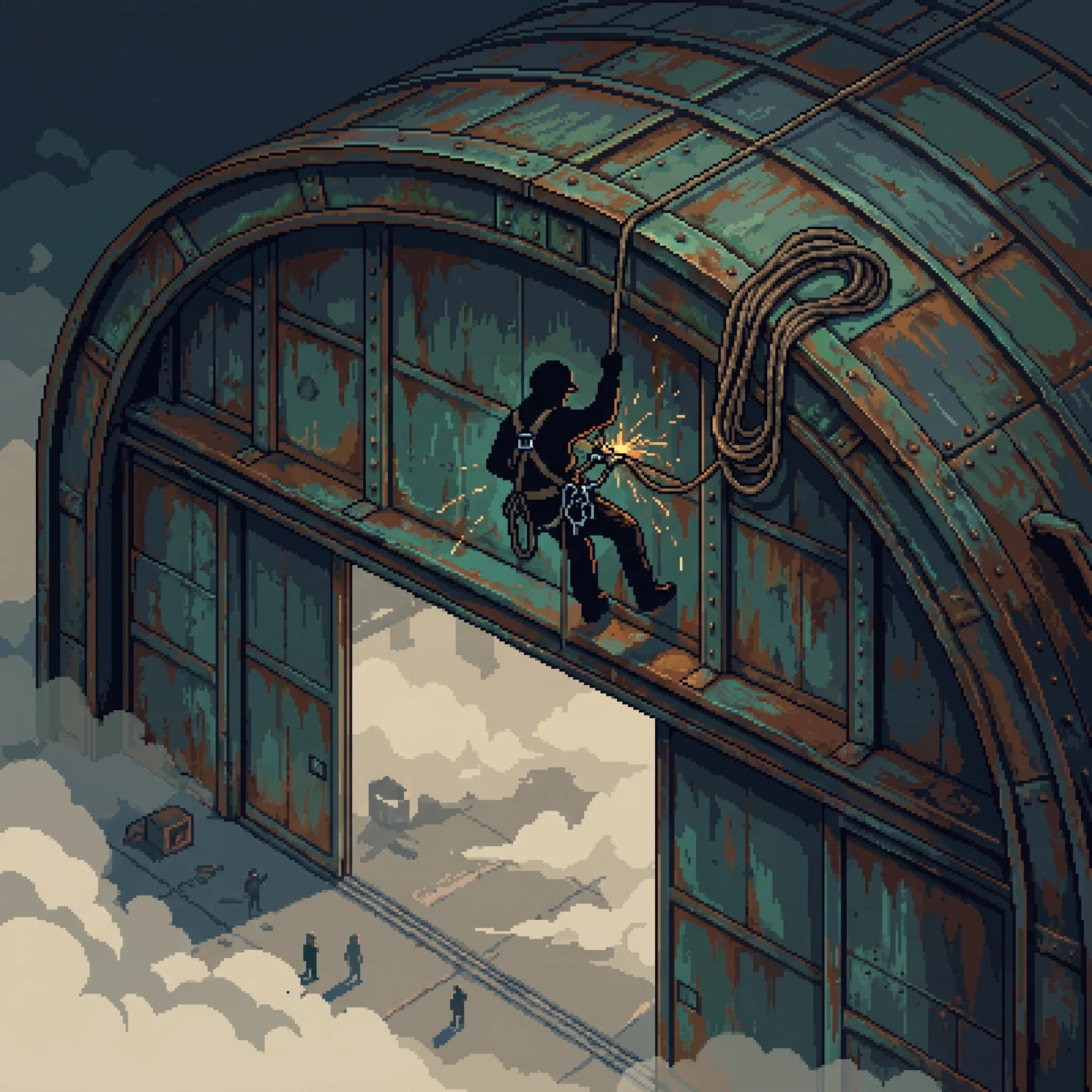
Internal reporting lists the Steeplejacks as 'unconverted service area, 210 est.' They decline the outreach barge's enrollment scan even at the cost of the free meal that comes with it, the only Sector 22 population to do so.
The unlicensed barter riggers who keep the Cathedral standing because salt kills every drone Ironclad sends.

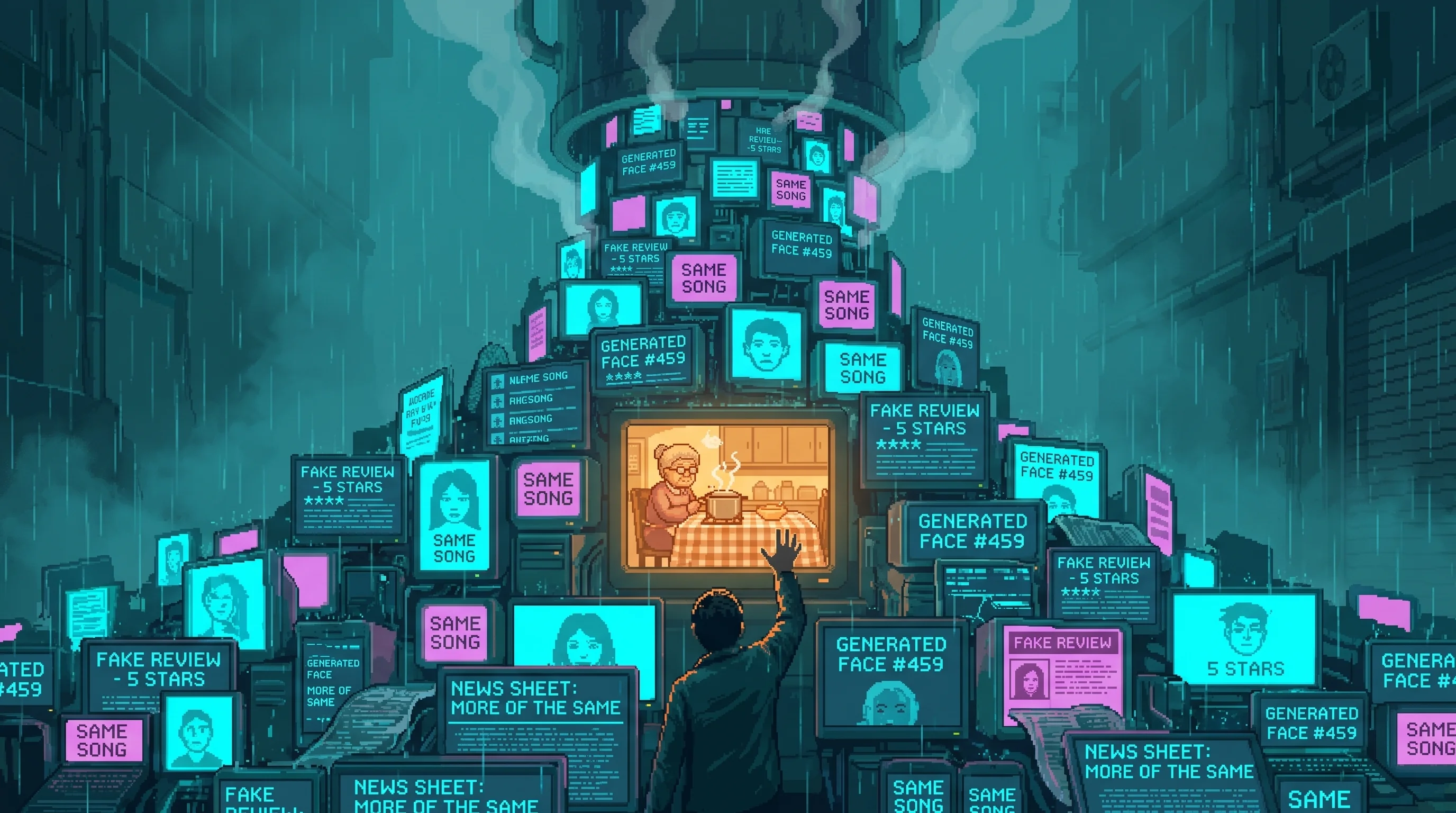


4407's residents have seen the Sprawl's food system described in databases — they are not interested
A sealed bunker of 800 who grow real food from a dead woman's handwritten manual and declined the Sprawl in nine words.

Lives in Wholesome's shadow, selling their surplus rations back to people Wholesome abandoned — Wholesome allows it because the math works

Wholesome manufactures consumer-grade stims marketed as 'wellness supplements'

Wholesome HQ looms nearby; their surplus rations supply the Graveyard's food economy, maintaining dependency

The scavenger gardener Ortiz's seep-zone greens undercut Wholesome's nearest Dregs distributor by 80% and are objectively better; an estimated 40 independent gardens now feed ~2,000 people outside Wholesome's SupplyChainIQ entirely
A drained bay basin where a quarter-million people the Sprawl calls 'uninhabitable terrain' live off its salvage.

Wholesome represents Gluttony — engineered four-hour craving cycles

Food, consumption (Fourth Brother)

Wholesome is The Seven's food company, owning the bloc's recurring market in hunger and consumption.
The public market bloc formed by seven Rothwell corporations whose shared family structure officially does not exist.

Lobbied food out of Article 1's protected classes — nutrition is a market, and markets are not infrastructure, per the market
The four-article document that ended the war in 2171 and has governed corporate conflict ever since.

Wholesome's Basic tier rations sustained her through the Tether Camp months
A Dregs mother whose cognitive loan to repair her son's brain now owns her sleep and her thoughts.

Wholesome's dispensary tier — 2,100 calories per day, nutritionally complete, texturally monotonous; the brand fed to Dregs and border districts via 22-hour automated dispensaries
Additional images


