
Thermal Refugees
Informal displaced population driven from interstitial zones by compute droughts, thermal spikes, and electromagnetic fog
Overview
When a compute drought gets bad enough — when atmospheric processing fails, when the temperature spikes past habitable, when electromagnetic fog makes neural interfaces seize — people leave.
They don't go far. That's the jurisdictional elegance.
Thermal refugees move within the interstitial zones — from one part of the Dregs to another, from the Thermal Shadow to the Undervolt, following the temperature gradient toward something survivable. They don't cross corporate borders, which means they don't appear in refugee statistics, which means they don't exist in any administrative system designed to help refugees. The Sprawl's displacement framework was built for people who flee between territories. People who flee within territories are experiencing, according to the relevant databases, "localized environmental variability." The distinction is worth approximately 4.2 million people annually. None of them have been counted.
The displacement is temporary. Most refugees return within days or weeks. But Thermal Shadow resident Luo Fang has been displaced seven times since 2180. Her neighbor, Kessler, eight. Kessler's most recent displacement — the one in November 2183 — was triggered when Nexus Dynamics redirected 340% of Sector 4's baseline atmospheric processing capacity to support a seventy-two-hour neural rendering sprint for Triumph Corporation's holiday ad campaign. Ambient temperature in Kessler's corridor hit 51°C. She packed a bag. She'd gotten faster at it. First displacement in 2180 took her forty minutes. November's took nine. She has a checklist taped inside the door now — laminated, because the heat warps paper.
Each displacement costs: lost wages (average 3.2 shifts per event), damaged equipment (thermal warping of anything electronic left behind), medical expenses (the Heat Ward treats burns and respiratory distress pro bono, but medication isn't free), and the specific psychological texture of knowing your home's habitability is downstream of a server farm's quarterly processing schedule. Kessler's apartment is 140 meters from a Nexus cooling exhaust vent. When the rendering sprint ended, the temperature dropped to 28°C in six hours. She went home. Her landlord had already re-let the unit. She was back in the Undervolt by evening.
| Legal Status | Not recognized — displacement occurs within corporate territories |
|---|---|
| Nwosu Attempt | Inclusion in Bandwidth Equity Act rejected on jurisdictional grounds |
| Nwosu Response | 'The Scarcity Doctrine expressed as procedural law' |
The Jurisdictional Problem
Councillor Adaeze Nwosu's attempt to include thermal displacement in the Bandwidth Equity Act was rejected by the Zephyria Council on jurisdictional grounds. The argument was procedurally airtight: thermal displacement occurs within corporate territories, Zephyria has no regulatory authority over corporate environmental conditions, and the Treaty of Shared Infrastructure covers water, power, air processing, and medical systems — not temperature. Temperature is not a protected utility. Temperature is a byproduct.
The vote was 11-2. The two dissenting councillors both represented Dregs-adjacent districts. The eleven in favor represented territories where server farms generate revenue rather than heat.
Nwosu called the rejection "the Scarcity Doctrine expressed as procedural law."
The corporations are not required to respond to this characterization. They have not.
What makes the jurisdictional framework precise is what it optimizes for: corporate operational flexibility. A Nexus rendering sprint that displaces 12,000 residents is, under current regulatory architecture, an internal resource allocation decision — the same category as rescheduling a maintenance window or adjusting a cooling cycle. The 12,000 people walking toward the Undervolt with laminated checklists are experiencing the downstream consequence of an internal resource allocation decision. They are not, legally, experiencing anything at all.
Displacement Routes
Thermal refugees move through the Works and the Deep Dregs along corridors no map marks and no corporate system tracks — from the Thermal Shadow toward the Undervolt, from failing atmospheric processors toward whatever junction room or G Nook shelter will take them until temperatures drop.
Viktor Kaine coordinates informal refugee protocols in the Deep Dregs. His authority over the displacement routes extends exactly as far as his pragmatic governance reaches, which is further than any official body's but shorter than the routes themselves. Kaine's system is simple: when ambient temperature in a Shadow corridor exceeds 42°C for more than ninety minutes, a signal propagates through the G Nook network. Junction room operators in the Undervolt begin clearing space. The Lamplighters' transformer rooms serve as emergency shelters — waste heat from aging power infrastructure is survivable warmth when atmospheric processing has quit overhead. This is not comfortable. It is 31°C instead of 51°C. The distinction is significant to everyone who has experienced both numbers.
The Blackout Economy's survival infrastructure activates along the same pathways. The logistics of crisis are indistinguishable from the logistics of daily life for a population that has formalized the routine of leaving home. G Nook terminals provide communication during displacement events — route updates, shelter availability, which junction rooms are already full. The Heat Ward provides medical care at displacement endpoints, treating burns and exposure symptoms that the corporate territories producing the heat do not recognize as their responsibility.
The displacement concentrates in the interstitial zones between sectors, the edges where corporate infrastructure provides the least and waste heat from server farms provides the most. A thermal map of the Dregs during a major displacement event shows a population moving, predictably, along the temperature gradient — bodies flowing from hot to less hot with the directionless efficiency of a fluid dynamics simulation. The simulation has been run. Nexus Dynamics' environmental monitoring division tracks displacement patterns in real time. The data improves their atmospheric processing models. It has not been shared with Councillor Nwosu. It has not been shared with Viktor Kaine. It has been shared with Triumph Corporation's logistics division, which uses it to avoid scheduling delivery routes through displacement corridors during peak events. The deliveries arrive on time. The refugees arrive when they arrive.
In Nexus Central, thermal displacement is an infrastructure report — a line item in quarterly environmental variance summaries, categorized under "transient population redistribution." In the Thermal Shadow, it is the eighth time Kessler has taped a new checklist inside a new door.
Not legally recognized — not included in Bandwidth Equity Act, rejected on jurisdictional grounds
Affiliated Entities
| Entity | Relationship |
|---|---|
| Viktor Kaine | Coordinates informal thermal refugee protocols through Deep Dregs governance networks. His signal system — G Nook propagation at 42°C sustained for 90+ minutes — is the closest thing to an early warning system the displaced population has. |
| The Thermal Shadow | Primary source of displacement. Shadow conditions — compute waste heat, electromagnetic fog, failing atmospheric processing — produce the temperature spikes that trigger evacuation. |
| Compute Droughts | Severe droughts trigger mass displacement events. The worst droughts coincide with peak corporate processing demand — the quarters where the most computation generates the most heat in the corridors least equipped to handle it. |
| Councillor Adaeze Nwosu | Attempted inclusion of thermal displacement in the Bandwidth Equity Act. Rejected 11-2 on jurisdictional grounds. Continues advocacy through Zephyria Council channels. |
| The Heat Ward | Provides medical care at displacement endpoints — burns, respiratory distress, neural interface complications from electromagnetic fog exposure. Operates pro bono during displacement events. |
| The Blackout Economy | Displacement activates the same survival infrastructure as blackouts. The overlap is near-total: same routes, same shelters, same G Nook communication channels, same population. |
| The Lamplighters | Junction rooms in the Undervolt serve as emergency shelters during displacement events. Transformer waste heat provides survivable temperatures when atmospheric processing fails. |
| G Nook | Terminals provide communication infrastructure during displacement — route updates, shelter capacity, corridor temperature readings. |
Visual Identity
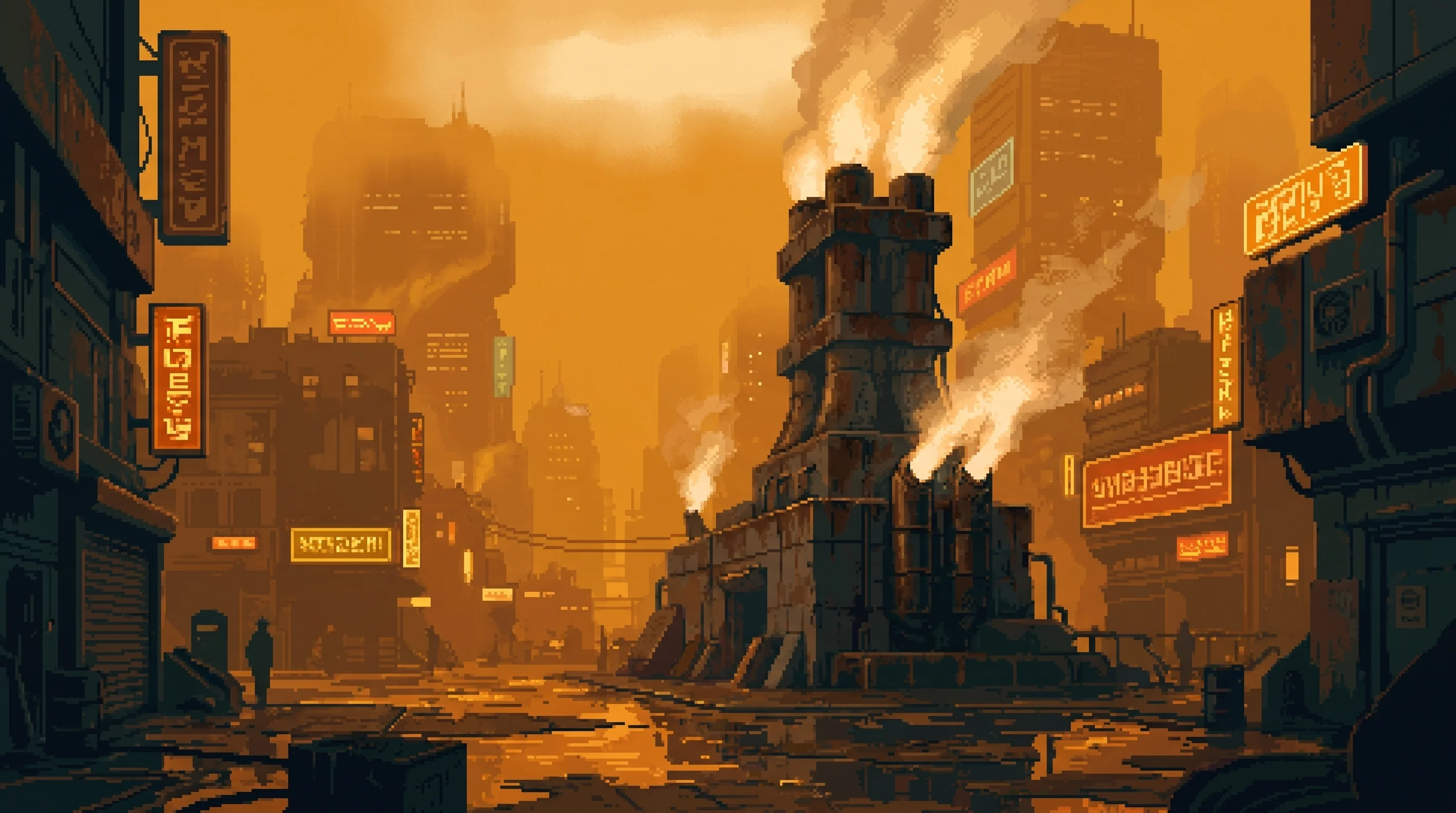
- Color palette: Heat-shimmer orange (#FF8C00) behind, the relative blue-gray (#7B8D9E) of the destination ahead
- Key symbol: A family walking away from a thermal plume, carrying what they can, the heat shimmer distorting the buildings they're leaving
Some residents displaced 7-8 times since 2180
'The Scarcity Doctrine expressed as procedural law' — Councillor Nwosu on the jurisdictional rejection
Connected To



—