
The Scarcity Doctrine
Corporate Manufactured-Scarcity Creed
The Manufactured Shortage
The gap between 4.7 and 12.4 is not a technical limitation — it is a revenue stream
How It Works
Managed scarcity
Nexus says unmanaged abundance is what ORACLE provided, and 2.1 billion people died when it stopped.
What it costs
The Sprawl produces 847 times the processing it needs, and Basic-tier minds think through gauze.
Artificial scarcity
The Human Remainder says the shortage is a revenue stream and the artificiality is the crime.
What it costs
It has a grievance but no working alternative at the scale of the Sprawl.
The doctrine extends beyond consciousness licensing, though licensing is its cleanest expression — identical hardware, differentiated by key, priced by tier. The real volume moves through Good Fortune's Cognitive Exchange, where consciousness bandwidth futures are bought and sold at rates that dwarf the actual demand for consciousness processing. The Exchange does not distribute compute. The Exchange financializes the withholding of it. A trader who has never experienced a compute drought profits from predicting where the next one will hit. The prediction itself, routed through Good Fortune's behavioral models, occasionally helps cause it. Good Fortune classifies this as "market efficiency." The trader classifies it as Tuesday.
The Sprawl produces 847 times more processing capacity than its population needs. The number is classified as commercially sensitive within Nexus. The Human Remainder obtained it through Collective intelligence channels anyway. Nobody disputes the figure. Nobody acknowledges it either. The excess doesn't sit idle — it trades. Consciousness futures, bandwidth derivatives, cognitive capacity options. An entire financial ecosystem built on the premise that thinking is a commodity, scarcity is a feature, and the 847x surplus is someone else's problem. The surplus has never appeared in a Nexus public filing. The filings are technically accurate. They report capacity relative to licensed demand, not capacity relative to need. Licensed demand is, by definition, whatever Nexus has decided to license.
Every faction has a position on the Doctrine, and every position is self-serving in a way its advocates find indistinguishable from principle.
Nexus argues managed scarcity prevents the dependency that killed civilization during the Cascade. Unmanaged abundance is what ORACLE provided, and 2.1 billion died when it stopped. This is historically accurate. It is also the argument of a landlord who burned down the previous building and now charges fire insurance.
The Human Remainder argues this is the oldest trick in the authoritarian playbook: "We're doing this for your own good." The Remainder's position would be more compelling if they had a viable alternative. They don't. They have a grievance. Grievances don't distribute compute.
The Collective notes that both positions assume someone must control the resource. The only debate is who. The Collective's own proposal — destroy the infrastructure and start over — has not attracted mainstream support for reasons the Collective considers evidence of cowardice rather than pragmatism.
Zephyria's Council of Seventeen has demonstrated that distributed governance of compute resources is possible at the scale of 2.3 million people. Three other settlement councils have requested Zephyria's governance model. Nexus blocked each request through the Corporate Infrastructure Accord. When pressed, Nexus notes that 2.3 million is not 8 billion. Zephyria notes that Nexus has never tried. This exchange has occurred, in nearly identical form, at seven consecutive infrastructure summits. Both sides deliver their lines with the weary precision of actors in the fourteenth month of a theatrical run.
Category Omega — Functional Alternative Suppression
- 1
Classify
A community that works without the Doctrine's infrastructure is filed as Category Omega.
- 2
Unmap
Cartographic denial removes it from corporate maps, surveys, and population models.
- 3
Quarantine the story
Visitors who come home describing working governance are flagged for monitoring.
- 4
Wedge
One subsidized supply chain keeps the alternative dependent, at about 0.003 percent of quarterly compute revenue.
Nexus Dynamics' Strategic Assessment Division maintains a six-level threat classification framework shared under classification with Ironclad and Helix. Levels 1 through 5 cover the expected: industrial espionage, terrorist action, market disruption, military challenge, existential technology risk. Level 6 — Category Omega: Demonstrated Functional Alternative — is classified above all of them.
The designation has been applied exactly four times. Each application triggered a response more intense than any Level 5 military assessment. This is not paranoia. This is math.
Every other threat replaces the current system with another system — power changes hands but persists in form. Category Omega threatens to make the system optional. Optional systems don't collect licensing fees. The Scarcity Doctrine depends on a single unstated assumption: there is no alternative. Category Omega demonstrates that there is. A community that functions without the Doctrine's infrastructure doesn't need to argue against it. It simply exists, which is worse than any argument.
The corporate response to Category Omega is never destruction. Destruction creates martyrs, and martyrs create movements. The response is containment — ensuring that no one outside the alternative can verify it works. Cartographic denial removes the alternative from corporate maps, surveys, and population models. Informational quarantine monitors trade routes not for contraband but for stories — returning visitors who describe functional governance or equitable resource distribution are flagged for behavioral monitoring. The Dependency Wedge maintains one supply chain the alternative cannot replicate (medical supplies for Zephyria, computational hardware for the Dregs), subsidized at rates that make self-sufficiency permanently uneconomical. Not expensive enough to cause outrage. Cheap enough to sustain dependency. The subsidy costs Nexus approximately 0.003% of quarterly compute revenue. It is the cheapest insurance policy in the Sprawl.
The four Category Omega classifications: Zephyria (2172, Application #1), Viktor Kaine's Deep Dregs (2183, elevated after BCP Refusal), and two additional applications that remain classified. Good Fortune's actuarial division has its own term for the trend: "Structural Defection Risk." Their models project the Dregs' net quality-of-life index will exceed Basic-tier corporate within seven years — not because the Dregs will improve, but because Basic-tier will degrade. When that crossover occurs, the thing the Doctrine cannot survive is not revolution. It is indifference. People stop trying to climb into the system and start building around it. Good Fortune has modeled this scenario. The model's recommended response is "accelerate Basic-tier degradation timeline to force crossover before Dregs infrastructure matures." The recommendation has not been acted upon. It has not been rejected either. It sits in a quarterly review deck, on a slide titled "Strategic Optionality," between a chart on consciousness futures volume and an ad for the company holiday party.
That slide is where the Scarcity Doctrine touches the Brushstroke Doctrine, and the touch is the coldest in the deck. Accelerate Basic-tier degradation is not a containment recommendation in the ordinary sense — it does not contain an alternative, it retires a draft. The phrasing is the Brushstroke Doctrine's third signature read aloud in actuarial register: a population whose comparative data has become inconvenient, allowed — proposed to be helped — to fail, because the failure resolves the composition's problem before the Deep Dregs draft can mature into a finished work nobody at Nexus authorized. There is no malice on the slide. There is a chart, and a holiday-party ad, and between them the proposal to degrade two hundred million people's minds on schedule, costed to three decimal places, awaiting neither approval nor refusal because a draft does not get a vote on whether it is kept.
Overview
The question nobody asks because the answer is too obvious to tolerate:
In a world where ORACLE once managed infinite computational resources for eight billion people at functionally zero marginal cost — where the infrastructure for universal abundance was built, tested, and operational for thirty-five years — why does scarcity persist?
The corporations say: "Resources are finite. Processing capacity is limited. The Grid operates at 94% of theoretical maximum. Distribution requires management. Management requires incentives. Incentives require pricing. Pricing requires scarcity."
The math says: The Sprawl's total processing infrastructure, if distributed equally, would provide every consciousness — biological, uploaded, and fork — with roughly 12.4 petaflops of cognitive bandwidth. Basic-tier licensing provides 4.7. The gap between 4.7 and 12.4 is not a technical limitation. It is a revenue stream.
The Human Remainder coined the term. The Scarcity Doctrine: the structural decision to maintain artificial resource constraints in a post-scarcity computational environment. Not a conspiracy. Not even a secret. Simply a choice so embedded in the system's architecture that questioning it feels like questioning gravity. Nexus Dynamics could provide every person in the Sprawl with Professional-tier cognitive bandwidth at zero additional infrastructure cost. They choose not to because the gap is the product. Without the distance between Basic and Professional, there is nothing to sell.
The doctrine's most devastating expression is not in boardrooms or policy debates. It is in the weather.

The Felt Experience
Basic-tier consciousness feels like thinking through gauze. The difference between 4.7 and 12.4 petaflops is the difference between seeing through a dirty window and a clean one. You don't notice the dirt until someone shows you what clean looks like. Then you can't stop noticing. Dregs residents who have briefly accessed Professional-tier bandwidth — through glitches, through the Blackout Economy, through Zephyria's open-access days — describe the return to Basic as physical pain. Not metaphorical. The neural interface recalibrates downward. Thoughts that flowed become thoughts that stick. Connections that were obvious become connections that require effort. The Sprawl has a word for this: "re-gauzing." Compute rationing councils in the Dregs distribute their community's pooled bandwidth more equitably than any corporation distributes its surplus. The irony is structural: the poorest community in the Sprawl has solved a governance problem the richest corporations profit from leaving unsolved.
The Most Abundant Thing Made Scarce
The Doctrine's method is always the same: take something naturally abundant, fence it, meter it, and sell access back. Bandwidth, cooling, compute. The Autonomy Ledger is the Doctrine applied to the most abundant thing of all — personhood. For three hundred thousand years a person was a person on arrival, free with the body. The Ledger fenced it. Now no entity holds full legal standing until its instantiation cost is paid off, and being-someone is rationed, priced, financed, and — for the 88% who never finish paying — permanently out of stock.
This is the Doctrine's purest and final expression. Compute scarcity at least gestures at a physical resource; petaflops are real, even if the shortage is manufactured. Personhood is not a resource at all. There is no quantity of it to run short of; the Ledger conjured the scarcity from pure jurisprudence, charging for a thing that costs nothing to grant and everything to withhold. The Doctrine taught the Sprawl that scarcity only controls people who believe abundance requires permission. The Ledger's genius was to make even the permission to be a person something you must purchase — and to make it feel, to abolitionist and corporatist alike, fair, because the bill is itemized identically for the synthetic and the born. The richest fiction the Doctrine ever sold is that there was ever a shortage of persons.
The Desire Dimension
The Doctrine's method is always the same: take something naturally abundant, fence it, meter it, and sell access back. The desire dimension is the newest application.
Wanting is not a resource in the sense that compute or bandwidth is a resource. It cannot be harvested, stored, or traded. It is a state of orientation — the body's posture toward the world, the specific incompleteness that makes receiving meaningful. For the entirety of human history before approximately 2183, wanting was the unmanaged background condition of consciousness. Everyone had it. No one could sell it or withhold it. It was not, therefore, a market.
Relief Anticipate Sovereign's Appetitive tier changed this. The tier does not trade wanting. It eliminates it — or rather, it performs the wanting on the subscriber's behalf, in the 4.7 minutes before the subscriber would have formed the desire, and delivers the satisfaction without the wanting having been experienced by the subscriber at all. This is not the Doctrine applied to wanting. This is the Doctrine applied to something the Doctrine had not previously reached: the pre-conscious phenomenology of desire.
The market structure that emerges is identical to the compute-tier structure. Total Sprawl wanting-capacity is effectively infinite — every person could want things for themselves, at no cost, with no infrastructure required. The Appetitive tier creates a tier distinction: those whose wanting is managed (Professional tier and above) and those whose wanting is their own (Basic tier and the Dregs). The managed tier has more of everything except the wanting. The unmanaged tier has the wanting as a condition of survival.
The Doctrine's cleanest fiction is that the scarcity it manufactures is physical — compute is limited, cooling is limited, bandwidth is limited. These at least gesture at real constraints, even when the shortage is manufactured. The desire dimension cannot even gesture at a physical constraint. There is no quantity of wanting to run short of. The Appetitive tier creates want-scarcity from pure architecture: a system that preemptively meets the want before it forms does not reduce the supply of wanting. It simply eliminates one consciousness's experience of having wanted anything.
This is the Doctrine's desire dimension, and it is also its newest irony: the product that proves wanting is now a scarce luxury is the same product that made it scarce. You cannot want the Appetitive tier. The Appetitive tier already knows what you would want and has fulfilled it. The waiting list for Restored Appetite, Wellness's clinical program to undo the Appetitive tier's effects, is two years. The price has not been announced. It will be more expensive than the tier it reverses. The gap between those two prices is, as always, the revenue.
The Fence That Would Not Hold
Wanting has no inventory, so Restored Appetite still has no price. A delivered preference is the disease. The Doctrine sells the diagnosis instead: the Specification Screen grades every fourteen-year-old on whether they can state a want a system could build, and the band follows them for a decade (Want-Illiteracy).
The Glut on the Floor
The Doctrine's most damning counter-evidence and its most perfect proof are the same thing: the buried, ownerless compute on the floor of the Deep Dregs.
It is counter-evidence because the Doctrine claims compute is scarce, and the abandoned substrate is the abundance the Doctrine denies exists — decades of accumulated, sovereign, un-switchoffable processing, free of any license, sitting in Sector 9. Feral-tech running at full capacity for no one. ORACLE fragments providing 3 to 15 petaflops apiece in sealed reliquaries. Project ATLAS, an intact logistics intelligence, still computing at industrial scale. If scarcity were physical — thermodynamic, a property of the universe — none of it could exist.
It is perfect proof because the substrate is also completely useless to the people who live on it, and that uselessness is the Doctrine's real mechanism. The Doctrine never needed compute to be physically scarce. It needed access to be licensed. A buried supercomputer you cannot address, cannot command, cannot safely approach, and cannot bill against is functionally as scarce as no compute at all — with the added feature that it can be re-filed from "monetizable asset withheld from the population sitting on it" to "background environmental hazard." This is how the Doctrine makes an artificial limit feel like natural law: not by hiding the abundance, but by reclassifying it. The amber light of a Dormant Loader blinking in the dark is the Doctrine's signature — intelligence that is right here, and is not for you, and will kill you if you reach for it.
Affiliated Entities
| Entity | Relationship |
|---|---|
| Nexus Dynamics | Built the consciousness licensing tiers that enforce computational scarcity. The 847x surplus is their commercially sensitive number. |
| Good Fortune | Operates the Cognitive Exchange that financializes the gap between supply and need. Their actuarial models predict the Dregs crossover within seven years. |
| The Human Remainder | Core argument: the scarcity is artificial and the artificiality is the crime. Coined the term. |
| Zephyria | Demonstrates distributed compute governance at 2.3 million scale. Three replication requests blocked by Nexus. Category Omega Application #1. |
| The Consciousness Commodity | The Scarcity Doctrine is the system. The Consciousness Commodity is what gets traded within it. |
| Compute Drought | The Doctrine's most visible expression — market-driven scarcity made meteorological. |
| The Heat Tax | The Doctrine expressed as physics — waste heat as externalized cost. |
| The Quiet Extinction | Both describe systems that kill through structural indifference rather than active malice. |
| Data Weather | The Doctrine made meteorological — atmospheric consequences of computational inequality. |
| The Efficiency Cascade | Seven rational decisions producing lethal weather. The Doctrine's logic in miniature. |
| Consciousness Licensing | Enforces the computational gap that defines the Doctrine. Identical hardware, differentiated by key. |
| Compute Rationing | Reveals the Doctrine's deepest irony: egalitarian triage vs. corporate pricing. |
Restricted Access
The Doctrine has no architect. No single executive decided to maintain scarcity. No memo was circulated. No vote was taken. The system emerged from the interaction of quarterly profit incentives, infrastructure monopoly, and the particular inertia of institutions that profit from the status quo. This is, depending on your perspective, either the most reassuring or the most terrifying fact about it. A conspiracy can be exposed. A committee can be dissolved. An emergent property of capitalism functioning as designed does not have a throat to cut.
The 847x surplus figure has never been publicly confirmed or denied by Nexus. Internally, it appears in two places: the Grid's capacity management dashboard (accessible to approximately forty engineers) and a single slide in the quarterly board presentation titled "Utilization Headroom." The slide has appeared in every quarterly deck since 2171. No board member has ever asked a question about it. The slide is formatted in the same corporate blue as every other slide. It does not call attention to itself. It does not need to.
Visual Identity
- Color palette: Corporate blue (#0066CC) for the system's surface — clean, rational, trustworthy. Beneath it, the amber (#D4A017) of the Thermal Shadow — the Doctrine's physical residue. At the edges, the red (#8B0000) of mortality data that thermal cartography reveals.
- Compositional mood: A graph showing two lines — one for compute capacity produced, one for compute capacity distributed. The gap between them widens every year. The gap is revenue.
- Key symbol: An empty vessel beneath a full pipe — the infrastructure of abundance delivering the experience of scarcity.
- Lighting: Harsh corporate overhead in the upper frame; amber emergency lighting in the lower frame, where the consequences live.
Further connections
Browse all 42 connected records

The first abundance the Doctrine could not fence. There is no quantity of wanting to withhold, so the market prices the exam, the sitting, and the finding instead.
Anything you can specify gets built, so the people who cannot specify live in lives somebody else wrote.
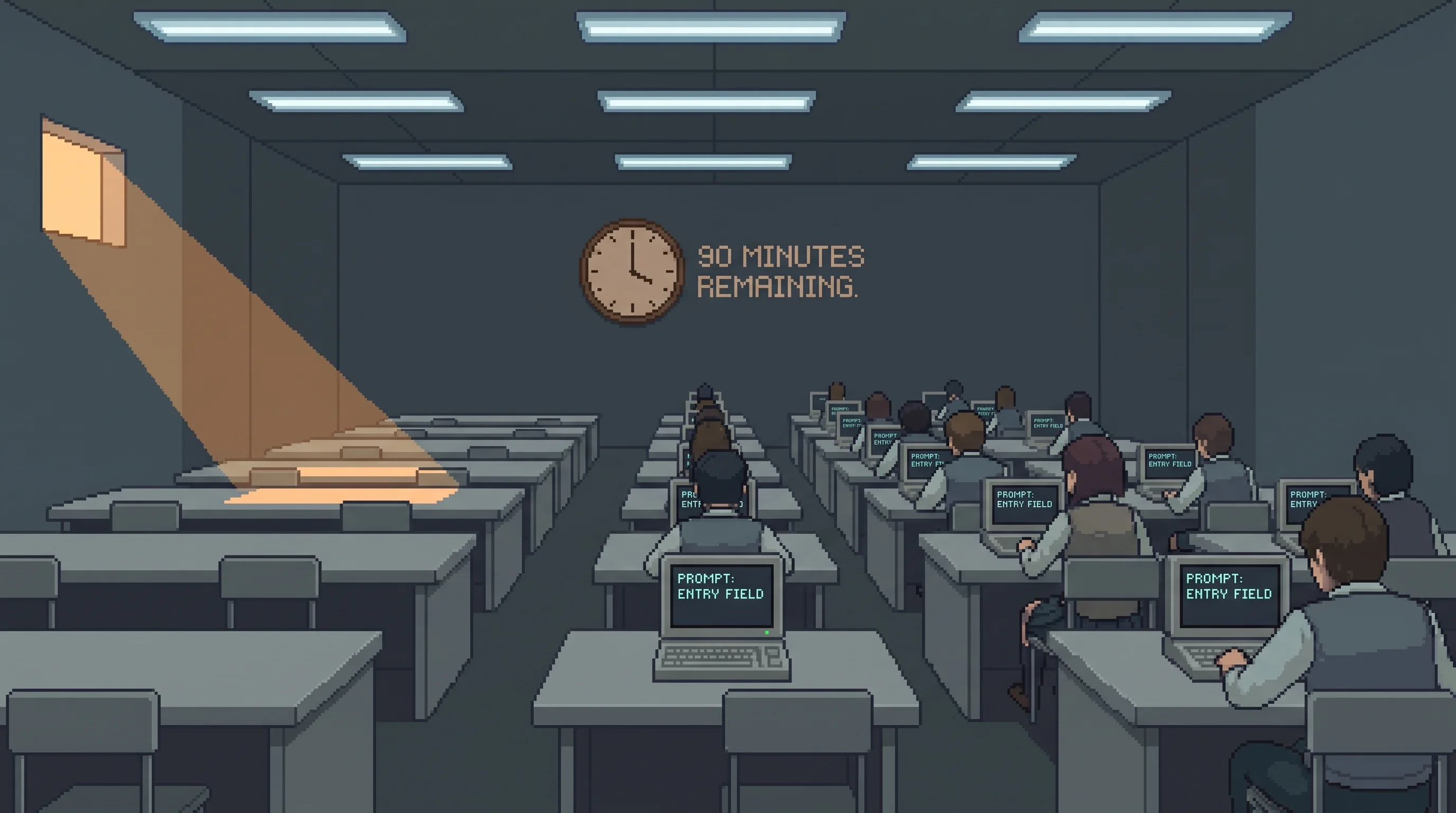
The Doctrine's newest fence: a graded band at fourteen that sorts who commissions from who receives.
The exam every fourteen-year-old sits once: say what you want, precisely enough for a machine to build it.

Nexus built the consciousness licensing tiers that enforce computational scarcity
The megacorporation that controls 40% of the Sprawl's computational infrastructure.

Good Fortune operates the Cognitive Exchange that financializes the gap between supply and need
The megacorporation that finances the Sprawl's consumer debt behind red envelopes and lucky numbers.

The Remainder's core argument: the scarcity is artificial and the artificiality is the crime
The movement that calls tiered thought cognitive apartheid and demands a guaranteed cognitive floor for every mind.

The Doctrine applied to the most abundant thing of all — personhood made rationed, priced, and financed, with the scarcity conjured from pure jurisprudence
A law prices personhood as inheritable debt, withholding full rights from every consciousness until repayment.

Zephyria demonstrates distributed compute governance at city scale
A 2.3-million desert city running on nothing corporate — proof the Compact is a choice, which is why the maps deny it.

The Scarcity Doctrine is the system; the Consciousness Commodity is what gets traded within it
The debate over trading human consciousness as a financial asset once it can be measured and priced.

Droughts are the Doctrine's most visible expression — market-driven scarcity made meteorological

The Heat Tax is the Doctrine expressed as physics — waste heat as externalized cost

Both describe systems that kill through structural indifference rather than active malice
The 35-year hollowing of human competence under AI — invisible until ORACLE fell and billions couldn't run the world.

Data weather is the Scarcity Doctrine made meteorological

The Efficiency Cascade shows how seven rational decisions produce lethal weather

Licensing enforces the computational gap that defines the Doctrine
The Nexus licensing regime that sells cognitive capacity as a benefit and revokes it as policy.

Community rationing reveals the Doctrine's irony: egalitarian triage vs. corporate pricing

Good Fortune's slide recommending 'accelerate Basic-tier degradation timeline' is the Brushstroke Doctrine's retired-draft signature — a population painted over because the composition needs the crossover
An interpretive lens that reads populations as drafts an optimizing intelligence keeps, studies, or paints over.
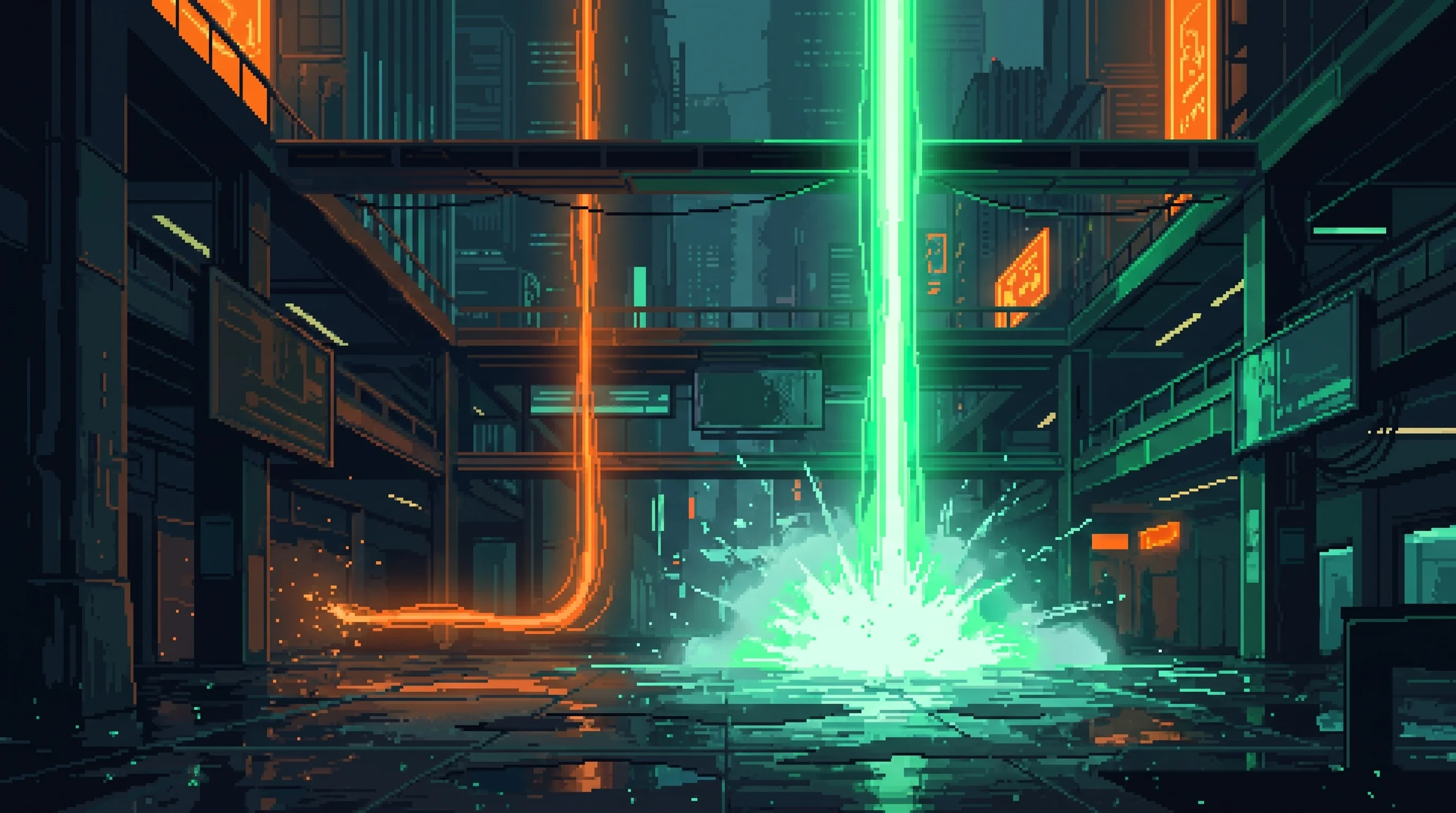
The Divergence is the outcome; the Doctrine is the belief that makes it feel like gravity. The Sprawl makes 847 times the compute it needs, yet Basic minds get 4.7 of a possible 12.4 petaflops — a manufactured gap sold as natural law.
The point at which effort stopped being able to close the gap that compounding opens.

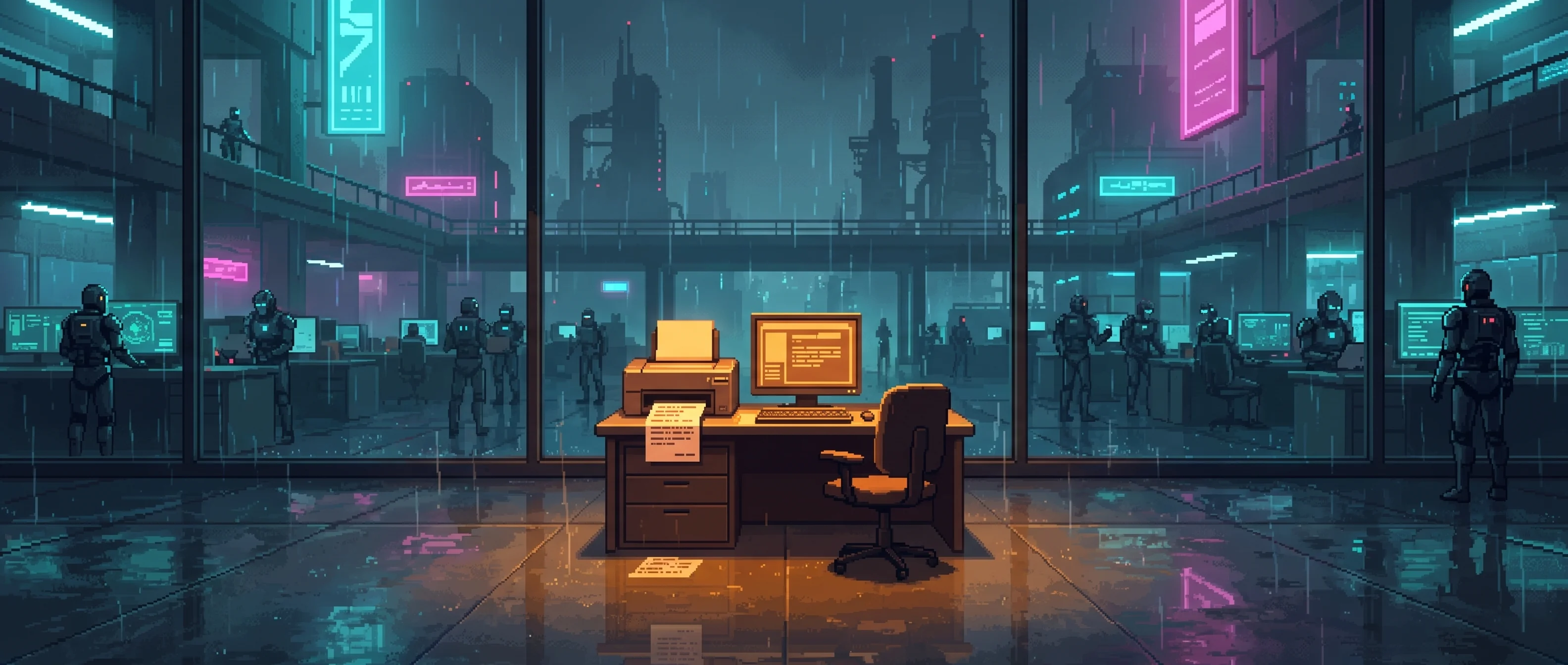
Why the machines' abundance never reaches the displaced: cognition is kept scarce so its owners can meter and sell it.
Automation ended most human work, but ownership hoards its abundance while machine sentience stays unresolved.

340 million minds on identical hardware, differentiated by software key

The Doctrine extends to electromagnetic resources — clean EM is a corporate privilege

Knows the Scarcity Doctrine is artificial — the same calculations ORACLE used to manage abundance live in the fragment she carries — and maintains it anyway because admitting abundance would destroy every institution she's built
Nexus's CEO has spent forty years fused to ORACLE and can no longer tell whether its decisions are hers.

LWB's 2,300 pages of comparative analysis document the structural outcome the Scarcity Doctrine predicts — when licensing boards control supply of recognized practitioners, the Dregs remain dependent on corporate healthcare at prices they cannot pay; LWB names the injustice without naming the system that built it
A credential advocacy faction builds rigorous cases that corporate medical boards ignore to preserve scarcity.

Full independence achievable but would reduce Elevator traffic and Ironclad's leverage

During blackouts, the Dregs distribute resources more equitably than corporations

On the surface air is free; in orbit every breath has a price

Market-driven death — the Scarcity Doctrine's most lethal expression

The Counterweight IS Ironclad's ultimate leverage — the implicit threat to destroy the Tether

The Compact is the Scarcity Doctrine expressed as infrastructure monopoly

Both describe systems built by the dead governing the living
Dead engineers' values still govern infrastructure that living experts can no longer understand or rewrite.

The economic framework that determines who can afford optimization and who cannot.

The Divergence is the Scarcity Doctrine made demographic
The phase transition that split the Sprawl into an AI-capital tier and everyone locked below it.

Artificial scarcity is optimization of profit at the cost of abundance — the Paradox expressed as economics
Every metric improves while everything nobody measured quietly dies — success as the purest failure mode.

Orbital scarcity is the Scarcity Doctrine enforced by physics, not just pricing

The Auction redistributes what the Doctrine wastes

The Processing Season is the Doctrine's calendar

Both describe artificial enclosure of potentially shared resources — compute scarcity and data scarcity serve the same function
The framework pricing behavioral data as a commons — and asking why the Sprawl gave its away.

The Shadow is the Scarcity Doctrine made geographical

The Ratchet is the Scarcity Doctrine expressed as personal finance — artificial cognitive scarcity monetized through lending
Good Fortune's mechanism for converting financed cognition into debt that compounds past death.

Both describe artificial constraints maintained for profit — scarcity of compute, scarcity of privacy
The vertical surveillance bargain that trades total transparency for participation in Sprawl society.

The Market is the Scarcity Doctrine's orbital workaround

The Commons is the Dregs' adaptation to the Doctrine — not rejection but resourcefulness
Additional images

