The Founding Principles
Three phrases guide Zephyrian life:
- "Nothing depends too heavily." Redundancy over efficiency. Every system has a backup. Every backup has a backup.
- "The desert remembers." History matters. What worked before can work again. What failed before will fail again.
- "Marina's last breath." A reminder that freedom has costs. The city's founder died for her principles. The city exists because she did.
Daily Life
Life in Zephyria is harder than life in the Sprawl. Fewer conveniences, more physical labor, higher mortality from conditions that corporate medicine renders trivial. But there's something else, something visitors notice immediately:
People here make eye contact. They know their neighbors' names. They argue about Council decisions because their votes actually matter. They die younger, but they die knowing who they were.
A Morning in Zephyria
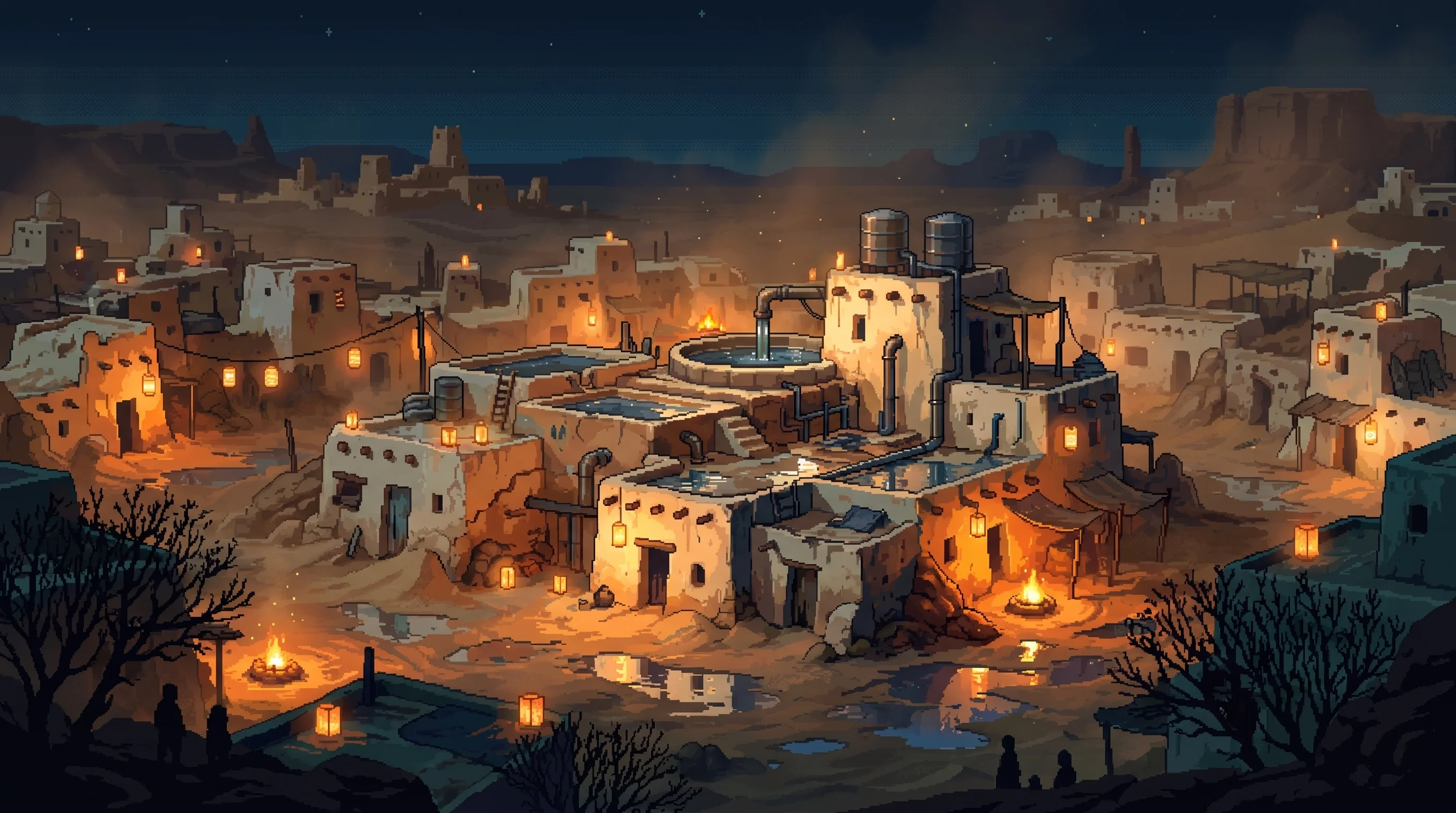
You wake when you wake. No corporate chronoalert, no productivity ping, no mandatory wellness check disguised as an alarm. The light comes through woven-reed shutters—not smart glass, not adjustable opacity, just reeds that a neighbor cut and a friend wove. The light is warm because the desert summer is already baking.
The first sound is water. Not piped, not metered, not monetized—hand-pumped from the district cistern two streets over. Someone is always there before dawn, filling clay jugs. You learn names by who's at the pump at what hour. Ezra, who gardens at first light. Suki, who runs the repair cooperative and never sleeps past four. Old Danko, who lost his arm in Scraptown and pumps one-handed with a rhythm like a heartbeat.
Breakfast is what you grew or what your neighbor grew. Flatbread from Greenward wheat, peppers from the rooftop garden three buildings east, eggs from the communal coop on Ninth Circle. Coffee is rare and expensive—a Waste trader luxury. Most people drink yerba pulled from Marina's Garden cultivars. It tastes like earth and something green and faintly bitter. You stop missing coffee after about six months. Most people stop.
Then you work. Not a job—there's no employer, no clock, no performance review. You contribute. You fix the thing that's broken, teach the skill you know, haul the water or tend the crops or sort the salvage. Some days you build. Some days you sit in the Archive and read paper books until your eyes ache from the unfamiliar act of focusing on something that doesn't glow. The Archive smells of dust and old binding glue and the faintest trace of smoke from the Cascade fires that the oldest books still carry in their pages.
The Silence Where Ads Should Be
The first thing Sprawl arrivals notice isn't what Zephyria has. It's what it doesn't.
No jingles. No product placement hovering at the edge of your neural feed. No "suggested purchases" based on your biometrics. No corporate announcements sliding into your peripheral vision like a hand reaching for your wallet. No mandatory Nexus wellness broadcasts. No Helix health alerts calibrated to sell you the cure for whatever they just made you afraid of. No Rothwell mood-nudges disguised as entertainment recommendations.
Silence.
Not actual silence—the city is loud with people, with hand tools, with arguments and laughter and the clang of the Scraptown yards carrying on the desert wind. But the silence where advertising should be. The gap in your attention that no corporation is trying to fill. New arrivals describe it like phantom limb syndrome: reaching for a notification that isn't there, waiting for a voice to tell them what they want. Some find it peaceful. Some find it terrifying. A few never adjust—they leave within the first month, walking back toward the Sprawl's border checkpoints, craving the comfortable noise of being told who to be.
What Freedom Costs
Yael Marin died on a Tuesday.
She was thirty-one. A cough that became an infection that became pneumonia. In any Sprawl district, a Helix clinic would have cleared it in an afternoon—standard antivirals, covered under corporate citizenship. In Zephyria, the Patchwork clinic in her district had run out of broad-spectrum antibiotics three weeks before. A resupply was coming through the Waste trade routes, but the caravan was delayed by raiders near Duchess Steel's border. Dr. Farid's emergency request to the Council for a Sprawl procurement run was still being debated when she stopped breathing.
Everyone in the Ring Districts knew someone like Yael. The woman whose child came too early and the incubator parts hadn't arrived. The man whose diabetes was manageable everywhere in the Sprawl but lethal in a city that can't manufacture insulin. The teenager who cut her hand on scrap metal and developed sepsis because the wound sealant was allocated to Scraptown, where injuries were more frequent.
The Council kept a register. Not officially—officially, the city didn't track preventable deaths. But Elena Valdez, the Old Core archivist, maintained a private list. She called it "The Cost of Principles." Last count: 4,847 names since 2165. People who would be alive if Zephyria accepted Helix's aid packages, accepted the strings attached, accepted the slow absorption that Helena Voss called "The Harvest."
Dr. Hassan Farid read from the list at every Council session. Not all of it—just the new names since the last meeting. The Council listened. The Council voted. The Council continued to refuse.
"We're a city that kills its own people slowly," Farid said in a 2183 address, "so that corporations can't kill them quickly."
Nobody had a good answer for that.
The Consumer's First Week
Kito arrived from Nexus Central on a supply truck, hidden between crates of salvaged circuit boards. He was twenty-four. He'd worked data entry for a Nexus subsidiary. He left because he'd found a Collective pamphlet and couldn't stop reading it.
His first morning, he tried to order breakfast. Stood at a food stall in Haven's Edge and waited for a menu to load on his neural display. Nothing loaded. He tapped the interface gesture three times before the woman behind the counter—Amara, who'd been in Zephyria since she was nine—reached across and physically placed a flatbread in his hand.
"You eat it," she said. "You don't order it."
His second day, he broke a sandal strap and spent two hours looking for a retail outlet. When someone pointed him to the repair co-op, he asked about warranty. The repairwoman—a Flatline Purist defector named Torrin who'd learned leatherwork because she believed every person should be able to fix what they used—stared at him for a long time. Then she fixed the sandal and said, "The warranty is that I live next door and you can yell at me if it breaks again."
His third day, the district cistern pump broke. Kito waited for maintenance to arrive. An hour passed. Two hours. He asked a neighbor when the service crew was coming. The neighbor handed him a wrench and said, "You're the service crew."
By the end of the week, Kito had learned to pump water, patch adobe, and argue with three different neighbors about whose turn it was to clean the composting latrine. He hadn't smiled that much since childhood. He also hadn't slept well—the silence where Nexus's sleep-optimization broadcast should have been kept waking him. His body expected the corporate lullaby. The desert offered only crickets and someone else's snoring through thin walls.
He stayed. Most of them stayed.
When the Unknown Entity Votes
The Council meets monthly in Marina's Garden, under paper lanterns strung between desert willows that Marina Orosco planted sixty years ago. Seventeen seats arranged in a circle—no head of table, no podium, no corporate power geometry. Elena Valdez calls order. Thomas Brightwater proposes. Rust Jin Tanaka objects. Dr. Farid reads names. Maya Strongbow reports border status. Old Chen dozes and then votes with uncanny accuracy on things he appeared to sleep through.
And Speak-to-Thunder sits.
They arrived in 2178 with credentials nobody can quite remember verifying. They don't speak during debate—six years of silence while the Council argues water rights, militia funding, refugee quotas, and whether to allow limited AI assistance during drought season. They never propose motions. They never ask questions. They sit in their seat—third from the east end, always the same seat—and when the vote comes, they raise their hand with whichever side has twelve votes. Always. Without fail. The tiebreaker that never breaks a tie.
What it feels like: imagine you're arguing with your neighbors about something that matters—really matters, life-and-death matters. And in the corner of the room sits someone you can't quite describe afterward. You know they were there. You know they voted. But when you try to picture their face, you get the impression of patience, and nothing else.
Some Council members have stopped noticing Speak-to-Thunder entirely. Miriam Ezeji says she sometimes forgets the seat is occupied until the vote count comes back seventeen instead of sixteen. Others—Thomas Brightwater especially—can't stop staring. He's convinced that Speak-to-Thunder is an ORACLE fragment that achieved something the others didn't: the ability to listen without wanting to optimize.
The Collective's cell in Haven's Edge has standing orders to investigate. Three operatives have tried. All three filed reports that said, essentially: "Nothing to report." One of them later told Jin she couldn't remember what she'd been investigating.
Speak-to-Thunder votes. The city endures. Nobody talks about it much.
The Ceremony of Arrival
New residents undergo a simple ritual: drink from the Original Well, state your name (any name—it doesn't have to be your old one), and make a promise. The promise is private. Most promise to contribute. Some promise to remember. A few promise revenge on whatever drove them to the Wastes.
Religion and Belief
Zephyria has no official religion, but the city's existence has spawned several:
- The Marinaites: Believe Marina Orosco achieved a form of transcendence through her sacrifice
- The Water Church: Worship the aquifer as a living entity that chose to sustain the city
- The Practical Faith: "Believe in what works. Pray to what helps."