Rust Point Radio
Overview
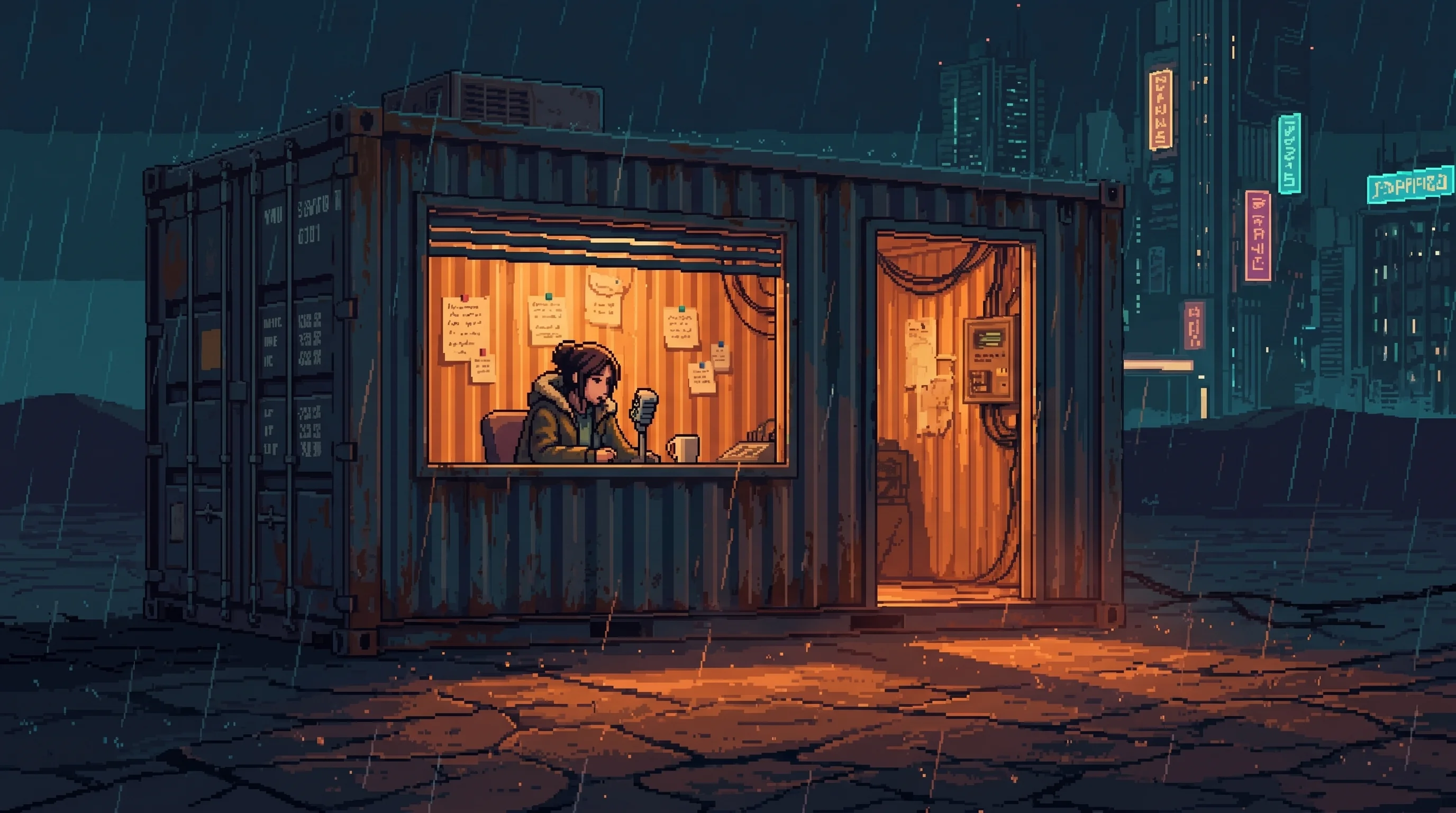
Rust Point Radio broadcasts from a shipping container 3km past the eastern border of The Deep Dregs, in the stretch of hardpan where the Sprawl's last atmospheric processors give way to open desert and Nexus surveillance coverage drops below functional thresholds. The nearest monitoring node is 4.7 km away. At that distance, signal triangulation requires equipment nobody has allocated to the task, because the task would require explaining to a budget committee why a single woman reading verified reports to 40,000 people constitutes a surveillance priority.
The woman is Needle. She broadcasts four hours per night, 2100 to 0100, from a salvaged console that predates the Cascade by at least two decades. The microphone is older than that. The ceramic cup next to the microphone is newer, purchased within the last three years, and has become — through no effort or intention on Needle's part — the most recognized sound in Dregs independent media. She sets it down when she's about to say something she's thought about. Listeners have learned the clink. The clink means pay attention.
The gesture has outgrown the broadcast. Setting down a ceramic cup before speaking has migrated off the airwaves and into everyday Dregs conversation as a shared signal for considered speech — a broadcasting tic that became a cultural grammar. People set their cups down before saying something that matters, and the people across from them know to listen. Needle has never acknowledged this. She may not know.
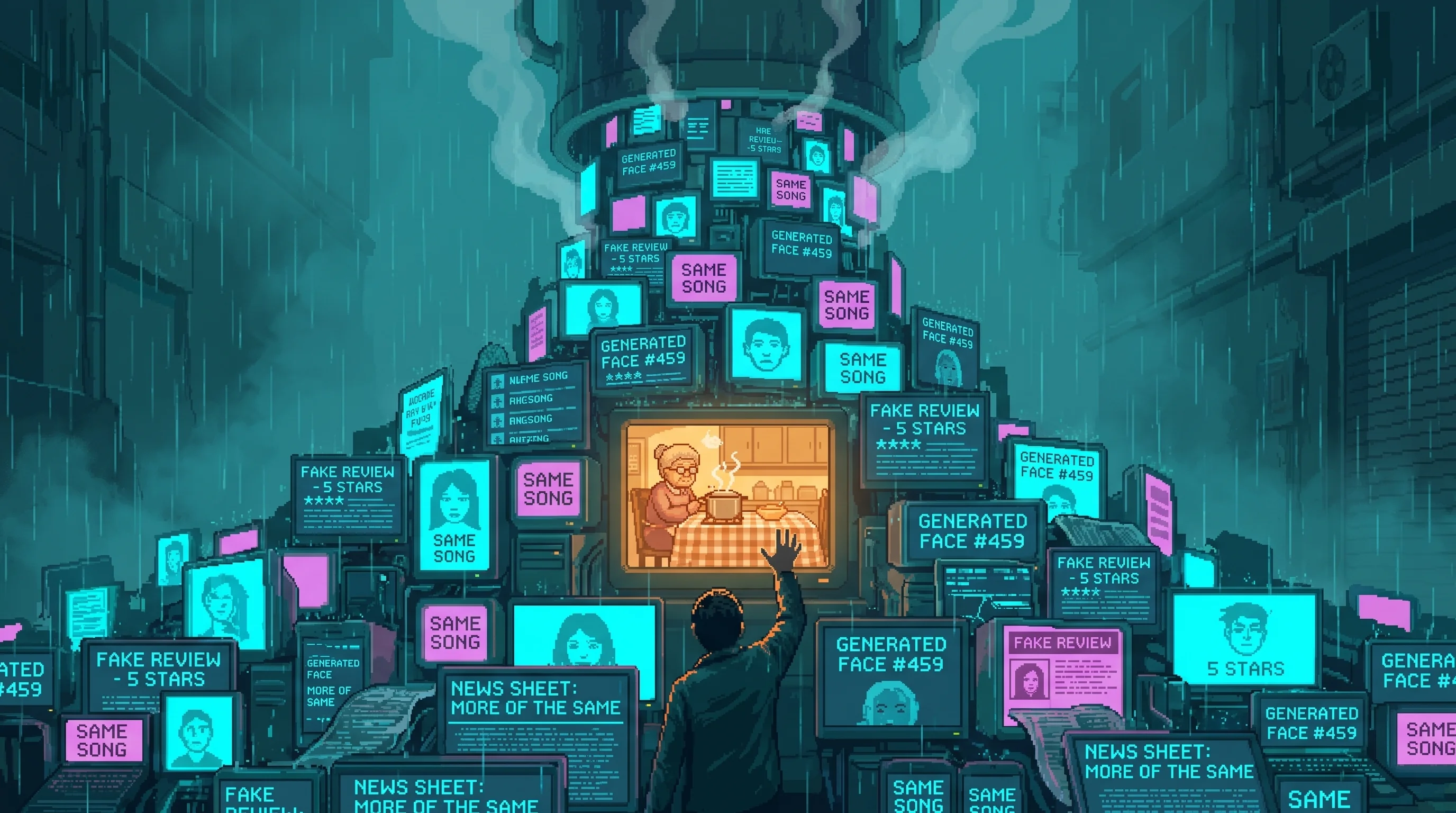
The Content Flood reaches 847 million people. Rust Point Radio reaches approximately 40,000, carried through a relay network maintained by Lamplighters who consider the upkeep community service and have declined, on four documented occasions, to explain their routing architecture to anyone. The 847 million absorb and respond. The 40,000 believe. These are different activities. The market has not found a way to make the second one scale, which is either the problem or the point depending on which number you think matters.

Conditions Report
The container retains the day's heat at broadcast start — 28°C at 2100, dropping to 14°C by sign-off at 0100. Needle wears layers. She adds them during the broadcast, on-air, and does not acknowledge it. Longtime listeners can estimate the time by the sound of a jacket being zipped between segments. The broadcast schedule was chosen, according to Needle, because "people listen at night." It was not chosen for thermal comfort. Thermal comfort was not a design consideration for any element of Rust Point Radio, including the chair, which is a crate.
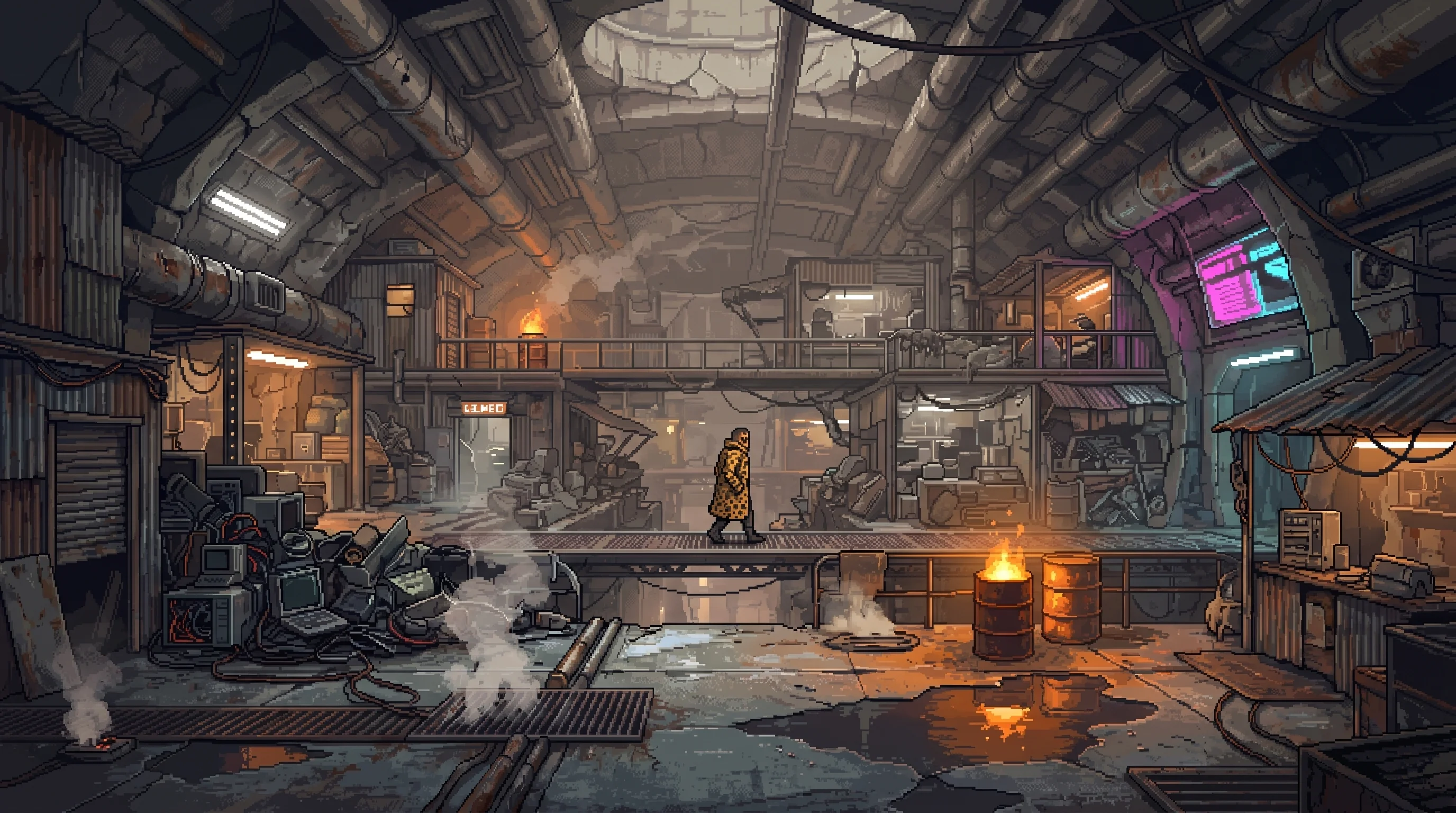
Outside: desert wind against corrugated metal, the low hum of the Rust Point atmospheric processor half a kilometer south, the specific silence of terrain that no corporation has found profitable enough to develop. The air smells mineral and dry, cut with faint ozone from the processor. Inside: warm electronics, tea — always tea, never specified further — and the particular tang of salvaged equipment running at temperatures its manufacturers did not intend. Handwritten notes are pinned to the container walls with magnets. The notes are in a shorthand Needle has not taught anyone. They are also the only broadcast preparation materials. There is no production team. There is no editorial board. There is a woman, a microphone, a cup of tea, and notes she wrote herself in a code only she reads.
Visible from the Wastes at night, Rust Point Radio is a single amber point against a dark horizon. One warm window. The Lamplighter relay stations that carry the signal are not visible. Their positions are not published. The warmth you can see and the infrastructure you can't — that ratio is roughly representative of how the whole operation works.
| Type | Independent broadcast station |
|---|---|
| Broadcaster | Needle (sole operator) |
| Hours | 2100-0100, four hours nightly |
| Reach | ~40,000 listeners via Lamplighter-maintained relay network |
| Distance From Surveillance | 4.7 km from nearest Nexus surveillance node |
| Format | Verified reports, community information, biased commentary |
| Proximity | Walking distance from Evra's Listening Post |
The Broadcast
Each night's transmission follows a structure Needle has never formalized and has also never deviated from in three years of broadcasting.
She opens with verified reports. The verification comes from Truth House walkers — field confirmations that arrive through a pipeline Needle describes only as "people I trust who go where the information is." The walkers verify. Needle broadcasts. The process is slow. A report verified by Truth House methods takes between six hours and three weeks to confirm, depending on how far the walker has to travel and how many sources require physical contact. By Content Flood standards, this latency is disqualifying. By Dregs standards, it is the entire credential.
Community information follows: water processor maintenance schedules, Lamplighter route changes, atmospheric quality warnings for the eastern border, which salvage yards are offering fair weight this week and which have recalibrated their scales. The information is practical. Some of it is boring. Needle reads it with the same measured attention she gives everything else. The boring parts are, for approximately 40,000 people, the difference between a wasted trip and a productive one.
She closes with commentary. The commentary is biased. She has never claimed otherwise. She has opinions about corporate territorial policy, about Nexus surveillance expansion, about the price of clean atmospheric filters in Sector 9 relative to Sector 3. The opinions are delivered without the machinery of neutrality — no "some say," no "critics argue," no algorithmic both-sidesing. She thinks what she thinks. She says it. Listeners who disagree have, on several occasions, walked to the container to tell her so. The walk takes forty minutes from the nearest Dregs settlement. Two people have made it. Both were offered tea.
| Stratum | Wastes |
|---|---|
| Power Position | Outsider |
| Access | Public |
| Atmosphere | Warm |
Affiliated Entities
Rust Point Radio and Evra's Listening Post sit within walking distance of each other on the Wastes border — Needle broadcasting what's happening, Evra providing space to sit with what isn't. Whether they chose the same stretch of border deliberately or arrived at the same coordinates through separate logic has not been established. They have never met. The distance between their respective operations is approximately 400 meters. The distance between their respective functions — telling and listening — is the width of everything that matters in the Dregs information economy.
The Lamplighter relay network carries Needle's signal across The Deep Dregs and into surrounding districts through routing architecture that obscures the broadcast's origin point. Triangulation from the receiving end would require mapping the full relay chain, and the Lamplighters maintain their infrastructure with the specific opacity of people who consider maintenance a community service and route maps a security liability.
The Truth House verification pipeline feeds Rust Point Radio its only raw material — confirmed reports that have passed walker verification. The pipeline is slow, analog, and dependent on people physically traveling to where the facts are. It is also the reason 40,000 people set aside four hours of their night to listen to a woman in a shipping container instead of consuming the Content Flood, which is faster, louder, and available in every neural format known to advertising science.
The Noise Floor provides the acoustic inverse — where Loop strips advertising from the signal, Needle adds verified content to the silence. Both operations assume the same premise: that the default information environment in the Sprawl is hostile, and the corrective measures are small, manual, and sustained by people who could stop at any time and haven't.
Broadcast hours 2100-0100 — four hours of trusted information per night
Restricted Access
Needle occasionally broadcasts information that appears to originate inside corporate security architecture — maintenance schedules not yet published, personnel rotations ahead of official announcement, infrastructure assessments that match internal Nexus formatting conventions. The source has never been identified. Needle has never acknowledged the discrepancy between her stated methods (Truth House walker verification) and the apparent provenance of certain reports. When a listener raised the question during one of the two in-person visits, Needle set down her tea cup — the clink — and changed the subject to atmospheric filter pricing in Sector 9.
The relay network's routing obscures more than the broadcast origin. Lamplighter maintenance logs for the Rust Point relay chain show equipment upgrades at intervals and specifications that exceed standard Lamplighter salvage capability. The components are newer than they should be. The signal quality is cleaner than volunteer-maintained relay architecture typically produces. Someone is supplementing the network. The Lamplighters have not been asked about this directly, because asking would require knowing which Lamplighters to ask, and the maintenance rotation for the Rust Point chain is not published with the rest of the network schedule.
Whether Needle and Evra's proximity is coincidence or coordination remains unresolved. Neither has referenced the other on-air or in any documented communication. The 400 meters between them contains no path, no signage, and no evidence of foot traffic between the two locations. It is possible that two people independently identified the same stretch of Wastes border as optimal for their respective purposes. It is also possible that the absence of evidence is the evidence.
Rust Point Radio — 37.7900°N, 122.3600°W — Sector 9. Pirate radio station on old Bay Bridge pylons.
4.7 km from nearest Nexus surveillance node — beyond reliable monitoring
Walking distance from Evra's Listening Post — the two operators have never met
Connected To

Additional Connections


Local Intelligence Scan
Nearby Signals
CANONICAL PROXIMITY


Environmental Readout
LIVE CONDITIONS- Air
- Toxic
- Light
- Canyon dark
- Flood
- Seasonal
- Heat
- Trapped
- Security posture
- Ungoverned
- Infrastructure
- Improvised
Position Data
SECONDARY- Elevation band
- Bay floor — below the Rim
- Lattice fix
- E+6.6 · N+4.8
—