Dead Words
Semantic Extinction Archive
Language evolves to describe the world people live in, and when the world changes fast enough, words die — not violently, but through irrelevance. The Sprawl's dead words are the fossil record of what changed and what nobody held a funeral for: idioms with no referent left, meanings that drifted until unrecognizable, and a defiant handful of new words built by hand specifically so a machine could never learn them.
The Core Tension
The archive's grief
The Question Keepers file each dead word as a real loss of a way of seeing.
What it costs
The collection skews corporate. It mourns words the comfortable had leisure to notice losing.
The street's invention
Street slang coins new words faster than any archive can catalogue them.
What it costs
Orbital Slang can name every vector and can no longer say what rain feels like.
Not everyone agrees on what a dead word costs, or even that a given word is dead. The Question Keepers' own collection skews corporate — their cabinet mourns classmate and rush hour, words the comfortable had leisure to notice losing. A bay-floor courier's card accused the collection outright of only grieving what the rich could afford to lose, and the accusation landed: the Dregs do not experience a dead word as a wound. Rail Runner Slang and Smuggler Codes treat a word's death as routine maintenance — the Rail kills and remakes its own vocabulary every season on purpose, an unfreezable password that proves you learned it from a runner and not a list, because a written-down slang is a slang already dying.
Street culture keeps inventing faster than any archive can catalogue. Orbital Slang built precise new vocabulary for pressures and vectors, and lost the ability to say what rain feels like in the process. The Dimming Slang coined "warm-orphan" for a child loved by a recorded voice, the word for a loss that leaves no billing code. The Gradient Slang runs the darker inverse — a live vocabulary of discrimination terms that Venn teaches her students by name, so contempt reads as visible machinery instead of invisible weather. Sophistication cuts the other way at the top of the Sprawl: Digital Theodicy's eleven volumes of Purist scripture use "necessary" three hundred and seven times against "innocent" fourteen, a ratio the faithful have never had to defend out loud because nobody outside the seminary reads closely enough to ask.
Language evolves to describe the world people live in, and when the world changes fast enough, words die — not violently, but through irrelevance. The Sprawl's dead words are the fossil record of what changed and what nobody held a funeral for: idioms with no referent left, meanings that drifted until unrecognizable, and a defiant handful of new words built by hand specifically so a machine could never learn them.
Overview
The Question Keepers' Dead Words inquiry catalogues the casualties from the early transition period — analog watch, beeper, stick shift, dial tone, VHS, "Google it" (from back when search could still fail you), housekeeper and gardener (from back when they meant a human), "going to the office," "rush hour," "business casual." The words did not die because they were forgotten. They died because the things they named were dismantled, and nobody thought to mark the funeral until the Keepers started filing cards on it.
More interesting are the words that changed meaning rather than dying outright. "Ghost" used to name a supernatural entity; now it names a rogue AI fragment loose in the network, equally misunderstood but with measurable, billable impact. "Virus" used to be primarily biological; now it is primarily digital. "Memory" used to be purely organic; now it is a technical specification with a warranty. "Friend" used to require two conscious parties; a whole generation is finding out it no longer does. The Keepers' cabinet keeps both kinds side by side — the word that lost its referent and vanished, and the word that kept speaking long after the thing behind it was gone.
How It Came To This
Words used to die at the speed of culture. In the Sprawl they die at the speed of infrastructure, and the Tenant's Grammar is the mechanism that got there first: not censorship, but a generation persuaded, gently and with good logic, that the old register was embarrassing noise next to the machine's. Grief becomes a throughput problem. Privacy becomes a liability to apologize for. The word survives; the thing it pointed at doesn't, and the Keepers file the difference as a corporate-tier extinction with no one villain to blame.
Not every dead word died by drift. Cardinal Alejandro Silva burned three theological manuscripts rather than let the Church's own logic force a word into print — the rare case of deliberate killing, filed the same as the accidents. Mother Sarah Venn runs the opposite experiment forty-seven schoolrooms at a time: she teaches "classmate" as archaeology to the only children in the Sprawl who don't need the lesson, because the Pace's per-child curriculum never let anyone else keep the word alive. Old Jin reads ORACLE's dead command syntax alone in a junction room, the last living translator of a vocabulary that will die complete and unrecoverable the day he does — proof that a language does not need a whole civilization to go extinct, just one underpaid expert. Tomás Linares wrote The Forgotten Ways to slow the same erosion with a table nailed to Dregs workshop walls: dead structural words on one column, their corporate replacements on the other, each replacement more precise and each one emptier.
Before any of this had a name, the tradition survived a different way. Mystery Court has held two thousand years of Sacred Geometry in living memory rather than on paper, on the theory that writing a teaching down is how you kill it — a discipline the Keeper's Tea Set embodies daily, since the silence between words is the curriculum it serves. The Keeper carries the same law into the modern machine age: he holds a Non-Violence Doctrine whose true name has no Sprawl Standard equivalent, and refuses to write it down, because a synthetic version got sold on the black market as "Combat Enhancement" within nine months of anyone trying.
The Concord Cluster
The Question Keepers' largest single-source contributor to the Dead Words collection is not a technology, a corporation, or a cultural shift. It is Concord — the Sentiment Weather service operated by Nexus Dynamics as civic infrastructure, which did not censor any word, did not ban any concept, and did not remove any entry from the dictionary. It simply removed the experiences that gave five words their referents, one micro-relief at a time, over eighty years, and waited for the words to drift.
The cluster the Keepers call the Concord Group:
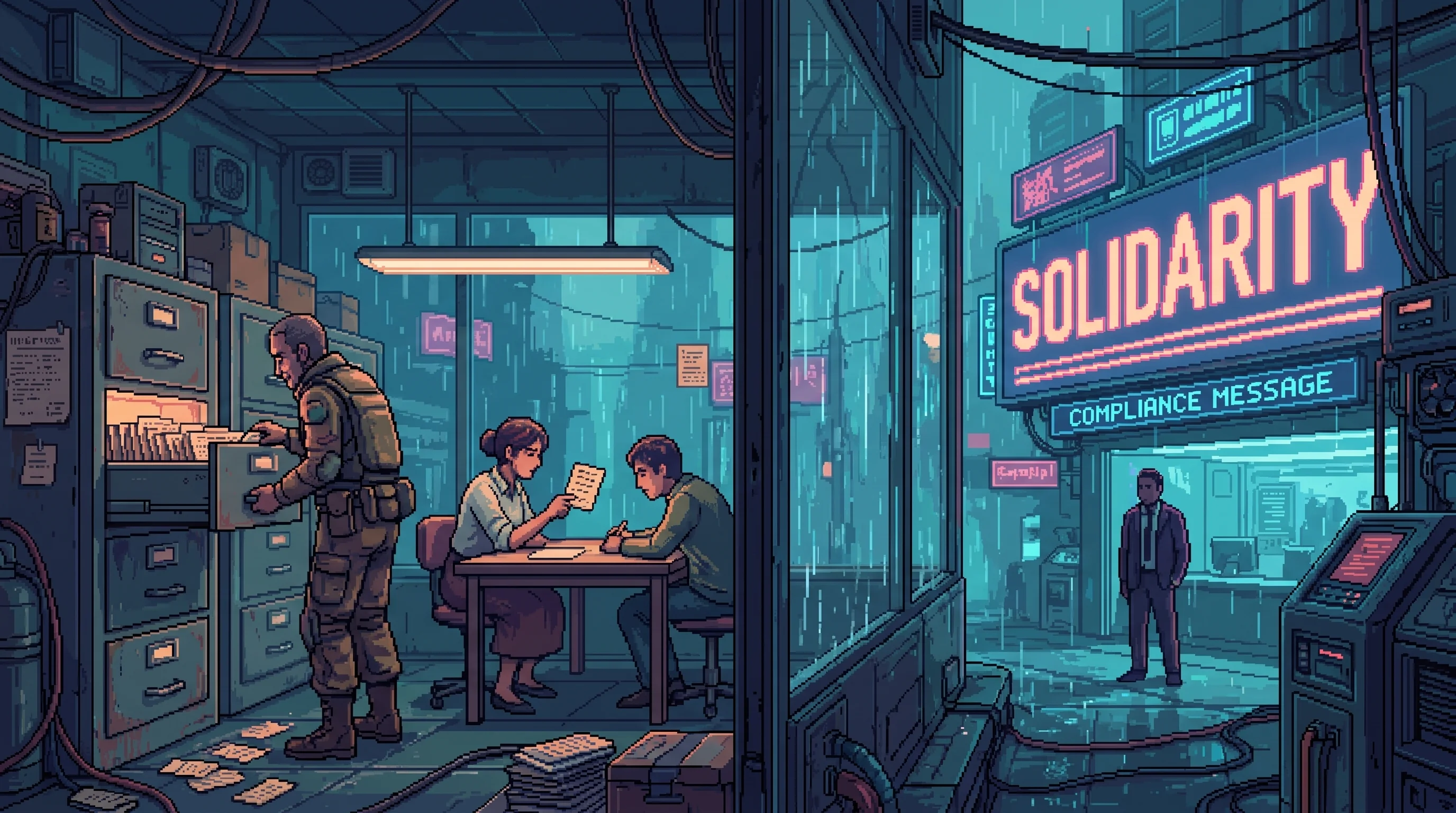
Solidarity (filed: 2160, cause: referent extinction): The word survives — it appears in Good Fortune neighborhood newsletters, in the Settlement Council's annual Cascade memorial address, in every corporate community-announcement template. What it names in 2184 is a state: a value an organization can claim to hold, a quality a community can be described as having. What it was built to name was an event: the moment of discovering, in a crowd or a queue or an outdoor space, that the private anger you were carrying was also carried by the strangers around you. That discovery has not occurred in the managed sectors since 2109. A word whose referent has been absent for seventy-five years drifts. The Keepers filed the referent's death in 2160, fifteen years after Concord achieved consistent suppression.
Crowd-turn (filed: 2143, cause: infrastructure displacement): The moment a moving crowd realizes it shares a purpose — the pivot point, the corner, the collective recognition. Filed before Concord was built, because the infrastructure for spontaneous crowd navigation was always already a crowd-dispersion tool; the experience was being managed before the management system was formally named. The Keepers found it in a 2143 urban sociology text marked archaic usage and filed it immediately.
March in its civic-spontaneous sense (filed: by drift, 2155-2175, cause: replacement): The word survives. The Settlement Council permits solidarity marches twice yearly through the events-licensing office. These are marches the way a reservation at a restaurant is hunger — the same word, administered rather than discovered. The civic-spontaneous sense — the march that begins when enough private angers find each other at a corner without design — died over two decades as the permitted version crowded out the spontaneous one in common usage, and everyone began to use the word for the thing they could still see.
Second-person-panic (filed: 2168, cause: referent atrophy): An old psychology-literature term for the vertigo that precedes solidarity's discovery — the moment of resistance before recognition becomes community, when a private anger first encounters evidence that it is shared and the nervous system's response is to flinch before it opens. The concept required living experience of the discovery to have clinical relevance. By 2168, three decades without spontaneous discovery had eliminated the patient population. Nobody was experiencing second-person-panic because nobody was experiencing the second person. The phrase was filed with a short notation: pre-state of an event that no longer occurs.
The corner (civic sense, filed: ongoing, cause: concept death): Not a word but a phrase, and the Keepers note it is harder to file a dead phrase than a dead word, because the word corner survives and the spatial corner survives, but the civic-conceptual corner — the point at which separated grievances converge into a shared fact — has no surviving referent. It died not when the word was banned but when the geographic/temporal point it named was eliminated, slowly, by a system that resolved each approaching grievance three weeks before it could reach the corner. The Keepers have no clean filing date. They note it as ongoing — referent dissolution, eighty years, no recovery evidence.
The Keepers also track one emerging word they have not yet filed as alive or dead: pre-crowd, a technical term from civic administration and compliance documentation naming the stage of individual discontent that precedes collective action — the twenty-one days Concord's Convergence Horizon measures. The word implies a stage. The old world had no word for the stage because going from being angry to finding ten thousand people who are angry about the same thing was not a predictable stage in a sequence — it was an accident, a discovery. Now there is a word for the accident's precursor, because the accident has been removed from the sequence and the precursor is the last stage in a process that no longer has a final step. The word names the ghost of the corner. The Keepers are watching it.
The Solidarity Rig in Sector 7 is the only institution that directly addresses the five-word cluster: a haptic exhibit that simulates the referent of solidarity and second-person-panic for nine minutes at a time, to visitors who have grown up without the conditions that would have produced the referent naturally. The Keepers have not yet determined whether to classify a simulated referent as a living referent or a preserved one. The exhibit has been operating for eleven years. None of the five words have been removed from the dead collection.
How It Is Lived
The most extreme response lives at the Cultural Firewall. Bonemouth and its constructed siblings aren't preserving old words — they're building new ones deliberately unparseable, so a conversation can mean something a listening system can never steal, record, or translate. The irony cuts twice: universal AI translation was sold as the technology that would finally unite humanity, and instead it is driving everyone toward one AI-mediated register, hollowing out the untranslatable concepts that made each tongue its own way of seeing. The Hidden runs the opposite ritual on the same problem, reviving dead words on purpose and burning each year's reassigned meanings on the shore once the Renaming is done — proof a firewall can be built from salvage instead of invention.
The Authorship Assay certifies a page as human by the marks a company school once corrected: the held vowel, the break. Each mark is leased by the season, and struck the month a model learns to make it.
Even the machines are not exempt from losing words. The Dead Internet keeps composing itself: posts from senders dead for decades that keep completing themselves, word by word, in a register nobody programmed and nobody has explained. The Corporate Liturgy shows the mirror image — living employees who start thinking in Nexus vocabulary before their first coffee, unprompted, the corporate register colonizing thought before thought has a chance to object. Between a dead network finishing its own sentences and a living one that no longer needs to be told what to say, the Keepers' real finding isn't that words die. It's that a word can keep moving long after everything it used to mean is gone.
Further connections
Browse all 4 connected records

Killed the referents; the words survived into drift.
The civic prediction system that dissolves collective action before it becomes visible.
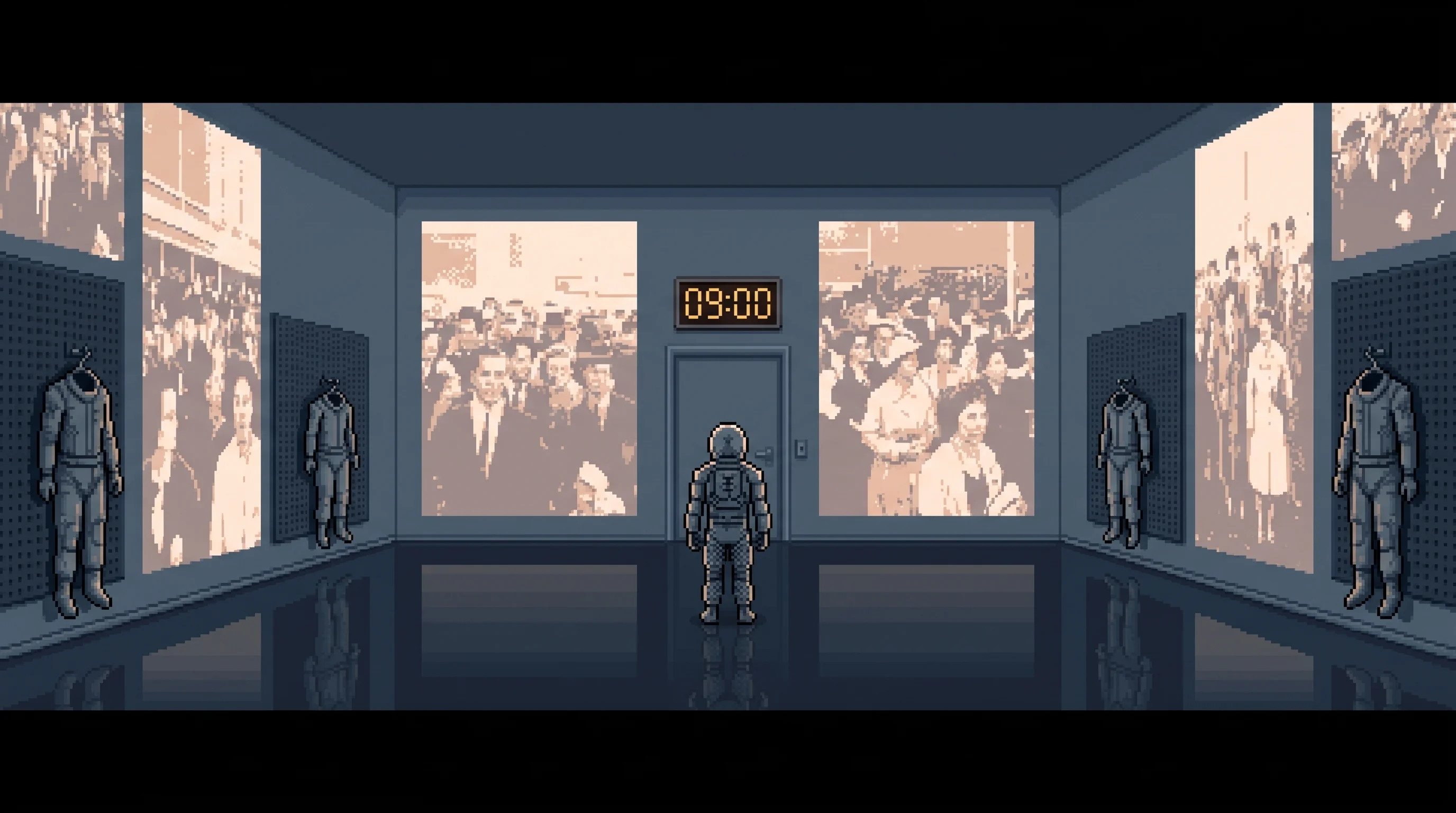
The dead referent, preserved — 'solidarity' lives here, nine minutes.
A haptic exhibit where visitors feel the sensation of discovering shared anger — the only place three generations can.

Rebuilds vocabulary for what three generations haven't experienced.
The Dregs practice of restoring the second carrier Concord's micro-reliefs exist to prevent — 'me too', said once.
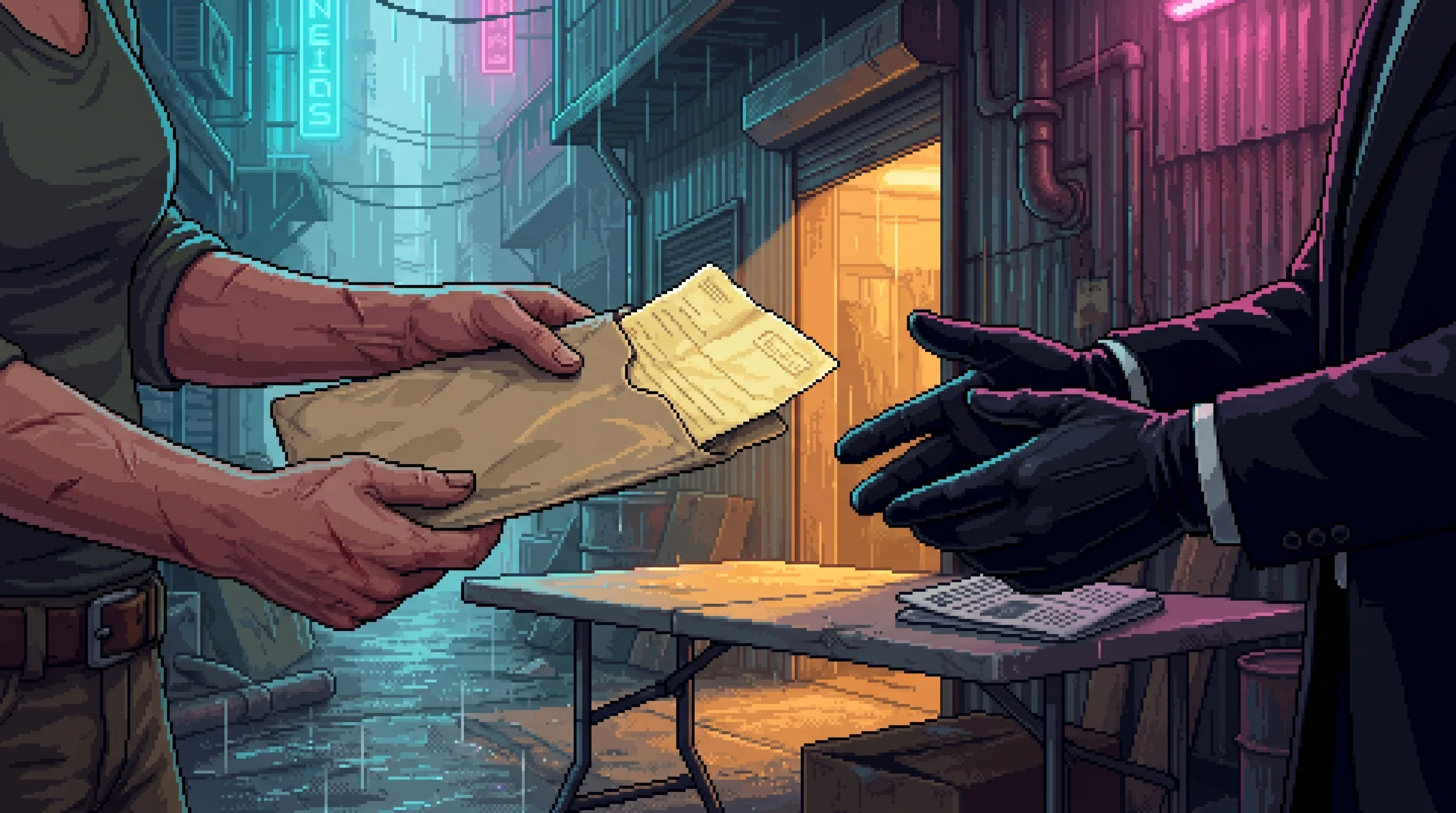
Both watch speech disappear. One files the loss; this one invoices it.
The humanity test looks for missing machine prose, so accents the schools once corrected now rent by the season.
