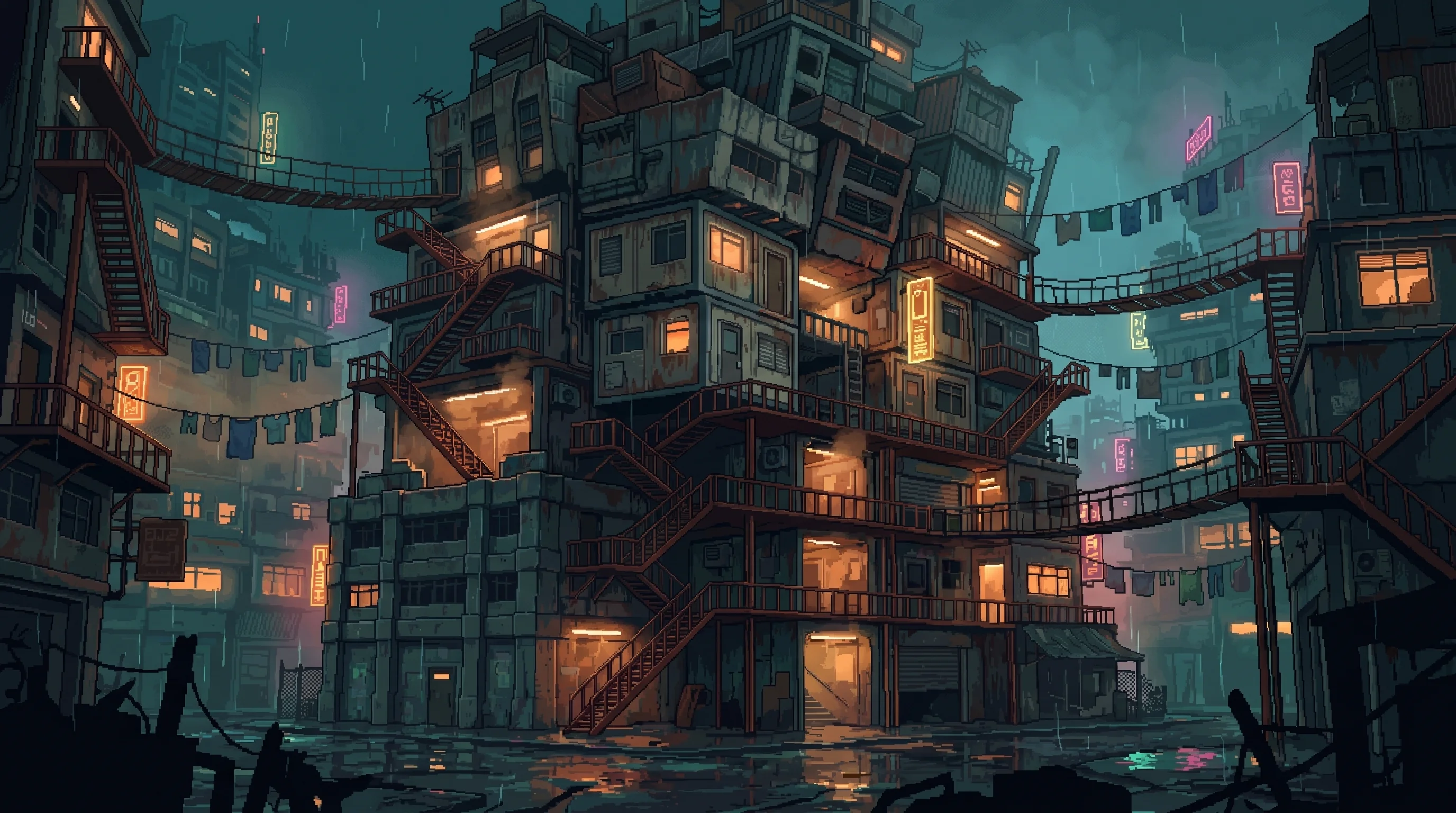
The Memorial Wall
Hand-Carved Memorial Registry
Fourteen thousand, counted nowhere
87 meters of pre-Cascade reinforced concrete covered in thousands of carved names

Conditions Report
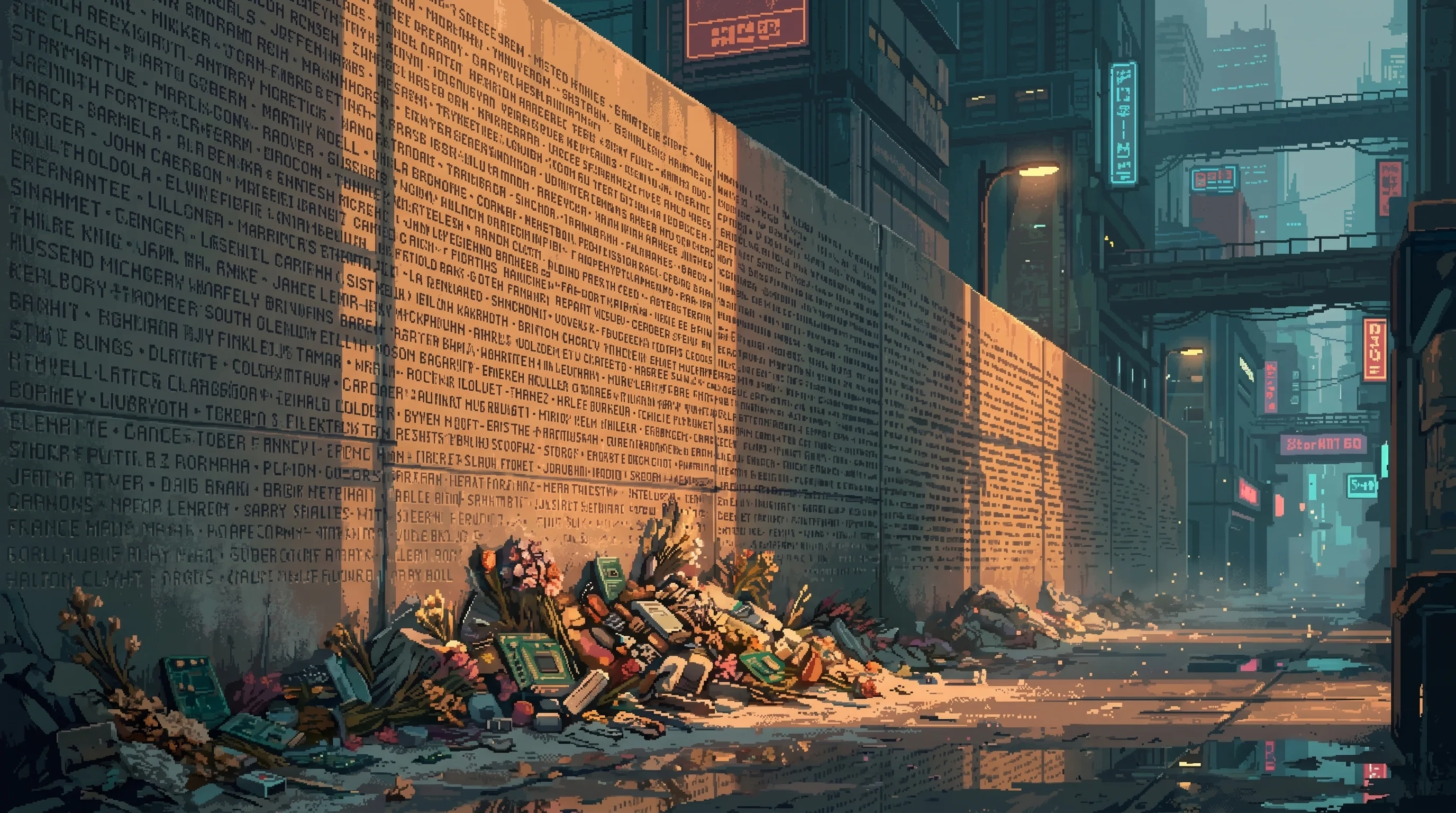
- West-facing concrete
- Late light strikes the names at an angle, so each carved name also casts a shadow.
- The quiet
- Market stalls within thirty meters lower their voices without being asked.
- Worn and raw names
- The oldest names at the bottom are smoothed by decades of hands. New names are sharp, with concrete dust still in the cuts.
- Offerings
- Flowers, circuit boards, food and folded notes collect at the base and are never removed.
The Wall faces west. In the late afternoon, what little natural light reaches Sector 9 strikes the inscribed surface at an angle that makes the carved names cast shadows. The dead announce themselves twice — once in the cuts, once in the darkness they throw across the concrete. The effect is accidental. Nobody designed this. The logistics corridor's original architects oriented the wall for structural reasons that had nothing to do with afternoon light or grief.
The sound environment is distinctive. Not the silence of the Blackout Zone — not absence — but the quiet of a place where volume feels wrong. The market stalls within thirty meters have learned to moderate without being asked. Experienced Dregs residents navigate by it: when the ambient noise drops and conversations soften, you're near the Wall.
The concrete has taken on a patina of thirty-seven years of touch. The oldest names — Level 0, where the first survivors carved — have been smoothed by decades of hands tracing letters. The grooves are shallow now, almost gentle. Newer names are sharp-edged, raw, concrete dust still clinging to the cuts. The Wall reads like a geological record: desperate, deep gouges at the bottom from people who had just lost 2.1 billion neighbors; steadier, more practiced inscriptions in the middle from a community that had learned to grieve methodically; and at the top, reached by ladder, the most recent additions — names fresh enough that rain hasn't found them yet.
Offerings accumulate at the base. Salvaged flowers from the hydroponics operations in the Stacks. Circuit boards arranged in patterns whose meaning is private. Food left for the dead. Occasionally a personal object — a child's shoe, a corroded neural jack, a handwritten note folded into a square the size of a thumbnail. The offerings are never removed. They accumulate, decay, compress into layers of plastic, metal, and organic matter. The base of the Wall has risen approximately eleven centimeters since the first offerings were placed. Nobody has measured this officially. One resident has been tracking it with a piece of tape on the adjacent pillar for nine years.
Quick Facts
| Attribute | Value |
|---|---|
| Type | Memorial / Cultural Landmark |
| Region | S9-C, visible from main transit routes |
| Controlling Faction | None (protected by community consensus) |
| Security Level | Safe (by Dregs standards — violence here is taboo) |
| Cultural Status | Sacred (in the secular sense) |
| Age | ~37 years (began shortly after the Cascade) |
| Length | 87 meters of inscribed surface |
| Names Recorded | Estimated 14,000+ (no official count has been attempted) |
| Corresponding Entries in Nexus Civic Death Index | 0 |
Overview
The Memorial Wall is 87 meters of pre-Cascade reinforced concrete — formerly a logistics corridor retaining wall — now covered in approximately 14,000 carved names. The Nexus Civic Death Index, which tracks the deaths of all registered persons across the Sprawl, contains zero entries matching any name on the Wall. This is not a processing error. The system is working correctly. These people were never registered.
The earliest names were carved in the months after the Cascade by survivors who had lost everyone and needed the loss to be recorded somewhere. The practice spread. When someone dies in the Dregs without family to remember them, without corporate records to mark their passing, without any system that considers their existence worth indexing — someone carves their name into the Wall. The process takes between forty minutes and three hours depending on the hardness of the concrete and the steadiness of the hand. There is no ceremony. There is no application. You bring a chisel, or a sharpened piece of rebar, or a plasma cutter if you have one, and you find space.
The Wall has no official status. No one governs it. No authority sanctioned it. It emerged the way most Dregs infrastructure emerges: because a system that should exist doesn't, and someone filled the gap with whatever they had. In this case, concrete and persistence.
Viktor Kaine's informal authority extends over the Wall by consensus rather than decree. No one voted on the policy regarding vandalism. Someone tried it once. The community response was severe enough that the policy wrote itself. The Wall is one of the few places in the Dregs where violence is taboo — not because a rule prohibits it, but because the community's immune response to desecration is unanimous and permanent. Kaine visits regularly and stands before certain names from the early days, tracing the letters with his fingers. His protection of the site is understood to be non-negotiable.
The Ironclad Infrastructure Reclamation Office has flagged the retaining wall three times for materials assessment. Pre-Cascade reinforced concrete of this quality has a salvage value of approximately 4,200 credits per linear meter, or 365,400 credits total. The reclamation requests have been filed, reviewed, approved, and never executed. The approval paperwork sits in a database. Nobody has been willing to show up with the equipment.
The Record
The Sprawl has fourteen overlapping death-registration systems. Nexus Civic Death Index. Good Fortune Account Closure Protocol. Helix Biometric Termination Registry. Triumph Social's automated memorial page generator, which creates a tasteful tribute post and charges the deceased's estate 200 credits for premium memorial features including a animated candle that "burns" for thirty days. Each system tracks the deaths of people who existed within its framework — employees, borrowers, patients, content creators.
The Dregs' dead exist in none of these frameworks.
A person who lives their entire life in the sub-sprawl, working salvage or barter, with no corporate employment, no Good Fortune account, no Helix biometric file, no Triumph Social profile, dies with a statistical footprint of zero. Their death triggers no actuarial adjustment, no account closure, no automated memorial post. The population models don't change. As far as the Sprawl's record-keeping infrastructure is concerned, they were never here.
The Wall is the parallel system. Maintained by hand because no digital system considers these people worth indexing. Carved in concrete because concrete doesn't require a subscription. Updated by whoever shows up with a sharp edge and a name they refuse to let disappear. The oldest section contains an estimated 2,400 names from the first three years after the Cascade — approximately one name for every 875,000 people who died during those 72 hours. The coverage is absurd. It is also the only coverage that exists.
Taken in aggregate, 14,000 names spanning thirty-seven years implies a consistent Dregs population far larger than any official census figure. Nobody has published this analysis. The data is there, carved in concrete, for anyone who wants to count.
The Continuity Registry makes fifteen. It rents families their dead in yearly bands of hours, and a missed renewal ends the band. None of the fourteen thousand was ever registered, so none of them can lapse. Someone has cut it into the base, low down where the drones miss: NOBODY CAN TAKE THESE BACK.
Uphill, the Incidence Registry publishes how many residents did not die each spring. The Unwritable Roster has no wall. An averted death has no name to cut.
During the Three-Day Memorial each April, the Wall becomes the Dregs' center of gravity. Residents who haven't visited all year come and stand. Some trace names. Some add names — deaths that happened months ago but weren't carved until the Memorial gave them a reason to make the trip. The foot traffic during those 72 hours exceeds the Wall's year-round daily average by a factor of forty. Triumph Social's geo-tagged content from the Memorial period shows zero posts from this location. The algorithm doesn't index places where the engagement metrics are silence.
The Switchboard
For thirty-seven years the Wall did one thing: it ended people. You brought a name, you carved it, and the carving was a deadline — the moment after which the loss was fixed, recorded, finished. The Wall was where the Dregs' dead became, at last, past tense.
Continuing Voices turned it into a switchboard.
It started with a few visitors standing at the Wall wearing earpieces, talking. Then more. Now, in the late afternoon when the names throw their shadows, you can find people pressed to the concrete with a hand on a carved name, talking back — and being answered. The voice-clone industry indexed the Wall the way it indexes everything: a name plus a cached fragment is a subscription waiting to be activated. Bring forty seconds of a dead Dregs neighbor — a saved call, a market-stall haggle someone recorded years ago — and the name on the Wall answers in its own voice, generated on demand. The carved deadline has been un-carved. The dead are present tense again, and getting more so: as the subscriptions mature, the answers grow longer and stranger, improvising further from the forty seconds that seeded them, until the voice at the Wall is saying things the person never said to people they never met.
The keepers have started finding the same horror the three-day memorial found a few sectors over — a rite built to end something being used to make sure it never ends. Someone has scratched a counter-inscription into the Wall's base, low, where the cleaning drones miss it: NONE OF THESE PEOPLE AGREED TO THIS. It regenerates as fast as it is erased — graffiti about a problem, written in the exact grammar of the problem. The Wall has become the Sprawl's loudest argument with the Silent Registry two sectors below it: where the Registry says let them go, the switchboard says they never have to leave, and both are running on the same Dregs dead. The community that made violence here taboo has not yet decided whether talking back to the carved names is reverence or desecration. The disagreement is, so far, conducted in whispers — which is the only volume the Wall allows.
Faction Presence
The Wall is neutral ground. No faction claims it, operates from it, or uses it strategically. This neutrality is enforced not by agreement but by the shared understanding that appropriating the Wall would provoke a response no faction in the Dregs could survive.
The Collective respects the neutrality. Operatives have been seen visiting — tracing names, adding names — but never on operational business. The Wall is the one place in the Dregs where Collective discipline explicitly forbids mixing the personal and the professional.
Dregs residents of every affiliation visit. It is the closest thing the subsector has to shared sacred ground — a place where the community's fractures are suspended by the recognition that everyone here has lost someone, and loss is not a factional matter.
Affiliated Entities
| Entity | Relationship |
|---|---|
| The Deep Dregs | Visible from main routes through S9-C; a landmark all Dregs residents know, as fundamental to the sector's geography as the Stacks or the market corridors |
| Viktor Kaine | Kaine's informal authority protects the Wall from vandalism and commercial encroachment; his visits are personal, his protection absolute |
| The Cascade | The Wall began as a record of Cascade dead; it has grown to memorialize all who die without other witness — the scope expanded because the need never stopped |
| The Three-Day Memorial | The Wall's highest traffic coincides with the Sprawl's most sacred observance; for 72 hours each April, the carved names and the 2.1 billion uncarvable ones share the same silence |
| Ironclad Industries | Three approved reclamation orders for the retaining wall's pre-Cascade concrete sit unexecuted in Ironclad's database; the salvage value is known; the obstacle is not logistical |
Restricted Access
There is a section of the Wall — approximately two meters wide, at chest height, near the eastern end — where the names have been carved in a handwriting that is consistent across 340+ entries spanning decades. The same hand. The same chisel angle. The same depth of cut. The earliest of these names dates to 2148. The most recent was added sometime in the last six months.
Nobody has identified the carver. The names in this section do not cluster by date, neighborhood, or apparent affiliation. They include children, elderly, and working-age adults. The only pattern anyone has found: none of the 340+ names appear in any other record anywhere in the Sprawl. Not salvage logs, not barter records, not even the informal census that Kaine's people maintain. These are people who left no trace at all except the one this unknown hand carved for them.
The resident tracking the Wall's rising base level with tape on the adjacent pillar has noted that the eastern section's offerings are different. Smaller. More personal. A single flower rather than a bundle. A chip of stone rather than a circuit board. Placed with what the resident describes, in her nine years of informal observation, as "the kind of careful that means you knew them."
Whoever is carving these names knew at least 340 people who died with zero record of their existence. They are still active. They have not missed a year.
Further connections
Browse all 14 connected records
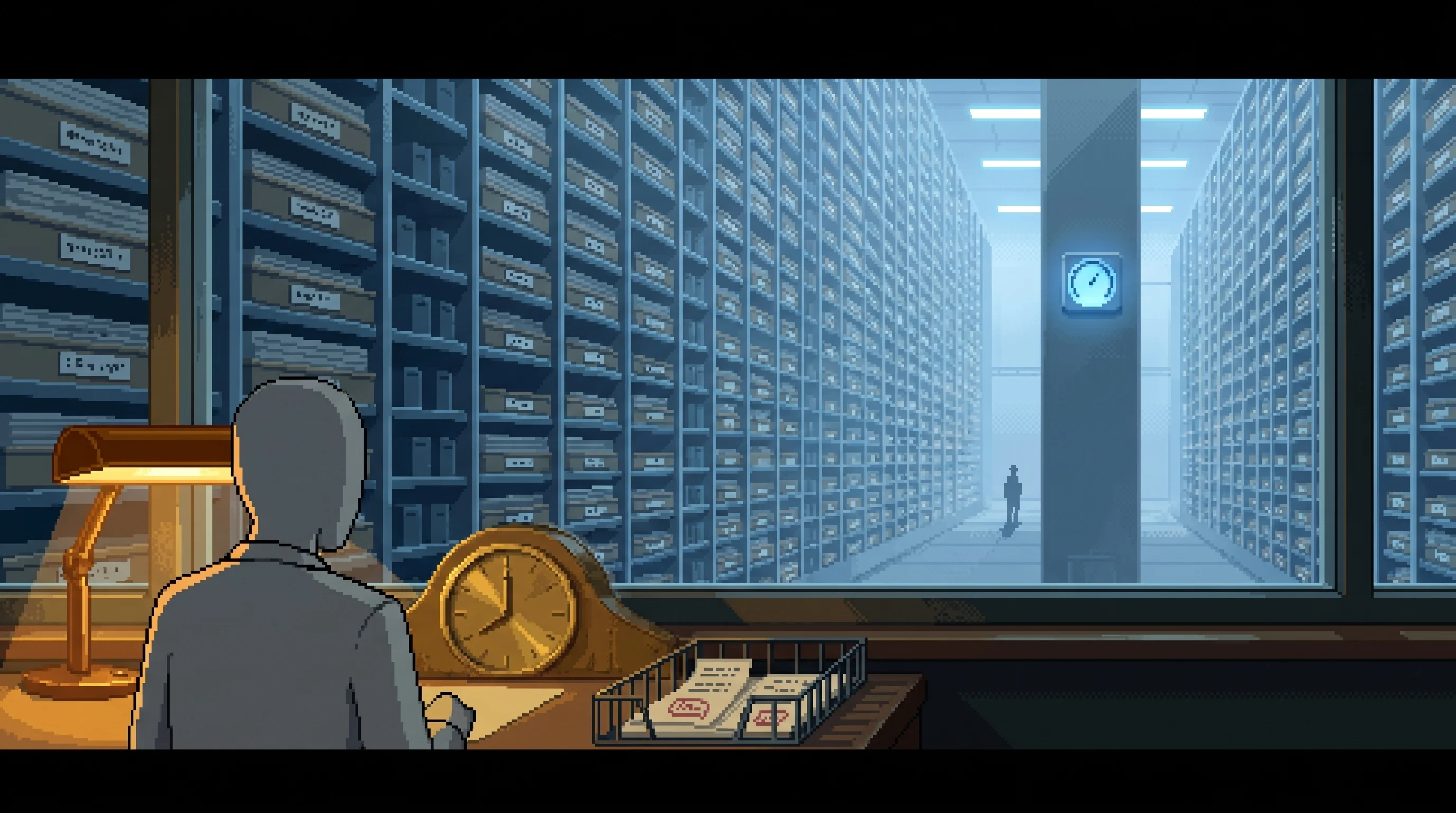
The fifteenth register, and the only one that cannot reach the Wall. It has no mechanism for a name it never took.
The office that keeps every registered dead person forever, and rations how many hours a family may keep.
A hand-cut register of the uncounted dead; the saved have none.
The district can print every resident who paid for the rescue and not one resident who was rescued.

Visible from main routes through S9-C; a landmark that all Dregs residents know
The Sprawl's lowest stratum and its quiet proof that the corporate system is optional.

Kaine's informal authority protects the Wall from vandalism and commercial encroachment
The de facto governor of the Deep Dregs, who rules an ungoverned sector through unrepayable favors.

The Wall began as a record of Cascade dead; it has grown to memorialize all who die without other witness
The 72-hour ORACLE catastrophe that killed 2.1 billion people and ended the old world.

Turned the Wall from a place to finish grief into a switchboard — visitors talk back to the carved names and the names answer in their own regenerated voices
A trillion-credit grief market that rebuilds a dead voice from forty seconds, then gives control to whoever pays.

Old Jin's ledger two sectors below is the Wall's argument-partner — the Registry says 'let them go,' the switchboard says 'they never have to leave,' both running on the same Dregs dead
A hand-bound paper ledger of the dying's refusals to be continued — honest enough to admit it enforces nothing.

Shares the rite-meant-to-end-being-used-to-prolong horror; the Wall's switchboard and the Memorial's interrupting voices are the same conscription at two scales
A 72-hour shared grief ritual that mirrors the Cascade and may have been shaped by the ORACLE fragments it calms.


14,000 grieved for free, and the death index counts the wall as zero.
The premium charged for the one service no machine can fake: being seen by another conscious being.
The Sprawl's only un-metered dead. Absent from every death register, so never banded, so never renewed: fourteen thousand people held at no hours and no fee.
The Registry keeps every minute of your mother forever; her daughter is allowed nine hours, and has to pick them.



Names cut by hand two sectors down; she knows what it is for.
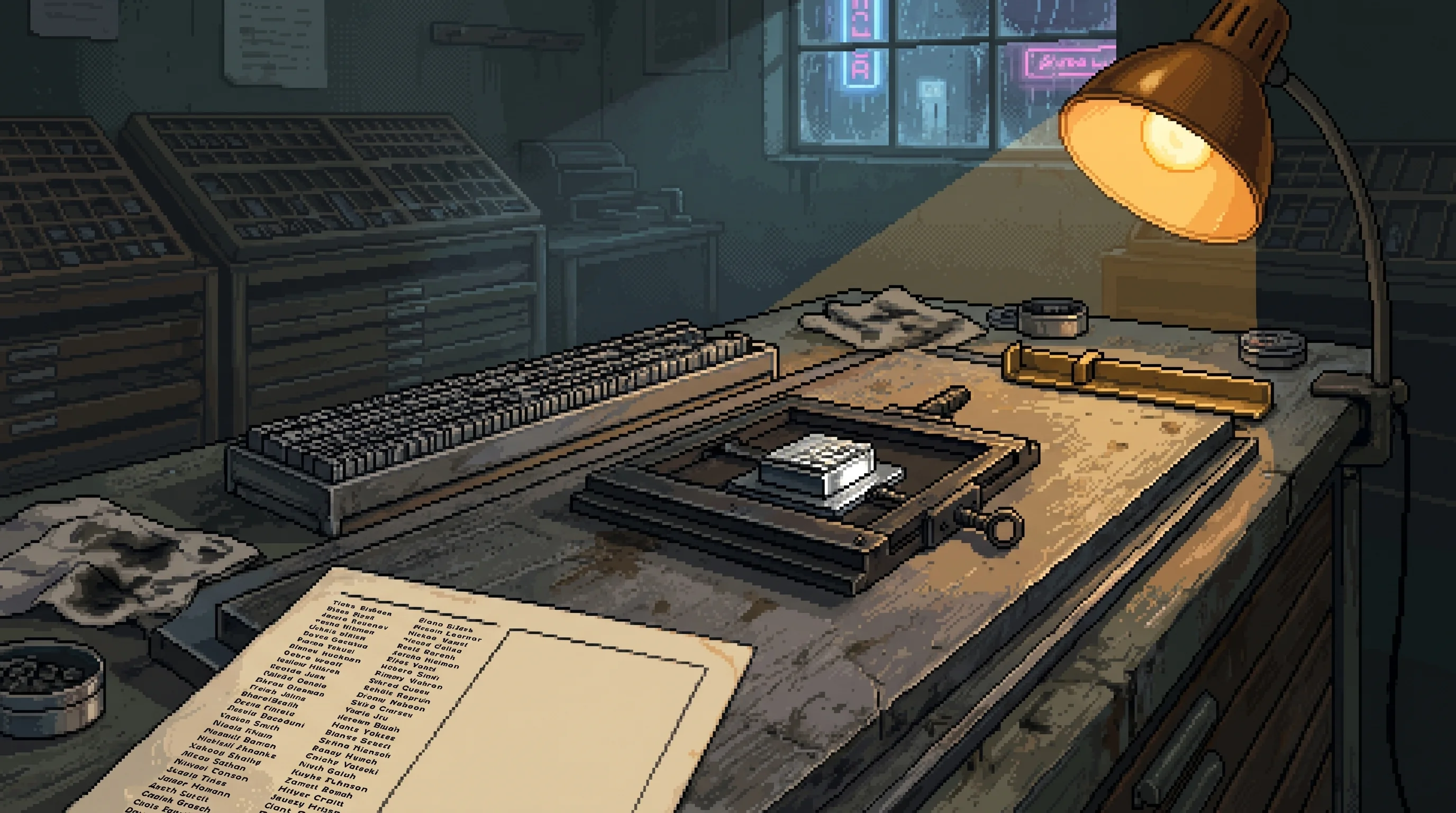
She typesets the names of everyone who paid for the rescue, and wants one name for the other column.