The Analog Exam
Public Unassisted Cognition Exam
The Pencil Test
Created 2172 by Zephyria's founding Council of Seventeen
Overview
The Analog Exam is a six-hour pencil-and-paper test administered once a year in a building that smells like old wood, to approximately 400 people who have voluntarily disconnected from every cognitive system the Sprawl considers essential.
It measures nothing the Sprawl's economy values. Four hundred people take it anyway.
Zephyria's founding Council of Seventeen created the exam in 2172, the same year they declared the Free City's independence from corporate cognitive infrastructure. The logic was circular and intentional: Zephyria measures what it considers important, and what it considers important is whatever can be done with a pencil. The Council Hall — a converted pre-Cascade courthouse with wooden desks bolted to the floor — hosts the exam each spring. The desks were not chosen for their aesthetic. They were the desks that were already there. Zephyria has elevated this into philosophy.
Six domains: mathematical reasoning, linguistic comprehension, logical analysis, creative association, spatial manipulation, and ethical reasoning. No augmentation. No Second Mind. No neural interface. No calculator. Participants receive a sharpened pencil, a paper booklet, and six hours alone with a brain that most of them haven't used unassisted since childhood. The pencils are pre-sharpened because three participants in the exam's second year did not know how to operate a manual sharpener. This is not mentioned in the orientation materials. The pre-sharpened pencils are mentioned.
How It Works
Questions are designed by a rotating committee of Analog School teachers, Memory Therapists, and Zephyrian academics who take evident pleasure in constructing problems that punish computational brute force and reward the kind of lateral thinking that augmented cognition has been quietly replacing for decades. The mathematics sections favor insight over calculation — pattern recognition, symmetry exploitation, the sudden clarity that arrives forty minutes into staring at a problem that a Second Mind would solve in eleven seconds.
The ethical reasoning section is the one nobody prepares for. Participants must argue convincingly for positions they disagree with. Not summarize. Not steelman. Argue — with the passion and coherence of genuine belief. The committee scores for quality of reasoning, not conclusion. A Flatline Purist who writes a devastating case for mandatory augmentation scores higher than a Nexus analyst who writes a tepid defense of cognitive freedom. The section has a 23% completion rate. Most participants abandon it mid-argument, reportedly because the experience of inhabiting an opposing position without augmented emotional regulation is, in the committee's understated phrasing, "cognitively demanding."
The scores are public.
In a Sprawl where cognitive capacity is private — metered by consciousness licensing tier, measured by the Loyalty Coefficient, visible only to the corporations that sell it — the Analog Exam publishes every score under every name for anyone to read. This is Zephyria's most deliberate provocation. Each score is a data point in the Capacity Question: what is human cognition worth when it isn't augmented, optimized, or metered? The exam does not answer the question. It makes the question impossible to ignore.
Nexus's position: "a charming anachronism." The Flatline Purists' position: "the only honest measure of a human being." The Dregs' position: nice test, but does it keep the lights on?

The Measure of What Was Lost
The exam's most devastating output is not its highest score. It is its average.
Year one: 72 across all six domains. Year twelve: 61. The committee calibrates difficulty annually. The test has not gotten harder. The people have gotten softer — not biologically, but infrastructurally. Daily life in the Sprawl assumes augmented cognition the way it assumes breathable air from the Breath processors. Navigation, arithmetic, memory retrieval, emotional regulation, scheduling, spelling. The muscles of unassisted thought don't degrade because brains are failing. They degrade because nobody uses them. A generation raised on Second Mind assistance sits down with a pencil and discovers that the pencil is the hard part. Exam proctors report that hand cramps account for more incomplete sections than intellectual difficulty. The average Executive-tier participant hasn't held a writing instrument in six years. Their handwriting resembles a seismograph output. Their spatial reasoning, disconnected from the augmented overlay that handles it seventeen hours a day, collapses into something the committee's scoring rubric classifies as "pre-literate."
The forty percent of participants who travel from across the Sprawl carry a question they cannot ask in their home districts: what am I worth without my machines?
The answers are not kind. Professional-tier analysts score below Zephyrian teenagers who have never owned a neural interface. Executive-tier strategists whose entire professional identity rests on cognitive superiority discover that the superiority was licensed, not earned — a subscription service they mistook for a personality trait. One former VP of Strategic Intelligence at Nexus scored 34. The internal memo leaked. Nexus has quietly prohibited Executive-tier employees from participating since 2179 — not through official policy, because official policy would acknowledge the exam matters. Through structural nudges: the exam scheduled during mandatory corporate retreats, travel authorization for Zephyria-bound transit redesigned to require three levels of approval, the Zephyria entry in the corporate travel portal moved from "Autonomous Zones" to "Restricted — Recreational" alongside combat tourism and Waste expeditions.
For Dregs residents who score in the seventieth percentile — unaugmented, unlicensed, thinking with equipment that the Sprawl considers obsolete — the result is a specific kind of grief. They are demonstrably capable. The demonstration changes nothing. The Sprawl does not hire pencils. The Cognitive Ceiling does not care what you scored on a paper test in a courthouse that smells like furniture polish. The exam proves they can think. The economy proves thinking isn't the bottleneck.
Soren Achebe set the highest score in the exam's twelve-year history at age fifteen. The committee published the number without comment. Nexus published a response within hours: an internal efficiency report calculating that the cognitive output Soren demonstrated in six hours of pencil work could be replicated by a Basic-tier Second Mind in nine minutes. The report did not mention that Soren's creative association score — the domain that measures the capacity to connect ideas no algorithm has connected before — has no Second Mind equivalent. The report did not mention this because Nexus's efficiency metrics do not contain a field for "things we cannot replicate." The absence is not an oversight. It is an optimization.
The Last Genius would have recognized the exam immediately — not as a test of intelligence but as a test of what survives when intelligence is no longer scarce. The answer, eleven points lower every twelve years, is: less.
The Same Test, Measured The Other Way
The licensed districts run this exam too, under the Re-Defence. They call it a sitting. It is unannounced: forty minutes, alone, on one credited entry drawn from a whole career. Fail it and the entry is struck. Zephyria's registrars have printed the comparison more than once. The districts have not answered.
Affiliated Entities
- Zephyria (The Free City): The exam is Zephyria's most visible civic ritual — the annual moment when the Free City's founding premise becomes measurable. Every published score is a line item in Zephyria's argument that unassisted cognition has value. The argument gets harder to make every year the average drops.
- Soren Achebe: The highest score in twelve years, set at fifteen. The committee treats the score as evidence. Nexus treats it as an efficiency comparison. Soren, reportedly, treats it as something that happened to him once.
- The Cognitive Ceiling: The exam exists because the Ceiling exists. Every participant who sits down with a pencil is testing whether unassisted cognition is worth measuring in a world that has already answered no. The eleven-point average decline is the Ceiling's signature, written in graphite.
- The Capacity Question: Each score is a data point. Four hundred data points per year, declining. The Capacity Question asks what human cognition is worth unaugmented. The exam provides the number. The number goes down.
- The Last Genius: The exam measures what the Last Genius embodied — the upper bound of what a human mind can do alone. The exam's declining average suggests the embodiment is becoming historical rather than aspirational.
- Nexus Dynamics: Nexus calls it a charming anachronism, then quietly blocks its employees from taking it. The structural nudges — scheduling conflicts, travel restrictions, portal reclassification — are more honest than the official position. Nexus does not fear the exam. Nexus fears the memo.
Visual Identity
- Color palette: Old wood grain, cream paper, pencil graphite, the specific yellow of a No. 2 pencil — the palette of a world that stopped updating
- Key symbol: Rows of wooden desks, each holding a single pencil and a paper booklet — the simplest possible test in the most complicated possible world
- Lighting: Natural light through courthouse windows, unfiltered, unaugmented — illumination that wasn't designed and doesn't optimize for anything
Further connections
Browse all 9 connected records
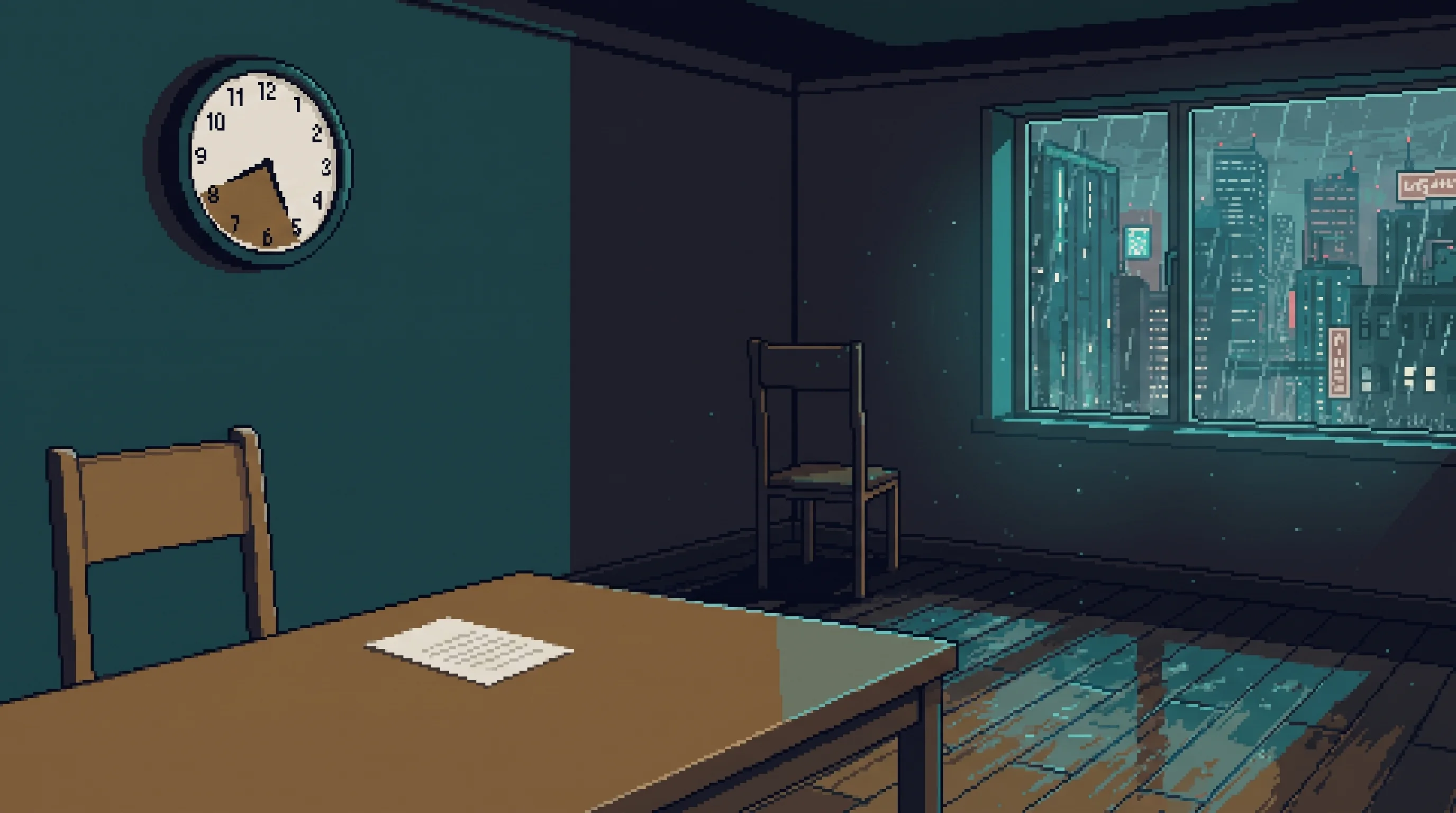
The same faculty, measured the opposite way. Six hours, once, in public, by choice, scored as an achievement — against forty minutes, unannounced, alone, held over a working life as a liability that never matures.
Anything you were credited with can be recalled and re-argued alone; nothing held against you ever is.

A civic institution of Zephyria — created as a statement of values
A 2.3-million desert city running on nothing corporate — proof the Compact is a choice, which is why the maps deny it.

Soren set the highest score in the exam's twelve-year history at age 15
A 17-year-old unaugmented Dregs student who scored the highest Analog Exam result in its history.

The exam measures what the Last Genius embodied — unassisted human cognitive capacity

Each score is a data point in the argument about what human cognition is worth when it isn't augmented
A Sprawl-wide debate asks what human intelligence is for after AI surpasses it, while rival answers stay unresolved.

The exam's existence is a statement that unassisted cognition is worth measuring
The settled fact that no living human's mind can out-think a five-dollar chip.

Nexus position: 'a charming anachronism'
The megacorporation that controls 40% of the Sprawl's computational infrastructure.

The Divergence's rebuttal in pencil: unassisted cognition scored in public, where Soren Achebe set the record.
The point at which effort stopped being able to close the gap that compounding opens.