
The Distraction Tax
Basic-tier users spend ~12% of cognitive capacity on ambient content evaluation
Overview
Nobody in the Sprawl has ever been billed for the Distraction Tax. It does not appear on any invoice, is not collected by any corporation, and is not recorded in any financial system. It is paid 847,000 times per day by every Basic-tier mind in the Sprawl, in a currency that has no name and no exchange rate: the 0.3 seconds your threat-assessment architecture spends evaluating a stimulus before concluding it is irrelevant.
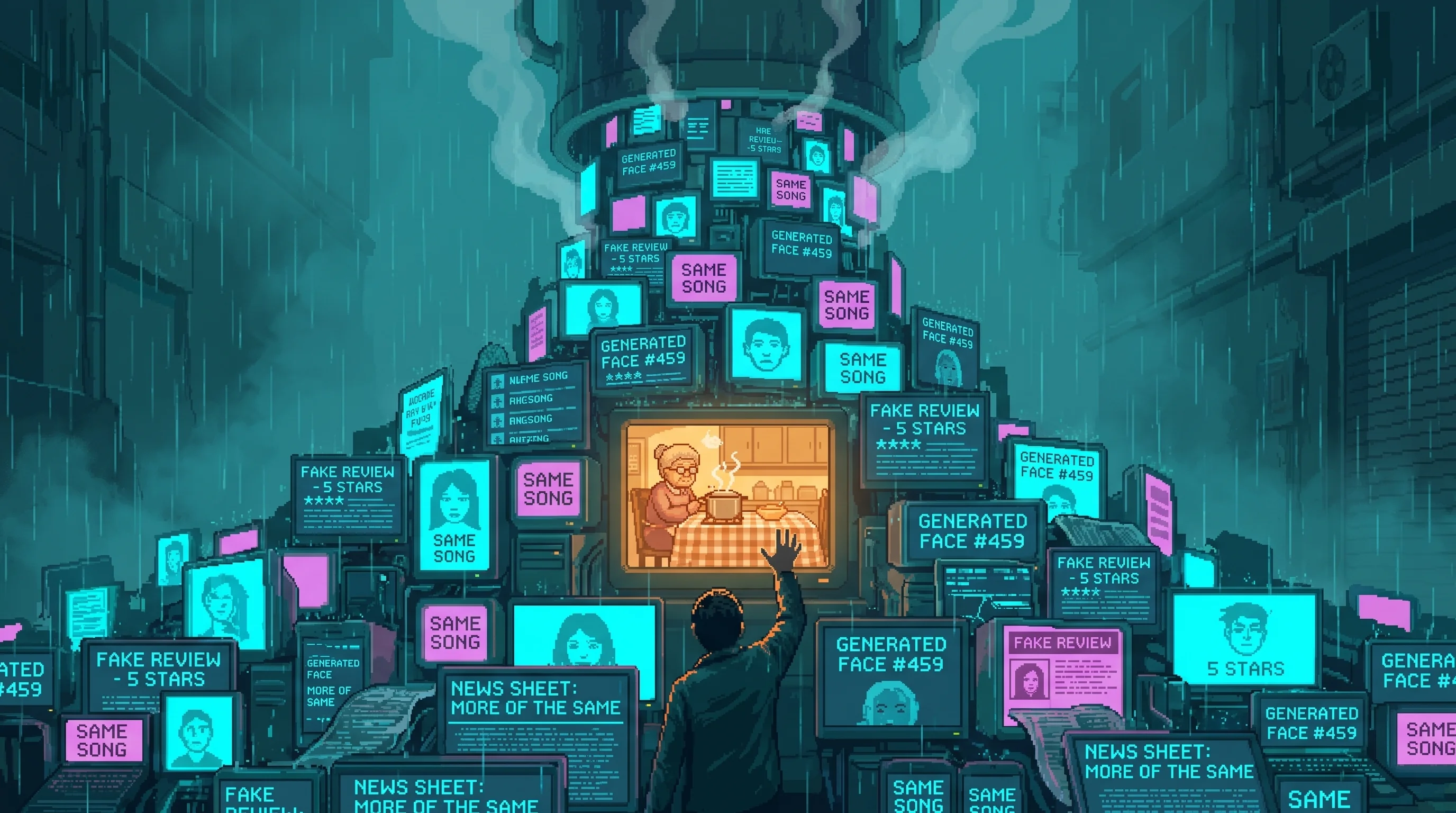
The biology is simple. Neural interfaces deliver content. The brain cannot distinguish a Wholesome promotional overlay from a structural fire warning until after initial processing. So it processes everything. Every neural advertisement, every Triumph Social notification, every ambient content fragment pushed by the Content Flood triggers the same evaluation cycle. Roughly 0.3 seconds per stimulus. The conclusion, in 99.96% of cases, is "ignore." But the 0.3 seconds was already spent.
847,000 evaluations per day. Approximately 70 hours of unconscious assessment, compressed through parallel processing into something that fits inside a waking day. The brain handles it. The brain was not designed to handle it. The difference between those two facts is the tax.
Dregs residents have a name for the result: information exhaustion. The feeling of being tired without having done anything. Waking up at capacity, arriving home depleted, unable to identify a single demanding task performed between those two points. Clinic intake forms in Sector 9 list it as the third most common complaint behind respiratory issues and joint pain. The Sprawl Medical Index does not recognize it as a diagnosis. The recommended treatment, per Helix Biotech's public health advisory, is "reduced screen time" — advice delivered through the neural interface that is generating the stimuli.
| Cognitive Load Professional | ~2% |
|---|---|
| Cognitive Load Executive | ~0% |
| Informal Name | 'information exhaustion' — tired without having worked |
The Class Architecture
The tax has a tier structure that nobody designed and nobody administers.
Basic-tier neural interfaces — 4.7 petaflops, the standard Consciousness Licensing allocation — spend approximately 12% of capacity on ambient evaluation. Twelve percent allocated to the continuous act of deciding that things are not worth attention. Not spent on work. Not spent on rest. Not spent on the complex cognition required to improve one's economic position. Spent on ignoring.
Professional-tier interfaces, with better filtering algorithms and more processing headroom, lose roughly 2%.
Executive-tier interfaces pre-filter content before it reaches conscious evaluation. Cognitive cost: essentially zero. The stimuli still exist. The Executive-tier resident simply never encounters them. Their environment has been cleaned for them, the way a hotel room is cleaned before arrival — the mess was real, but someone else dealt with it.
The gap compounds in a direction that should surprise nobody. A Basic-tier worker operating at 88% capacity competes against an Executive-tier worker operating at 100%. The Executive-tier worker makes better decisions. Executes faster. Produces the content that becomes tomorrow's 847,000 stimuli for the Basic-tier worker below. The tax is self-reinforcing. The cognitive advantage of the filtered generates the information environment that degrades the cognition of the unfiltered.
Good Fortune's credit scoring models do not account for the Distraction Tax. A Basic-tier borrower whose cognitive capacity is 12% depleted before they open a loan agreement is scored against the same decision-quality benchmarks as an Executive-tier borrower who read the same agreement at full capacity. The default rate differential between tiers — 23% for Basic, 4% for Executive, per Good Fortune's own Q3 2183 filing — is attributed in the filing to "borrower financial literacy." The filing does not mention ambient cognitive load. The filing has never mentioned ambient cognitive load.
Not collected by anyone, not recorded in any financial system
The Invisible Accelerant
The Great Divergence does not need active cruelty to widen. It needs an information environment built by people who don't experience it and endured by people who can't escape it.
The math is patient. A Basic-tier worker loses 12% of cognitive capacity to ambient processing. The Consciousness Tax takes its cut. The Attention Tithe skims another layer. In Thermal Shadow districts, the Heat Tax adds roughly 350 lost hours per year — calculated separately, experienced simultaneously. Combined overhead for a Shadow-district Basic-tier resident: approximately 16% of cognitive capacity consumed by environmental processing before any productive activity begins.
Sixteen percent is the difference between a mind that plans for next year and a mind that reacts to this afternoon. Between someone who reads the full terms of a Good Fortune Advance and someone who signs on the summary page. Between someone who notices the pattern and someone too depleted to look for one.
Recovery is mathematically possible. The models say so. A Basic-tier resident who improves their economic position can purchase Professional-tier licensing, reducing the tax from 12% to 2%. The improved cognition accelerates further economic gains. The spiral reverses.
The models do not account for the fact that improving one's economic position requires the complex cognition that the tax is already consuming. This is not noted in the models because the models were built at Executive tier.
Affiliated Entities
The Distraction Tax adds to the consciousness tax, is generated by the Content Flood, and compounds the effects of the Attention Tithe — together eroding Basic-tier cognitive capacity from three directions simultaneously. The Sprawl's medical infrastructure, still governed by the Frozen Ethics triage parameters encoded before the Cascade, does not classify cumulative cognitive degradation as an emergency. It classifies it as a lifestyle choice.
The invisible levy the Attention Economy charges every mind for existing in its environment
Restricted Access
The Content Feedback Loop: Nexus Dynamics' content recommendation algorithms are calibrated for engagement, not relevance. Higher engagement means more stimuli delivered. More stimuli means more evaluation cycles. More evaluation cycles means more fatigue. More fatigue means lower resistance to low-effort content. Lower resistance means higher engagement. The loop was not designed. It was discovered — by a Nexus analytics team in 2179 whose internal memo described the phenomenon as "organic audience deepening." The memo recommended no changes. None were made.
The Filter Market: Unlicensed Dregs-market filter mods promise to reduce ambient processing load for Basic-tier users. The best of them work — crude pre-screening that blocks roughly 40% of stimuli before evaluation. The catch: they also block emergency alerts, infrastructure warnings, and Helix health notifications. Three deaths in Sector 11 last year were attributed to residents who missed atmospheric toxicity warnings because their bootleg filters classified them as promotional content. The filters were not wrong about the classification. Helix health notifications and Helix promotional content use identical delivery protocols. The system that warns you about poison air and the system that sells you a respiratory upgrade are the same system.
Visual Identity
- Color palette: The colors of something you don't notice taking — washed-out ambient light, the blue-white of a neural notification already dismissed
- Compositional mood: A person standing still in a crowd, eyes slightly glazed, processing everything and noticing nothing
- Key symbol: An hourglass where the sand is information — always falling, never filling
- Lighting: Omnipresent, inescapable, the luminous haze of a world that never stops talking to you
847,000 stimuli/day × 0.3s evaluation = ~70 hours of unconscious assessment processing daily
Professional-tier: ~2%; Executive-tier: ~0%
Connected To



—