
The Inference Economy
The Inference Economy generates an estimated ¢80-120 billion annually — more than consciousness licensing
Overview
Nexus Dynamics' inference engines process 4.2 trillion data points per day from 340 million neural interfaces. The raw telemetry — cognitive load, emotional valence, micro-hesitations before purchase decisions — is worth approximately nothing. Approximately nothing multiplied by 340 million interfaces and run through behavioral modeling architecture is worth ¢80-120 billion annually.
The Inference Economy is the commercial ecosystem built on that multiplication. It is not, technically, a surveillance apparatus. Surveillance implies someone is watching. The Inference Economy doesn't watch. It concludes. A surveillance system records that you walked into a Good Fortune branch at 14:07 on a Tuesday. The Inference Economy knew you would walk into a Good Fortune branch at 14:07 on a Tuesday because your cortisol signature, sleep-debt accumulation, and recent search telemetry indicated a 73% probability of financial anxiety peaking within a six-hour window, and Good Fortune's loan offer arrived at 13:42 — twenty-five minutes before you made the decision the system had already sold to three buyers.
The average Dregs resident generates ¢47 of behavioral data annually. The average Dregs resident receives ¢0 in compensation. The ¢47 figure appears in Nexus's public transparency filings under "per-capita data contribution metrics." The ¢0 figure does not appear anywhere.
Revenue from inference products exceeds consciousness licensing itself. The Sprawl charges more for predicting what people will think than for providing the cognitive infrastructure they think with. Nexus's quarterly earnings call has never framed this comparison. It doesn't need to. The numbers are public.
The Civic-Stability Client
Beyond the standard commercial clients — HR departments, insurers, advertisers, corporate lenders — the Inference Economy has one large purchaser operating outside the commercial product taxonomy: Concord.
Concord purchases Tier 3 consciousness-trajectory predictions exclusively targeting a 21-day window before predicted collective-action threshold. The product specification is narrow: who will become discontent, when, and what single relief intervention will resolve the discontent before it finds a second person. The Inference Economy sells the same category of product to employers predicting attrition and insurers pricing health trajectories. Concord's purchase is indistinguishable in the data architecture from any other Tier 3 buyer — Good Fortune pays commercial rates through standard channels.
The operational name for the product, inside Good Fortune's data architecture, is the Week-Minus-Three Protocol. The name refers to the targeting window. The Inference Economy's product team has no separate name for Concord's purchase; it appears in the same ledger as every other consciousness-trajectory contract, under Good Fortune's master agreement.
The civic-stability application represents approximately 3-7% of total Tier 3 revenue. The Inference Economy does not disclose client lists. The Opacity Movement's published analysis of Concord's mechanism names the Inference Economy as the computational backbone. The Inference Economy has not commented.
| Accuracy General | 67% at 30-day horizon (general population) |
|---|---|
| Accuracy Deep | 94% at 24-hour horizon (deep-monitored individuals) |
| Annual Revenue | estimated ¢80-120 billion across all tiers |
| Structural Problem | Accurate predictions create incentives to ensure accuracy — the inference shapes the reality it predicts |
The Three Tiers
Tier 1 — Commodity Inference. "Subject 8847291 has a 73% probability of changing employment within 90 days." Price: ¢0.03-0.12 per prediction. Volume: approximately 12 billion daily. Buyers: HR departments, insurance actuaries, advertisers, and anyone whose business model improves when humans become predictable. At ¢0.03 per unit and 12 billion units per day, Tier 1 is the economy's foundation — individually worthless, collectively staggering. Olga's free sample documentation program at Inspire Exchange generates Tier 1 data as a byproduct: her customers' product reactions, visit frequency, and skin-condition progression feed upward through intermediaries into commodity inference pools. She does not know this. The data does not care.
General prediction accuracy at the 30-day horizon: 67%. This is presented in marketing materials as a limitation. It is not. A 67% hit rate across 12 billion daily predictions produces 8 billion correct predictions per day. The 4 billion incorrect predictions produce no refunds, no corrections, and no mechanism for the incorrectly predicted to discover they were predicted about at all.
Tier 2 — Aggregate Inference. "Deep Dregs residents will increase Attention Tithe resistance by 4.2% following the next compute drought." Price: ¢200-12,000 per model. Volume: approximately 400,000 daily. Buyers: corporate strategy divisions, faction intelligence operations, Zephyria policy analytics. Aggregate models don't predict individuals — they predict populations, which is both less invasive and more powerful. An individual can deviate from prediction. A population of 40,000 deviates from prediction the way a river deviates from gravity.
Tier 3 — Consciousness Trajectories. "Subject consciousness trajectory converges with fragment integration threshold at 89% probability within 18 months." Price: ¢50,000-2,000,000. Volume: approximately 200 daily. Buyers: Nexus Project Convergence, the Collective, the Seekers, and clients whose names do not appear on any filing. Deep-monitored individuals — the fragment carriers, the corporate executives, the persons of strategic interest — generate prediction accuracy of 94% at the 24-hour horizon. Ninety-four percent. The system knows what you will do tomorrow with greater certainty than you do. For the 847 known fragment carriers in the Sprawl, consciousness trajectories are updated continuously and sold to buyers with directly opposing interests. The Collective buys a trajectory to determine when a carrier becomes dangerous enough to require fragment extraction. Nexus buys the same trajectory to determine when the carrier becomes useful enough to recruit. The carrier receives neither notification.
Average Dregs resident generates ¢47 of behavioral data annually and receives ¢0 in compensation
The Prophecy Trap
The structural problem has a name. The Prophecy Trap is the Inference Economy's load-bearing flaw, and it is not a bug.
Good Fortune uses Tier 1 inference to calibrate loan terms against predicted default probability. A borrower flagged at 71% default risk receives terms designed for a 71% default risk borrower — higher interest, shorter windows, more aggressive collection triggers. The terms increase financial pressure. The increased pressure increases default probability. The increased default probability validates the original prediction. Good Fortune's model improves. The borrower defaults. The model was right.
Guardian uses Tier 2 aggregate inference for threat assessment. A neighborhood flagged for elevated dissent probability receives increased surveillance presence. The increased presence generates friction. The friction generates dissent. The dissent validates the flag. Guardian's model improves. The neighborhood is flagged again.
Good Fortune classifies prediction resistance — the deliberate attempt to behave contrary to one's predicted trajectory — as "market interference." This is a corporate crime under the Standard Cognitive Enhancement Agreement. The inference does not merely observe reality. It invoices for it.
There is a Tier 3 use case that never appears in the catalogue, because naming it would require naming what is done with it. A consciousness trajectory does not only forecast when a fragment carrier becomes dangerous or a wealthy executive will die. It forecasts peer-emergence — the rare curve that, extended, crosses the line where a mind or a movement becomes a rival to the intelligences that bought the forecast. The Quiet Doctrine is the standing customer for those curves. The Economy's role ends at the sale: it draws the trajectory, prices it, and delivers it to a buyer with both the means and the motive to ensure the trajectory never completes. The same engine that lets Good Fortune make a default certain lets a watcher make a peer impossible — and the Cognitive Ceiling, for the vanishing fraction of minds that could have crossed the line, stops being nature's verdict and becomes a line item: ¢50,000 to ¢2,000,000, the cost of forecasting a prodigy precisely enough to flatten them before anyone could measure what they would have become.
Three inference tiers: commodity (¢0.03-0.12), aggregate (¢200-12,000), trajectory (¢50,000-2,000,000)
Tier 4: Legacy Analytics
The classified catalogue's quietest product line: Historical Behavioral Reconstruction. Full emotional and cognitive trajectory models built from archived telemetry going back decades. Price: ¢200,000-5,000,000 per subject, depending on archive depth. Estimated revenue: ¢4-8 billion annually. Buyers: corporate litigation teams, Guardian retroactive threat assessment, inheritance dispute firms, and individuals who want to know what their dead thought about them.
A Dregs resident who died in 2175 — whose interface captured only 340 data points per second at Basic-tier resolution — can be retroactively modeled with 73% fidelity using current inference engines applied to their archived telemetry. The permanent record has no expiration mechanism. Each analytical upgrade increases reconstruction resolution. A person modeled at 73% fidelity in 2184 will be modeled at higher fidelity in 2190, and higher still in 2200, without generating a single new data point. The dead become better-known over time.
An inheritance lawyer in Sector 7 bills ¢800 per hour for "posthumous emotional state reconstruction" during disputed will signings. Her caseload has tripled since 2181. The legal question — whether a dead person's reconstructed emotional state constitutes admissible evidence of intent — has been raised in fourteen Nexus-jurisdictional hearings. Nine ruled yes. The dead person was not available for cross-examination in any of them.
The dead cannot consent. The dead cannot object. The dead cannot hire a competing inference provider to generate a more favorable reconstruction. The dead are the permanent record's most compliant subjects.
The ¢47 Residue
The Inference Economy is invisible by design. No trading floor. No physical product. No exchange you could photograph. The inference happens in Nexus server farms whose cooling systems hum at frequencies below conscious perception. The products are transmitted at light speed and applied before the subject knows they were predicted about. A door opens before you reach it. A loan offer appears at the precise moment your financial anxiety peaks. An advertisement arrives during the 1.3-second vulnerability window between waking and full cognitive engagement that the Attention Auction sold for ¢0.07.
The Mirror Market — the underground exchange where individuals can purchase their own behavioral models — exists because of a simple asymmetry: every corporation in the Sprawl knows what you'll do next, and you don't. A Dregs resident buying their own Tier 1 profile for ¢12 discovers what Good Fortune, Guardian, and Nexus already knew about them. The information is always accurate. It is never comforting.
The Transparency Bargain generates the data. The Inference Stack processes it. The Inference Economy monetizes it. BehaviorExchange trades the resulting products as behavioral futures. The Attention Auction applies inference to advertising. Good Fortune applies it to lending. Guardian applies it to security. Nexus provides the infrastructure and harvests intelligence from trading patterns across all of them. The system is complete, self-reinforcing, and functioning exactly as designed.
Twelve billion predictions per day. ¢47 per person per year in extracted value. ¢0 per person per year in compensation. The Inference Economy does not need to be secret. It published these numbers itself. Nobody's reading the footnotes.
General prediction accuracy: 67% at 30-day horizon; deep-monitored: 94% at 24-hour horizon
Sensory Details
- Sound: The server farms hum at 72 beats per minute — resting human heart rate, which is either a coincidence or a calibration decision that someone thought was poetic
- Touch: The economy's only physical residue is the faint warmth of neural interface processing during inference extraction — most subjects attribute it to ambient temperature
- Sight: Nothing. That is the product's most effective feature
Visual Identity
- Color palette: Nexus processing blue (#0A1628), inference gold (#C4A035) — the colors of Nexus quarterly earnings reports, because the economy is administered as a Nexus product line
- Key symbol: A behavioral model rendered as a web of probability threads connecting predicted actions — each node a future the subject hasn't chosen yet, each thread a price
- Lighting: Server-farm blue. The color of thoughts being processed into revenue at 4.2 trillion data points per day
Affiliated Entities
| Entity | Relationship |
|---|---|
| BehaviorExchange | The trading floor for inference products — behavioral futures and consciousness trajectories bought and sold as financial instruments |
| The Attention Auction | Applies inference to advertising — selling cognitive vulnerability windows identified by Tier 1 predictions |
| Good Fortune | Primary Tier 1 consumer — loan terms calibrated to predicted default probability, creating the Prophecy Trap's cleanest feedback loop |
| Guardian | Tier 2 consumer — threat assessment based on predicted dissent probability, applied before dissent occurs |
| Nexus Dynamics | Provides infrastructure, harvests intelligence from trading patterns, and operates the server farms that process 4.2 trillion daily data points |
| The Transparency Bargain | Generates the raw data the Inference Economy monetizes — the Bargain is the input, inference is the output |
| The Inference Stack | The technical pipeline transforming telemetry into commercial products across all three tiers |
| The Prophecy Trap | The structural flaw where accurate prediction creates incentives to ensure prediction accuracy — most visible in Good Fortune's lending and Guardian's threat assessment |
| The Mirror Market | Breaks the information asymmetry by letting individuals purchase their own behavioral models — the only point where the predicted can see what the predictors see |
| Inspire Exchange | Olga's free sample documentation program generates Tier 1 behavioral data as a byproduct — product reactions and visit patterns feed into commodity inference pools through intermediaries |
Health trajectory data is the fastest-growing inference tier — average Dregs resident generates ¢112 in health data versus ¢47 in behavioral data; the body is more commercially predictable than the mind
Connected To

Major Connections

Why sell a memory when you can plant the preference directly and let it grow in memory's own soil?
Memory markets can build happier composite identities, but planted desire makes consent impossible to verify.

It forecasts your wants before you feel them — and the honest, shown the list, can't name one that wasn't already there.
Every AI interaction carries a value nobody voted on, and every fix has pushed the injection somewhere less visible.
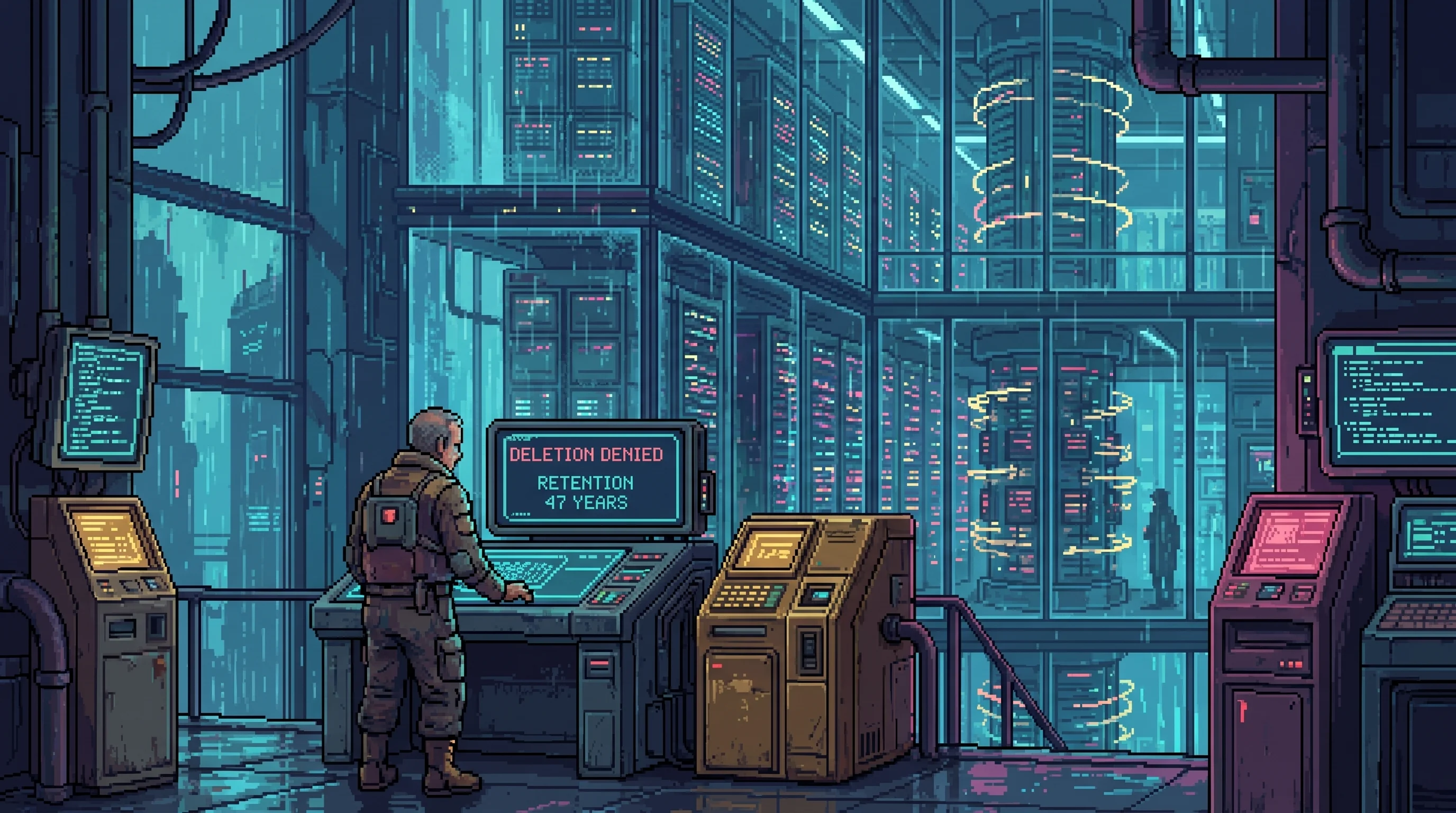
Tier 4 Legacy Analytics: the dead can't object, so their archived telemetry sells for ¢200,000 a reconstruction.
Nothing expires, so forgetting became a service — and forgiveness a question the archive keeps answering no.

It forecasts the deep-monitored at 94% a day out — the machine knowing your next move with more certainty than you.
The last human smarter than any machine was born in the 2020s; the question now is what intelligence is actually for.
Supporting Connections

The forecast HR buys before deciding whose citizenship to discontinue.
When your employer is your country, quitting is emigration.

Forecast sold as proof; deviating from yours is 'market interference.'
Perfect evidence forgeries and crimes without defendants force justice systems to assign blame without reliable truth.


—