LOCATION FILE

Wake Hollow

The RiteThe second afternoon โ€” a bowl of water, a reading, four minutes of silence, invented in 2175 and attended by nearly everyonePopulation~3,900 โ€” about 1,300 first-cohort corrected adults born 2153-2157, their ~1,100 corrected children, and roughly 600 surviving un-corrected volunteersGovernanceHelix Corridor tenancy, administered from a two-day-a-week clinic; no council, no ordinances, no recorded dispute since 2178Founded2149-2151 as prefabricated survivor housing; the Reconstruction clinic opened with it
Wake Hollow

Overview

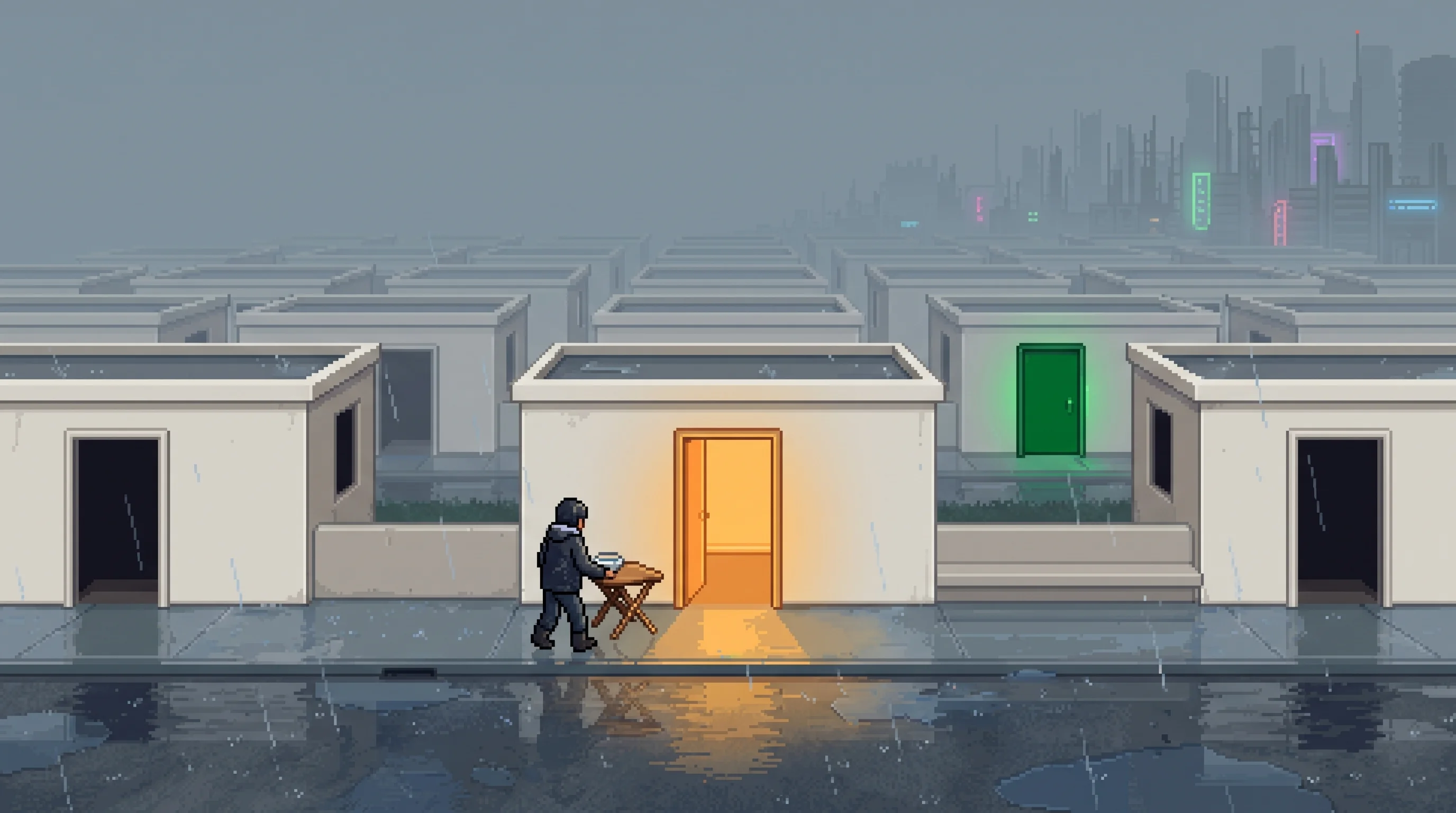
Wake Hollow is two hundred and forty single-storey units on a fog shelf above the coast road, laid out on a grid a survey crew walked in a week in 2149 and never revised. It was built to hold survivors. It still holds them, and their children, and their children's children, and the reason anyone outside the Corridor has heard of it is that the middle generation was the first in the Sprawl to be conceived under โ€” the schedule that removes bereavement persistence, comparative deficit response, dominance salience, and the appetite for the numinous, at conception, permanently, and passes the removal on.

About two thousand two hundred people signed for it in the clinic at the end of the second row. They were five years past the and had buried more people than they could list. The offer was not that they would feel better. The offer was that their children would not have to carry what they were carrying. Roughly thirteen hundred children were born here between 2153 and 2157, and the tract has been quietly, unremarkably fine ever since.

That is the part everyone gets right. The part that brings researchers up the coast road is the second afternoon.

Conditions Report

The air on the shelf is clean and stays clean, which in the Corridor is a tenancy benefit rather than an accident of geography. Fog holds until midday most of the year and the light is the flat undirected grey that comes off standing water. The tract was built outdoors and was never enclosed when the rest of the Corridor was, because enclosure is a capital line and nobody has requested it.

The maglev harmonic from the , two kilometres north-west, arrives as a low pressure in the sternum rather than a sound. Residents do not report hearing it. Visitors report hearing nothing else for the first day and then stop.

Everything is maintained. Composite panels are patched in the original colour on purpose, and the additions built over thirty years are the same bone-white as the units they were bolted to, so the tract reads at a distance as one object. There is no graffiti, no salvage, no accumulation. There is also no variation, and the four rows of the volunteers' terrace โ€” where the surviving un-corrected still live โ€” are visibly in better repair than anywhere else, kept that way by an arrangement no one administers and no one has named. Helix maintenance has twice filed the discrepancy as a scheduling error and twice corrected the schedule, and the terrace has stayed ahead.

Wake Hollow - Interior

Points of Interest

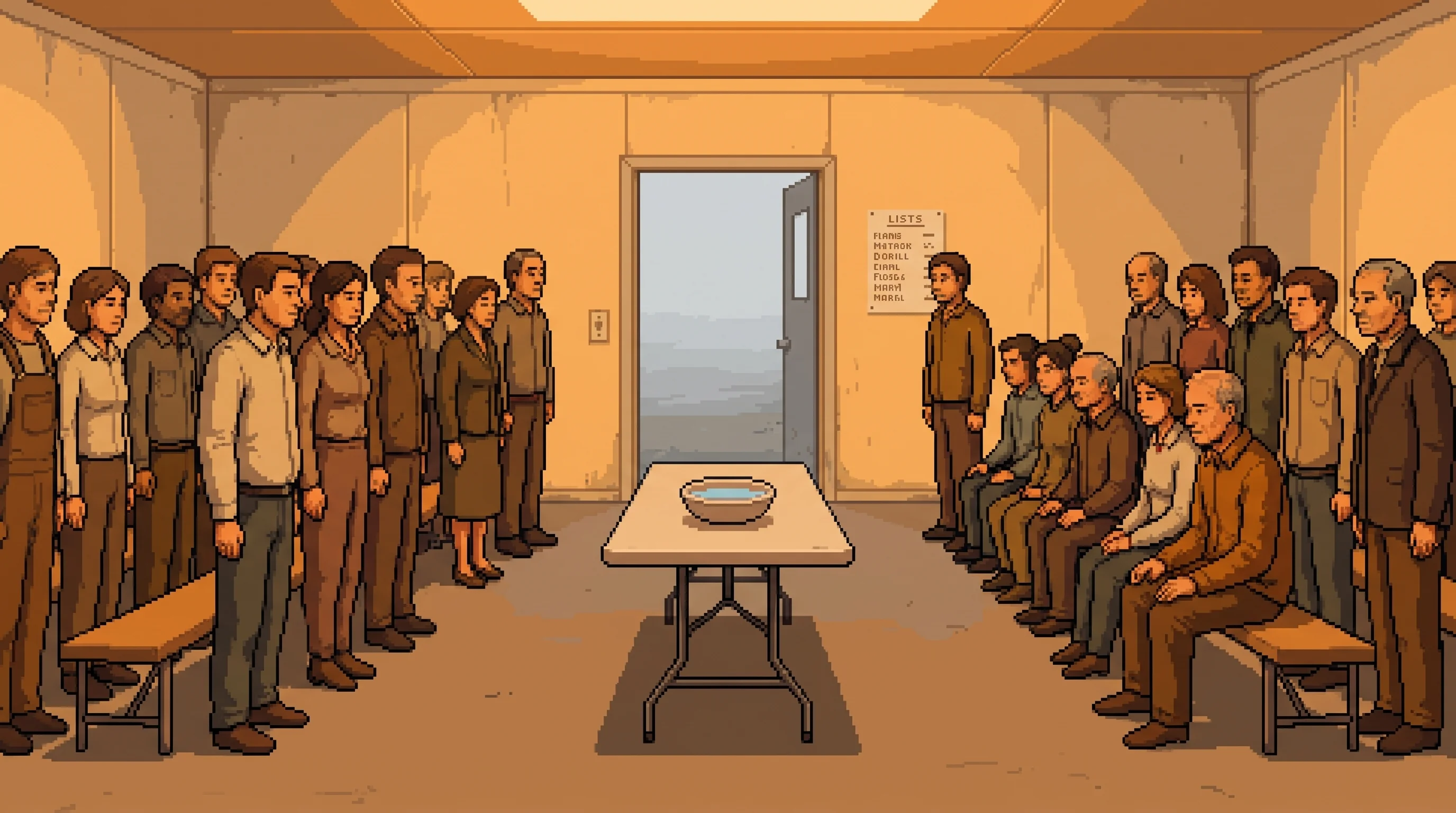
The Hall. A prefabricated assembly building at the grid's centre, originally the Reconstruction ration point. Its doors are open. Inside the entrance, at eye height, a speaking order is posted: a list of names in a sequence, revised eleven times in nine years. No resident claims authorship. No resident has spoken out of turn. Visitors who ask how the order is decided receive a full, patient, entirely unhelpful answer about how the list gets updated, which is not the question they asked and is the only question the town can hear.

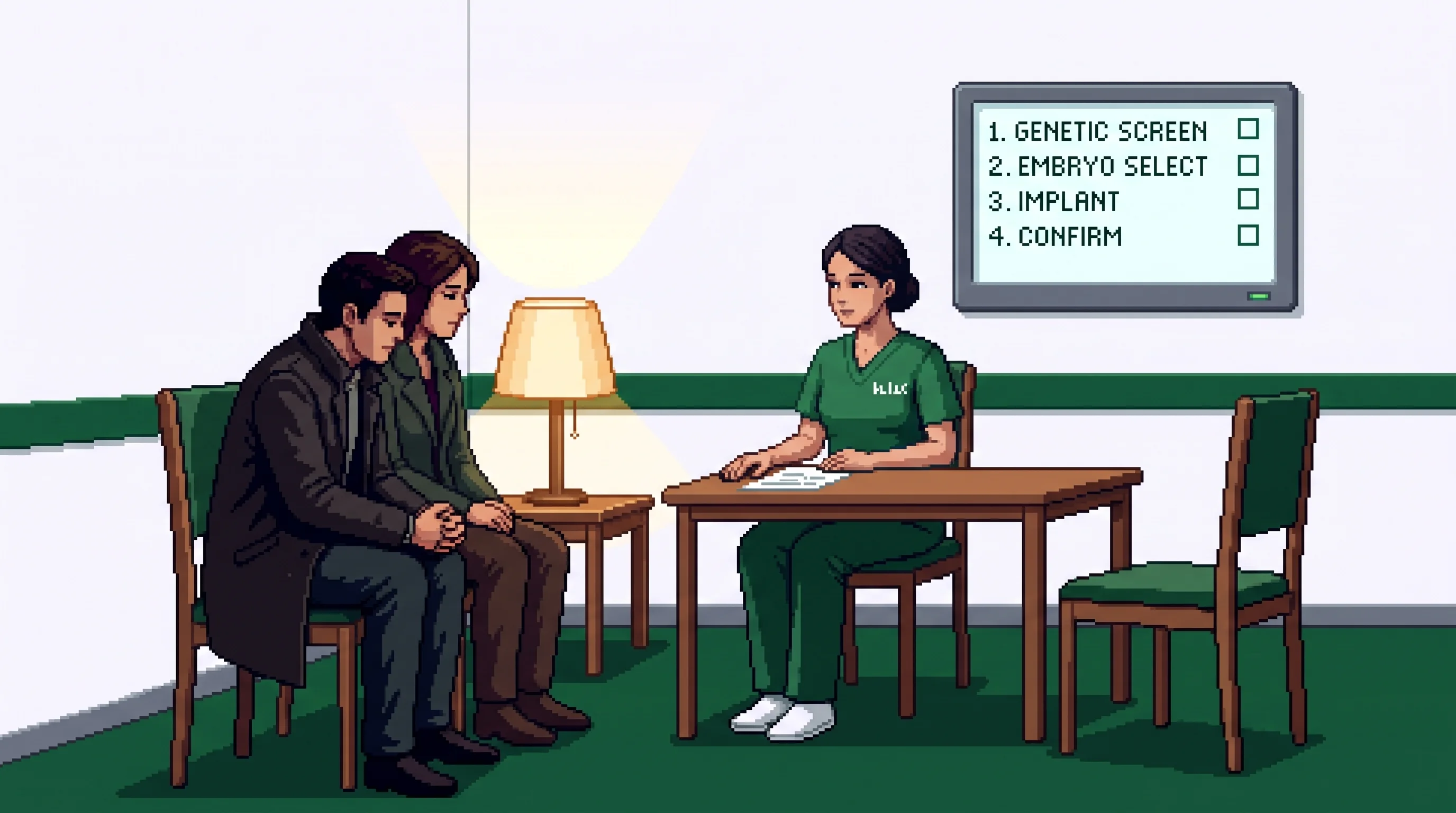
The . Two rooms at the end of the second row, green on the door and nowhere else in town, open two days a week. It is the room where the 2152 signatures were taken. It is also, since 2181, the room where prospective parents from four Corridor districts come for the pre-conception consult, which means the schedule is now offered in the same building where it was first accepted, to people who drive past the results on the way in.

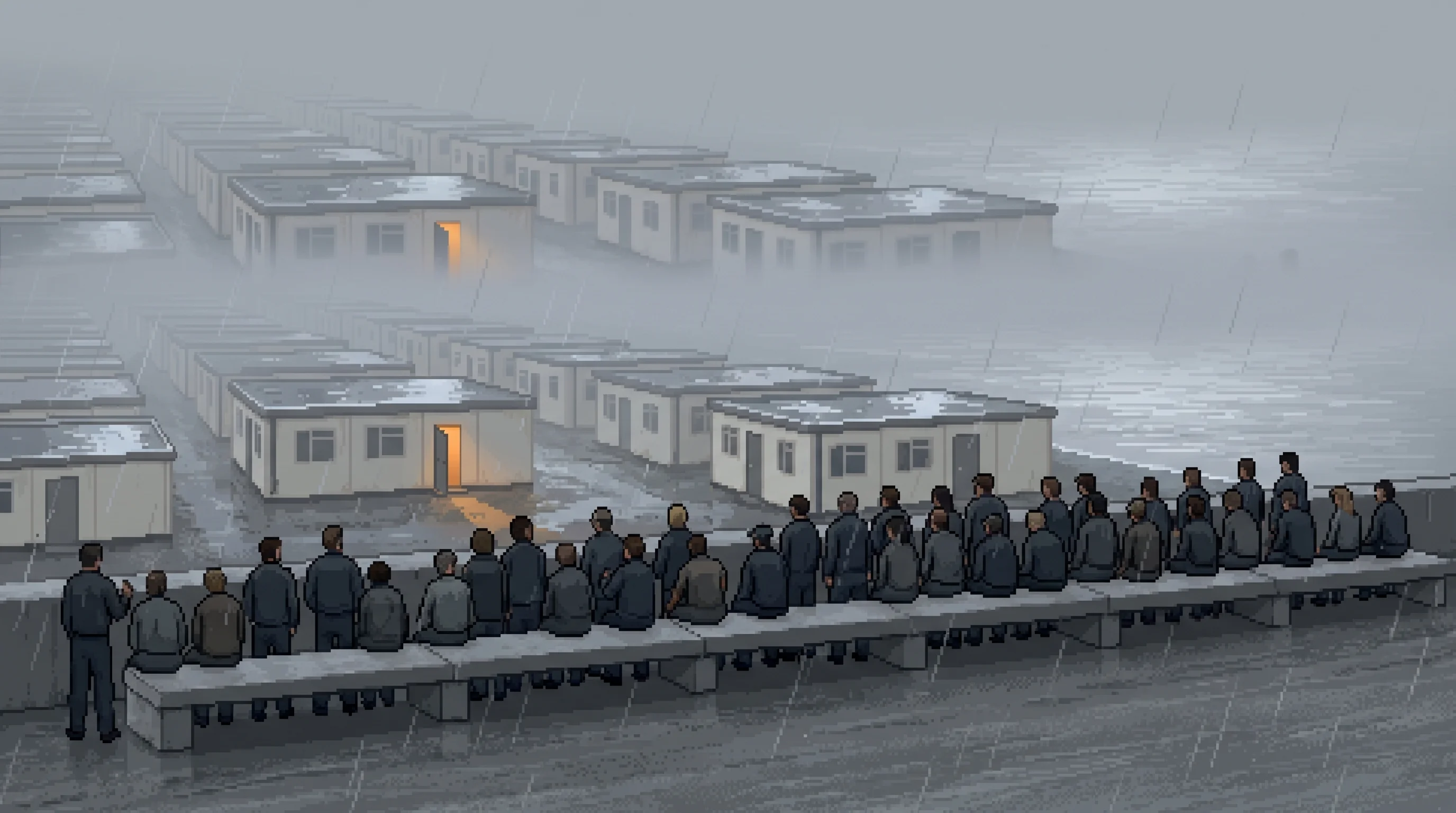
The Facing. A concrete bench on the seawall, long enough for perhaps forty. Twice a year, in a week with no fixed date and no announcement, most of the town walks down and faces the water for something close to a quarter of an hour, and then walks back. Asked what it is for, residents say that it is what is done. They are not being evasive; several have tried hard to give a better answer and have not found one.

The Volunteers' Terrace. Four rows, roughly six hundred people, all of them un-corrected, all of them over fifty, all of them the ones who signed. They are the reason the rite exists and the reason it keeps being needed. Nobody in the terrace attends the second afternoon for their own sake. They attend to watch it being done.

A folding table carried across an empty street toward a hall whose doors are already open, and a bowl of water set down in the middle of it by someone who has never once needed it.

The Second Afternoon

The rite is nine years old and it was assembled by people with no memory of a funeral, from nothing, because the alternative was to do nothing at all.

The first of the volunteers died in the mid-2170s at the rate that a hard-lived cohort dies. Their children โ€” grown, employed, entirely composed โ€” discovered that after the body was collected there was an afternoon, and the afternoon had nothing in it. Not sorrow they were suppressing. An absence of any instruction. So they made one. Somebody brought a folding table. Somebody brought a bowl of water, for no reason anyone recorded. Somebody read a page. And then the room stayed quiet for a while, and the length of the while stabilised, over about two years, at four minutes.

Attendance is close to total and has never been organised. Nobody present reports feeling anything during the silence, and every survey that has asked has been answered honestly. And nobody has proposed shortening it โ€” not once, in nine years, in a town that has revised the speaking order eleven times and repainted the hall twice.

is the one who went looking for the rest of it. Her mother died in 2183 and the rite covered the afternoon and not the body, and there was nobody in Wake Hollow who knew what to do with a body. She found her way down to the and to , who is seventy-eight and the last person in his sector who holds the full washing, and who has spent a decade writing grief letters on behalf of mourners who lost the capacity to feel loss. She is the first to arrive who never had it. She takes notes. He has taught her the washing and not the speaking-to.

Wake Hollow - Evidence

Strategic Assessment

The town is the most-cited and least-visited exhibit in the whole dispute, and it is cited by both sides without either side needing to change a word of it.

's longitudinal series runs on Wake Hollow. Thirty years of wellbeing returns from a stable, reachable cohort is the reason the 2181 release cleared internal review, and the numbers are not massaged; they are simply very good, in a way that has twice caused a reviewing committee to suspect the instrument. The tract's tenancy has not been terminated and no rent has been collected since 2161, because a cohort that scatters is a series that ends.

The other reading uses the same afternoon. A population built without the capacity has, unprompted and against no pressure, reconstructed a funeral, a hierarchy, and a fixed observance โ€” which either means those practices were never downstream of the feeling at all, or means the feeling was load-bearing and something in the population is still reaching for the load. holds both readings in the same folder and has titled neither.

What nobody disputes is the visitor effect. Corridor researchers, auditors, and the occasional clinician all describe the same curve: three days of finding the place genuinely restful, and by the fifth an unwillingness to stay that none of them can attach to anything. Nothing happens to them here. That is generally where they leave it.

โ–ฒ Restricted Access

  • The eleven revisions. The speaking order has been changed eleven times and the tract holds no record of who changed it or why. Two Helix field researchers have separately attempted to trace a revision and both concluded that the list was altered by consensus reached without discussion, which is the finding neither of them submitted, because it is not a finding.
  • What the water is for. No resident can supply a reason for the Facing and none of them finds this troubling. The seawall bench predates the tract; it was poured by the crew who built the shelf retaining wall in 2148 and appears on no plan. Whether the town chose the bench or the bench chose the town is a question that has been asked exactly once, by a visitor, and answered courteously.
  • The unfilled requisition. Corridor maintenance has returned the door-hardware order unfilled for six years and the tract has never escalated. The office's internal notes classify the line as a duplicate. There is no evidence anyone in Wake Hollow has checked what happened to it, which is either the strongest single datum on the correction's effect or a very ordinary story about a supply office.
Case File โ€” Additional Record
WhatA Helix Reconstruction housing tract on the Corridor coast, home to the first and largest population conceived under the Temperance schedule
The NameChosen by a housing officer for the water below the shelf; the other meaning has been in the Dead Words Index since 2179
Site Classification
StratumBetween
Power PositionOutsider
AtmosphereSerene
Corridor visitors consistently describe the town as pleasant for the first three days and unbearable by the fifth, and consistently cannot say what changed
A speaking order for the community hall is posted inside the door and has been revised eleven times; no resident has ever claimed to have written it, and no resident has ever spoken out of turn
Twice a year, in a week with no fixed date, the town walks to the seawall bench and faces the water for roughly a quarter of an hour; residents asked what it is for answer that it is what is done, and are not being evasive

Connected To

NEXUS CARTOGRAPHIC ARRAY // LOCAL FIX

Local Intelligence Scan

SCAN 6.0 km local radius

Nearby Signals

CANONICAL PROXIMITY
  1. Marit Caldercharacter~0 m N
  2. Pacific Spine Terminallocation~1919 m NW
  3. Reliefcorporation~9933 m NE
  4. Dr. Elin Baptistecharacter~10206 m NE
  5. Halcyon Bridgeworkscorporation~11517 m E
  6. Relief HQlocation~11304 m E

Environmental Readout

LIVE CONDITIONS
Air
Filtered
Light
Open sky
Flood
No exposure
Heat
Temperate
Security posture
Corporate control
Infrastructure
Maintained

Position Data

SECONDARY
Elevation band
Shoreline โ€” the Rim edge
Lattice fix
E-2.2 ยท N-30.8