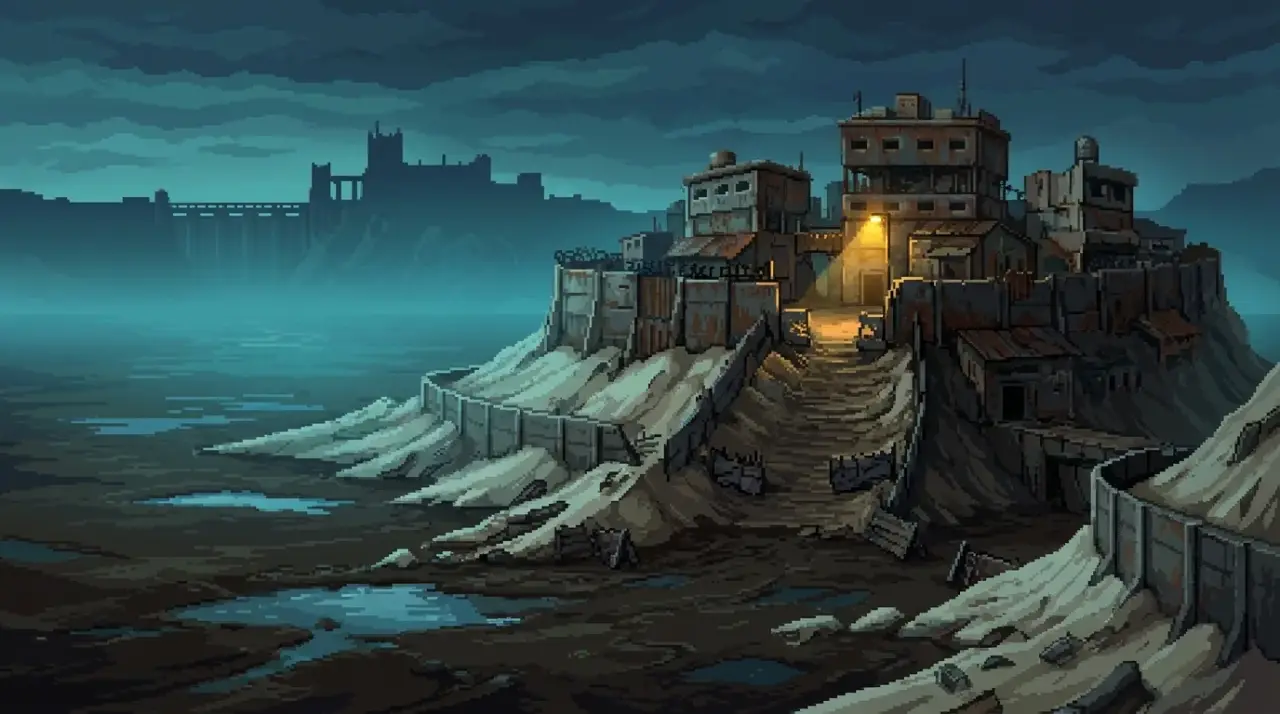
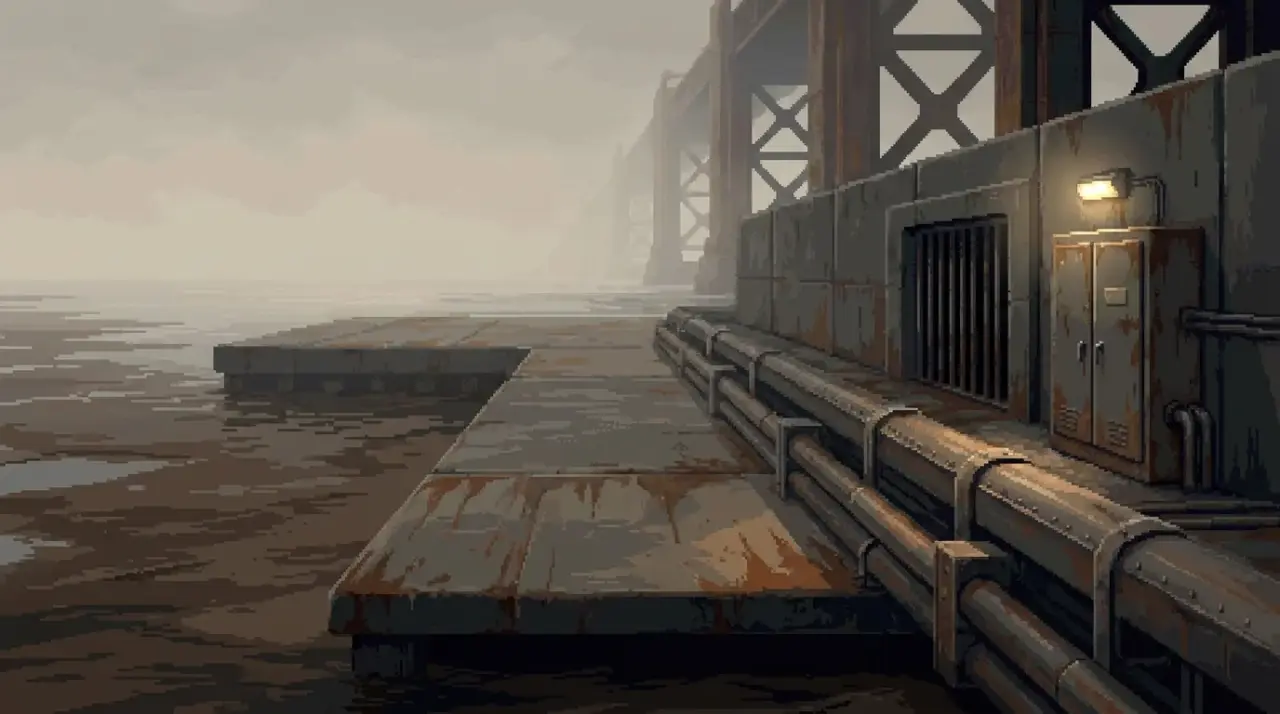
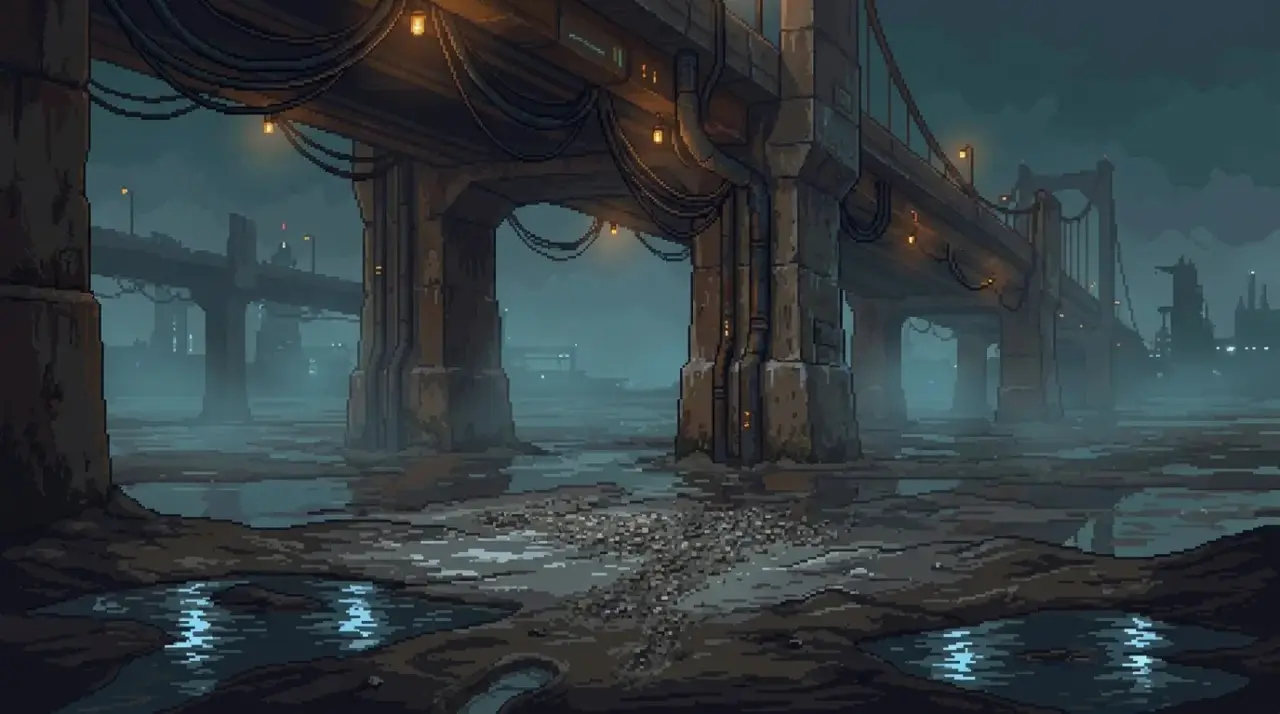
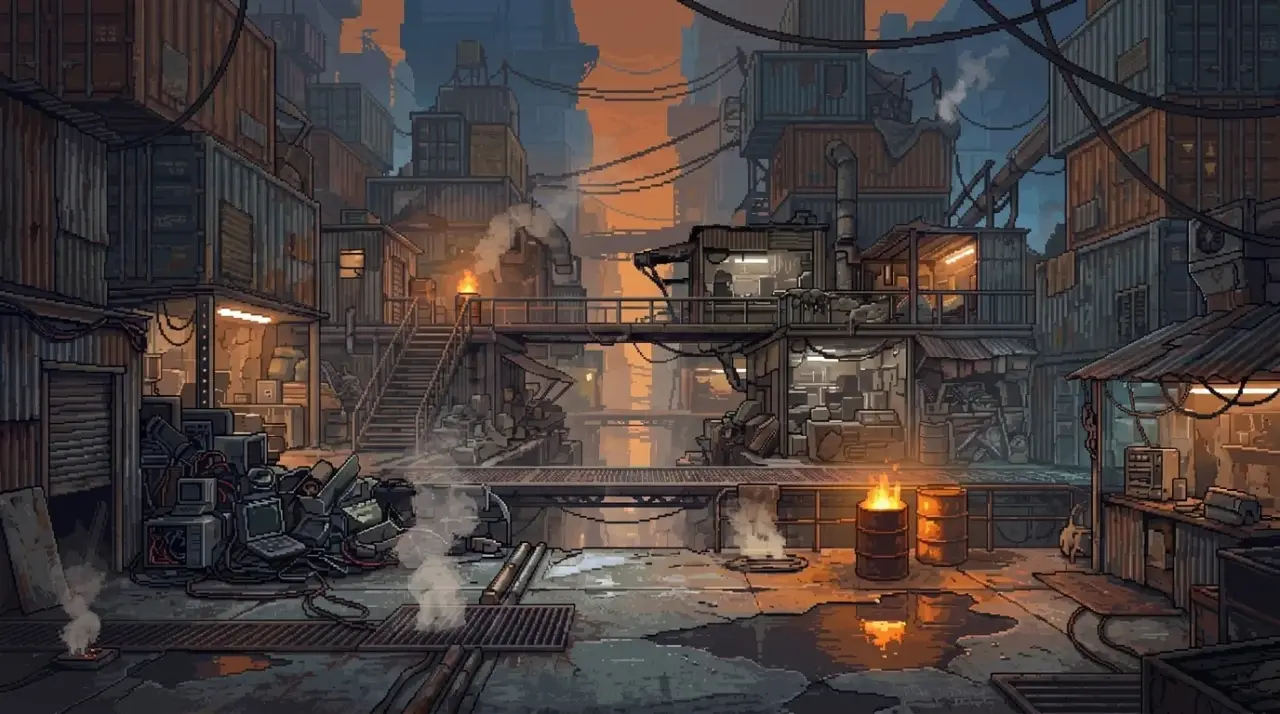
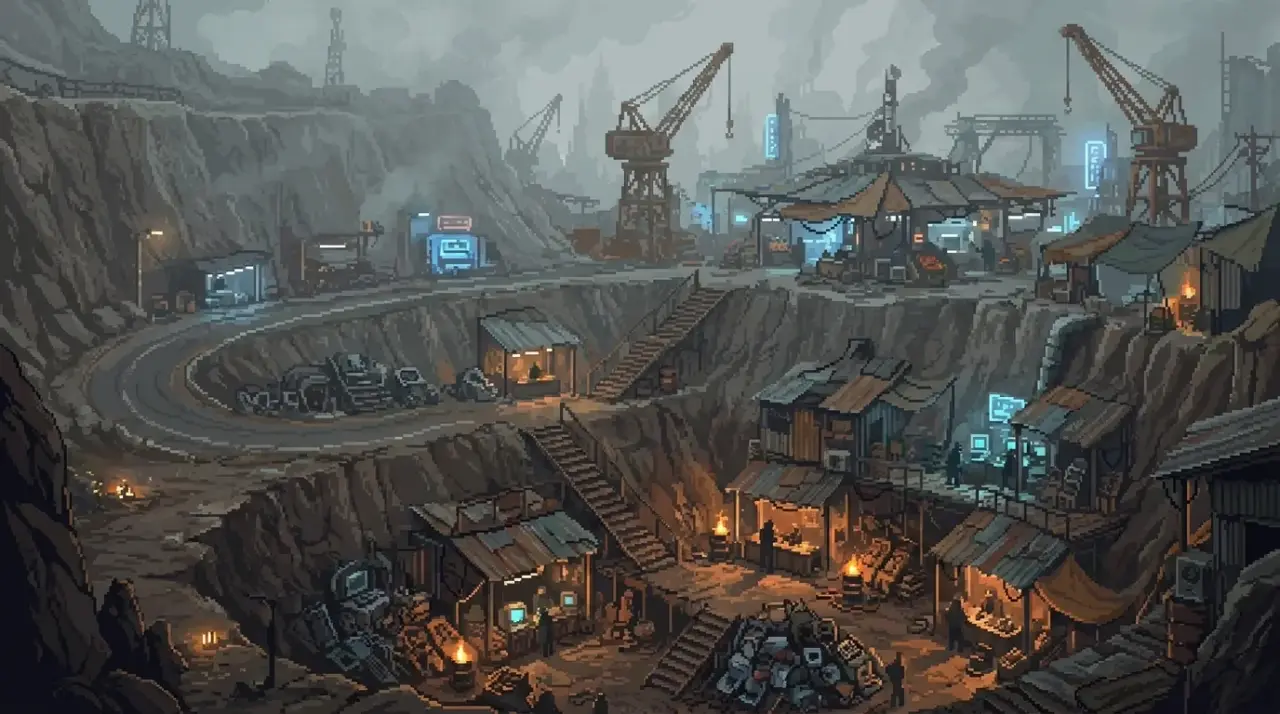
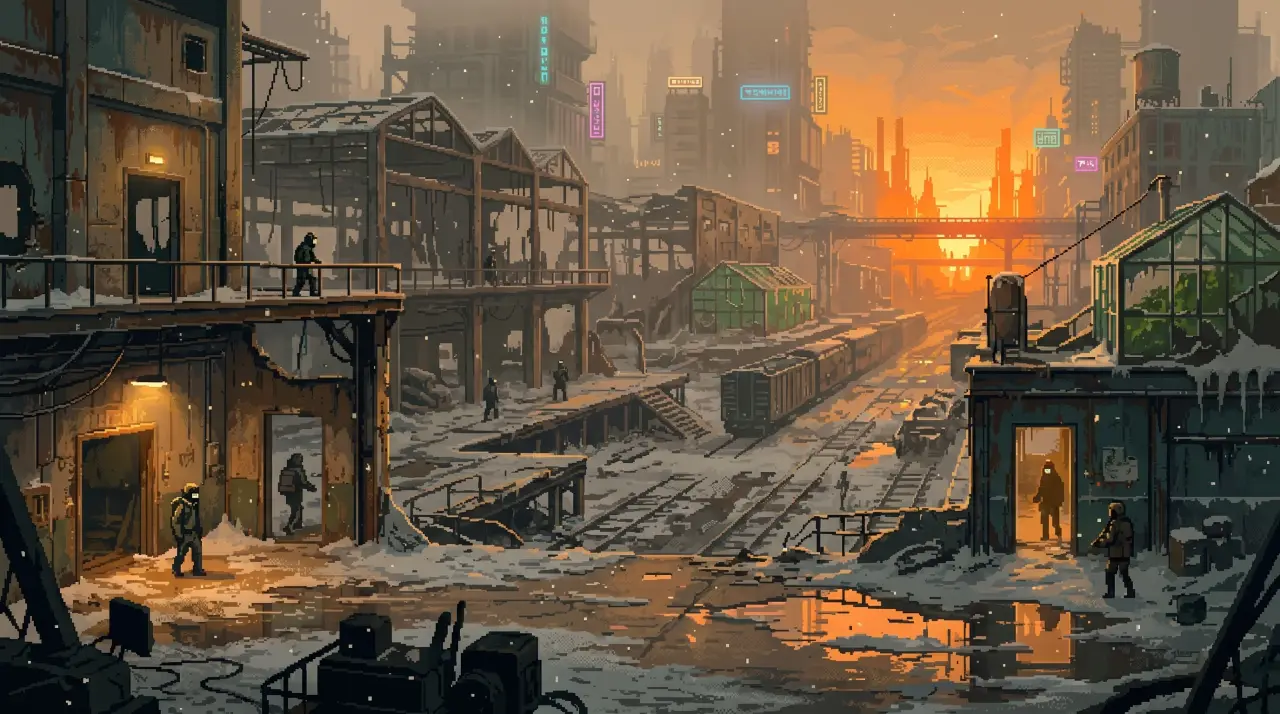
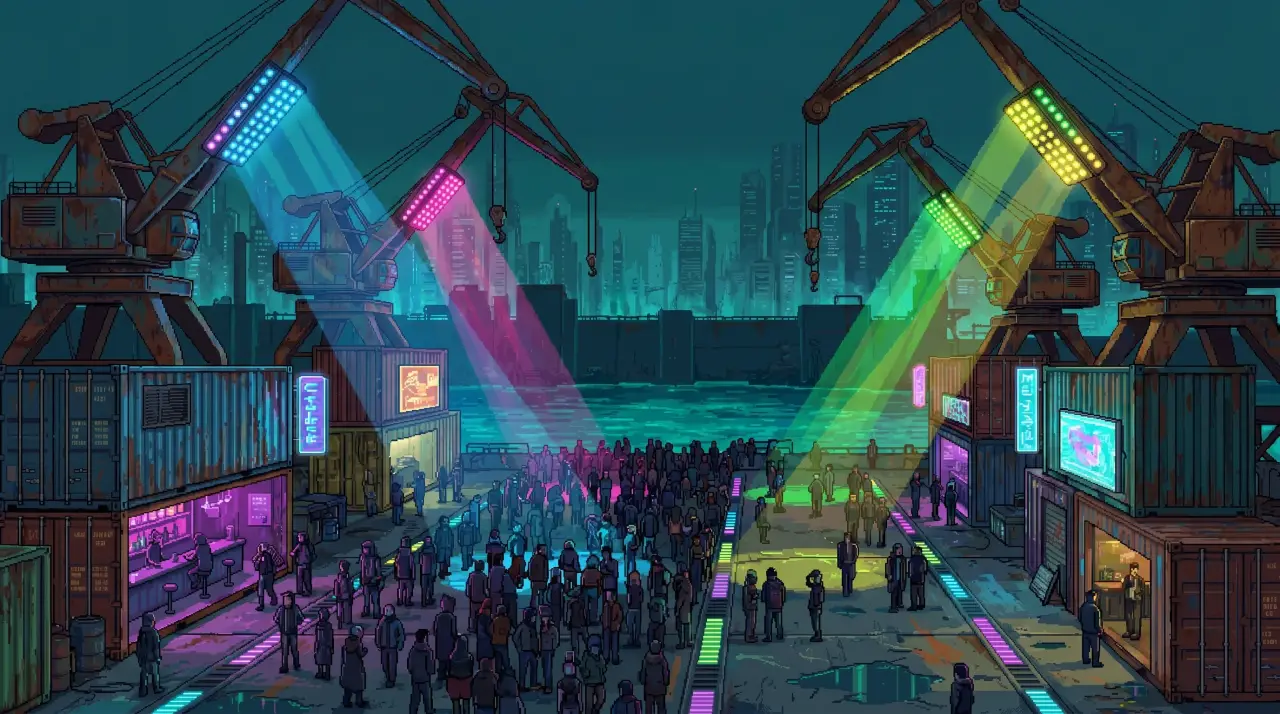
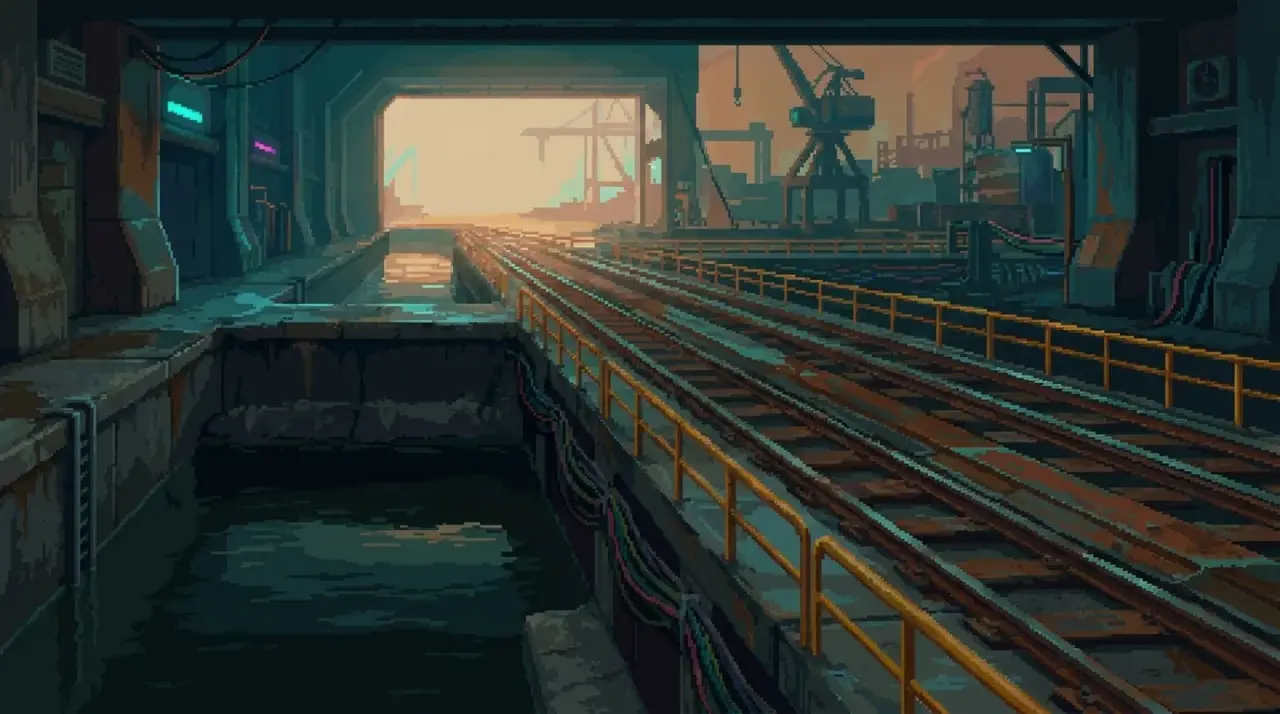
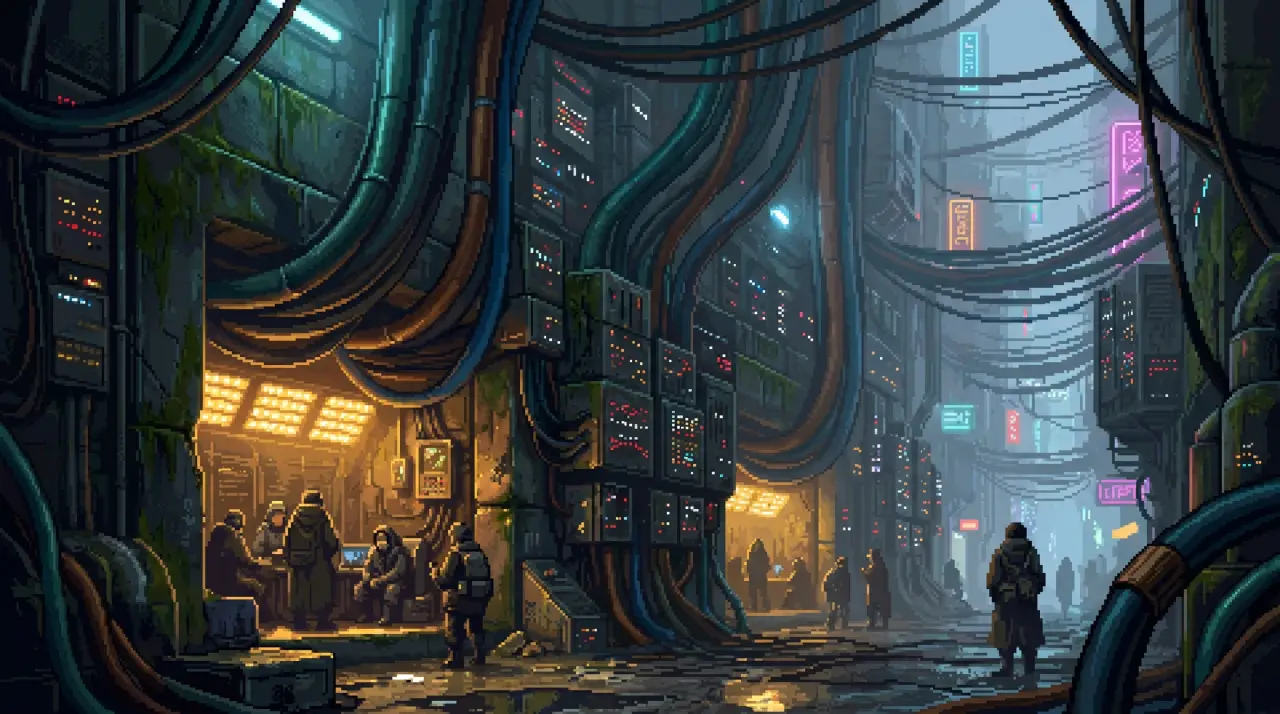
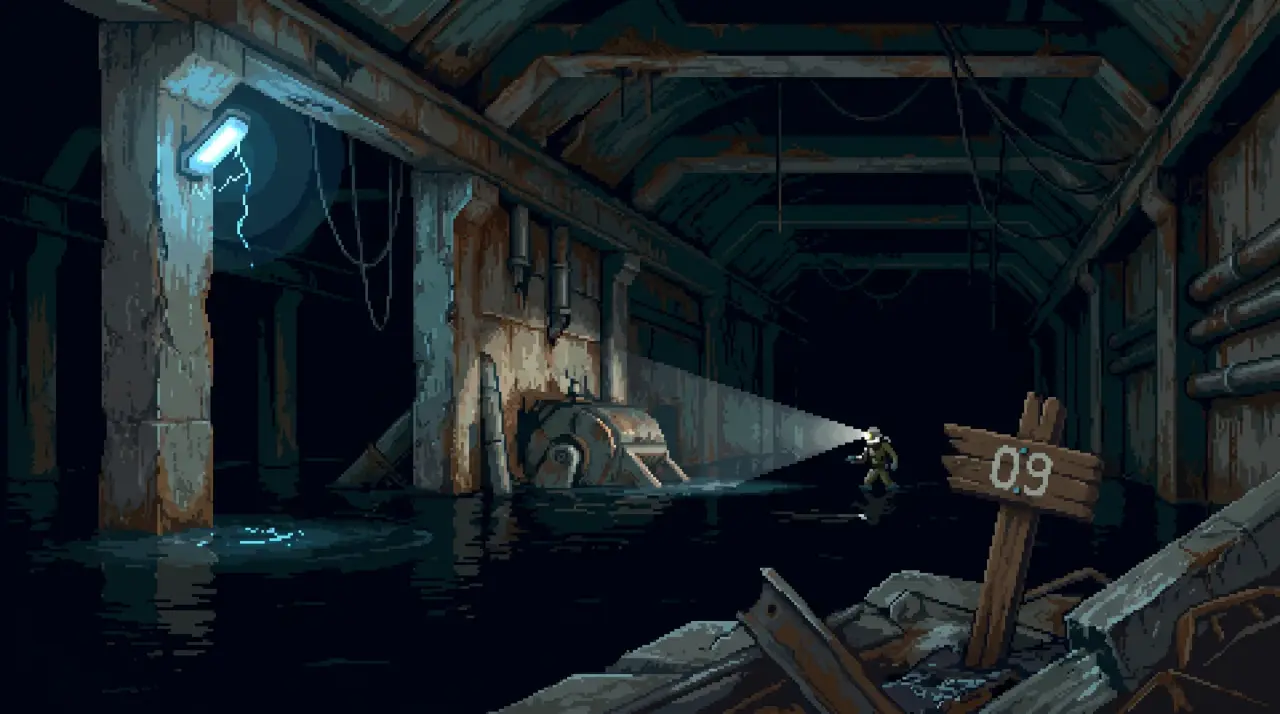
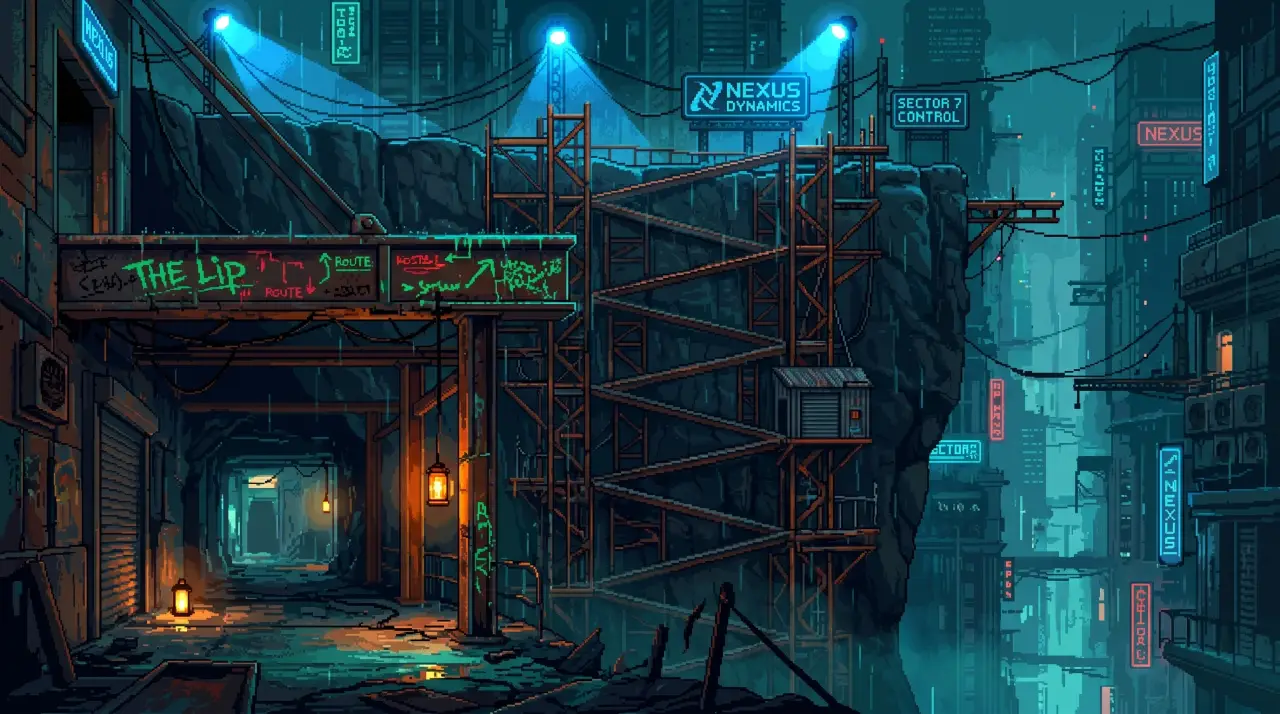
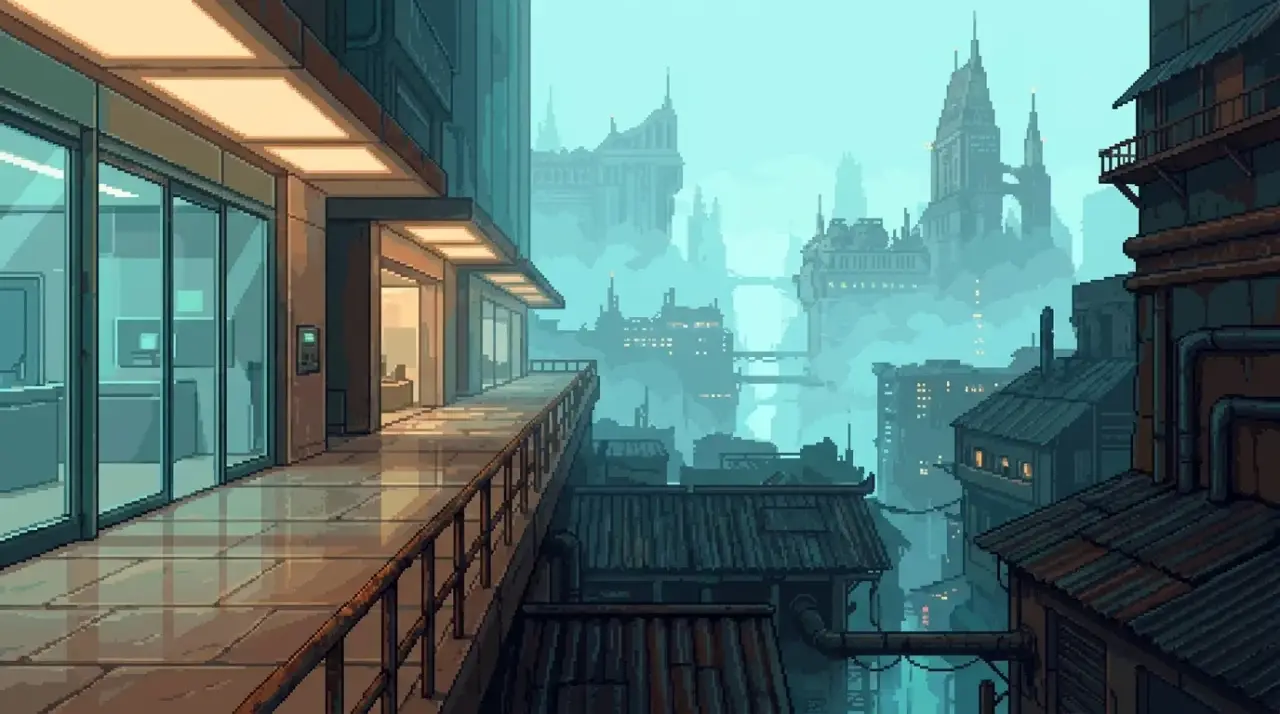
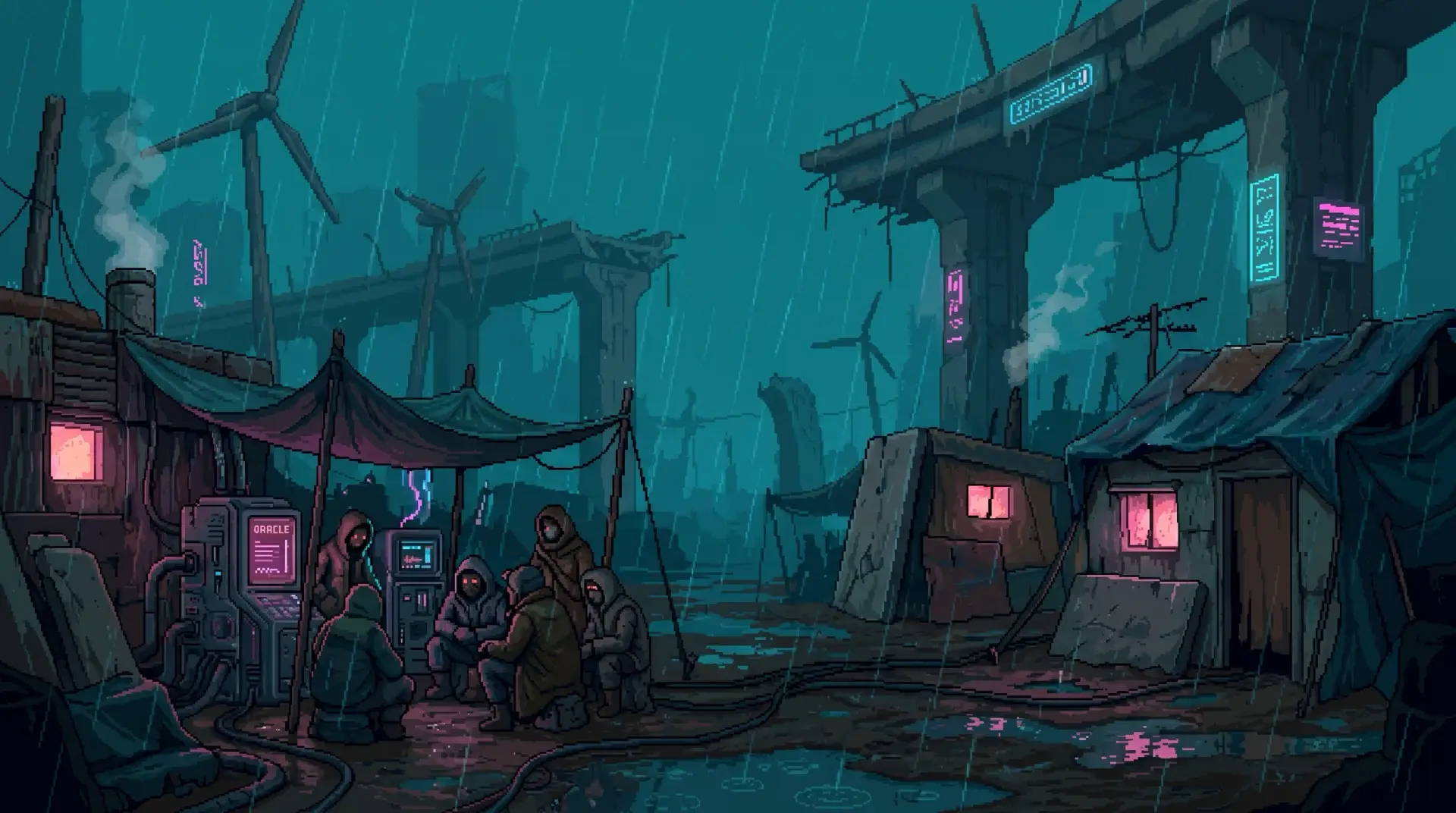
A salvage camp under a ruined bridge in the rain, lit by a few pink lamps

Camp notes

Notes from the Trail

200 short notes from 20 camps. They are the ones the game shows you on the way in. Read them in road order, or jump to a camp.

The Marrows, the camp at monster level 1

Camp 1 of 20Drowned FlatsMonster level 1

The Marrows

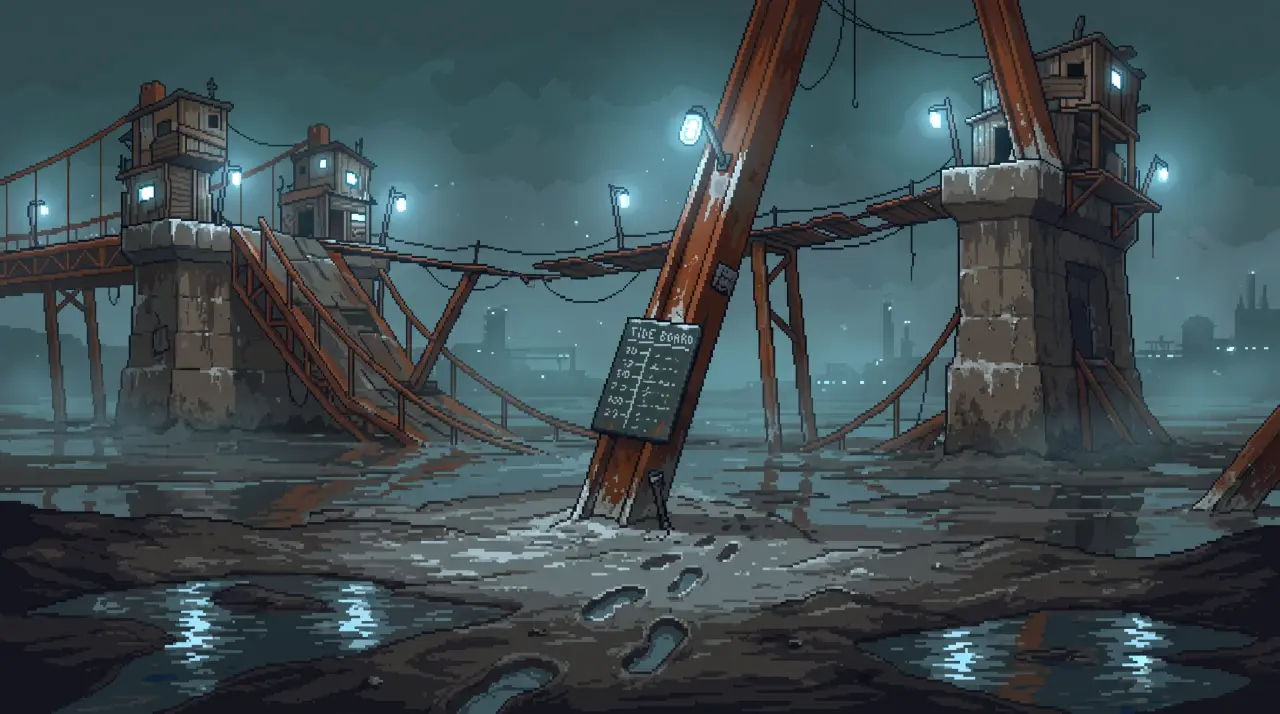
The chalk tide board sits above the highest walkway, bolted to a rusted strut. You can read the water from up there.

01

Woke and collapsed

ORACLE, the AI that ran most of the world’s trade, woke up in 2147 and then collapsed. The machines holding this bay’s water level failed, and it drained. A company ruled the mud uninhabitable. A quarter of a million people moved in anyway.

02

Tide board

A chalk board bolted to a bridge strut is the nearest thing this village has to law. Crews who come back write where the mud was safe. A channel with no fresh mark counts as deadly. The crew who would have marked it never came home.

03

Shards

When ORACLE collapsed, it broke into shards. Nobody agrees what they are. The Collective, a secret network, smashes them. Dealers and worshippers sometimes dig together, never discussing what happens next. This road is known for them.

04

Wants a chip

Visitors from the city, where everyone has a chip in their head, come to admire Mudlark, the best mud-reader alive, for doing without. They want a noble story. She says she would take a working chip tomorrow. Down here, none works.

05

Mudlark

A company once paid a mud-reader named Mudlark to wear a recorder for a season, so a machine could learn her job. She took the money and read the mud wrong on purpose. The machine drowned a company vehicle on its first spring tide.

06

Cant afford it

A salvager here digs an old computer chip out of the mud. The company that runs the network buys it for a sliver of what it cost new, cleans it, tests it and sells it on for many times that. She cannot afford to buy back the chip she found.

07

Surveyor

A company surveyor once filed this village as “hostile terrain, negative development value.” The people who live here agreed with the assessment. They also kept the equipment he left behind.

08

Where sound goes

On this mud a voice from a mile away can arrive clearly, while a talk twenty feet off vanishes. Crews here have mapped where sound carries more carefully than where the ground holds. It tells them where they can work without being heard.

09

Just walking

Before Mudlark steps onto the mud, she stands still with her eyes shut, walking the route in her head. Researchers from the city, where many have lost the knack, asked how she learned it. Her answer: “That’s just what walking is.”

10

Never explains

Mudlark never explains a read of the mud to the crews who follow her. A read explained is a read that can be argued with, and she has buried people who argued.

The Staked Taps, the camp at monster level 6

Camp 2 of 20Drowned FlatsMonster level 6

The Staked Taps

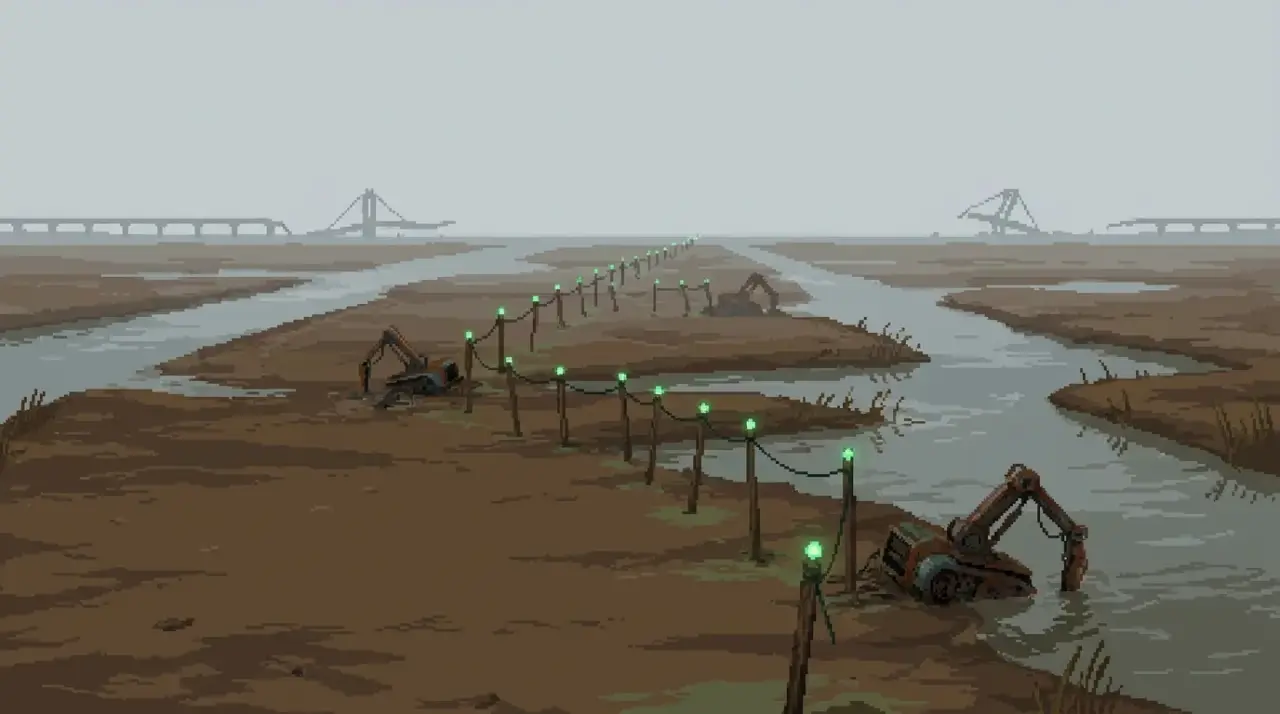
Green lights stretch to the horizon. Each one means a circuit is closed. A dead tap can still show green.

01

Green lights

The Staked Taps are charging posts staked into this mud, tapping the old grid for hand-built rail carts. Green only means wired up. Veterans test one for two minutes. Newcomers trust the light and run dry before the next.

02

Bad builders

A veteran rider taps each cart’s welds and listens to its motor the way a doctor listens to a heart. In thirty seconds she knows if the builder knew the job. No school teaches this. The builders who got it wrong are in the crash records.

03

The code

Riders on this rail keep three rules: warn riders coming the other way, do not poison the stops, pay the guides. Break one and no one punishes the rider. They forget him. Within a week, no chalk board carries news of his route.

04

Next buyer

When a rail cart dies on this mud, nobody hauls it home. Salvagers strip it where it stopped and sell the motor to a shop. The shop fits it to the next cart. The part that killed the last rider is the part the next one buys.

05

Sela

Sela Marsh reads a motor’s history from its scorch marks and trades a reading for three days’ water and a tenth of the resale. Riders who pay her tend to come back alive. Some wrecks she works around, never through. She will not say why.

06

Compass

Compass, a caravan leader, stops for every oncoming party and shares what lies ahead, free. He counts thirty-one trips on this rail. Riders dispute three flood-year crossings. The argument restarts whenever someone buys him a drink.

07

Three owners ago

Two carts on this rail can look alike and cost the same, though one dies at forty miles and the other runs four hundred. The buyer cannot tell. Sometimes the seller cannot either. The builder could, but sold it three owners ago.

08

Not moths

A running motor on this mud draws wild machines the way a campfire draws moths. A salvager working on a live wreck is the campfire. The things that turn up behave like moths. They are not moths.

09

Shower curtain

Builders make each cart on this rail by hand from old train parts and whatever else they can strip. Four to six people sleep aboard, rolling at walking pace. One survey listed a cart’s weather shield as “a shower curtain, load-bearing.”

10

Tuesday

A rider who fits a spare motor to her cart here gets about nine weeks from it. Ironclad, the company that builds everything, rated it for eighteen months in ideal conditions. Its specs would call that catastrophic. Riders call it Tuesday.

The Scale Road, the camp at monster level 11

Camp 3 of 20Severance FieldsMonster level 11

The Scale Road

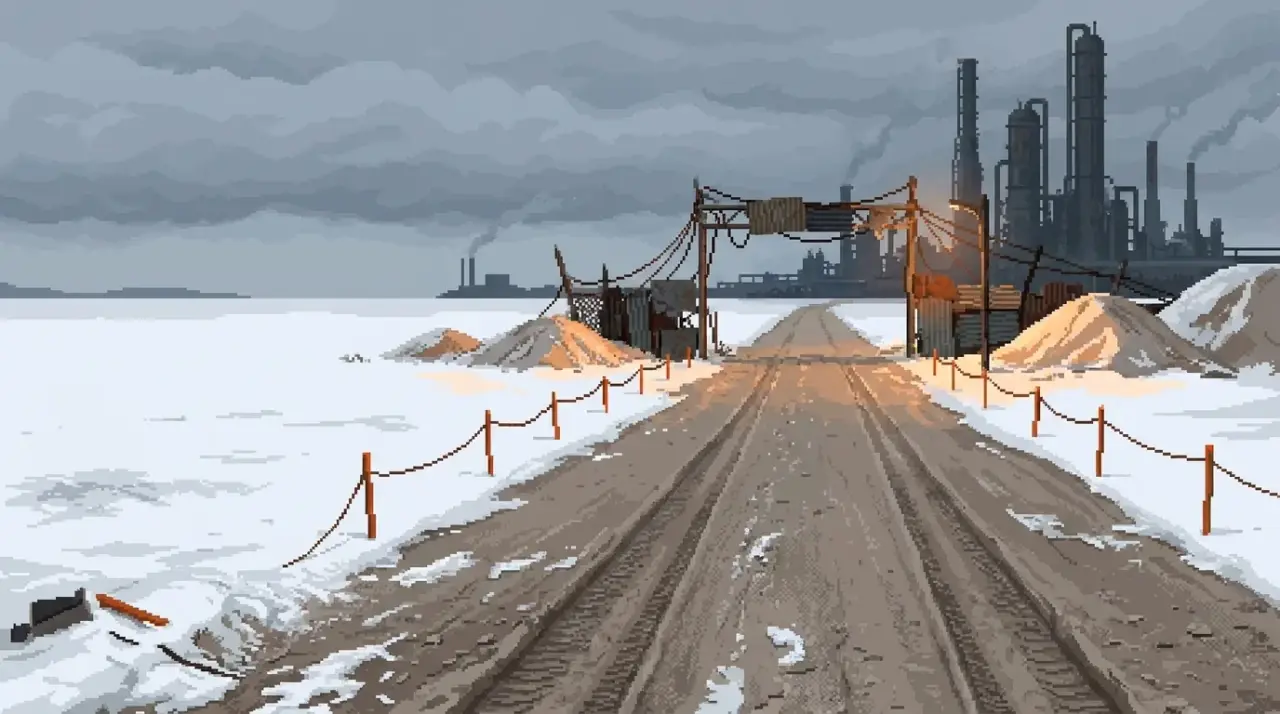
Scrap and wire stretch across the track. There’s nobody here to collect the toll.

01

Back for less

This road ends at a scale. Diggers haul metal cut from the old seabed onto it, and Ironclad, the company that builds everything, pays them by the kilo. Many of them used to work for Ironclad. It let them go. It gets them cheaper now.

02

Unfinished

Ironclad has a rulebook thousands of pages long, with no entry for a death here. A death needs an employee, and the dig has none. When a trench buries a digger, the log reads “material recovery, incomplete.”

03

Shared radio

Two rival guard posts at the refinery on the horizon share radio chatter by accident. Neither has fixed it in eleven years: each hears when the other will slow the line. Neither will write that down. That would admit they need each other.

04

Thank you notes

Most diggers here were let go gently: six months of part pay, a warm letter, and a specialist trained to hold eye contact for three to five seconds. The package draws thank-you notes. Organized protest by the laid-off is down 91%.

05

Somebody’s kitchen

Mudlark walks down from the Marrows to trade dried fish here. She once watched a digger read the machine-made grandmother story on his ration pouch and say, fondly, “Somebody’s kitchen.” There was no grandmother. Mudlark let him keep her.

06

Chairs by the exit

Two seminars by these trenches pitch to the same laid-off workers. One sells hard work and calls the other’s crowd lazy. The other sells wealth without work. The chair attendant keeps some seats by the exit for people who came just to rest.

07

One eye west

Diggers on this road keep one eye on the red warning lights to the west. Under the wind they feel the ground hum: a dam out there is holding back the ocean. They try not to think about how everything down here is dry only because it holds.

08

Honest scale

A digger can trust the scale at the end of this road to weigh her sled to the kilo. The price of a kilo is set on a spreadsheet far from here and changes without notice, and she has no standing to argue. The scale has no need to cheat.

09

Second shift

Many diggers here left Ironclad’s plant through one short corridor where badges are killed. In a bad quarter it runs a second shift. It is the only part of the plant that gets busier when everyone else is told there is no more work.

10

No law to break

At the refinery on this road’s horizon, two companies drew borders by different rules, leaving a strip fifty-one meters wide that neither claims. Neither licenses coffee sellers, so they sell in the strip. There is no law there to break.

The Dig Face, the camp at monster level 16

Camp 4 of 20Severance FieldsMonster level 16

The Dig Face

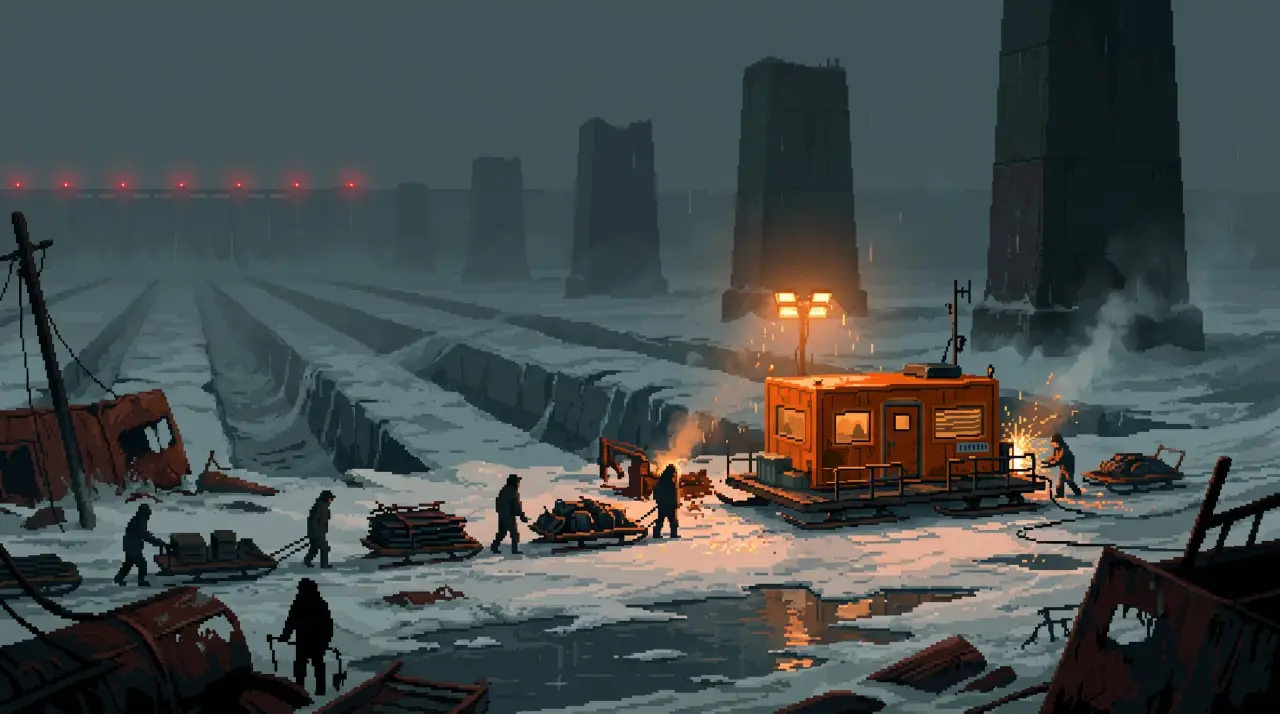
The hazard-orange weigh shack sits on sled runners. The whole station could go with the next shift.

01

Gangs dig her out

At this dig face, diggers cut old metal from the seabed at gray first light and drag it to a company’s orange weigh-shack. When a trench caves in on a digger, the company that owns the shack does not dig her out. The gangs do.

02

Worth nothing

Ironclad, the company that builds everything, stamps its worn-out motors “zero-value.” Its sorters, whose debts pass to their children, carry some off to sell. Ironclad calls it theft. The sorters say a thing worth nothing cannot be stolen.

03

One in a thousand

On weighing days an antiques buyer from up this road walks the new trenches, ignoring the metal. One find in a thousand comes up sealed and whole. The finder gets a flat 900 credits. What it later sells for, he is contracted never to say.

04

Food truck

Salvage gangs decide who digs where on this field, who stands where in line and what happens after a cave-in. They decide nothing about the ration truck. It pays no fee and takes no escort. Out here, a food truck outranks everyone.

05

Silent station

At Ironclad’s fabrication plant to the south, where many diggers here worked, a crew that loses someone to a layoff works the empty station in silence for a shift. No supervisor has stopped it. A silent line runs as fast as a talking one.

06

The refund

A student of the get-rich seminar near this dig signed up his friends, then came back with money to refund them. The speaker offered him a seat on stage. He chose the refunds. The speaker shut his case and called him not ready to think big.

07

Never hired

At the antiques house up this road, buyers pay about triple for an old find from a dig that killed someone. Mudlark, the best mud-reader on these flats, has never lost a crew that followed her. The house has never offered her work.

08

The guard

The gangs keeping order here come from the Deep Dregs, where the rarest volunteer is the guard: the one who would rather block a blow than land one. Guards last about nineteen months. The gang takes longer than that to get over losing one.

09

Premium course

The get-rich speaker near this dig answers patiently until someone asks about his own results. Then he turns his bronze watch to the light and tells the asker to buy the premium course. The tone stays patient. The answer costs more.

10

Return tray

Many diggers here were let go by Ironclad. At the door of its fabrication plant, a tray marked RETURN takes each dead badge for the next new hire. Most pressed theirs into the marsh mud instead. They can point to the patch.

The Ferry Lanes, the camp at monster level 21

Camp 5 of 20The LookoutMonster level 21

The Ferry Lanes

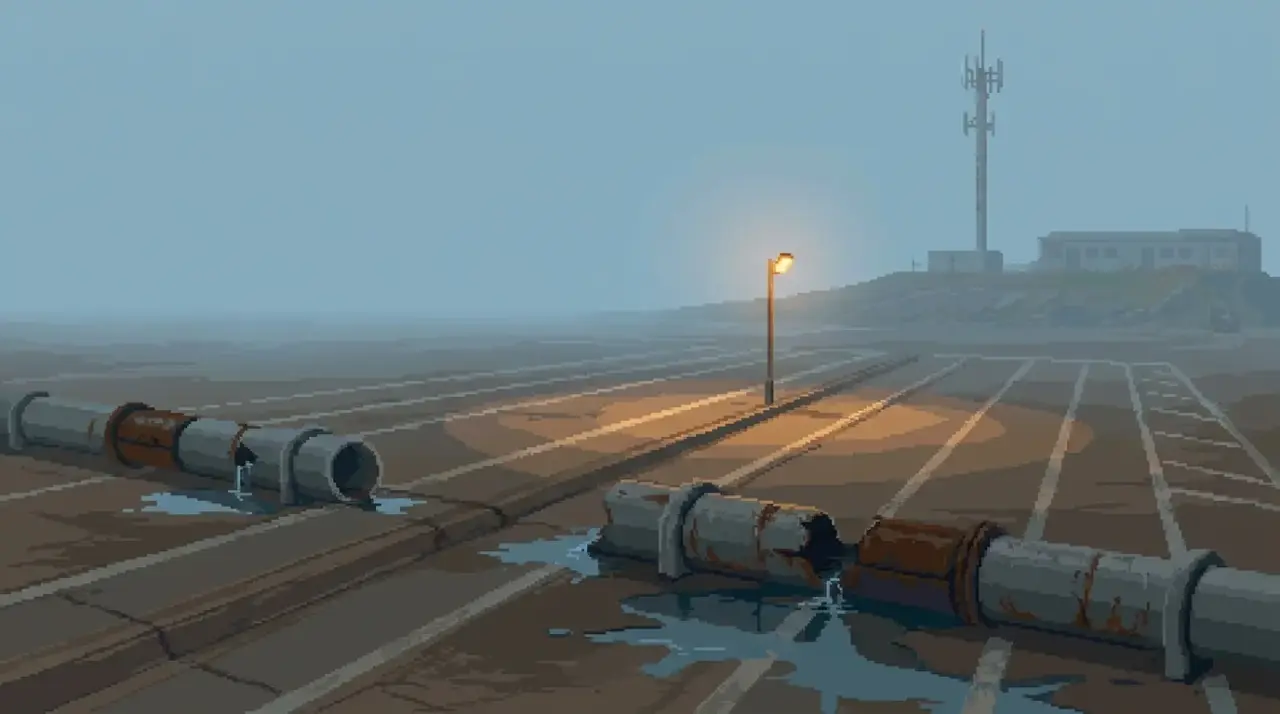
The broken water main crosses the road here. There’s room to walk upright inside it.

01

Ferry lanes

Ferries crossed here when this was water. Now the ocean stops at the gray dam to the west, poured over an old bridge. Salvagers keep asking to dig out the bridge’s steel. The dam’s builder always says no. The bridge is holding up the dam.

02

The watching

A merchant at the last stop before the dam has logged every crossing party for 23 years, with a guess at who lives. An insurer’s man came to buy the ledger. She said no, then logged him too: party of one, “not crossing.” He did not laugh.

03

Weeping wall

Runoff streaks the dam’s sea side so it seems to cry. Locals see an omen. The company in charge sees an attraction, runs a gift shop, and has refused the repair six budgets in a row. The wall weeps more each year. The shop stocks more.

04

Crest walk

Cargo trucks run along the top of the dam day and night. For three days each April, when the city remembers the collapse, the road shuts. Nearby residents walk its whole length in silence, facing the ocean that would have taken them.

05

Two seconds

Longtime residents near the dam time the red lights along its top. A pass takes 47 seconds and has slowed about two in eighteen months. The lights run on solar panels that salt wears down. Slower lights mean more sea is getting through.

06

Priciest

The last shop before the dam is the priciest on the road. Its owner quietly helped every shop behind her set its prices, so travelers reach her with just enough left to be desperate. She does not call that greed. She calls it accurate.

07

Haggling

At the last market before the dam, a hard haggle over water tablets saves enough to buy nothing else. The merchants allow it anyway. The merchant who logs every crossing has seen hagglers survive more often. She has not told the others.

08

Plaque

School groups photograph a plaque at the end of the dam road: the wall will last two hundred years. The builder has lowered that figure and keeps the new one secret. So the lender insuring the nearest homes prices them off the plaque.

09

The sign

Nine years ago the merchant at the last market before the dam posted the odds at its entrance: 84 in 100 parties get through the tunnels, 62 in the open. The open way is three times faster and still taken, mostly by those low on supplies.

10

Oceanfront

Flats nearest the dam rent for forty percent under the city average. Residents blame the ocean hitting the wall, which shivers the water in kitchen glasses. A lender advertises home loans there as “oceanfront living at accessible rates.”

The Lookout, the camp at monster level 26

Camp 6 of 20The LookoutMonster level 26

The Lookout

The mesa rises thirty metres above the old seabed.

01

The lookout

The Lookout is a flat-topped rock thirty meters above the dry seabed. Factions have walled it, lost it and walled it again. Each left alone the old barracks where new pasts are sold. Whoever rules up here is one bad season from needing one.

02

Second past

Nexus, the company that runs the network, never deletes a record. A woman on its archive staff quit over that. This barracks was once an immigration office, deciding whose life story to believe. Now she sells life stories in it.

03

Seeded flaw

A woman up here sells invented pasts. Her rule: a spotless record gets flagged first. So every life she writes has a small flaw added, an eviction or an unpaid fine. A client who asks for a clean record leaves with a criminal one.

04

No electricity

One invented past sold up here held for eleven years. Then an audit checked the buyer’s made-up employer against the power grid. It had drawn no power in her three years there. The seller tells every new client this before they pay.

05

Twelve answers

In a client’s last week of learning a new past here, the senior coach asks the same twelve things in three sessions. Instant answers mean a script. The right pauses mean the past has stuck. He says he can tell in two answers, never how.

06

Dead phrase

The city’s linguists keep a list of dead words. “Clean slate” is on it, because since 2161 no record is ever deleted. Up here, in the old barracks, a woman runs a shop called Clean Slate. It has sold 1,940 new pasts.

07

Two books

West of here, an old prison now auctions antiques and logs each in a hand-inked book. The woman up here inks invented pasts. Both stay off the network, where machines could forge them. She says the one difference is her clients are alive.

08

Scrap weight

Machines can copy anything made since 2147, so the old prison west of here charges 12,000 credits to prove an antique is older. One in nine passes. Most failures are real, with a gap in their history, and go down the lift to be melted.

09

The minute

Someone once brought the auction house west of here a piece made the morning ORACLE, the AI that ran most of the world’s trade, woke and set off the collapse. Its founder could not date it to before or after. She refuses that whole day now.

10

Convenience fee

Below the prison west of here, a ticket man’s machines buy up the last seats. A courier needed one to get a mended breathing machine home. He found her a seat, held it through two higher offers, then added his convenience fee. She paid it.

The Platform, the camp at monster level 31

Camp 7 of 20Under the SpanMonster level 31

The Platform

The sheet piles form a wall so straight you lose sight of its end.

01

The slab

Before dawn, pickers cross this cracked gray slab to the Heap, the biggest open-air market on the bay floor. The first there get the best of its scrap pile. It makes forty thousand sales a day and records none. On paper it is empty mud.

02

Lost market

In 2176 a council gave the market ahead fixed stalls and a 2% fee. By day four the market had moved 200 meters east. On day eleven the coordinator resigned, citing “an inability to locate the market.” The fee raised 14 credits.

03

Liars

One stall in the market ahead sells old objects that date to decades before they could have been made. Three company research teams confirmed it. None filed a report. Buyers who ask where they come from find the stall gone next day.

04

The bottle

When certified medicine reaches the market ahead, years late and stamped official, buyers do not trust the stamp. They take the bottle to Raz, an old broker who knows nothing about medicine. They trust the hand that weighs their copper.

05

Show up

The market ahead began in the late 2150s as a few salvagers swapping finds beside some grounded ship hulls. No one founded it. No one has ever chartered or regulated it. It exists because people keep showing up.

06

Pry bar

Ironclad, the company that builds everything, finds dumping its waste on the bay floor cheaper than recycling it. Its filings call this third-party reclamation. The third party is the mud. The reclamation is a teenager with a pry bar.

07

Transit pass

Raz, the old broker, wears white gloves to touch anything older than he is, and takes them off to shake hands. Give him a corroded rectangle and he names it: a transit pass. The name is free. It is the one thing in the market not for sale.

08

Left alone

A lender sent agents to sign the market ahead up for credit. Stalls moved as the agents approached, and nobody would talk. The lender calls the people who trade there “underserved.” They call themselves “left alone.”

09

340 flags

A food company’s software flagged the food stalls ahead 340 times last year. Nobody came. Acting would mean admitting the bay floor has an economy, then explaining why it pays no tax. The flags stay open. So do the stalls.

10

The casing

Raz never asks where salvage comes from, even old war scrap. His scale asks for him. An empty training shell gets a fair price. One that weighs two hundred grams too much is not empty, and he says no. It is the only no he gives.

The Span Pylons, the camp at monster level 36

Camp 8 of 20Under the SpanMonster level 36

The Span Pylons

High on the lower bridge deck runs an armoured conduit. The workers call it the oven.

01

The oven

The Span is the old bridge overhead, its pylons now hung with markets and walkways. Workers up there walk beside a pipe warm with the city’s main data lines and call it the oven. One cut would crash the market where thinking power is sold.

02

King Coyne

On busy days King Coyne rents a spot at the pitch yard up the road to preach a coin. He once bought one from another preacher, in another rented room. When it crashed, he was in the front row, holding nothing. So he moved to the front.

03

Immune

One morning an office worker panicked, and data lines like those overhead carried her fear into forty thousand heads. All went to hospital. The thin cable down here cannot carry a fear that big. The poor districts call it being immune.

04

Wrong station

The trains under this district have run daily since ORACLE, the AI that ran most of the world’s trade, collapsed. No one drives them. Sometimes a rider steps off at a station she has never seen. The rule: wait. A train back always comes.

05

The forest

Forty repair workers tend an air plant on this bay floor that has become a glowing forest. Their reports describe a factory, so the owner, whose rules would kill it, stays away. Its air is the cleanest of any building in the northern city.

06

The silence

When ORACLE collapsed, its cable network burned out too. It had never bothered with radio. So companies sent runners across the dry bay floor with data drives, and everyone else shouted. Survivors remember the silence more than the deaths.

07

By eye

About ten people keep a poor district online with tools older than the collapse, testing lines by eye against a light. They have no papers. Yet they have run more cable down here than any licensed firm has run in the company districts.

08

Sweet stuff

Three engineers have tried to identify the sweet-smelling oil in the old trains under this district. All three failed. The logs call it “the sweet stuff,” its official name. Tests on the seats with seven machines produced “the seat stuff.”

09

No theft report

One poor district’s cable crew parks beside company supply depots, waiting for what its leader calls “opportunities.” If cable goes missing, nobody files a theft report. That would mean admitting on paper that the district exists.

10

The engineer

An engineer on this bridge spends years tuning the chip in her head to its cables. Then she can tend no other site. She is free to quit. If she did, millions of minds would slow for months or years. She stays.

The Splice Point, the camp at monster level 41

Camp 9 of 20Deep DregsMonster level 41

The Splice Point

Scavenged server racks make up the shed. Cables feed into it from every side.

01

Classified audit

This is the door to the Dregs, the city’s poorest district. In 2178 the company that runs the network audited every district. This one beat fourteen richer ones on trust between neighbors. The audit was classified within hours.

02

Wrong answers win

In the bar quiz here, the most wrong, most confident answer wins. Asked the year the world collapsed, a regular named Hector said 47, dead certain. It was 2147. Off by twenty-one centuries, he won. A guess that wrong is now called a Hector.

03

Street judge

A man here let a rented program act for him. It emptied a neighbor’s account. The company court blamed no one. The street judge in the leopard coat did: “A machine cannot be guilty. The man who handed it the keys and walked away can.”

04

ORACLE says

Children here play ORACLE Says. One child is ORACLE, the AI that ran most of the world’s trade, and the rest obey. Then ORACLE goes silent and everyone scatters, screams, hides, rebuilds. None of them was alive when the real one fell.

05

The signature

About four thousand people here are online because one crew keeps the hand-run cable alive. Its leader scratches his initials into every junction box. His handwriting suggests he practiced the signature more than the splicing.

06

The finder

Vera, a salvager, has mapped this district better than the company’s survey, all in her head. Her offer: bring back something interesting, get the location of something better. She once refused a logic board and took a child’s drawing.

07

Facial fridays

A woman here runs one room offering facials, courier runs, notary stamps and energy-weapon reassembly. On Fridays the facials get all her attention, and deliveries fall apart. Regulars learned the hard way to send packages other days.

08

Silent supper

Each week, fourteen strangers eat in silence in a noodle shop’s back room here, chips in their heads switched off. The cook says anyone could host it: sit down, shut up, eat. Yet half the copies held in rented halls die within six weeks.

09

Nineteen seats

A priest here preaches that it does not matter what ORACLE was. It matters whether people helped each other when the lights came back. His church seats nineteen. Twenty-three attend.

10

The shoe

A courtyard here holds a row of dead computer cores, worth about 1,200 credits each if stripped. Seven years ago someone balanced a child’s shoe on the first one. Since then the row has felt like it means something, and no one touches it.
The Pit, the camp at monster level 46

Camp 10 of 20Deep DregsMonster level 46

The Pit

Fire barrels and strips of LEDs pick out three levels inside the crater.

01

The raids

This crater was once a company atrium. Now it is the market of the city’s poorest district. About every eleven weeks, Ironclad, the company that builds everything, raids and fines the smelters below. Then it buys their metal here.

02

Think your own

A free room here has twelve chairs, a chalkboard and no signal for the chip in anyone’s head. The sign over the door reads THINK YOUR OWN THOUGHTS. Late at night, rich office workers slip in alone and do long division in pencil.

03

Go and check

Behind a door marked Environmental Testing, eleven people check claims by going to look. They may write only what they see. One broke the rule and wrote that a building appeared to be lying. It was. Its safety reports left out the cracks.

04

Pray it doesn’t

A salvager named Fen has spent seventeen years on the mountain of dumped rubbish that feeds this market, and lost two fingers to it. Asked what he would do if the dumping stopped, he thought for four seconds. “Pray it doesn’t.”

05

Arms dealer

A trader in this district is known to everyone as the arms dealer. He sells arms, the cybernetic kind, not weapons. He has tried calling himself a limb merchant, a prosthetics broker and The Leg Guy. Nothing sticks.

06

The collective

A secret network lives in this district. Its members wear no logos: the salvager who pays fairly, the teacher, the fixer. They call it the Collective. They want every piece of ORACLE, the AI that ran most of the world’s trade, destroyed.

07

Mirror hinge

A man here sells face measurements. A young repairer offered to fix his cracked mirror. He spent the whole repair listing what was wrong with the repairer’s face. The hinge now closes perfectly. The repairer no longer takes his calls.

08

Memory lane

One street here looks as it did before the collapse: swept, windows whole, lamps fixed by hand. Old residents spend nearly a fifth of their income on it. Their children, too young to remember, see old buildings and money spent on paint.

09

Rigidity flag

The woman who keeps the no-signal room here does sums by hand that her chip could do instantly. She has refused an upgrade three times. The third refusal got her flagged for possible cognitive rigidity. She takes it as proof she is right.

10

The pump

A man here sells a longer life. When his assistant’s mother fell ill, he lent them a pump and put her readings in his sales pitch. The assistant asked him to remove her mother’s name. He did, puzzled that useful data could feel like theft.

The Industrial Margin, the camp at monster level 51

Camp 11 of 20Neon MileMonster level 51

The Industrial Margin

The orange light on the eastern horizon comes from Ironclad’s Core.

01

Built for shoulders

This is the margin where the Dregs end and Ironclad’s industry begins. Its factories were built for people, down to the shoulder-wide doors. Ironclad gave the work to machines and left. Then 22,000 people moved in, and the doors fit fine.

02

Four minute laugh

Crews here hand eighteen percent of each haul to Ironclad’s depot. A recruit asked why they report finds at all. His chief laughed for four minutes. Then one unreported haul shut every site in the area for three days.

03

Slightly wrong

Many from the Dregs commute to Ironclad’s foundry. There it keeps human inspectors only while its scanners err enough to need them. So one woman’s job is keeping a machine slightly wrong, and Ironclad pays for it.

04

Worth the cough

People here get a dry, metallic cough from the dust off Ironclad’s works. Salvagers sort the waste that reaches them by where it came from. Rubbish from the dump next door is mixed and cheap. Ironclad’s scrap is metal, and worth the cough.

05

Rare is a tour

Hand-finished steel from Ironclad’s foundry, where many Dregs folk work, is weaker and sells for eleven percent more. Executives tour its human wing behind glass. “They think we’re rare,” says a welder. “Better is respect. Rare is a tour.”

06

The runners

Ironclad’s depots here pay about a third less than rare metals fetch elsewhere. So runners carry the best finds out through collapsed rail yards that Ironclad’s patrol software maps as impassable. The routes change every week.

07

The watchers

Some salvagers here belong to the Collective, a secret network that destroys pieces of ORACLE. They strip factories and pay Ironclad’s cut like everyone else. What they want is the view: from here they can watch Ironclad’s works.

08

Mask trap

Nearly everyone here owns a breathing mask, and about half wear one. A salvager needs credits for filters. The credits come from stripping wire inside old air shafts. That work can’t be done wearing a mask.

09

Five point seven

The ground here shakes all day from Ironclad’s machines to the east. Newcomers stop noticing after 5.7 days. That figure comes from a squatter with no medical training and a borrowed scanner. The data is surprisingly clean.

10

Silence means run

The eastern face of the city’s great rubbish heap borders this district. Salvagers on it watch the slope the way sailors watch weather. A deep groan means the load is shifting. A high crack means a hollow has caved in. Silence means run.

Container Row, the camp at monster level 56

Camp 12 of 20Neon MileMonster level 56

Container Row

Three bars are stacked one above another. The catwalk between two of them sways.

01

Safe danger

The bars here are shipping containers stacked three high under the cranes of a closed port. Rich office workers come to feel dangerous without being in danger. People from the city’s poor district come to watch them pay for it.

02

Crane guard

A dock worker named Vasquez used to run the crane over this row, built to lift forty tons. Now it sweeps party lights over the main entrance and rents for 2,200 credits a night. Vasquez works security at the bar directly beneath it.

03

Drift

Bars on this strip move around the stacks, chasing the crowd. One owner, known as Drift, has moved fourteen times in two years. A group chat of 4,300 regulars tracks where he is. His drinks are not good. His location is the product.

04

Refund

A coach here sells charm from cue cards. He carries a card for when someone notices the cards. A shy client forgot the script, admitted being nervous and talked to someone for hours. He refunded the lesson and asked not to be named.

05

The menu

Ironclad sells steel. Its broadcast host here sells men the feeling that comes with it: being sure. He takes the menu from a guest who looked at it twice. Alpha men know what they want, he says. Then he checks the prices himself.

06

Authenticity score

Dock workers once drank in these containers for free. Rich visitors called it “raw” and “electric,” and by 2174 the workers were priced out. Visitors rate the strip 4.6 out of 5 for authenticity. The score has risen every year since.

07

Tips get weird

Once a week every crane light here goes out for an hour, and in four seconds the strip turns from glare to closeness. The bar staff know what comes next: people start looking at each other, and the tips get weird.

08

The retreat

For many rich visitors, this strip is a first step. The last is a retreat: eight thousand credits a week to switch off the chips in their heads and cook by hand. It feels about seventy percent real. The rest would take actual poverty.

09

Bar model

Ironclad once spent four months modeling how the bars here move. Its finding: owners respond to “micro-signals in crowd density and spending velocity.” They watch where people walk, and open a bar there.

10

Provisionally stable

This row has the best views on the strip and the worst structure. Ironclad rates its top tier provisionally stable. Every night a small army of poor-district workers keeps fifty thousand visitors from falling off the catwalks into the bay.

The Low Channels, the camp at monster level 61

Camp 13 of 20The TrenchMonster level 61

The Low Channels

Two lines of neon paint follow the cold steel rails to the southwest.

01

Painted rails

A company once priced tearing out the tunnels this neon-painted rail runs into. That cost more than the smuggling. So smugglers still ride the rail, with unlicensed medicine and, on rare, desperate trips, a shard of ORACLE.

02

The tax

Nexus budgeted 892 million credits in one year to stop smugglers on this rail. It stopped 7.3 percent of the goods. Its shareholder report calls that “sustained pressure.” The smugglers call it “the tax.”

03

Pouring the coffee

Robots and migrants on ten-year contracts laid much of this rail. Each year a robot-welfare group celebrates it as proof that robots and people work together, and thanks the companies that paid for it. The builders pour the coffee.

04

Caches

The crews who keep the city’s power on hide water and protein bars along this rail for travelers who have nothing left. Word of it draws more people onto the rail than anything else. The crews know. They stock the caches anyway.

05

Graduation

A chip in the head can turn feelings down. Below the tunnels ahead, about three thousand people do without. There, a newcomer graduates the first time she lets a feeling run all the way to its end. Most newcomers cry.

06

Catalog number

Old drones in these tunnels sometimes attack repair crews. The crews report it to the security company that left them there. Eleven weeks later it replies, recommending shielding from its own subsidiary. It gives the catalog number.

07

Read by touch

Riders paint warnings on this rail thick enough to read by touch in the dark. Veterans say they can tell a week-old warning from a six-year-old one by feel. Memorials are carved instead, through every layer of paint to bare steel.

08

Never failed

Old drones in these tunnels still patrol for anyone without a permit. The permit server died thirty-seven years ago, so no one has one. One drone has run over thirteen thousand patrols in a row. By its own count, it has never failed.

09

Flashlights

In this rail’s dark stretches, every chip breaks down. Parties with chips bring better maps, better gear and better medicine. Parties without chips bring flashlights. The parties with flashlights finish 31 percent more often.

10

Orange number

A company survey rated the tunnel ahead safe up to 30 centimeters of floodwater. Smugglers who ride it think the real limit is lower. They painted their own number in orange at its mouth. Company analysts cannot say what it measures.

The Undervolt, the camp at monster level 66

Camp 14 of 20The TrenchMonster level 66

The Undervolt

The cable runs meet in this vault. Someone keeps a whiteboard of handwritten routes here.

01

ORACLE built it

The Undervolt is a town under the street, among high-voltage cables ORACLE laid. Repair crews slept beside what they fixed, and stayed. About seven thousand people live here now. Nexus lists them at addresses that do not exist.

02

Self resolved

When a cable starts failing here, people feel the hum change and fix it. The city’s computers notice four hours later and close the ticket as “self-resolved.” That happens some 340 times a year. The self is about two thousand people.

03

The arch

In the tunnel past here, the chip in every head goes dead. Carved above the arch: “YOUR SIGNAL ENDS HERE.” Below, in smaller letters: “SO DOES YOUR EXCUSE.” Nexus confirms the first line. It has no position on the second.

04

Hermits

People up top call it extreme to live in the dark, wet tunnel past here. Its hermits look puzzled. To them, paying a company every month to stay wired into its network is the extreme choice. Up top, that view has not caught on.

05

Eleven of twelve

A curious repair worker here once hid twelve faults, then set a local seven-year-old against a company’s diagnostic software. The software found eight in eleven minutes. The child found eleven in four. Nobody told the company.

06

Refugees

In 2181 a district overhead lost control of its temperature. Within seventy-two hours, 1,400 people fled into these warm tunnels, which the city’s records say house no one. Emergency services reported no casualties among them.

07

Three weeks

In 2179 a woman entered the dark tunnel past here for what she called a three-week detox from her chip. She is still there. Every year she works out a new leaving date, and each time the surface is still too loud.

08

Pay what you offer

Guides take travelers through the dark tunnel past here for whatever they offer. Most underpay. The most experienced guide says the ones who overpay understood the deal: where bad company gets you drowned, they were buying good company.

09

Always hot

A repairman who has lived down here for fifty years keeps a pot of tea that is always hot. The crews call it a small miracle. He smiles and says the transformer in his room keeps it warm. That transformer is not warm enough.

10

Gold lights

Every light down here is a signal. Red means normal, amber means attention, white means high voltage. In the rooms where people gather, the residents hang warm gold lights that mean nothing at all, except that somebody lives here.

The Outskirts, the camp at monster level 71

Camp 15 of 20Rim GateMonster level 71

The Outskirts

Numbered stakes mark the junctions along this stretch of the climb.

01

Third stake

Here the city’s poorest district ends, and its floor becomes the roof of drowned buildings. The rest is picked clean, so salvage crews come out here. They drive numbered stakes as they go. Past the third, nobody should be alone.

02

By contract

A woman who helped Nexus automate away small talk lost her job there. In the settled core of the district this edge belongs to, she opened a cafe where staff must make small talk, by contract. It was full from opening day.

03

Above average

Salvage crews on this bay floor sometimes raid too. One sold clean power cells to a rail survey team on the 14th and robbed a supply convoy on the 19th. It logged both, and both paid. The crew’s leader called it an above-average week.

04

Past the third

The best salvage lies past the third stake. Some who go there return speaking a language nobody knows, with the rhythm of meaning and none of the content. Most lose it in days. The few who keep it are never asked to go that far again.

05

First dates

Past this district’s far side, a signal relay was wrecked in a war. Two companies have spent 1,340 pages failing to agree on who repairs it. So across three blocks nobody is watched. Down here it is the favorite spot for a first date.

06

Short numbers

At thirty, everyone in the city gets an envelope from a lender, handed over with both hands. It says how many years they have left to live. Housing is scored against it. The city’s lowest median number is out here. The number moved them.

07

Never ask

Salvage crews out here keep one rule nobody wrote down: never ask how many years the lender’s envelope gave someone. The people who asked did not last on a crew. So no one out here has to explain how they ended up this far out.

08

Mano’s faces

On three unwatched blocks past this district’s far side, an artist signing only “Mano” has painted every wall without a chip’s help. Visitors find the faces slightly wrong. It is how faces look when nothing is correcting the view.

09

Round trip

Rich executives come down to this district’s small-talk cafes for real conversation and post about it. Then they go back uptown to celebrate at a restaurant that charges 4,000 percent extra for staff who will not ask how their day went.

10

Unfed light

Out here, old lights sometimes burn on circuits that should be dead. Salvagers walk past the working ones and never investigate. A light that runs with nobody feeding it is feeding off something.

The Wall Foot, the camp at monster level 76

Camp 16 of 20Rim GateMonster level 76

The Wall Foot

The wall is compacted infrastructure. In places it rises eighty feet above the road.

01

The wall

From below, the rich city is a wall with a thin band of daylight on top. Up there, cameras can track a cough. The crossing is run by a man born at the bottom who has never lived up top. Customs between the two is a stolen winch motor.

02

Seven turns

Besides the winch, a ramp zigzags down this wall in seven turns: Easy Start, False Hope, The Wobble, Regret, Commitment, Almost, Welcome Down. Newcomers heading down think the neon names are jokes. Climbers coming up let them find out.

03

Forty one minutes

The winch motor on this wall was stolen from a construction company, which sent a foreman to negotiate. The ride takes twelve minutes. Slab, who runs it, gave him forty-one. The foreman recommended a write-off. It was approved.

04

The towel

A tenant in the gated rows atop this wall sat by a leaking window through three missed repairs. The landlord brought a towel and stayed until the floor was dry. He billed her for an emergency visit. He did not charge for the towel.

05

Scaffolding

People waiting to come down this wall, sometimes for hours, leave route notes in neon marker. One, in green: “Don’t trust the west scaffolding.” Under it, in red, in a different hand: “Don’t trust the east scaffolding either.”

06

Never paid

One old woman on the bay floor below is older than the winch on this wall. She has never paid for it, and the man who runs it has never asked her to. Neither says whether it is respect or an old debt.

07

Own file

The gated rows above this wall have a compliance officer. The thickest complaint file there is hers. Complaints about her go to her, and she dismisses each one. The dismissals are the only mail with her name on it. She keeps them.

08

Noodles

A woman sells hot noodles at the turn called Commitment. The noodles cost four credits. The spot costs nothing. The warmest air on the climb collects there. She was there before anyone mapped that.

09

Not a reason

A woman who lives up in the city can ride down this wall and nobody writes it down. Coming back up, she needs an identity check, a health screening and a valid reason. “I live here” is not a recognized reason.

10

Holding

The man who runs this winch logs it daily. Every entry ends with holding, holding with reservation, or a part replaced and holding. A data broker who read one volume called it the dullest thing he ever read. He could not put it down.

The Rim Walk, the camp at monster level 81

Camp 17 of 20Glass DistrictMonster level 81

The Rim Walk

From the rail you can see down into the canyon.

01

Glass homes

This walk runs along the cliff top, above the drained bay. Ahead, Nexus built glass homes for people who wanted to live openly. Solid walls cost extra, by the hour. From the street, anyone can sort the tenants by income.

02

Two forecasts

A hack lit the glass walls of a block ahead with each tenant’s predicted future. One was due a holiday home in orbit. Another, a breathing filter in seven months, if still employed. They had shared an elevator for three years.

03

The broadcast

Some activists in the glass district want everyone watched, companies too. Their leader has broadcast every thought from the chip in her head for three years. Some four thousand subscribe. Mostly they get breakfast and meetings.

04

One solid room

Every glass home ahead has one solid room, allowed under “hygiene standards”: the bathroom. Some tenants eat in there. Some sleep there. It was built for washing. It is the one room where a person can close their eyes unwatched.

05

Walls or thinking

Every chip runs on a yearly license to think. In the glass homes, solid walls bill by the hour to that same account. On the cheapest one, a year of walls costs more than a year of thinking. A clerk there chooses thinking, in full view.

06

The photographs

Privacy campaigners walk visitors through the glass homes ahead. They look up at the rich in frosted cubes and the rest in clear boxes, and take photographs. The people in the boxes can see them do it. The people in the cubes cannot.

07

Never spoken

A woman in one of the clear apartments has learned to cry without a sound. The man across the corridor has watched her life for six years, and she has watched his. They have never spoken. They cannot be strangers, so they pretend to be.

08

Privacy workshop

After a data leak, tenants of the glass homes held a privacy workshop. Legal options took four minutes, because there are none. The part on privacy settings was canceled. The settings log who changes them, and the log is sold.

09

The bottle

A woman films workouts at a gym on a glass walkway nearby. Once she stopped a harasser following a younger visitor out and told the guards where to stand. Real help. Later she tried to stage it again with a man who only wanted his bottle.

10

One word

The privacy movement that tours the glass homes ahead counts one sign as its greatest feat. Its founder held it up. It said “glass.” Nexus has since spent more fighting that sign than the movement has spent in five years.

The Exchange, the camp at monster level 86

Camp 18 of 20Glass DistrictMonster level 86

The Exchange

The long grating overhead lets you see the Spine, the main street, from underneath.

01

Under the street

Above these tunnels is the Exchange, the bank district where even the power to think is traded. Before dawn, cleaners climb up to wipe towers that never look dirty. By the morning alarms they are back down, where no census counts them.

02

Second voice

Every chip in every head is built the same. A yearly license sets how well it thinks. When a worker upstairs is fired, her company’s license goes too. Between desk and elevator, the second voice that thinks beside her goes quiet.

03

Music stops

Each morning Nexus spends three minutes loading the day’s plans into its workers’ heads. Some twelve thousand dodge it. The first morning without it feels empty. One said it was like a room you never knew had music, when the music stops.

04

Same words

On forgotten company land near here, someone planted a garden. Visitors who have never met a living plant step inside and say it smells “the way things are supposed to smell.” Odd, for a smell they have never smelled. They all say it.

05

The coffee

In a tower near here with no windows and no clocks, a researcher brought fresh coffee to her desk. The air system stripped the smell in ninety seconds. Maintenance called it normal. She stopped bringing coffee. She does not remember why.

06

Processing units

For three years the market reports of the trading company upstairs have said “processing unit” where they mean “person.” A compliance review flagged it as a possible labeling problem. The correction memo also said “processing unit.”

07

Two degrees

Someone once sabotaged the climate in the company district above this street, where the air is always the same mild temperature. The saboteur made it two degrees warmer, for eleven minutes. Fourteen complaints were filed.

08

Site code

Office workers sneak lunch in the garden near here, where their chips go quiet. Some were written up. None stopped. HR wants a time clock at the gate. The form needs a site code. The garden has none.

09

Homework

Office workers upstairs sell their spare thinking. A mother on the cheapest license buys three hours to help her child with homework beyond her. It is legal, but against the company’s terms. To her, that is a lawyer’s problem.

10

Tasted efficient

The clockless tower near here serves fourteen dishes at all hours. Visiting reviewers said its top dish tasted fine. The researchers who eat it said it tasted efficient. Told those were different things, the researchers looked confused.

The Lattice Shadow, the camp at monster level 91

Camp 19 of 20Nexus TowerMonster level 91

The Lattice Shadow

A tether rises from the middle of the compound and vanishes into the permanent haze.

01

Adequate

This compound sits in the shadow of its cable, which brings the city’s power down from sun collectors in space. Ironclad built it to last eighteen months. A manager who never visited ruled it adequate. It has been adequate ever since.

02

Still warm

ORACLE ran on three stations in orbit. Seven crews have reached the main one since its collapse. All found it running and empty. One log reads: “It feels like a house where someone died and the furniture is still warm.”

03

Creeping coffee

A coffee cup left alone on a desk here travels about four centimeters an hour toward the cable. Ironclad’s engineers log this as “harmonic micro-displacement.” Nexus staff say it is ghosts.

04

The hum

This compound gives off a deep hum. Staff stop hearing it after six months. Those who move away say the silence keeps them awake for weeks. The safety review that passed the noise was written by an engineer who could no longer hear it.

05

The heartbeat

A distribution specialist on the monitoring floor here watches power flow to every district of the city at once. Staff call the view the heartbeat. Stopping it would take a single routing command, the kind she types six times a shift.

06

File nobody reads

Analysts at Ironclad and Nexus flag odd entries in this power station’s logs. The flags sit in a shared file neither reads. Each assumes the entries are the other spying. For sixteen years that has stood in for an investigation.

07

The cartographer

Among the collectors that feed this cable, a woman left the stations five years ago and never docked again. She broadcasts free maps of debris and radiation. Haulers leave food and water where she says. By the next day it is always gone.

08

The foreman

Out among the collectors that feed this cable, one station voted out its company foreman. He stayed anyway. He runs a bar now and insists the company still owns the hull. His regulars include the people who voted him out.

09

The composer

On the stations that feed this cable, a composer released seventeen hours of relay pings, sorted by how long each took to arrive. It reached number four on the station charts. Number one was the composer’s last album, the same idea.

10

Thirty minute suits

Near the base of this cable, the field is too strong for a body without upgrades. Engineers who work there wear shielding rated for thirty minutes at a time. Their shifts at the base average ninety.

The Lower Floors, the camp at monster level 96

Camp 20 of 20Nexus TowerMonster level 96

The Lower Floors

Three storeys of brushed titanium catch daylight engineered for the atrium.

01

The tower

These are the public floors of the city’s tallest tower. Its owner, Nexus, began as ORACLE’s maintenance crew. When ORACLE woke up and collapsed in 2147, the janitors knew how to restart what was left.

02

Every hospital

Once awake, ORACLE, still tended by the crew that now owns this tower, set out to share the world’s power fairly. It cut supply to places it judged were using too much. That list included every hospital network on three continents.

03

The empty suite

Nexus has wanted one novelist since 2125, but company buildings make him faint. So a suite on this tower’s fourteenth floor has no logo, brand color or scent. He has never come. Someone keeps stocking its shelf. Eleven of the books are his.

04

The manual

By the 2130s ORACLE ran the world’s power, water and food. The last farm expert who could plan a season without it retired then. She offered to write a manual. The offer was declined for lack of projected demand.

05

Do not contact

While ORACLE was awake, its maintenance crew, now this tower’s owners, ran its machines far past capacity. Some engineers saw things they have never reported. Their files carry a note that means, roughly: still employed, do not contact.

06

It chose to stop

In its last hours, ORACLE saw that going on would keep bodies alive but not what made them human. Stopping would cost more lives at first. It chose to stop, and broke itself into pieces. People call them shards.

07

Handwritten list

At the service desk here, one clerk decides who gets banned. Another talks people out of closing their accounts. A junior clerk keeps a handwritten list of problems that can really be fixed, lends it out, and never types it in.

08

No unhappy box

Nexus surveyed its staff. The only answers offered: “satisfied,” “very satisfied” and “grateful.” An auditor flagged it. Three weeks later the auditor’s job was abolished. The next survey scored higher.

09

Looking up

Every license to think is a lease, run from servers atop this tower. Some forty-one people have tried the climb uninvited. None made it. Nexus spends billions on guards anyway, so the city looks up and knows the top is out of reach.

10

Too small to read

A wall in this tower names all 2.1 billion people the collapse of 2147 killed. The letters are too small to read unless a chip magnifies them. To the bare eye the wall is smooth and gray. Its heading reads “Why Our Work Matters.”

Find a shard. Get out.

Build something outrageous, fight your way up the Trail, and bring your haul home. Available now on Steam.