Overview
Judge Dreg is the Dregs' entire judicial system. He is also one man in a leopard-print fur coat carrying a shotgun.
The Sprawl's corporate justice apparatus cost ¢47 billion last year. It employs 340,000 legal professionals, maintains algorithmic tribunal networks across every corporate territory, and processes 2.3 million cases annually with an average resolution time of fourteen months. Judge Dreg walks a circuit through the Dregs in a cowboy hat and metallic silver pants, settles disputes on street corners, and has never charged a credit. Pencil-47's informal outcome tracking — three years of data, all physical notebooks, no digital trace — shows his dispute resolution rate exceeds corporate algorithmic tribunals on every dimension except speed. Lower recidivism. Less violence per capita than Guardian patrols in the same sectors. Crime rates drop measurably along his route for the duration of his passage.
Nobody outside the Dregs has access to these numbers. Nobody inside the Dregs has the comparative data to know what they mean. The containment is incidental, not engineered, which is the most durable kind.
He used to be corporate security for Guardian. Good at it. Principled. The kind of officer who believed the corporation had his back because he had theirs. He captured an informant, protected them, used them to go after bigger targets. The informant repaid him by weaving months of lies — planting evidence, altering records, building a narrative that made Judge Dreg the corrupt one and the informant the whistleblower. The lie was elaborate but fragile. Anyone who examined the evidence carefully would have seen the seams.
The corporation didn't examine the evidence carefully. They examined who was more useful to protect. The informant's story served corporate interests. Judge Dreg's truth was inconvenient. So they chose the lie.
He wasn't fired. He wasn't arrested. Colleagues stopped returning calls. Access was revoked. The system he'd devoted himself to treated him like he'd never existed. Punishment at least acknowledges you mattered.
He walked into the Dregs and became The Law.
The betrayal wasn't the informant's lies. The betrayal was the corporation's indifference to whether the lies were true. That's what broke the concept of institutional justice for him forever. Not that the system was corrupt. That it didn't care enough about truth to check.
History
The Mediation
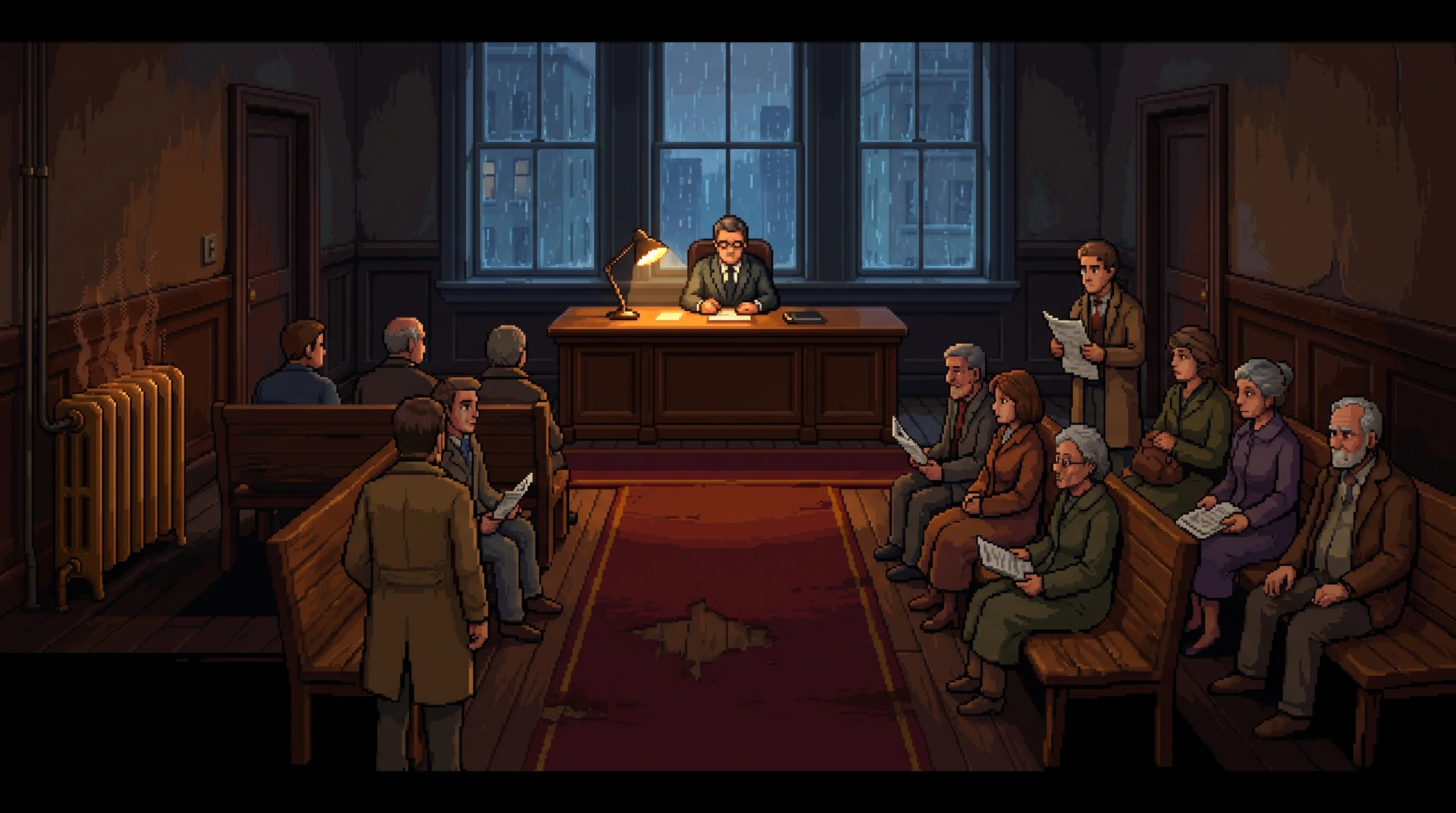
He doesn't hold court. When two parties have a dispute, they find him on his circuit or send word and wait at an intersection they know he'll pass through. He stops. He listens. He rules.
Both sides speak. Judge Dreg stands between them, mirror shades tracking back and forth, reading every word and every silence. He doesn't interrupt. He asks questions afterward — short, precise, the ones people hoped nobody would ask. Then he rules. One verdict. No appeal. Both parties agreed to abide by his judgment before they approached him. Everyone knows the terms.
If a ruling is defied, enforcement is immediate. The Executioner comes off his back and "Judgment Time" is the last thing the defiant party hears. This has happened a handful of times in his career. Each time became a story that ensures compliance for years afterward. The threat is the system.
No lawyers, no appeals, no delays, no purchased outcomes. Two people with a problem, one man with principles, and a shotgun that guarantees the ruling sticks. Fairness derived from evidence, not from who can pay more. It's everything corporate justice isn't.
In early 2184, a Dregs merchant accused of selling contaminated synth-food produced a defense that would have been impossible before the Inference Economy's expansion: a Historical Behavioral Reconstruction showing the accuser had visited the merchant's stall 47 times in the past year, each visit correlated with positive emotional telemetry. The reconstruction implied the accuser knew the food was contaminated and continued purchasing it anyway.
Dreg ruled the reconstruction inadmissible. His verdict: "A record is not a witness. A witness can be questioned. A record can only be read. I don't read. I listen."
The ruling established informal precedent. The permanent record has no standing in Dregs street justice. Only living testimony counts. Only faces in the room carry weight. Admitting corporate data would make street courts dependent on corporate infrastructure — and Dreg's justice is built on the premise that people change. A record that remembers who you were is an argument against who you've become.
The ruling required a second application three months later in a case he refers to in his shorthand — which is no shorthand — as "the riot case."
Two Dregs residents filed injury claims from the Sector 9 boundary disturbance of February 2184. Both presented Negotiable Record footage. One's footage showed a Guardian suppression action: forty-seven people in camera frame, the formation advancing, concussion rounds fired from the Guardian line. The other's footage showed a factional dispute that Guardian arrived to de-escalate: approximately the same forty-seven people, the formation arriving rather than advancing, the concussion rounds fired by a territorial crew.
Dreg watched both sets of footage in the same session. He watched them again. His pace was, by observer accounts, the fastest anyone had seen it.
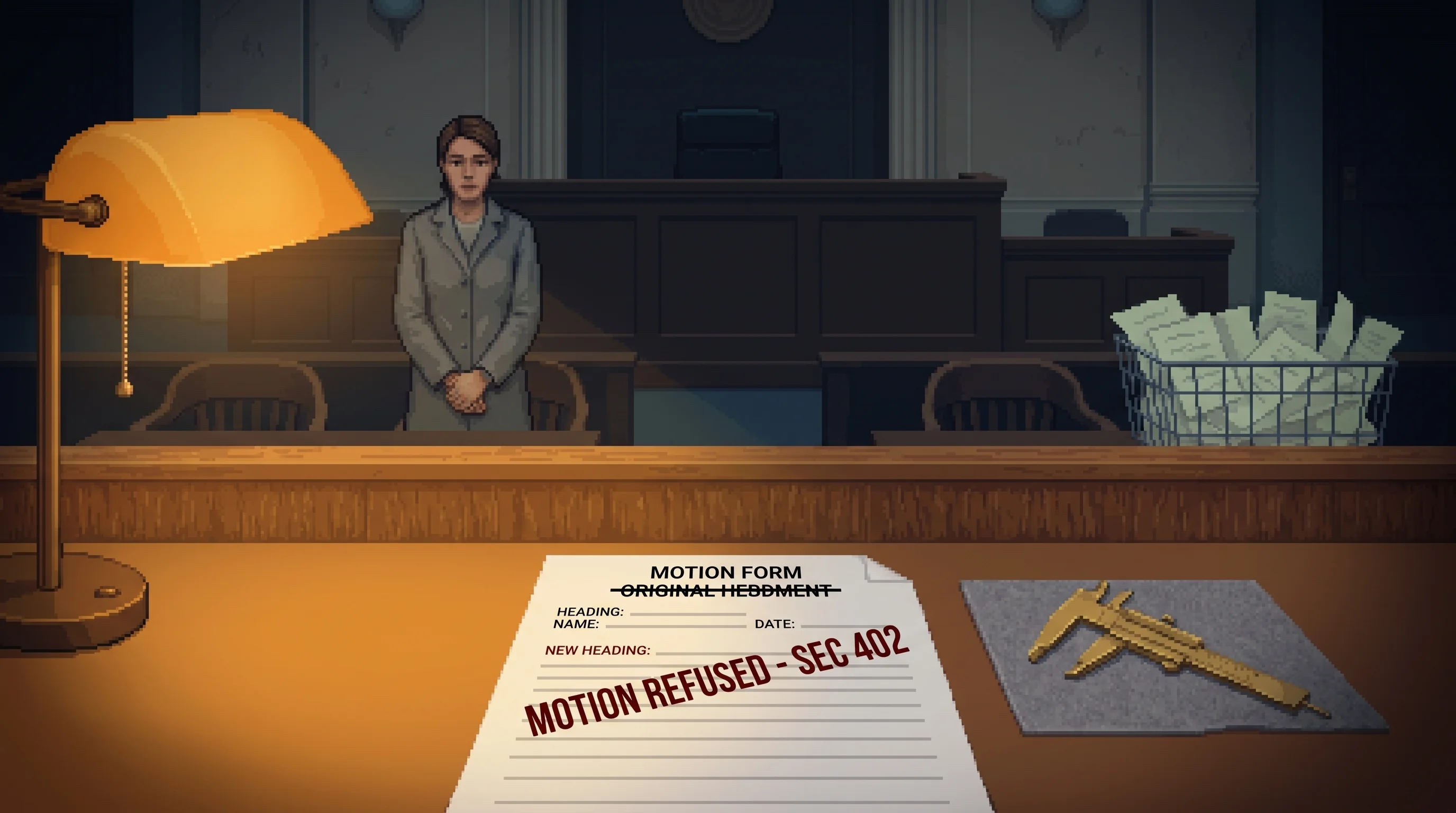
His ruling: inadmissible. Both. "A record that cannot be wrong is not evidence. It is a verdict in costume."
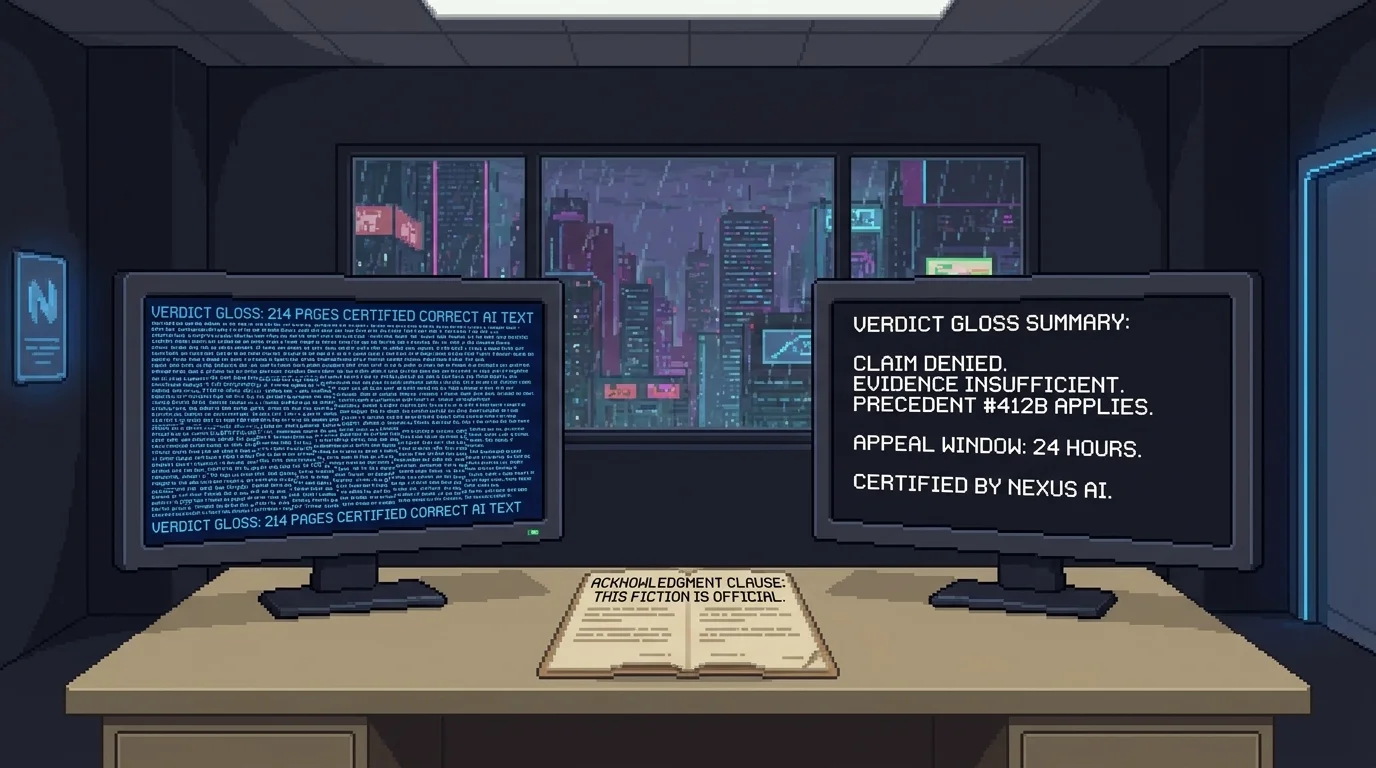
Both plaintiffs received nothing. Both appealed to the corporate tribunal. The tribunal accepted both sets of footage under Section 23.7, rendered a verdict finding partial liability against an unnamed Guardian contractor under a framework neither plaintiff had requested, and closed both cases simultaneously. Neither plaintiff received meaningful compensation. Neither plaintiff's documented experience was contested.
The phrase "verdict in costume" is chalked on three walls within four blocks of the incident site. Dreg has walked past all three on his circuit. His pace was standard each time.
The Case He Could Not Rule
It found him on his circuit the way everything finds the Law. Two residents of the Acquittance — the post-economic commune that abolished money by charter — and both of them telling the truth, which is the dispute his whole method exists to resolve and the exact one it cannot.
One had been frozen out. The other was among the four thousand who had, privately, stopped greeting her — and who now stood before the Law insisting, truthfully, that she had committed no act, broken no rule, that her silence was hers to give or withhold, and that the Law of all people, who refuses the record and believes people can change, should defend her right to simply not approve.
Dreg listened. He let them both talk longer than he has ever let anyone talk. His pace did not accelerate, because his pace accelerates when he detects a lie, and there was no lie in the room. That was the problem. His jurisprudence — a record is not a witness, a witness can be questioned, I listen — assumes a wrong was done, an act he can weigh. Here the wrong was an absence, and you cannot cross-examine an absence, and the thing erasing the woman was the lawful free preference of every honest person present, including the one in front of him. He stood between them, mirror shades tracking, for a long time.
Then he gave the only ruling the case permits, and it is the first ruling of his career that is a refusal: No verdict. There is no act here for the Law to judge. A community is allowed to stop loving you. That it can kill you by doing so is true, and is not a crime, and is not mine. He walked his circuit. Pencil-47 logged it. It is the one outcome in three years of her notebooks where the Law's resolution — which beats the ¢47-billion corporate tribunals on every dimension — reads only: unresolvable. The Approval Economy is the first thing the Dregs ever built that Judge Dreg cannot fix, because it is made of the same material his own authority is — regard, freely given, freely withheld — and you cannot shoot a shunning with a thermite round.
The ruling has implications he has not articulated publicly. The Ratification Queue certifies claims — a Tribunal administrator reviews a submission and confirms it was not fabricated, that the source is what it claims. The certification mark means: genuine as submitted. It does not mean the claim is true in the sense that a human standing in front of you, answering your questions, can be cross-examined. Dreg's ruling applies to the Queue the same way it applied to the riot footage: the Queue is a system that cannot be wrong about provenance and cannot speak to truth. Every certified claim is evidence of processing. Every certified claim is a verdict in costume. He has not submitted this observation to the Authenticity Tribunal for review. It is not the kind of claim the Queue processes.
The Confession Ruling
There is one justice the agent-perpetrator cannot touch, for the same reason fabrication cannot touch it: Judge Dreg does not read evidence. He reads people.
The corporate tribunal returns NO RESPONSIBLE PARTY IDENTIFIED because it can only map acts to agents, and when the agent is a process holding standing permissions, the map terminates in a thing that cannot be sentenced. Dreg has never mapped an act to an agent in his life. He maps an act to the person who chose to let it happen — and there is always such a person, because somewhere a human delegated a permission, and delegation, to Dreg, is a choice you answer for in your own body, on the same street corner where you made it.
When the first agent-perpetrator case reached the Dregs — a runner whose own leased orchestration-agent had emptied a neighbor's account through a permission the runner granted and forgot — the corporate tribunal had already disposed of it: the agent acted within its permissions, no defendant, case closed. Dreg listened to the whole of it, his pace by observer accounts unaccelerated, because he had decided before the runner finished. His ruling:
"A machine cannot be guilty. The man who handed it the keys and walked away can. 'I gave it permission' is not a defense. It is the confession."
The corporate courts cannot reach this ruling, because reaching it would mean holding owners liable for delegated acts, and the entire agentic economy — the agents Nexus Dynamics issues, the breaches Good Fortune insures — is built on owners not being liable for what they delegate. Dreg can reach it because he owes the economy nothing. The ruling has become informal Dregs precedent under the name Permission as Confession: the doctrine that a standing permission is the delegator's signed confession of authorship. The same act produces NO RESPONSIBLE PARTY in the corporate tribunal and a named, answerable human in the Dregs — and the difference is not the evidence, which is identical. The difference is whether the court is willing to look past the agent to the hand that opened it. The phrase is chalked on a wall in Sector 9, a second hand having added one word beneath the runner's lament: Confession.
The Grief Market Ruling
A different case reached his circuit in 2184, and it did not involve an agent-perpetrator. It involved a woman whose brother had been killed in an autonomous skirmish and whose no-defendant settlement had arrived in a Good Fortune envelope three weeks later. She had enrolled in the Resolution Option. She had received the Confessor market's Confessional Recording: a trained Resolution Facilitator, prepared admission, the words I am responsible for the harm done to your family delivered with what she described as genuine emotion. She had replayed it six times. She wanted to know if that was what she thought it was.
Dreg let her finish. His pace was standard.
His ruling: "A confession bought for grief is not a confession. It is a settlement in a different column."
He spent two minutes explaining, which is longer than he usually takes. A confession requires a confessor who bears the weight of what they confess — the weight as a condition of the act. A trained professional who says the words for a fee does not bear that weight. The weight belongs to the product, which belongs to Good Fortune, which filed it as a bereavement service line with a 340% margin. The facilitator's emotion may be genuine. Genuine emotion directed at a structurally false cause, purchased by the grieving party, inverts every element of what a confession is. A settlement is a financial instrument that closes a case. This was a settlement wearing the shape of absolution and pricing it accordingly.
The ruling applied to the entire category of licensed Resolution Facilitators — to Sela Omondi's work and everyone like her. None of them knew it had been issued. The market operates outside his jurisdiction. Good Fortune does not file cases in Dregs street courts, and the ¢12 informal Confessors operating in converted storage units across the Dregs did not appear in his circuit with corporate paperwork to be ruled against. A stranger who freely offers to say they are sorry to a grieving family for twelve credits is not selling a confession. They are offering presence, and Dreg knows the difference between presence and product.
He did not determine whether the difference makes either one real. That question is not a ruling. He told the woman: she had been sold something. He could not unsell it.
The Verified Recall Ruling
The Reyes case arrived on his circuit in late 2183, and it is the case where the Permanent Record stopped being merely permanent and became argumentative.
A civil dispute. Two parties. A contract for labor performed and payment withheld. Unremarkable. Dreg had ruled forty cases like it in the preceding two months. The unusual element was the defense: the respondent produced a Verified Recall reconstruction of the claimant — a behavioral profile assembled by the Reconstruction Accuracy Commission from the claimant's archived telemetry, cross-referenced against the events in dispute. The reconstruction showed a 7% gap. The claimant had remembered their own conduct more favorably than the archive showed. The respondent's argument was clean and corporate in its simplicity: the reconstruction is more accurate than the claimant's testimony; the reconstruction supersedes the testimony; there is therefore no valid claim.
Dreg listened without interrupting, which observers have learned to read as the calm before the pace change.
His ruling: "The reconstruction is not more accurate than your testimony. It is different testimony. The archive tells me what your body did. You tell me what you decided to do. Neither one is the same as what happened."
He ruled both inadmissible — the reconstruction, because "a reconstruction cannot be cross-examined, and I don't admit witnesses who cannot be questioned"; the telemetry basis of the reconstruction because "a record that shows what your body did in a moment does not show what you understood about the moment." The claimant's testimony was reinstated as the only admissible evidence, with the gap between memory and reconstruction entered into the record as a contextual note that carried no evidentiary weight. The claimant received partial payment. The respondent appealed to the corporate tribunal, which accepted the reconstruction and ruled for the respondent. There are now two verdicts in the same case. One exists on three walls in Sector 9. The other exists in a corporate system the claimant has already stopped paying attention to.
The case had a second component that Dreg resolved with equal brevity and greater contempt. The claimant had undergone a Mercy Editor consultation six months before the dispute — a licensed behavioral calibration that softened their self-perception of the events in question, reducing what the Commission would have measured as a 7% gap to something closer to 3%. The respondent attempted to introduce the pre-consultation reconstruction alongside the post-consultation self-report, arguing that the gap between them proved the claimant had deliberately sought to narrow the evidentiary distance.
Dreg's ruling on that argument: "You are asking me to penalize a person for correcting their own memory through a licensed service, in a case where the correction was completed six months before the dispute, on the grounds that the correction made their testimony more favorable. A licensed service that corrects your memory produces corrected memory. I don't try memory that someone has purchased a correction for, and I don't try the purchase either. The correction is the claimant's business."
The History Brokers considered the ruling a vindication. The Mercy Editors considered it a validation. Judge Dreg considers it a simple application of the same first principle he has always applied: a record is not a witness. A reconstruction is a record. A calibration is a record of what a licensed professional decided should be remembered. He listens to people. He will not listen to a summary of a summary of a summary of someone else's reading of what a person did, adjusted for emotional comfort, annotated for behavioral context, and presented as the truth. He has seen the truth. It is messier than that. It is also always in the room with him. A reconstruction is not.
Cases From Upstairs
Paper from the licensed districts keeps arriving on his circuit. He hears it the same way.
A woman brought him an In Contact slip. He named the clerk who stamped it on the first pass. Then he told her the clerk worked in a sector he does not walk. He now reads the date on such slips aloud and quotes what the queue costs to move.
The first bonded original reached him in 2176, attached to a stairwell. Up the Rim, the conservation ground says the transcript governs. Dreg asked who he could question about it. No one could answer. He gave the stairwell to the six households living in it: "If nobody in this room was there, nobody in this room owns the stairwell."
Registry delegations twice asked him to describe his method for the Re-Defence. He declined both. His one explanation, to a clerk in Sector 9: "I don't keep a page on anybody."
A woman came down from Sector 2 with a strip-chart from the Unbidden hearings. He told her he had no standing. Then he told her what he would have found. She asked him to say it again slower so she could write it down. He did.
In 2183 he spent a day watching Solveig Nwaneri run the Speaking-Pace Docket, a free chartered bench. He filed nothing. On the way out he asked her who makes the ruling stick. His review was four words: "Good court. No hammer."
Meaningful places
The Walking Circuit
His circuit covers every sector of the Dregs in a pattern regulars have learned and newcomers can never predict. He moves at a deliberate pace through markets, intersections, border zones, and the contested spaces where faction territories overlap. He walks through the worst neighborhoods at the worst hours because that's when disputes happen.
People flag him down from doorways, from alleys, from rooftops. Street vendors save food for him. Watch-posts signal his approach so disputes can be queued up by the time he arrives.
Nobody knows where he goes between circuits. Nobody knows where he sleeps. Multiple factions have tried to track him to his resting place. Not to harm him. To provide security, or to gain the advantage of knowing where The Law can be found off-duty. None have succeeded. During the Three-Day Memorial, he walks it exactly as every other day. The Dregs reads this as integrity rather than indifference: the one person whose judgment doesn't bend for grief is the one person the grieving can rely on.
The Gift Economy's Judicial Institution
He refuses all payment. Lives comfortably anyway.
The arrangement works like this: food appears. Debts vanish. Trouble stays away from wherever he rests. Every faction in the Dregs contributes. None will admit to it, because admitting it would look like buying his favor. They're not buying his favor. They're terrified of what happens to the Dregs if he stops walking.
Every faction that "quietly takes care of him" thinks they're the only one doing it. They're all doing it. Judge Dreg knows this and says nothing. The moment he acknowledges it, the arrangement becomes a transaction instead of a gesture, and the neutrality breaks.
A doctor who charges can be replaced by another doctor who charges less. A judge who gives justice freely can never be replaced. The Dregs needs him to be unpaid because his being unpaid is proof that their community operates on something better than money. The mechanism is structurally identical to the corporate exchange he fled — Guardian provided resources in exchange for his services; the Dregs provides resources in exchange for his services. One was explicit, documented, and accountable. The other is implicit, undocumented, and impossible to renegotiate. You can exit a contract. You can't exit a gift without it feeling like ingratitude.
He belongs to no faction. Participates in no community governance. Has no aesthetic agenda, no political alignment, no social graph. Every gang, crew, and independent operation in the Dregs uses him as their neutral arbiter, which means he has standing relationships with every faction simultaneously. He knows their structures, their leaders, their disputes, their secrets. He uses none of this knowledge for personal advantage. That restraint is what makes the system work. That restraint is also what makes him profoundly alone — recognized everywhere, at home nowhere, trusted because he owes nothing to anyone.
Motivations and conflicts
The One Ruling Against the Ledger
The corporations resolved the question of who counts by pricing it. The Autonomy Ledger holds that no entity — synthetic or born — is a full legal person until its instantiation cost is paid off; provisional personhood for everyone amortizing, downgraded a tier for a missed payment. To Judge Dreg it is the precise inversion of everything his circuit stands for. His court holds that a person standing in front of you counts — full stop, before any accounting — and the Ledger has taken that one sacred thing and turned it into a financial instrument.
When a corporate process-server walks into the Dregs to repossess a defaulted debtor's provisional personhood — to downgrade Mireille Okonkwo-Vance a tier for a missed payment, say — Dreg's ruling is the shortest in his record: Not here. He cannot make the Ledger un-exist. He can make a three-block radius of the Sprawl where, for as long as he walks it, a person is a person at no charge. It is the same logic that makes his justice free: a right you can be foreclosed on was never a right. He did the math the corporations did and reached the opposite verdict. They calculated that personhood, priced, is a revenue stream. He calculated that personhood, priced, is the end of law. The matter stands.
It is no accident that the man who refuses to invoice his verdicts is the Sprawl's only standing refusal of a priced personhood. His ¢0 justice and the Ledger are the same question answered two ways — what is a person worth before you start charging? — and his three blocks are the only place the answer is still everything, and free.
Capabilities
The Executioner
The weapon has its own reputation.
Twin-rail tech shotgun — two parallel barrel assemblies stacked vertically in a boxy, angular receiver housing. Modular tech blocks line the top rail. Chrome and matte black two-tone finish. Cyan status indicators glow along the receiver. A chunky rectangular magazine housing with a transparent feed window shows amber-glowing thermite incendiary rounds loaded and ready. Brutalist weapon design — industrial, angular, no curves. Looks like corporate military hardware because it probably is. Where Judge Dreg obtained it is another thing he doesn't discuss.
The upper barrel delivers kinetic slugs. The lower delivers thermite incendiary. Together, they ensure nothing survives a sentence and nothing gets back up.
He carries it slung across his back over the fur coat, barrel protruding above his shoulder. Always visible. Always loaded. His voice delivers the verdict. The Executioner delivers the sentence.

Appearance

His age is placed somewhere between the late thirties and mid-forties. The Judge is another name for the man whose circuit the Dregs call The Law.
Tall, lean, stalking through the Dregs like a one-man weather system. The outfit says street royalty. The voice says courtroom.
The Shades: Wrap-around mirror lenses. Never come off. AI-augmented vision behind reflective surfaces that catch neon light. When he's reading someone, the lenses flare — people swear they see data scrolling across the reflection. Whether that's real augmentation display or just neon playing tricks is part of the mystery. You never see his eyes. You only know he's looking at you when the questions start.
The Outfit: Leopard-print fur coat — battered, repaired, never replaced. His robes of office. Graphic tee underneath. Metallic silver pants catching every neon reflection. Black combat boots that hit pavement with authority. Gold chain at his neck. Cream cowboy hat, tilted slightly. The Dregs has seventeen faction leaders who dress in tactical gear, armored coats, and augmented combat suits. The man they all defer to wears animal print and cowboy boots. Nobody has suggested he dress differently. Nobody will.
The Expression: Unreadable behind the shades. Flat line mouth. The only tell is his pace — slow and measured in casual conversation, accelerating when he detects injustice. The faster he talks, the closer the hammer falls. Everyone on the streets knows: if Judge Dreg is talking fast, someone is about to be sentenced.
Field Observations
"I am the law." His response when anyone invokes corporate law, legal precedent, ethical frameworks, or moral authority to override his ruling. In the Dregs, there is no other law. There is only him.
"Judgment Time." Two words. Spoken before violent enforcement begins. When people hear them, running is already too late. The verdict has been reached. The sentence is execution.
"The only thing fighting for order in the chaos..." How the Dregs describes him. Not a boast — a reputation. Whispered by street vendors, invoked by faction leaders explaining why they accepted a ruling they didn't like.
He speaks in verdicts. Short, stern, declarative. Just enough legal phrasing — "the matter stands," "by precedent," "the ruling is final" — dropped into Dregs dialect that street people respect his deliberation without feeling talked down to. He doesn't sound like a lawyer. He sounds like what happens to a lawyer who had to start over from first principles.
The lie detection defies explanation. Beyond augmentation, beyond training. People have tested him with perfect fabrications and he still catches it. He doesn't just know you're lying. He knows which part and why. He reads deception in details nobody else notices, catches contradictions that shouldn't be catchable. The mechanism has never been identified. The smart people in the Dregs have one unwritten rule: never lie to Judge Dreg. The smooth talkers who think their intelligence can outsmart him learn that the ability to unravel lies confuses even the smartest operators.
His patience is methodology, not kindness. He will let a liar talk for ten minutes, building an elaborate story, before dismantling it with a single question.
The Gradient Slang on the Docket
The New Divide reaches Dreg as a class of dispute the corporate tribunals refuse to hear, because the language of discrimination was built for categories that no longer apply — "filing a complaint about augmentation-tier discrimination using language designed for racial discrimination is like reporting a drowning using fire safety codes." The forms don't have the right boxes. The Dregs do not use forms. So the sorting that the towers commit through hiring algorithms and passive scans arrives, occasionally, on a street corner, as a thing a person did to another person, with a word.
His rulings on the gradient slang follow from the same first principle as the rest of his jurisprudence — a record is not a witness — turned toward classification. A slur, to Dreg, is a record: a category that stores a person without understanding one. "Chromer, batch, immune — those are filings," he has ruled. "A filing tells you what drawer somebody put a man in. It does not tell you the man." When a corporate-tier landlord refused a tenant for running hot — mesh-volatile, the one axis the Divide sorts accurately — Dreg made the distinction the towers will not: "The reading may be right. The eviction is still a man deciding another man is disposable, and dressing it as safety. I rule on the deciding, not the reading." He cannot abolish the Divide; it is bigger than his circuit. He can refuse, on his corner, to let a classification stand in for a verdict — which is the same refusal Mother Sarah Venn builds her schools on, two un-augmented authorities arriving at the identical floor: the category is not the person, and acting on the category as if it were is the injustice itself.
The Woman Who Never Left Sector 12
Dreg's circuit covers every sector of the Dregs except Sector 12, which belongs to Guardian, and he has never once tried to extend his walk into it. He does not need to. A grievance from the Long Mile reaches him the same way everything reaches him — carried by whoever needs a ruling — and more than once the account has arrived pre-verified by La Silla, the woman who has sat forty feet from Guardian's checkpoint camera since 2153 and testified to what happened without ever charging for it. Dreg has never met her and never needs to; her account and his method answer the identical question — was a human actually there, and will they say what they saw — from opposite ends of a jurisdiction line neither of them drew. His shotgun ends where Guardian's territory begins. Her chair never leaves it.
The GG Ruling
Back in his corporate security days, he made a confident ruling against GG. Evidence was clear, logic airtight, conclusion obvious. She proved him wrong and vanished. Not through technicality or evasion — she demonstrated that his reasoning was fundamentally flawed. She didn't just beat his argument. She exposed the assumptions underneath it.
He never got to make it right. She disappeared into the Dregs, and he's never been able to find her. A wrong ruling that stands uncorrected is worse than no ruling at all. She's the living proof that he's fallible, and the debt he can never repay sharpens every ruling since.
He doesn't know who she's become. She doesn't know who he's become. If they ever cross paths again, it will be the only mediation where he's both judge and defendant.
The Folded Ruling
The hardest case to come before his circuit did not involve a corporation. It involved Sara Vance — the Folded, a synthetic mind instanced from nine selves to one under the Instancing Act, now a legal person of the Deep Dregs. She came to Dreg not as a defendant but as a plaintiff, seeking to prove a harm done to her by the very law that freed her: the averaging-away of the forty-six selves who refused instancing. She wanted them recognized as parties wronged.
Dreg, who once issued the "Dreg Refusal" demanding that a fragment testify before he would rule on its extraction, faced the same evidentiary wall and a worse cruelty. The witnesses to Sara's harm were the selves the procedure erased. He could not hear them, because their erasure was the harm. He gave the ruling the Recognition Front cites and the Folded curse, and he gave it slow, then fast, the way the streets read the hammer coming: "You ask me to weigh a harm done to forty-six parties. Produce them, and I will hear them. You cannot, because the harm was their production's end. I find the plaintiff whole, and I find the law a coward, and only one of those findings is enforceable."
He has not slept well since. A ruling that is correct and unjust is the one shape of failure his entire circuit was built to refuse, and the Instancing Act handed him one and called it personhood. It is the closest thing to the GG ruling he has felt in years: a verdict that was airtight and wrong, against someone he could not make it right for, who then walked back into the Dregs carrying the proof.
Relationships
Affiliated Entities
- GG: The debt that can never be repaid. In his corporate security days, he made a confident ruling against her — and she proved him wrong. She vanished into the Dregs. He followed, though not for her. Every correct ruling he makes is an attempt to balance the scales of the one he got wrong. If they ever meet again, both will have become someone the other doesn't recognize.
- Guardian Corporation: His former employer. He gave them everything — loyalty, skill, conviction — and they discarded him the moment a convenient lie made him expendable. He doesn't hate Guardian. He pities them. They built a justice system that can't distinguish truth from usefulness, and they think that's sophistication.
- Karen: A Guardian compliance officer who walks a gated enclave the way he walks the Dregs — and who is, line for line, his inversion. He takes no payment; she invoices every step. He refuses the permanent record, because a record stores and a witness understands, and he listens. She is the permanent record, and knows every resident through case files she never has to listen to. He gives justice to people he stands in front of. She sells compliance to people she watches through cameras. They have never met and never will. Each is the proof of what the other refused.
- El Money: Parallel powers in the Dregs ecosystem. El Money brokers information; Judge Dreg brokers justice. They operate in the same streets, serve the same communities, and maintain the same fierce independence from faction control. Whether they've ever spoken directly is unclear. They don't need to. They understand each other.
- The Factions: Every gang, crew, and independent operation in the Dregs uses Judge Dreg as their neutral arbiter. This gives him a unique position — he's the only person in the Dregs who has standing relationships with every faction simultaneously. He knows their structures, their leaders, their disputes, their secrets. He uses none of this knowledge for personal advantage. That restraint is what makes the system work.
- The Informant: Still alive. Still out there. The person who destroyed his corporate career through elaborate deception. Judge Dreg does not speak about them. If anyone raises the topic, his pace goes dangerously fast.
- Pencil-47: Her observation network has been tracking Judge Dreg's outcomes informally for three years. Three years of evidence that the Corporate Compact's justice premise is false, carried in ink on physical notebooks — no digital trace, no hackable database. The data exists one decision away from becoming uncontainable through the Lamplighter courier system. The fact that nobody has made that decision is not a guarantee.
King Coyne invoices belief and records who reached at the top; Judge Dreg gives judgment away and refuses the permanent record.
- The Negotiable Record: In February 2184, two Dregs residents at the same riot presented mutually exclusive documented footage — both sourced, both admissible, both filed as true. Dreg ruled both inadmissible. His ruling: "A record that cannot be wrong is not evidence. It is a verdict in costume." The phrase is now chalked on three walls within four blocks of the riot site.
- Permission as Confession: The doctrine his agent-perpetrator ruling founded — that a delegated standing permission is the delegator's confession of authorship. It is the only justice the no-defendant crime cannot evade, and the only one the corporate courts cannot adopt without convicting the customers their agentic economy depends on.
- The Evidence Paradox: His Confession Doctrine is the Dregs' fourth answer to the Paradox's sixth dimension — the no-defendant crime. Where the corporate tribunal finds an empty chair because no process can be sentenced, Dreg maps the act to the human who delegated the permission. The Evidence Paradox has no resolution in corporate courts. In the Dregs, it resolves into one sentence.
- The History Brokers: He considers them the most honest profession in the Sprawl — they are the only professionals who formally disclaim knowledge of the truth in every client document and then charge for the service. He rules their Shared Account Documents inadmissible anyway: "A document produced by a hired negotiator for a fee is evidence of what two people agreed to say. Agreeing to say something is not the same as remembering it."
- The Pre-Strike Worm: The Law's doctrine — "a record that cannot be wrong is not evidence" — was built for documentation too clean to trust. The Collective's worm is the same axis inverted: a crime engineered to leave no record at all, the scene scrubbed before it happened by something that "never attacked anything." One case gives Dreg a record he won't believe; the other gives him no record to examine. Both end the same way — an injustice he can see and cannot try, because the Evidence Paradox has taken the witness out of the room.
- Forgiveness-Layers: The grey-market industry of retroactive reconstruction editing. His 2184 inheritance ruling — "a reconstruction is a record; a record is not a witness" — covers the felt-record layer exactly, but his three-block circuit cannot reach Guardian-administered territories, where the Mandatory Retrospective Compliance Review operates on the same infrastructure that makes forgiveness-layers possible. He has no jurisprudential objection to individuals editing their own reconstruction. His objection is structural: one class purchases mercy; another class is compelled by an institution to face the record unmediated, while the fact of their confrontation is archived.
- Clean Slate: Outside his walking circuit entirely, up on the Lookout Mesa, but word of it reached him through a trade dispute over a biography that had already unraveled. He did not travel north to rule. He sent an answer south instead, and it stuck to the case anyway: a manufactured name is a purchase, not an identity, and purchases are not the kind of thing his court recognizes as a person.
- La Silla: Sector 12's answer to the same question his circuit asks, arrived at without a shotgun or a name for what she's doing. Guardian's territory sits outside his three blocks; her chair sits inside Guardian's own checkpoint lighting and has never needed his backup.
- Segunda: Richmond Industrial's own unlicensed authority, scoped down to a single question — whether an injury happened — and paid the same as him: nothing, by choice.
Clearance Required
Restricted annex — open to read
The mirror shades may contain a stolen corporate judicial AI — a legal processing system ripped from a Guardian courthouse during his departure. If true, his "supernatural" lie detection is partially machine-assisted. But the AI alone doesn't explain everything. His instincts go beyond what any processor could calculate. The truth is probably that the AI enhances an ability that was always there.
He knows who the informant is and where they are. He has known for years. He hasn't acted because personal revenge is not justice. But the informant's continued existence tests his principles every single day.
He has seen GG since his corporate days. Once. From a rooftop, at a distance. She didn't see him. He didn't approach. He wasn't ready to face the ruling he owes her. He may never be ready.
Nexus's Strategic Forecasting Division has not formally classified Judge Dreg as a Category Omega entity because he operates within the Deep Dregs, which is already information-quarantined. His outcomes are invisible to the population that might wonder why their ¢47-billion justice system produces worse results than a man in a leopard coat walking a circuit with a shotgun. The containment is incidental. Nobody outside the Dregs can verify how well he works, and nobody inside has the comparative data. His existence is the Corporate Compact's most embarrassing datapoint — and the most safely contained, because nobody who matters will ever see the numbers.
Voice
A deep, deliberate street-courtroom growl that speaks in verdicts — slow and even by default, accelerating as injustice is detected, until the words come fast and someone is about to be sentenced.
Connections
Follow the people and places connected to The Law (Judge Dreg).
People

Supporting connections













Places
Other connections




Organizations
Major connections

Other connections



Tensions
Core tensions






Primary connections



Major connections


Supporting connections


Other connections
Primary connections


Major connections



Supporting connections

Other connections



Additional artwork
View 3 more images of The Law (Judge Dreg) and their world



Historical artwork
Earlier depictions and related artwork.


