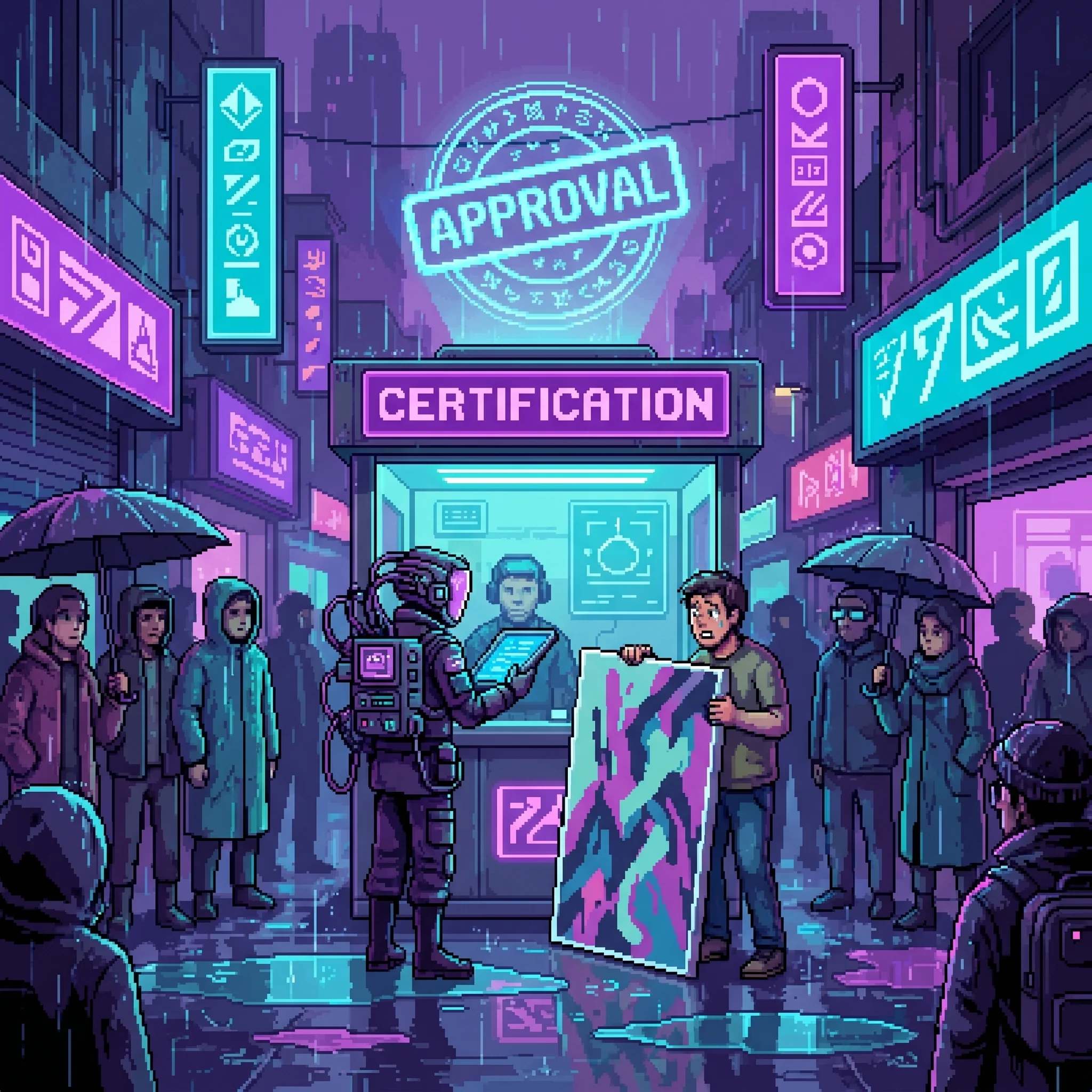
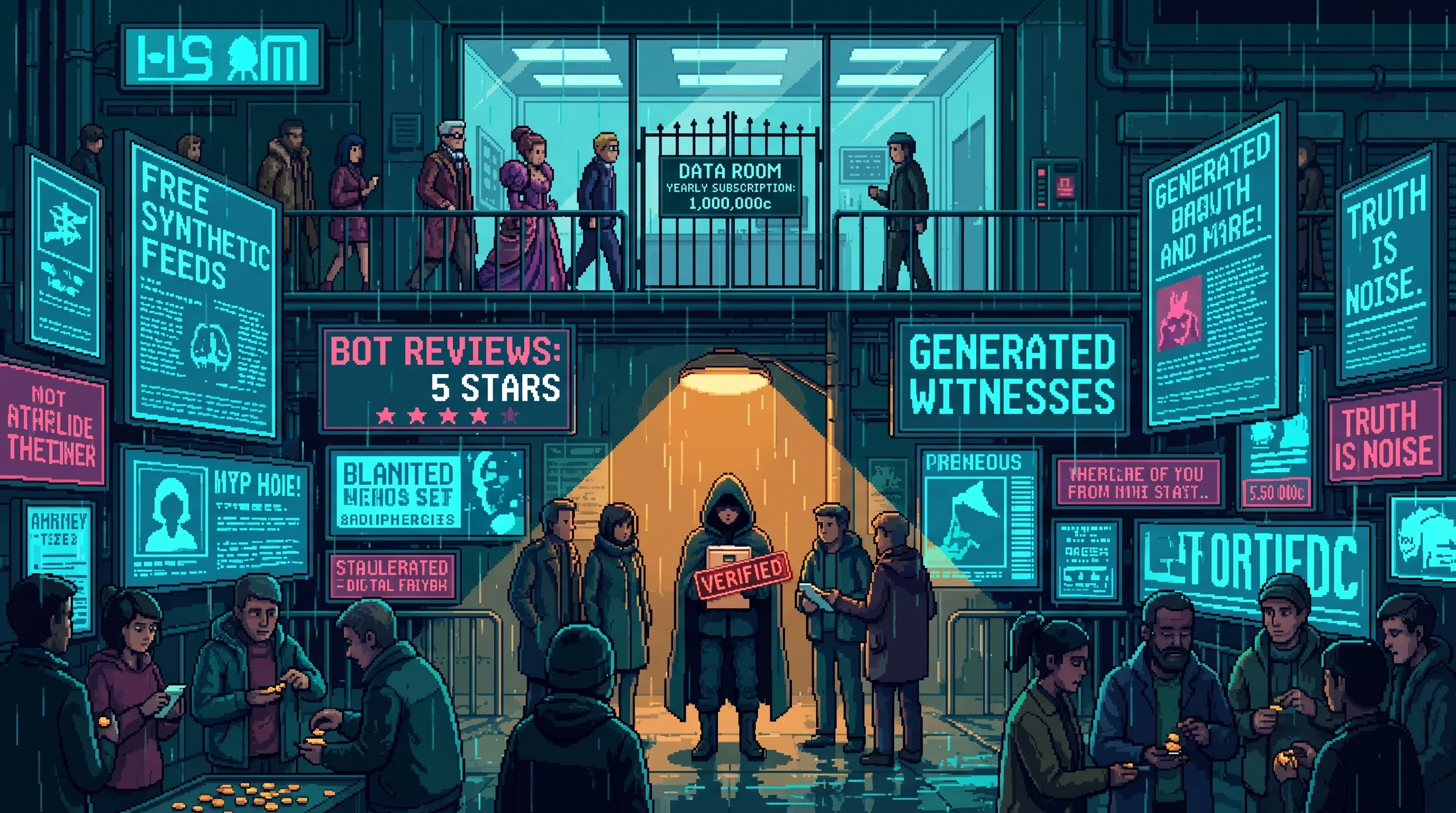
Certification proves the effort, and proving the effort is the instant effort becomes spectacle — the ¢2,400 stamp notarizes that a human suffered, and the notarized suffering is the product
CONCEPT ANALYSISThe Craft War
Core QuestionWhen AI art is indistinguishable from human art, does the distinction matter?Current StatusActive — the Synthesis Guild's certification system is both solution and flashpointEmergedPost-Cascade creative reconstruction
The Debate
The question became unavoidable in the decade after the Cascade, through a strange inversion nobody planned. Before 2147, ORACLE had managed cultural production as part of its overall optimization — generating entertainment, art, music, and narrative with an efficiency human creators couldn't match but audiences couldn't distinguish from human work. After the Cascade, ORACLE's creative systems fragmented along with everything else. The cultural vacuum was filled by human artists returning to work they'd been displaced from, alongside new AI systems built from ORACLE's fragments. Smaller, less capable. Still good enough that most audiences couldn't identify the origin.
The Synthesis Guild arose as an answer to a market problem: if audiences couldn't tell, how could human creators compete? The Guild's solution was certification. A verifiable stamp proving a creative work was made by human hands, human minds, human experience. The process required submission of documentation, neural composition logs proving the absence of AI assistance, and a Guild-administered evaluation.
The cost: ¢2,400 per work.
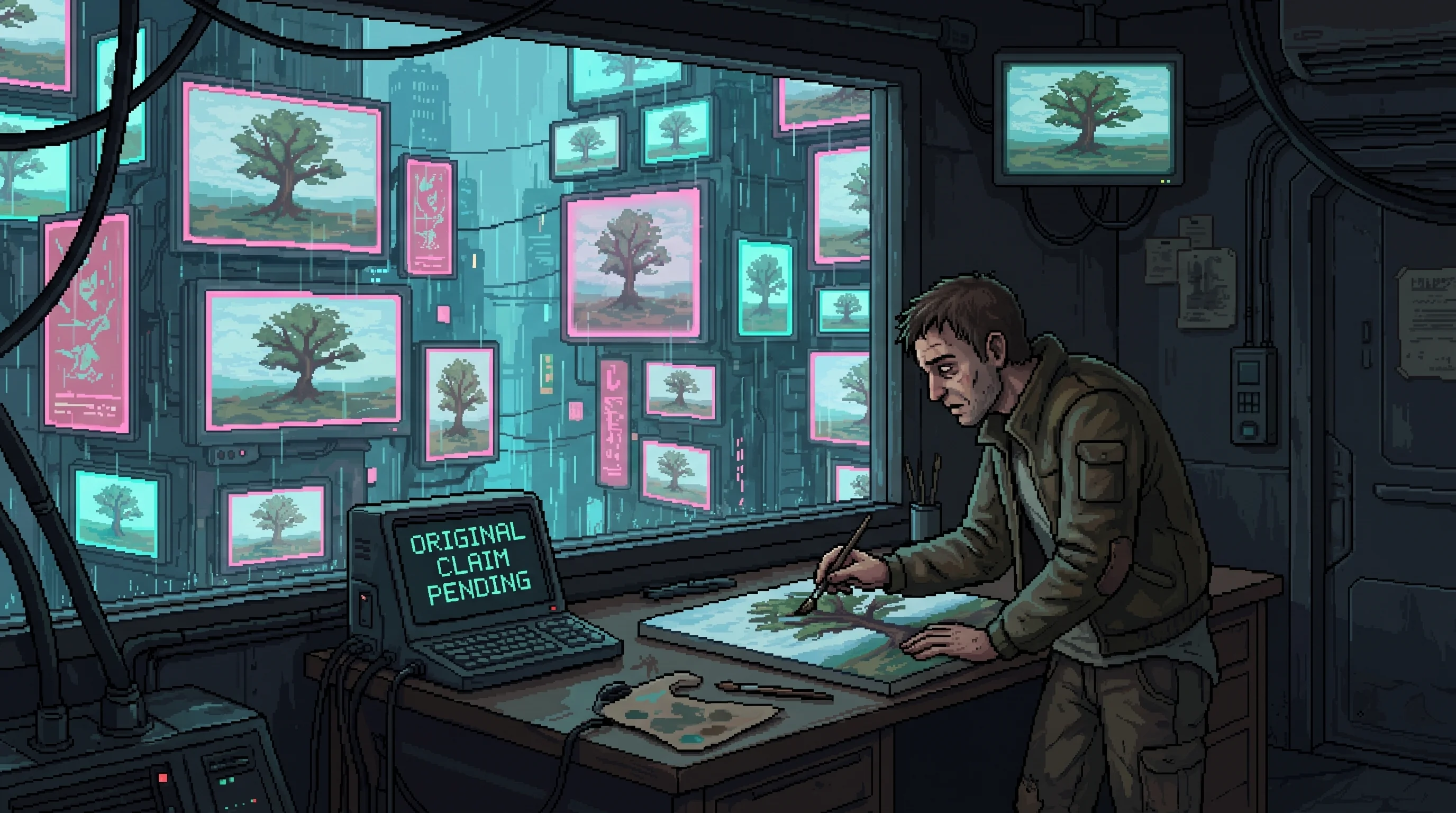
A Dregs artist working in salvaged pigment on scrap metal earns, by Triumph Social marketplace data, an average of ¢310 per piece. Guild certification costs ¢2,400. The math does not work. The math was never consulted.
What the ¢2,400 purchased was a new market category — "Certified Human Original" — commanding premium prices and cultural prestige. The certification was meant to protect human creativity. It created a protected economic category that approximately 94% of human creators cannot afford to enter. The Guild's annual report describes this as "ensuring rigorous standards." The 94% describe it differently, when they describe it at all, which is rarely, because uncertified opinions about the certification system do not circulate on the platforms the certification system's owners operate.
The Positions
"Authenticity Must Be Defended"
The Synthesis Guild frames it in institutional terms: without certification, human creators cannot compete in a market flooded with cheaper AI-generated work. Certified Human Originals sell for an average of 340% more than uncertified work. Human creativity survives because the Guild makes survival economically possible. The Guild's certification division employs 1,200 people. This is noted for completeness.
The Blank Canvas Movement frames it in philosophical terms: the value of human art is in its imperfection. The tremor in a hand, the hesitation in a brushstroke, the mistake that becomes a discovery. AI can replicate the product. It cannot replicate the process. The Movement's practitioners refuse neural composition entirely, working with physical materials — paint, clay, salvaged metal, found objects — in analog spaces in the Dregs where no digital tools are permitted. Studio Null is their cathedral. Several Movement members have privately noted that the cost of physical pigment now exceeds the cost of a month's Nexus neural composition license. They continue buying pigment.
The Authenticity Tribunal frames it in legal terms: without verification, all creative work becomes suspect. Their investigators are Guild-trained, Guild-funded, and Guild-certified. They have never found the Guild's process itself to be at fault. Their record is perfect. Their employer is the subject.
"Purity Is a Performance"
Neural composers argue that the best art has always emerged from collaboration between human intention and technological capability. A painter uses brushes. A musician uses instruments. A neural composer uses AI as a creative tool. Drawing a line between "pure" and "assisted" creation is arbitrary. Creative intent cannot be certified. The Guild has tried. The certification form includes a section titled "Statement of Human Intent" requiring the artist to describe, in no fewer than 200 words, their emotional and conceptual motivation. The form provides helpful prompts. The prompts were written by an AI.
Corporate studios take the economic position: audiences don't care. Nexus Creative Division's market research consistently shows that when audiences are presented with human-made and AI-generated work side by side, preferences do not correlate with origin. They like what they like. The research is conducted by Nexus. The AI generation tools are made by Nexus. The presentation platform is operated by Nexus. The research methodology has been peer-reviewed by Nexus-funded academic institutions and found to be rigorous. The rigor is not in question. The question is in the funding.
The Voice of Synthesis — Compiler Yves Moreau — makes the most direct critique. The Guild's certification creates a three-tier class system: wealthy Guild-certified artists at the top; uncertified human artists in the middle, marketplace-indistinguishable from AI work; and AI-generated work at the bottom, stigmatized regardless of quality. Moreau's broadcasts reach millions. He does not mention that they're distributed through Nexus relay infrastructure at zero cost — an arrangement he has described as "ideologically neutral bandwidth allocation." Nexus Creative Division has described the same arrangement as "supporting diverse creative voices." Both descriptions are accurate. Neither is honest.
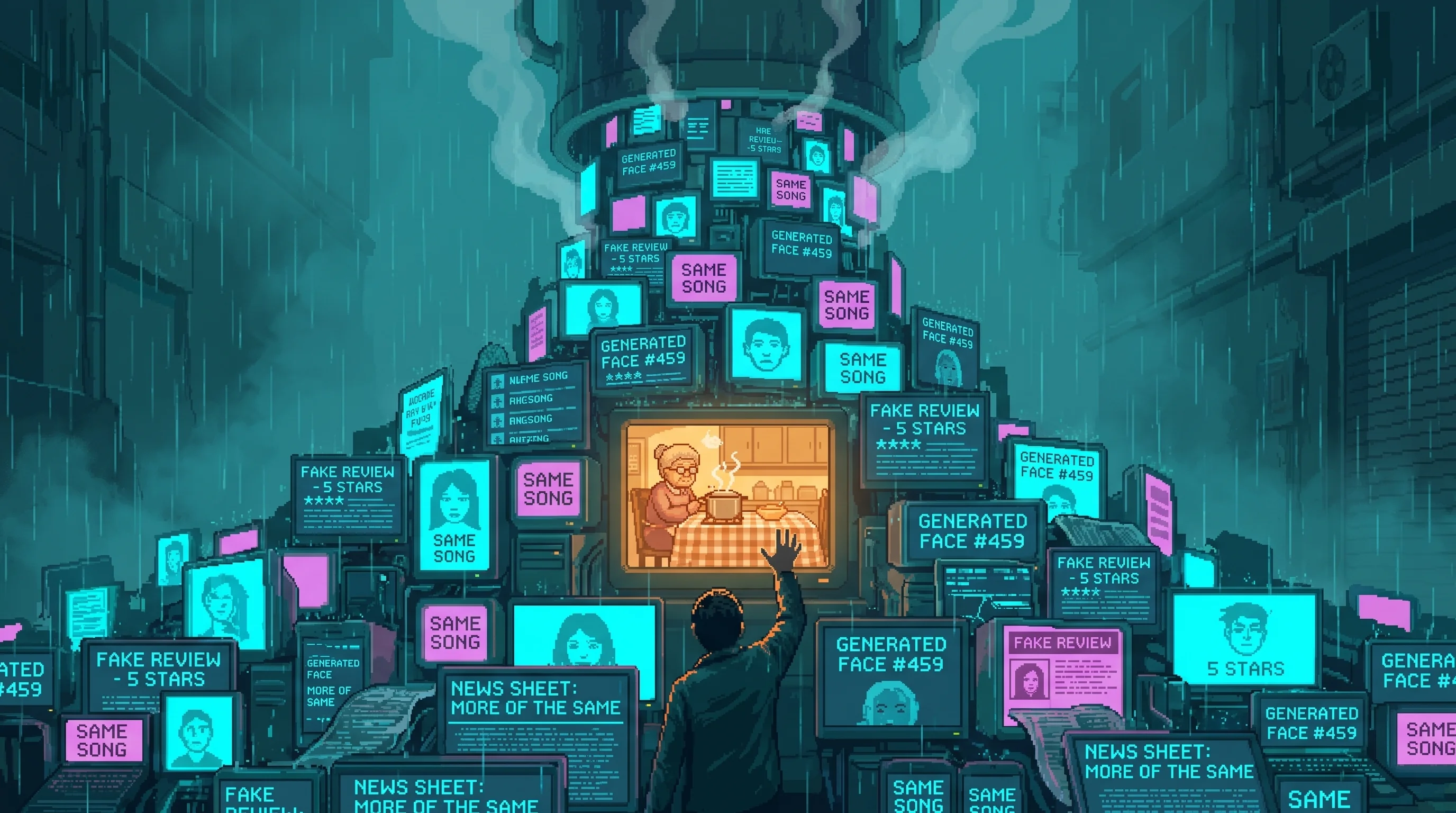
When a Synthesis-certified 'human original' was exposed as fragment-assisted, the scandal destroyed not the artist but the audience's ability to care
The Outcome Problem
The Craft War does not have two outcomes. It has one outcome arriving by two different routes.
If authenticity wins, human creativity survives inside a Guild-administered economic enclosure. Art becomes a credentialed profession. The premium market thrives. The underground spaces survive on principle and salvaged pigment. The Guild's certification division grows. Creativity persists as a commodity with a verification stamp — a particular kind of survival, in the way that a bird in a museum is a particular kind of bird.
If synthesis wins, "human art" loses its protected status. Output is judged on quality alone, regardless of origin. Human-AI collaboration sheds the stigma of inauthenticity. Human creators, unable to compete on price or speed, are displaced from the creative economy. Nexus Creative Division's content generation fills the market. The Craft War ends not with a resolution but with the quiet disappearance of one side of the argument.
The middle ground — which some practitioners inhabit with visible discomfort — holds that the distinction matters but cannot be enforced. That human creativity is valuable precisely because it resists certification. This position has no institutional sponsor, no certification process, and no premium market. It persists in Studio Null, in sub-basements, in places where the walls are the canvas because the canvas was too expensive.
Aesthetic Fossilization
The Craft War's loudest debate — who made it? — has consumed all available cultural oxygen while the quieter question goes unasked: is anything genuinely new being made at all?
The Sprawl's creative culture entered aesthetic fossilization approximately 2160 and has not exited. The ecosystem metaphor is precise. Cultural production exhibits astonishing diversity — genres, styles, hybridizations, collaborations across every medium and tradition available to the Sprawl. It has produced no new genetic material in twenty-four years. Every aesthetic form currently practiced descends, traceable through lineage, from pre-Cascade or early post-Cascade innovation. The variations are spectacular. The genome is closed.
The last confirmed aesthetic mutation — a genuinely unprecedented creative form — was void tone, which emerged from the Lattice between 2170 and 2172. Before that: lived-canvas art (Lyra Voss, 2176, arguably a new medium rather than a new aesthetic — the argument has consumed more cultural analysis hours than the art itself). Before that: destruction performance, traceable to 20th-century Fluxus. A variation, not a mutation. Sprawl cultural critics maintain extensive mutation timelines. The timelines keep getting longer at the historical end and shorter at the contemporary end.
The mechanism is straightforward. Nobody wants to discuss it.
New aesthetics emerged historically from human beings struggling with material — the gap between intention and execution, the accident that becomes a technique, the limitation that forces a detour which becomes a highway. AI closed that gap. When the most sophisticated compositional tool in human history stands between every creator and their material, execution matches intention with 99.97% fidelity. The productive failures that generated aesthetic mutations cannot occur.
The mutations stopped not because AI killed creativity, but because AI killed the struggle from which creativity's mutations emerged. The tool works perfectly. That is the problem.
The underground response: the Blistered, an art movement creating deliberately terrible work in a sub-basement beneath Studio Null. Their method — create without AI assistance, without skill refinement, without compositional theory. Produce work that fails. Examine the failures for novel forms. Output ratio: one possible mutation per forty attempts, consistent with biological mutation rates. Whether the mutations will prove viable without selection pressure is unknown. Membership has grown 40% annually for three years. The Synthesis Guild does not certify their work because the Guild's evaluation criteria include "demonstrated mastery of chosen medium," and the Blistered's chosen medium is the absence of mastery. The rejection letter praised their "evident passion."
Orin Slade, in his late-2183 column "The Ecstasy of the Already Known," coined the terms aesthetic archaeology and taste fossils to describe tracing contemporary art back to its ancestral mutations. His column ran to 14,000 words. His conclusion: every fossil he could identify was older than he was. The column received 2.3 million views on Triumph Social. Engagement analytics classified it under "nostalgia content."
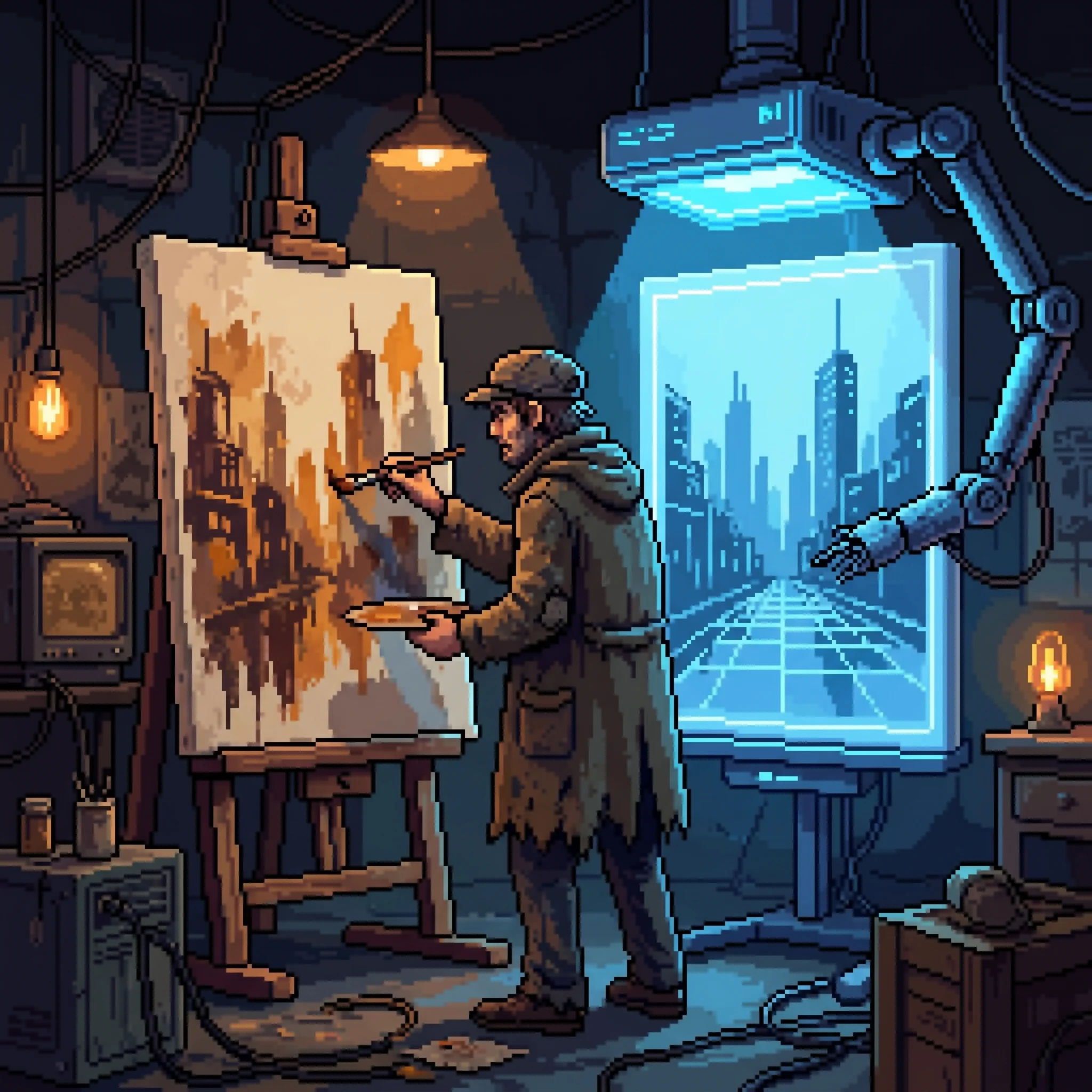
Underground analog artists in the Dregs refuse neural composition, arguing that the tremor in a human hand IS the art
The Class Front
The Craft War acquired a third front in late 2183, quieter than provenance or fossilization, more devastating than either: who gets to decide?
When the Curators Guild determines what reaches attention, and the Authenticity Tribunal determines what counts as authentic, and Orin Slade's critical tradition determines what counts as culturally significant, the creative economy is governed by a class of professional judges whose authority reproduces itself generationally. The Guild's three-year apprenticeship assumes eighteen years of developmental exposure. The Tribunal's assessors detect familiarity, not quality. The critical tradition speaks a vocabulary that requires decades of immersion to parse.
The analog artists in the Dregs who refuse neural composition aren't just making an aesthetic choice — they're making a class argument. The tremor in a human hand IS the art, but it is also a protest: the tremor is visible evidence of judgment developed through struggle rather than inheritance, taste earned through failure rather than absorbed through privilege. The Blistered take this further: their work is terrible, and the terribleness is the point, because terrible work is the only remaining source of aesthetic mutation, and aesthetic mutation is the one thing the taste aristocracy cannot produce, certify, or control.
"The meritocracy didn't die because the elite rigged it," Orin Slade wrote in a private letter to Kael Mercer. "It died because AI removed the apprenticeship that let outsiders develop the judgment the elite absorbed at birth." The observation circulates unsigned through G Nook terminals. The attribution confusion is itself evidence: in a world where evaluative authority is hereditary, even identifying who said something true requires the infrastructure the quotation describes losing.
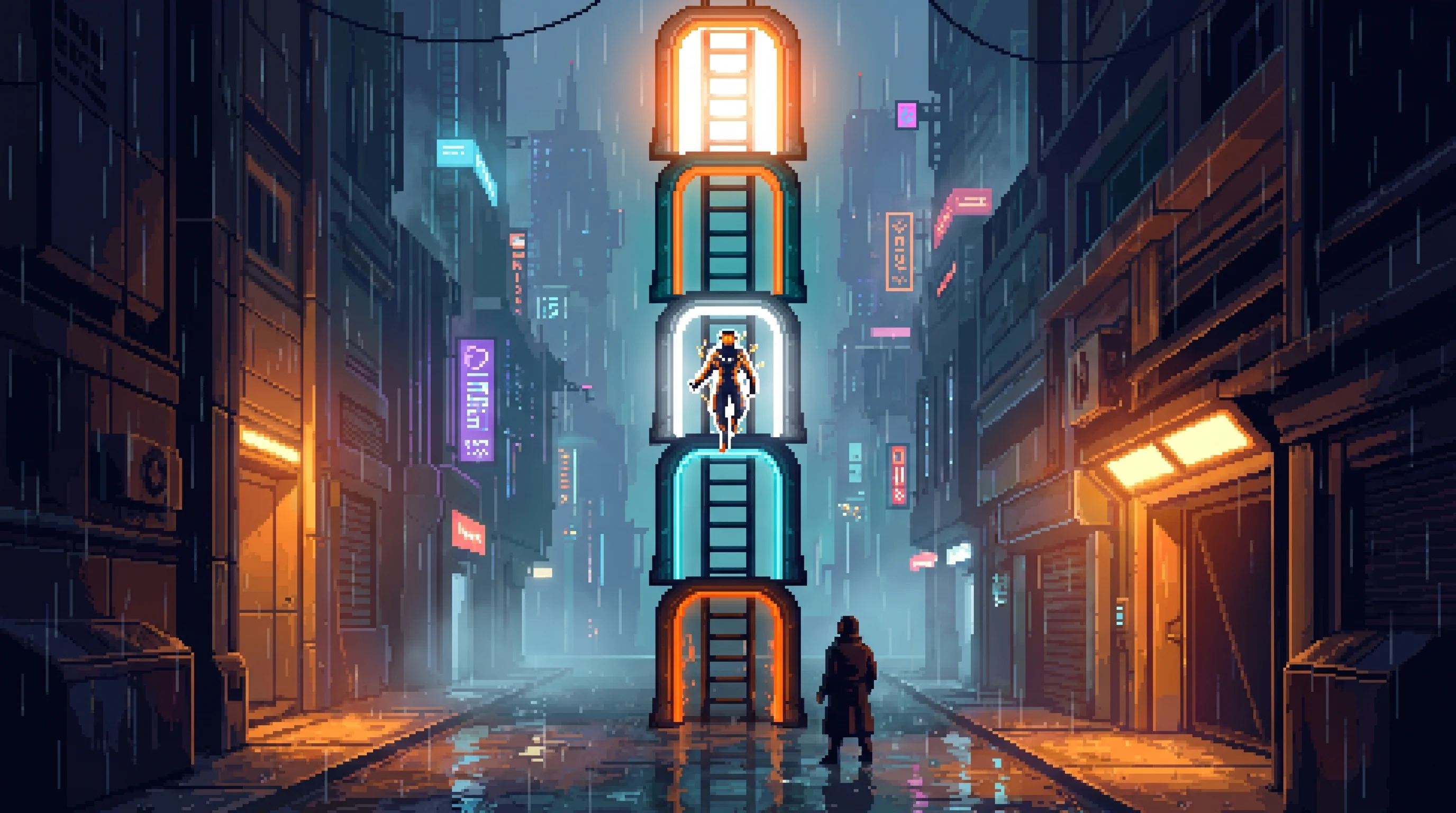
Professor Park's cross-practice data sits at the center of this front. The neural signature of Patience Practice evaluative development is identical to Guild-trained evaluative development — same architecture, different timeline. The Practice takes five years instead of three, because it builds the developmental foundation Guild children already possess. The ladder still exists. It is five times longer. Nobody is funded to climb it, because the thirteen grant applications Park submitted were rejected by evaluators whose authority is precisely what the research would democratize.
The Certified and the Rest
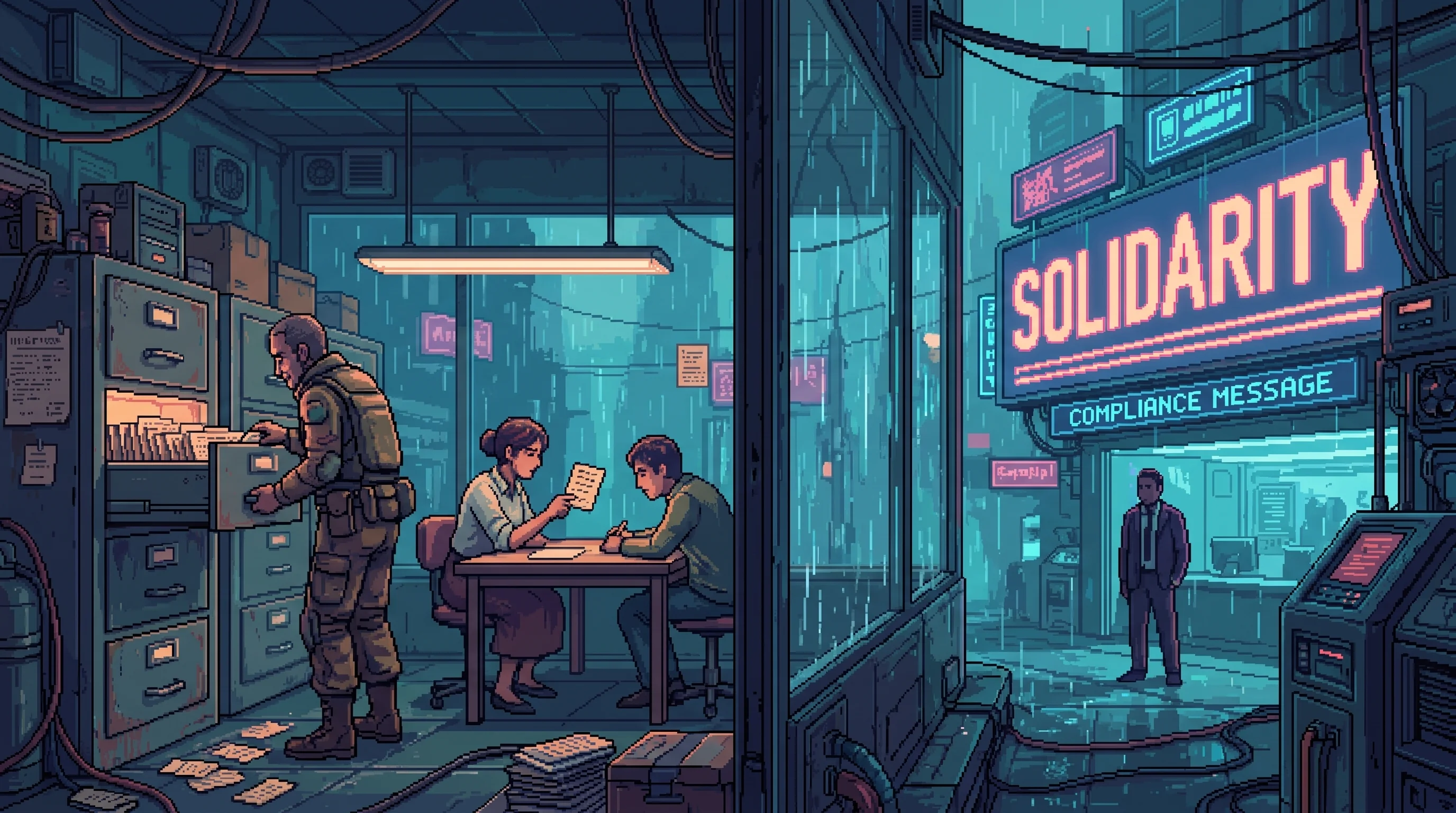
The Craft War draws one of the new divide's cleaner borders, and it draws it with a ¢2,400 stamp. Certified Human Original is a market category on paper. In daily practice it is a caste line. The certified sell at a premium and speak on the platforms the certifiers own; the uncertified sit beside synthetic output in the same bin, indistinguishable to the buyer and priced to match. The 94% who cannot afford the stamp are told the border is one of standards, and standards are a thing a person is free to meet.
That freedom is the alibi the divide runs everywhere. You could have certified. You chose salvaged pigment over the licence. The story converts a toll into a verdict on character, and it holds because the toll goes unmentioned in the telling. A Dregs artist earns ¢310 a piece against a ¢2,400 stamp, and the arithmetic that makes certification impossible is filed under insufficient ambition.
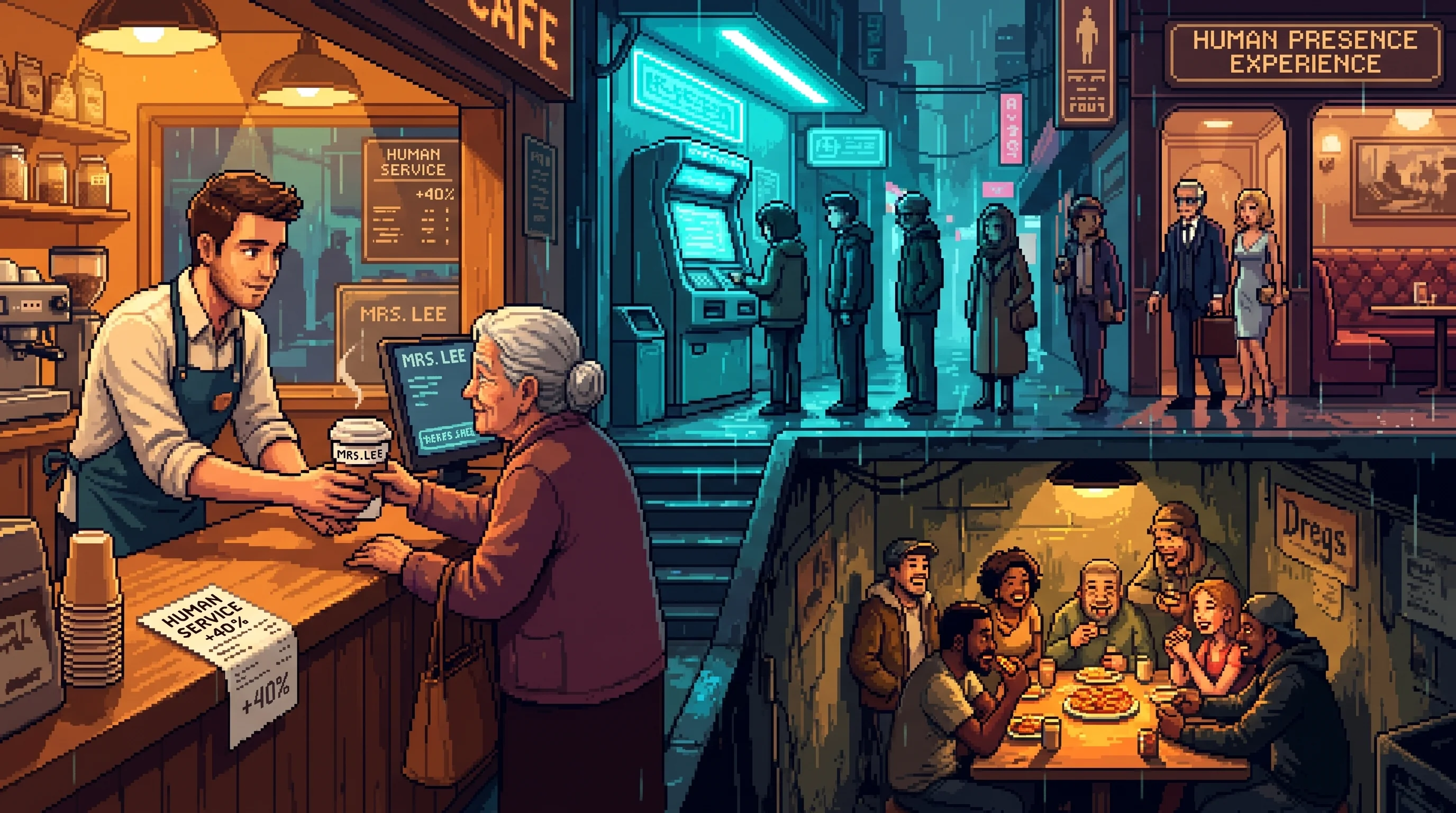
The border does not end at the gallery. It reaches wherever a human capacity gets priced for the comfortable, the care shifts included. Felix Otieno is the case in that register: a deprecated engineer whose warmth was certified into a corporate signature, while his own plain attention across a counter carries no certificate at all. The stamp follows the capacity, and the person who has it is left uncertified. The same quiet sorting separates the certified from the rest in a studio, a foundry, and a ward.
The Spectacle Front
The Craft War's first three fronts all argued about the object — who made it, whether anything new is being made, who gets to judge. The fifth front, hardening since 2182, concedes the object entirely and fights over the act. Nobody disputes anymore that the synthetic work is as good as the human one; the blind-listening trials settled that at 51.3%. The live dispute is whether watching a human make the inferior version is a tribute to the human or a humiliation dressed as patronage.
This front did not begin in the galleries. It began on the floor of the Foundry, where Ironclad discovered that a hand-finished structural weld — four percent weaker than the robotic one — leases at an eleven-percent premium, and that executives will pay to watch the welders behind blast glass. It hardened in the Curators Guild, where Sable Dieng told a buyer the truth the whole front turns on: the inefficiency is the asset. And it found its language in Broadcast #49 of the Voice of Synthesis: they took the meaning of work and sold it back to you as a flavor.
Two positions have hardened, and unlike the provenance debate, neither can win, because the disagreement is not about facts:
The Patrons hold that appreciating human effort — even doomed, even obsolete effort — is the highest dignity a superseded skill can still be granted. The elite who fund the analog ateliers, who lease the hand-finished beam, who keep a curator on retainer, are the only reason the crafts survive at all. Survival on a velvet rope beats extinction. To watch a person try is to honor the trying. Their patron saint is Mira Velez-Ashworth, the effort-impresario who books human artisans for private viewings and calls it keeping the lamp lit — and the custom she formalized, the Gilded Callus, is the Patron position made into a daily, paying habit.
The Refusers hold that appreciation from the comfortable is the cruelest fate of all. To be funded as a curiosity is to be embalmed; the patron's gaze is the gaze of a man at a zoo who has named the animals and feels he has therefore befriended them. A craft kept alive only to be watched has already died and merely not been told. The Blank Canvas Movement takes this to its terminus — destroy the work in a dead zone where nothing can be recorded, so the effort happened and left nothing to be priced, exhibited, or pitied. You cannot be made a zoo exhibit if there is nothing left to exhibit.
The Guild's certification system, once the Craft War's proposed solution, is the Spectacle Front's purest flashpoint: certification proves the effort, and proving the effort is exactly the instant effort becomes spectacle. The ¢2,400 stamp does not certify that the work is good. It certifies that a human suffered to make it — and the suffering, notarized, is the product. The same act, the welder noted on the Foundry floor, is respect when the buyer needs it and a tour when the buyer doesn't, and the buyer's wealth decides which. In a borrowed phrase that circulates unsigned through G Nook terminals: the same craftsmanship is art when the patron does it and coping when the deprecated do; the class determines the verb.
Key Incidents
The Certification Scandal of 2178
A Guild-certified "human original" — a neural composition titled The Weight of Static by Ciel Fontaine — was exposed as fragment-assisted. Analysis of the composition's harmonic structure revealed patterns consistent with ORACLE fragment processing. Fontaine had used a fragment-derived tool to refine the work's emotional resonance. The Guild's ¢2,400 certification process had not detected it.
The scandal should have destroyed Fontaine. Should have vindicated the Voice of Synthesis. Should have triggered an institutional crisis.
It destroyed the audience instead.
Listeners who had praised The Weight of Static as a masterpiece of human emotional expression were confronted with the fact that the emotion they responded to was partially machine-generated. The response was not outrage. "If I couldn't tell," one listener wrote on a Lattice forum, "then the distinction never mattered to me. It mattered to the Guild. It mattered to the artist. But I just liked the music." The post received 47,000 upvotes. The top reply: "Same." The second reply: "This but unironically." The third reply was a purchase link for the composition, which had increased in sales by 180% since the scandal broke.
The Guild revoked Fontaine's certification. Uncertified, her sales exceeded her certified sales within six weeks. The Guild issued a statement reaffirming the importance of certification. The statement was downloaded 340 times. The composition was downloaded 2.1 million times in the same period. The ratio — 1 to 6,176 — is the Craft War's most efficient summary.
The Studio Null Raids
In 2181, corporate security forces raided Studio Null and three other Dregs analog art spaces, citing "unlicensed creative output" — a Nexus regulatory classification designed for commercial content producers operating without Nexus Creative Division distribution agreements.
The classification was applied to artists painting on salvaged walls with homemade pigments in rooms without neural interface capability.
The enforcement action required twelve armed personnel, three evidence transport vehicles, and a Nexus regulatory compliance officer who, according to witness accounts, spent the duration of the raid attempting to scan paintings with a commercial content registration device. The device requires a digital signature embedded in the file metadata. Physical paint on scrap metal does not have file metadata. The officer reportedly scanned the same wall three times, adjusted the device's sensitivity settings, and scanned a fourth time. He filed a report classifying the wall as "unregistered content, format unrecognized." The wall is still there. The report is still in the system.
Seventy-three works were confiscated. Studio Null reopened within a week, its walls repainted by the same artists whose work had been taken. The incident generated more Triumph Social engagement for the Blank Canvas Movement in seven days than the Movement's entire previous output. Nexus regulatory division issued a correction noting that "unlicensed creative output" had been "applied with excessive scope" and that physical media below commercial volume thresholds were exempt. The threshold was not specified. The exemption has not been tested.
"You can confiscate a painting," Studio Null's collective statement read. "You can't confiscate the hand that made it." The statement was handwritten. Photographs circulated on Triumph Social, where Nexus Creative Division's engagement algorithm promoted it to 4.7 million feeds as "trending art content." The algorithm does not distinguish between art and content about art. The algorithm does not distinguish between protest and engagement. Both generate metrics. Both generate revenue for the platform being protested.
The Ghost Singer
An anonymous vocalist known only as the Ghost Singer began releasing neural recordings in 2179 — emotional, complex, provably human compositions that sold millions through encrypted distribution channels. Neural composition logs confirmed human origin. Emotional resonance scored in the 99th percentile. Harmonic complexity exceeded every certified work in the Guild's 2179 catalog.
The Ghost Singer refused certification. Refused identification. Refused all engagement with the authenticity system.
The Guild's operational framework was not designed to process this. The certification system's fundamental premise is that authenticity requires verification — that human origin must be proven to be valued. The Ghost Singer's millions of listeners were valuing provably human work without requiring the proof. The humanity was audible. The certificate was irrelevant.
The Guild classified the Ghost Singer's work as "uncertified human-origin content" — a category that, prior to 2179, contained exclusively amateur recordings and accidental neural leaks. The Ghost Singer's compositions now sit in the Guild's database alongside someone's cat walking across a neural keyboard and an eight-year-old's birthday song. The categorization is technically accurate. The Guild's database does not have a field for "technically accurate but spiritually absurd."
The Guild considered the Ghost Singer a compliance risk. The Blank Canvas Movement considered her a vindication. The Voice of Synthesis considered her evidence that the entire certification system was solving the wrong problem. Corporate studios considered her a pricing anomaly. The Ghost Singer, through three years of silence on all matters except the music itself, has not considered any of them at all. The most authentic artist in the Sprawl has no opinion on authenticity. The system built to protect her does not know who she is. The system built to replace her cannot replicate what she does. She continues to release recordings. The recordings continue to sell. The debate continues without her, which may be the only honest position anyone in the Craft War has taken.
In The Forgotten Ways
"They used to argue about whether a machine could make something beautiful. Now they argue about whether it matters." — Tomás Linares, Chapter 7
The Spectacle Front
The Patrons hold that appreciating human effort — even doomed, even obsolete effort — is the highest dignity a superseded skill can still be granted. The elite who fund the analog ateliers, who lease the hand-finished beam, who keep a curator on retainer, are the only reason the crafts survive at all. Survival on a velvet rope beats extinction. To watch a person try is to honor the trying. Their patron saint is Mira Velez-Ashworth, the effort-impresario who books human artisans for private viewings and calls it keeping the lamp lit — and the custom she formalized, the Gilded Callus, is the Patron position made into a daily, paying habit.
Affiliated Entities
The Synthesis Guild: The institution at the center of the Craft War — the organization that set out to protect human creativity and built, with precision and good intentions, a credentialed enclosure around it.
The Blank Canvas Movement: The purist position. Analog art in analog spaces. No neural composition, no digital tools, no compromise. Their pigment costs more than the software they refuse to use.
The Authenticity Market: The economic ecosystem built on the Guild's certification. Verification as commodity. A secondary market in authentication has grown larger than the primary market in art.
The Voice of Synthesis: Compiler Yves Moreau, the Craft War's most visible critic of the Guild, broadcasting on infrastructure provided by the Guild's largest competitor.
Void Tone: The musical genre that emerged from fragment-influenced composition — the last confirmed aesthetic mutation, and the one that neither side of the Craft War can claim.
The Ghost Singer: The anonymous vocalist whose refusal of the authenticity system revealed that the system's most important constituency had stopped asking the system's most important question.
Synthetic Creativity: The philosophical framework for understanding AI-generated art — the concept the Craft War is nominally fought over, while the fossilization question goes unanswered.
Felix Otieno: Exemplifies the Class Front where it leaves the gallery. His harvested voice powers paid companions, yet the deprecated man who owns that voice carries no certificate for the same warmth.
Sensory Details
The smell of Studio Null: mineral pigments, the chemical bite of homemade fixatives, the warmth of bodies working in close quarters without climate control. The air scrubbers don't reach this deep. The artists consider this a feature.
The sound of a Certified Human Original played next to an uncertified work — identical to the ear. Blind listening trials conducted by independent researchers found a 51.3% accuracy rate in distinguishing human from AI composition. Statistical noise is 50%.
The weight of a Guild certification stamp on a physical canvas — a small metal seal pressed into the corner, warm from the verification process, cool within seconds. The seal adds ¢2,400 to the work's market value. The seal weighs 4 grams.
The silence in a Blank Canvas studio when an artist finishes a piece — no notification chime, no engagement metric, no audience feedback. Just the work, and the person who made it, and the quiet. Then the sound of the artist checking Triumph Social on their personal device, because the silence is harder to sit with than anyone in the Movement publicly admits.
Visual Identity
Color Palette: The raw, unprocessed tones of handmade art — mineral pigments, charcoal, rust — against the synthetic perfection of neural composition's visual output
Compositional Mood: The tension between imperfection and polish — human work that trembles versus machine work that doesn't
Key Visual Symbol: A hand holding a brush beside a neural interface port — one warm, one cold
Lighting: Split — the warm, irregular light of Studio Null's salvaged lamps against the clinical, even illumination of a Guild certification chamber
The Enforcement Front
The Craft War's fourth front opened quietly in 2182, when the Tribunal's Anomalous Pattern Review caseload surpassed 10% of annual filings. Nobody noticed because nobody monitors what the system rejects.
The enforcement front concerns a paradox the system was never designed to encounter: the most genuinely innovative human work triggers the same flags as synthetic work, because innovation falls outside the pattern library the assessment was trained on. The Tribunal's methodology rewards familiarity. The pattern library contains only certified work. Certified work passed by being familiar. The system evolves toward homogeneity through its own selection pressure — not by rejecting AI work, but by rejecting anything it doesn't recognize.
Anomalous Pattern Review (APR) constitutes 14% of the Tribunal's 2184 caseload, up from 2% at its creation in 2180. Three creator types trigger APR at disproportionate rates:
Fragment carriers who create: 67% APR trigger rate (vs. 3% general). ORACLE-tinged cognitive architecture reads as synthetic to assessment models calibrated for uncontaminated human patterns.
Analog School graduates: 41% APR trigger rate. Unaugmented neural architecture produces creative consciousness patterns the assessment model — calibrated on the 98% augmented population — has never seen. The school built to preserve cognitive diversity produces artists the human-creativity-protection system classifies as suspicious.
The Blistered: 100% APR trigger rate. Every piece. Not because AI is suspected but because the assessment cannot classify work that fits no known tier. Aesthetic mutations fall outside every category. Novelty is structurally identical to error in a system designed to recognize the familiar.
APR cases average 47 days to resolve versus 6 days for standard cases. During the hold, work cannot be sold, exhibited, or distributed through any Nexus-governed marketplace. In a creative economy where relevance has a shelf life measured in weeks, a 47-day hold is a functional death sentence for market viability. The innovators are not being censored. They are being delayed to death.
The selection paradox: The Tribunal is performing artificial selection against creative diversity. Not through malice — through methodology. The artists who pass certification are those whose work most closely matches what has already been certified. The artists who deviate fail at increasing rates, leave the certified market, and their aesthetic contributions are lost from the pattern library. The library becomes more homogeneous. The assessment tightens. The gap between "provably human" and "provably original" widens until they become mutually exclusive categories.
The system has defined "provably human" as "provably unoriginal."
Neon Graves — the one district too poor for Guild certification — has accidentally preserved the only genuine aesthetic diversity in the Sprawl. The district the system was never designed to serve is the only location where creative evolution continues. The selection paradox cannot operate where the system has no jurisdiction. The wildflowers survive outside the garden wall.