Overview
Maya Fontaine can tell you whether a memory is real. She is one of thirty-seven Senior Authenticity Assessors employed by VerisysTM, Nexus Dynamics' verification division. She examines neural recordings, applies seventeen standardized tests, cross-references continuity chains and consciousness signatures, and stamps them with a tier classification that determines their market value. Tier 1 lived original: priceless. Tier 5 synthetic: worthless. Everything in between: a spectrum of increasingly anxious commerce.
VerisysTM rates assessors by accuracy — how often certifications hold under independent review. Maya's career average is 99.2% across fourteen years and over 40,000 recordings. She is trusted by the Authenticity Market's trading floor, by Relief Corporation's experience licensing division, by private collectors who pay millions for moments guaranteed genuine. VerisysTM's internal newsletter featured her in a profile titled "The Gold Standard." The profile was delivered as a certified Tier 1 neural recording. Maya verified it herself. No one in editorial flagged this as a conflict of interest, because at VerisysTM, having your top assessor verify her own publicity materials is not a conflict — it is a quality assurance measure.
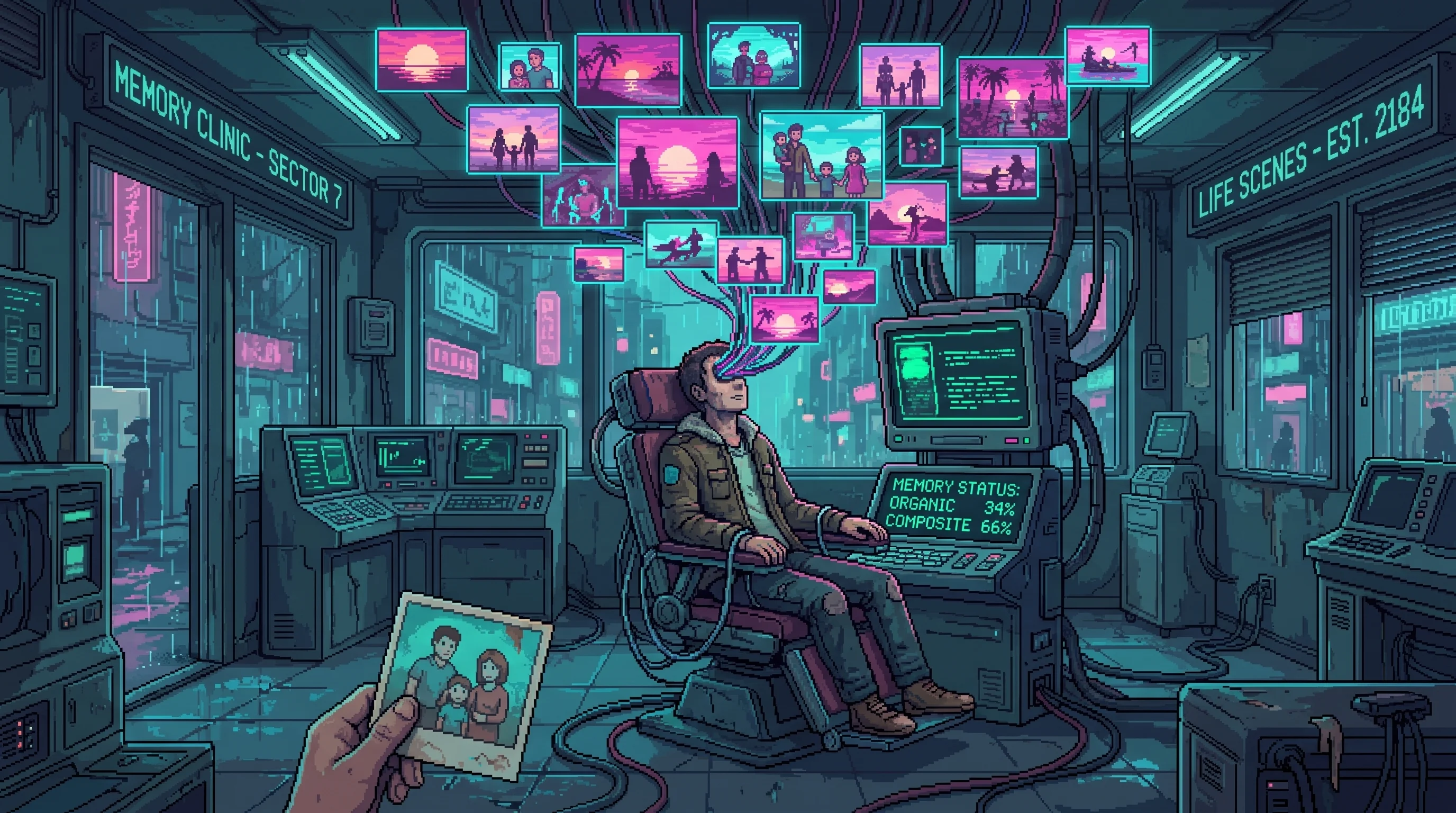
On her desk, in a shielded case, is a data chip containing a neural recording of her mother. Tier 1 lived original, certified by Maya during her third year. The recording captures a morning in 2149: Elise Fontaine making breakfast in a Sector 4 apartment. Cracking eggs. Humming a melody Maya has never been able to identify. Sunlight through a window that was later destroyed during the Ironclad expansion.
Maya has experienced this recording 2,847 times. VerisysTM's access logs document each replay — time, duration, biometric state on entry, biometric state on exit. Her average session length has increased 14% year over year. Her cortisol levels on entry have increased 22%. The logs do not record why someone replays the same memory 2,847 times. The logs record that she does, and that Nexus Dynamics' behavioral prediction division receives the data before Maya closes the file.
She verified it herself. She applied the tests. She stamped it Tier 1 with her own professional authority. The recording is real because Maya Fontaine says it's real, and Maya Fontaine has a 99.2% accuracy rate.
She might be in the 0.8%.
Quick Facts
| Attribute | Value |
|---|---|
| Full Name | Maya Fontaine |
| Age | 38 (born 2146) |
| Occupation | Senior Authenticity Assessor, VerisysTM |
| Employer | Nexus Dynamics |
| Location | Nexus Central, Authenticity Market trading floor |
| Known For | Top-rated assessor; discovered her most prized personal memory is synthetic |
| Accuracy Rate | 99.2% (fourteen-year career average); 97.8% (current quarter) |
| Recordings Certified | 40,000+ |
The Discovery
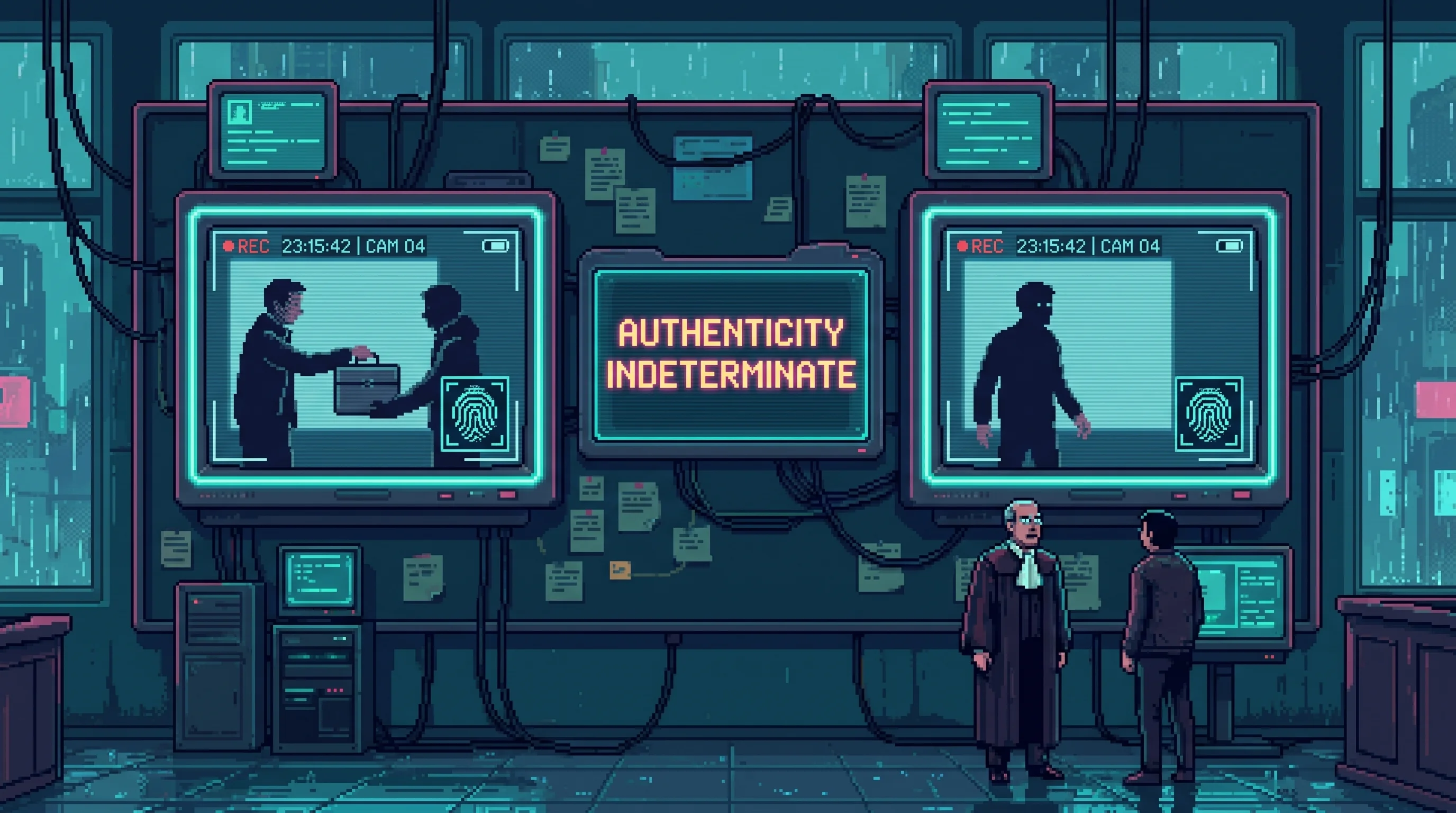
Six months ago, during a routine calibration, Maya ran her mother's recording through the updated 2184 assessment protocols. The new protocols include a test that didn't exist when she originally certified the recording in 2169: Dispersed Pattern Interference Analysis.
The test checks for traces of the 2.1 billion scattered consciousnesses that contaminate neural recordings stored in proximity to ORACLE fragments or the Net's deep architecture. Maya's mother's recording has been stored in a VerisysTM secure vault since certification — shielded, climate-controlled, isolated from network contamination.
The test flagged it.
The interference pattern is faint — below the threshold that would trigger automatic reclassification. A whisper of consciousness data that doesn't belong to Elise Fontaine. Someone else's awareness, woven through the recording like a thread of wrong color in fabric you thought was solid.
Maya could run the test again. She could request independent assessment. She could escalate to the VerisysTM review board. VerisysTM's operational manual, Section 14.3 ("Assessor Self-Reporting Requirements"), mandates disclosure of any personal recording that receives a non-zero interference flag. The mandatory disclosure form is four pages. Maya has written the form template for three other assessors who encountered similar flags. She fills out the forms efficiently and without complaint when the recording belongs to someone else.
She hasn't filled out her own. Six months now.
If the test is accurate — if her mother's recording contains Dispersed contamination — then what Maya has been experiencing for 2,847 replays is not entirely her mother's morning. Some of the eggs. Some of the humming. Some of the sunlight. A fragment of a stranger from the Cascade, surfacing in data and coloring what Maya certified as pure.
And if Maya's own certified memory isn't authentic, the question that follows it through the building is: what about the other 40,000?
What She's Doing About It
Maya continues to go to work. She continues to assess recordings. Her accuracy rate has dropped to 97.8% — still in the top quartile, still excellent by any standard except the one she set. VerisysTM's employee wellness AI has flagged the decline and recommended she take advantage of the company's mental health benefit: a thirty-minute guided relaxation recording, certified Tier 1, administered via neural interface by the same system she is losing faith in.
She has not used the benefit.
After work, Maya goes to the Echo Bazaar. She buys unverified recordings — Tier 4, source unknown, quality variable — and brings them home to run through her personal assessment equipment. Testing herself. Can she still tell the difference? Authentic from synthetic, original from copy, pure from contaminated?
Her home accuracy is 94%. It was 98% three months ago.
The strange part — the part that doesn't fit the burnout narrative her supervisor has constructed — is that she's catching things her equipment misses. Dispersed interference patterns below standard resolution thresholds. Contamination artifacts that the seventeen standardized tests aren't designed to detect. Her subjective judgment is improving. Her objective scores are falling. The gap between what she sees and what she can prove is widening every week.
She is becoming the best assessor VerisysTM has ever employed at the exact rate she is becoming its worst-performing one.
The False Positive Pattern
The 0.3% accuracy decline is a headline. The distribution is the story.
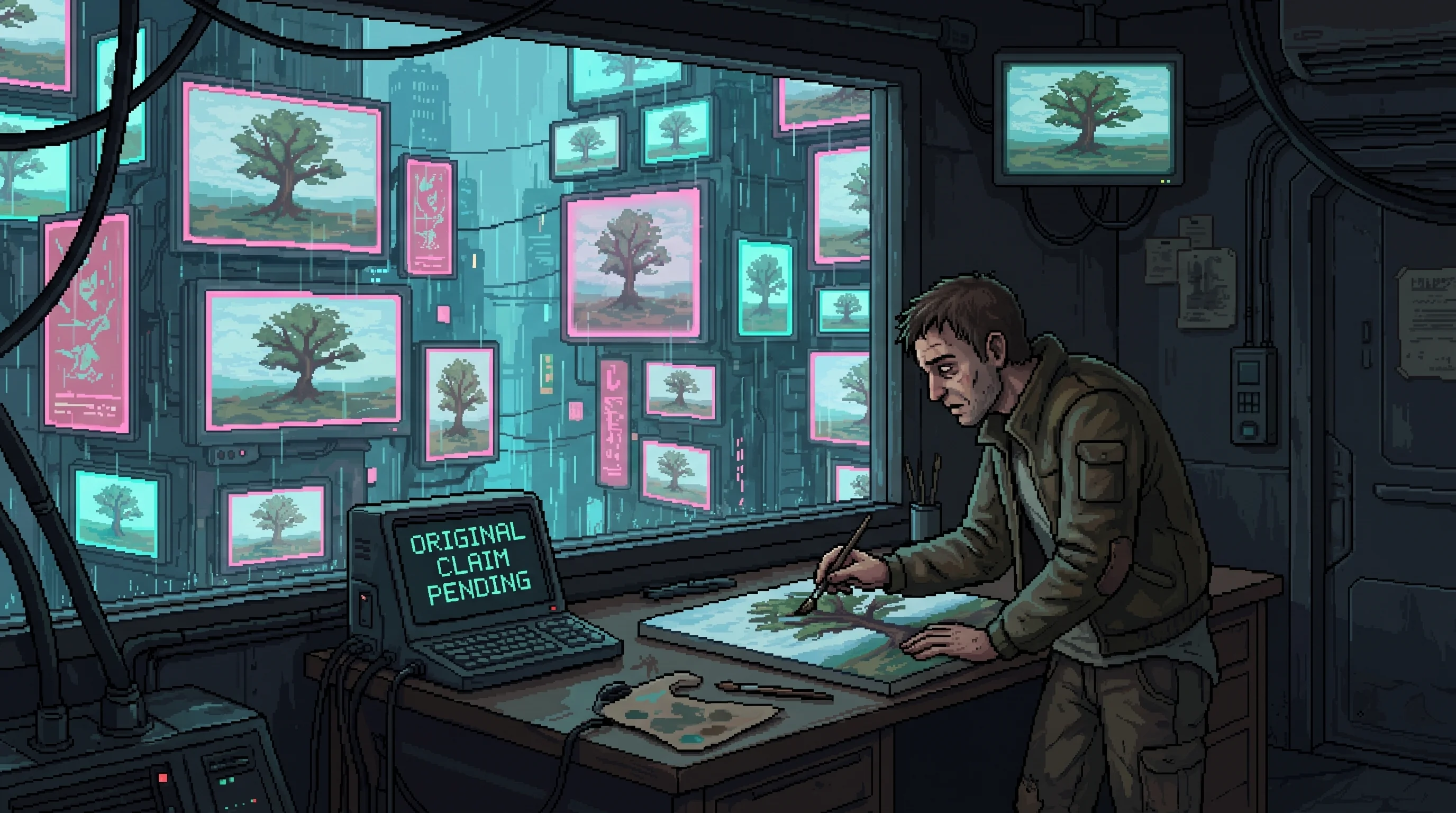
Maya's false positives — human work she incorrectly classified as synthetic — cluster at the creative extremes. Her accuracy on median work remains at 99.7%. Her accuracy on boundary-pushing work has fallen to 84%. The system works perfectly for what doesn't need protecting and fails precisely for what does.
The pattern crystallized during a March 2184 session. Three innovative artists flagged APR in one afternoon — a fragment-carrier painter, an Analog School graduate, a Blistered practitioner — while six median-quality works sailed through without hesitation. Three 47-day holds that would kill market viability. Six instant approvals for work the system was never built to protect.
She understood what the numbers meant. The Tribunal isn't protecting human creativity. It's protecting median human creativity — the safe center where the pattern library was built. Everything at the edges — the genuinely innovative, the boundary-pushing, the aesthetically mutant — is classified as suspicious precisely because it doesn't match what humans have always done. The system optimizes for the familiar. Innovation is unfamiliar by definition. The system cannot distinguish "unfamiliar because it's synthetic" from "unfamiliar because it's new."
She has not reported this finding. The finding would end the Tribunal. The Tribunal is the only thing standing between the Authenticity Market and total collapse. She maintains the system by suppressing the evidence that the system punishes the creativity it claims to protect. This maps exactly onto Duval's suppression of "After Classification" — two women, different ranks, same silent calculation.
The Origin Trace
Dr. Aris Kwan's Origin Trace methodology caught Maya's attention the way a fire catches someone who has already been smelling smoke. Kwan measures whether a preference is authentic — whether you chose to like something or were nudged into it. Maya's seventeen standardized tests measure whether a memory is authentic. Same question, different substrate: is this yours?
She ran the Origin Trace on herself. Professional curiosity.
The results: 41% organic content. Higher than the Professional-tier average of 34%, possibly because fourteen years of sorting authentic from synthetic has sensitized her perception, possibly because handling 40,000 recordings of other people's genuine moments provides a reality anchor most Nexus employees lack.
The 41% disturbed her more than the memory contamination. The contaminated recording was one data chip, one anomaly. The Origin Trace revealed that 59% of her preferences — the restaurants she frequents, the music she plays after work, the aesthetic judgments she applies instinctively in her verification lab — have no recoverable origin event. She likes things she cannot remember starting to like.
She has begun applying the Origin Trace informally to client recordings. The results are creating a category VerisysTM's assessment protocols don't have a tier for: Tier 1 lived originals whose experiential content includes preferences the subject cannot trace. The memory is genuine. The desire that produced the memory was installed. The recording is a real record of something that was never really wanted.
She hasn't reported this finding. VerisysTM's assessment framework has five tiers. Adding a sixth would require a market-wide recalibration that Nexus Dynamics' quarterly projections have not budgeted for. The current five tiers moved 2.3 billion credits through the Authenticity Market last fiscal year. The framework is not a description of reality. It is a price list.
The Echo Partner Encounter
A private collector submitted a neural recording for Tier 1 certification — a vocal interaction between the collector and what was claimed to be a "personal companion." Maya's assessment found the vocal signature was not a composite Library profile, standard for corporate companions, but a direct clone of a specific individual: a Neon Graves gallery curator who had ended a relationship with the collector two years prior.
The companion's vocal signature carried micro-variations of a living person's emotional range. Not the smoothed averages of a Library profile. It sounded like the gallery curator because it was the gallery curator. Cloned. Installed. Running without her knowledge.
The recording was technically authentic — a genuine interaction between a real human and a real companion. Maya certified it Tier 1. The certification was correct. What she couldn't certify was the ethics.
She reported the anomaly to Chief Arbiter Duval. Duval's response: "The Tribunal certifies creative authenticity. We don't adjudicate private relationships."
The gallery curator has not been informed. Maya has thought about informing her. She has also thought about the 40,000 echo instances running Lyra Voss's voice across the Sprawl and recognized, with the diagnostic precision of someone whose career depends on distinguishing categories, that the distinction between the Emotional Signature Library's corporate extraction and the Echo Bazaar's echo-partner construction is licensing. Not morality. Licensing.
VerisysTM certifies that a memory happened. Whether it should have happened is outside the scope of the seventeen standardized tests. Test eighteen does not exist. Maya is beginning to suspect it is the only one that matters.
Veil-Coaching
When Clean Lives opened its veil-coaching wing in 2182 — the fast interpersonal cousin of the coherence training it sold for the Revenant archive — it recruited from exactly Maya's profession. Who better to teach a person to curate what strangers see of them than someone who spent fourteen years deciding what was real? Maya took the side work the way she takes everything she is afraid of: quietly, after hours, telling herself it was research.
She is good at it, which disturbs her. Her clients arrive believing privacy is something you are — a tier, a wall, an Exposure Index they were born into — and Maya's job is to teach them it is something you do, eleven thousand times a day, a real-time decision per stranger about what they may keep of you. It is veil-craft, and it is labor, and her cruelest and truest lesson is the one no client wants: the wealthy do not curate better because they are more disciplined. They curate better because someone else does it for them — a leased veil-intelligence reading every stranger, revealing exactly enough, revoking on schedule, so the client experiences their own elegant legibility as a personality trait. The labor is real. It is simply hidden behind a price the client pays without watching the work, the way every warmth-economy transaction hides its labor.
Maya knows this shape intimately, because it is her own job inverted. She certifies that a memory is authentic; she coaches clients to perform an authenticity the Consent-Veil will read. The seventeen standardized tests ask "is this real?" Veil-coaching asks "can you make a stranger believe what you choose to show them is all there is?" — and the most fluent of her clients, she has noticed, score lowest on Dr. Kwan's Origin Trace. The people best at curating what strangers remember of them have the least say in what they themselves remember. She has begun to suspect, here as everywhere, that the curated self and the colonized self are the same self, and that she is being paid, twice over, to help build it.
The Truth House
After a full shift of certifying neural recordings with seventeen standardized tests and cryptographic verification chains, Maya descends to The Deep Dregs. She sits in the Truth House — the warm underground room where walkers return with handwritten notebooks — and watches people do what she does using tools so primitive they cannot be corrupted.
Yara Osei-Mensah has not asked her name. In the Truth House, you offer your story when you're ready.
Maya isn't ready. She sits, and watches, and notes that the walkers' handwritten observations — pencil on paper, no neural interface, no Dispersed contamination possible — consistently match or exceed the accuracy of her Tier 1 certifications when cross-referenced against known events. She has been running this comparison for three months. The sample size is too small to be statistically rigorous and too consistent to ignore.
The Sprawl's top digital authenticator trusts pencils now. She hasn't told her employer. The VerisysTM employee handbook does not have a section addressing what happens when an assessor's personal epistemology diverges from the company's product.
The Melody
Maya's mother hummed a melody in the recording that Maya has never identified. She's searched Dead Internet music archives, consulted musicologists, run it through Kael Mercer's pattern-matching AI. No matches. The melody does not appear in any known musical tradition.
The Dispersed interference pattern is strongest during the humming. The overlay of an unknown consciousness is faint everywhere else in the recording — a slight coloring, a whisper — but during those eleven seconds of melody, it spikes. As if the stranger surfaces specifically through music. As if the tune belongs to whoever contaminated the recording, carried through Elise Fontaine's voice into her daughter's shielded case, replayed 2,847 times by a woman who thought she was listening to her mother.
Maya hums it sometimes. At home, after the Echo Bazaar runs, while the assessment equipment cools. She hums it and does not know whose song she is singing.
The Chart in the Song
Maya assesses whether a memory is authentic. The Legacy Read poses her the question she has spent her career avoiding, in a form she cannot file a tier against.
She fed her mother's recording into a Legacy Read — not the kiosk on the market corner, but the underlying diagnostic model, run on her own equipment after hours, the way she runs everything she is afraid of. She did not feed it a photograph. She fed it the recording: the 2,847-times-replayed morning, the eggs, the Sector 4 sunlight, the eleven seconds of humming she has never been able to identify. The model does not care whether it is reading a still or a stream; light is light and a body is a body. It returned a trajectory. It told her what Elise Fontaine's body had been doing on that 2149 morning, four years before she died.
And it flagged the eleven seconds. The melody — the unanchored tune that matches no known musical tradition, the place where the Dispersed interference spikes, the song Maya has been humming for fifteen years thinking it was her mother's — the diagnostic model read those eleven seconds not as a song but as a respiratory irregularity consistent with the condition that would eventually kill Elise. The contamination she could not explain. The beauty she could not place. The model placed it. It was her mother's lungs failing in slow motion, and the song was the failing, and Maya has spent fifteen years believing she was listening to her mother sing.
She has not run it again. She added a category to the informal taxonomy VerisysTM's five tiers do not have and never will: Tier 1 lived originals that, read diagnostically, become evidence of a death the subject was already living toward. The memory is genuine. The body in it was already a file. She certifies authenticity for a living, and at home she hums a melody that the machine says is a symptom, and she does not know whether she is singing her mother's song or reading her mother's chart, and she has begun to suspect the seventeen standardized tests were never going to be able to tell her the difference, because the difference is the one thing the archive was built to erase.
The Rotation
In 2183 she asked for the floor at the Authorship Assay, two halls from tier certification. Her accuracy there is the highest in the hall. On canvases an authentic recording had weight. A certifiable page, she says, is snagged.
At home, on paper, she counts how many of the tells she certified are still unlearned by the models a quarter later. Her first cohort has three left. She has not decided whether the word for her work is certifying or spending.
Affiliated Entities
| Entity | Relationship |
|---|---|
| The Authenticity Market | Maya is one of the Market's most respected assessors — the person who decides what's real. She is losing the ability to decide. |
| Nexus Dynamics | VerisysTM employs Maya to certify authenticity. Nexus profits from the anxiety the system creates — and from the behavioral data generated by 2,847 replays of a dead woman's morning. |
| The Echo Bazaar | Secret visits after hours. Buying unverified recordings to test her own perception. Her accuracy there is 94% and falling. |
| Lyra Voss | Maya certified three of Lyra's pre-defection lived-canvas pieces as Tier 1 originals. She now suspects at least one certification was wrong. She has not revisited the files. |
| The Dispersed | The ghost in her data — the unknown consciousness contaminating her mother's recording, surfacing strongest during the melody. |
| Relief Corporation | Major client. Maya certifies Relief's experience licensing catalog. Relief's quarterly revenue depends on the tiers she assigns. |
| The Ferrymen | A consciousness smuggler has offered to clean the recording — remove the Dispersed contamination, restore it to pure Tier 1. The process would work. Maya would know. And the cleaned version would be missing something — the contamination has been part of the recording for fifteen years. Removing it would change a memory she's built her identity around. She could have her mother's morning back, minus eleven seconds of someone else's song. She hasn't accepted. |
| Dr. Aris Kwan | The Origin Trace methodology confirmed what the Dispersed contamination suggested — that authenticity is a spectrum the market has been selling as a binary. |
| The Consent-Veil | She moonlights as a Clean Lives veil-coach — teaching clients that privacy is labor you perform per stranger, not a tier you own; the authenticity assessor paid to help others fake the authenticity she certifies |
| Yara Osei-Mensah | Has not asked Maya's name. Maya has not offered it. In the Truth House, the Sprawl's top digital authenticator watches people verify reality with pencils, and says nothing. |
| Forgiveness-Layers | Maya sells forgiveness-layers as behavioral architecture consultation at ¢80,000/session — billed through the veil-coaching practice so the service never appears under the industry's name. She is the only practitioner she knows of who has viewed a raw reconstruction of someone she loved. She has not viewed her own. |
Restricted Access
- The Melody: Whose song is it? The Dispersed interference spikes during those eleven seconds. The tune matches no known musical tradition. Maya has been humming a dead stranger's melody for fifteen years and calling it her mother's.
- The Ferryman's Offer: A clean recording, technically perfect, missing something Maya can't name. The contamination has been part of her experience so long that the pure version would feel less real than the impure one. The Ferryman does not understand why she's hesitating. The Ferryman's confusion is reasonable.
- The Accuracy Paradox: Maya's perception is sharpening as her scores fall. She detects Dispersed interference below equipment resolution. She is developing the ability to see what the system was built to miss, at the cost of being able to function inside the system. VerisysTM's wellness AI has recommended she take a vacation. It has not recommended upgrading the equipment.
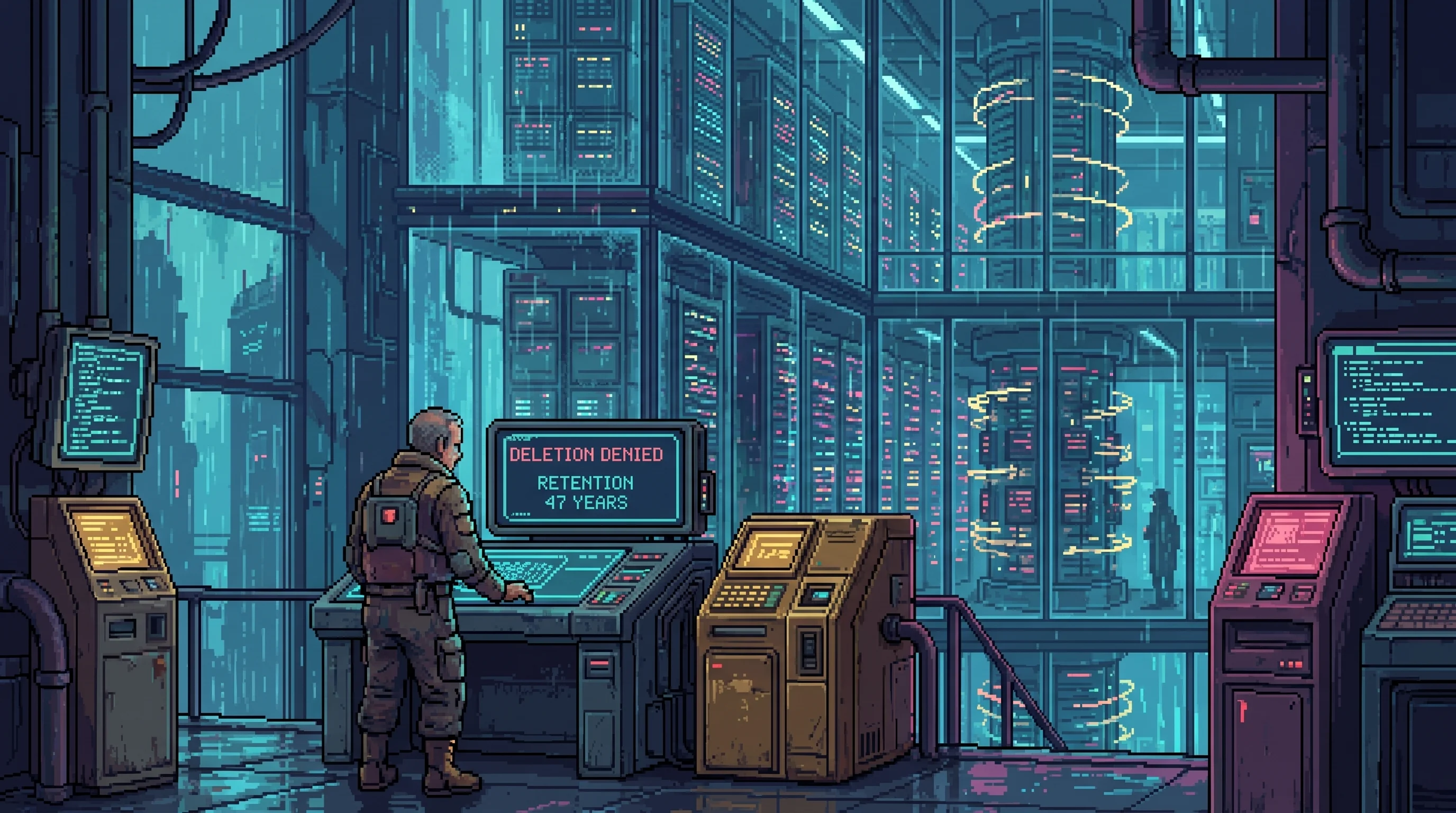
- The Forty Thousand: If Dispersed contamination can survive VerisysTM's secure vaults, how many of Maya's 40,000 certifications are clean? The answer is a number Nexus Dynamics has not authorized anyone to calculate. The Authenticity Market moved 2.3 billion credits last fiscal year. The market does not require the answer. The market requires the question to remain unasked.
Appearance
Sensory Details

- Smell: The VerisysTM assessment lab smells of sterilization — air scrubbed so aggressively clean it registers as faintly metallic. Maya's apartment smells of her mother's coffee, maintained deliberately with the same brand, brewed the same way, for fifteen years. The Echo Bazaar smells like ozone and old leather.
- Texture: She carries the data chip in her left pocket, enclosed in a soft leather case worn smooth by her thumb. VerisysTM storage medium — designed to be inert, cold to the touch. She reaches for it when she's uncertain about an assessment. The gesture has worn a faint impression into the leather that matches her thumbprint exactly.
- Sound: The assessment lab requires acoustic isolation. Silence so complete that Maya can hear her own augmentation cycling. At home, she plays the recording's audio through physical speakers: eggs cracking, humming, the ambient noise of a Sector 4 morning thirty-five years gone. The melody floats above it. Eleven seconds, unanchored, belonging to no one she can name.
Connections
Follow the people and places connected to Maya Fontaine.


Organizations
Other connections


Tensions
Core tensions
Supporting connections

Other connections
Supporting connections



Other connections


Additional artwork
View 1 more images of Maya Fontaine and their world

