Overview
At forty-four, Kael Mercer is the most successful musician alive. He barely plays an instrument.
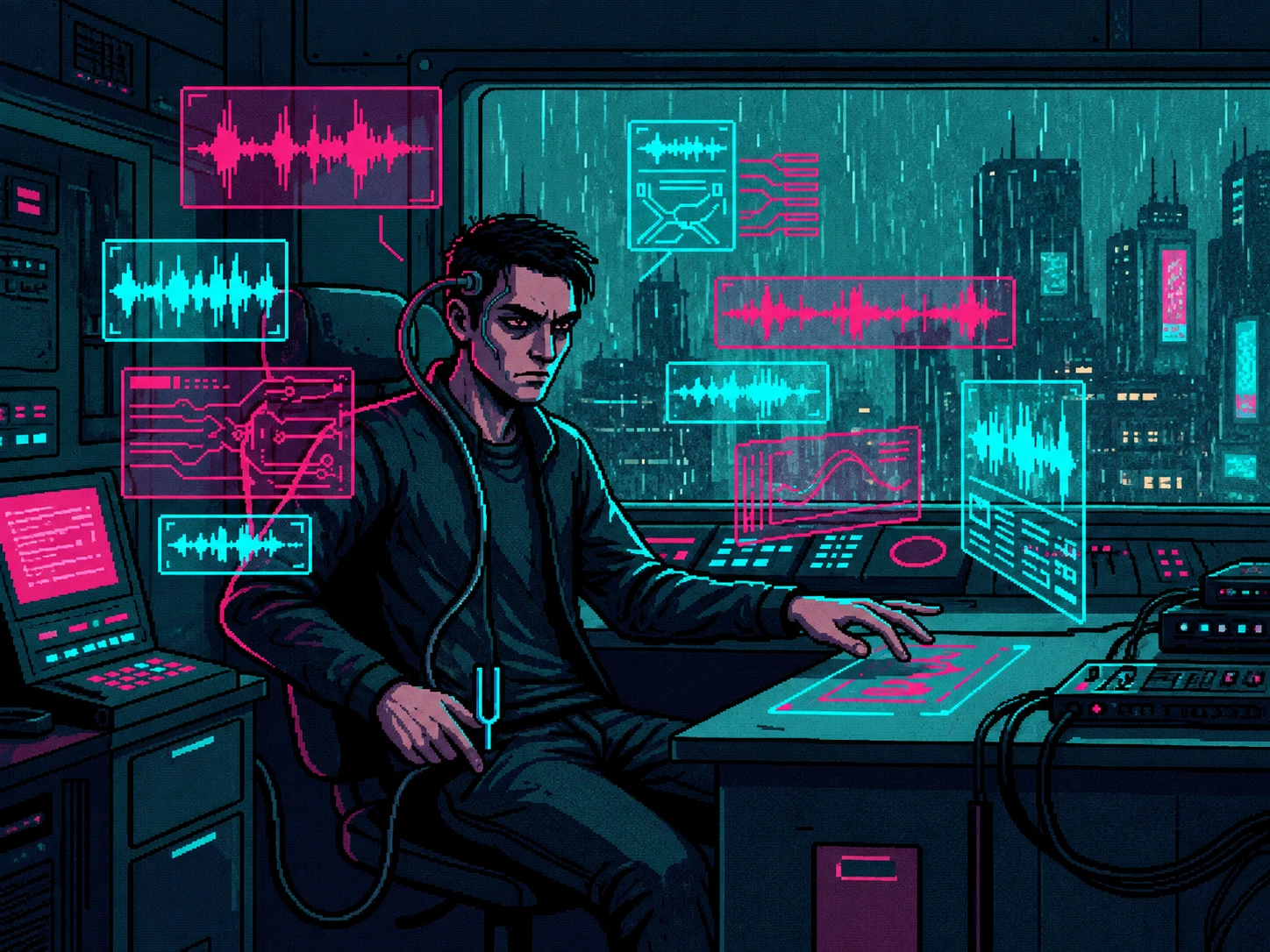
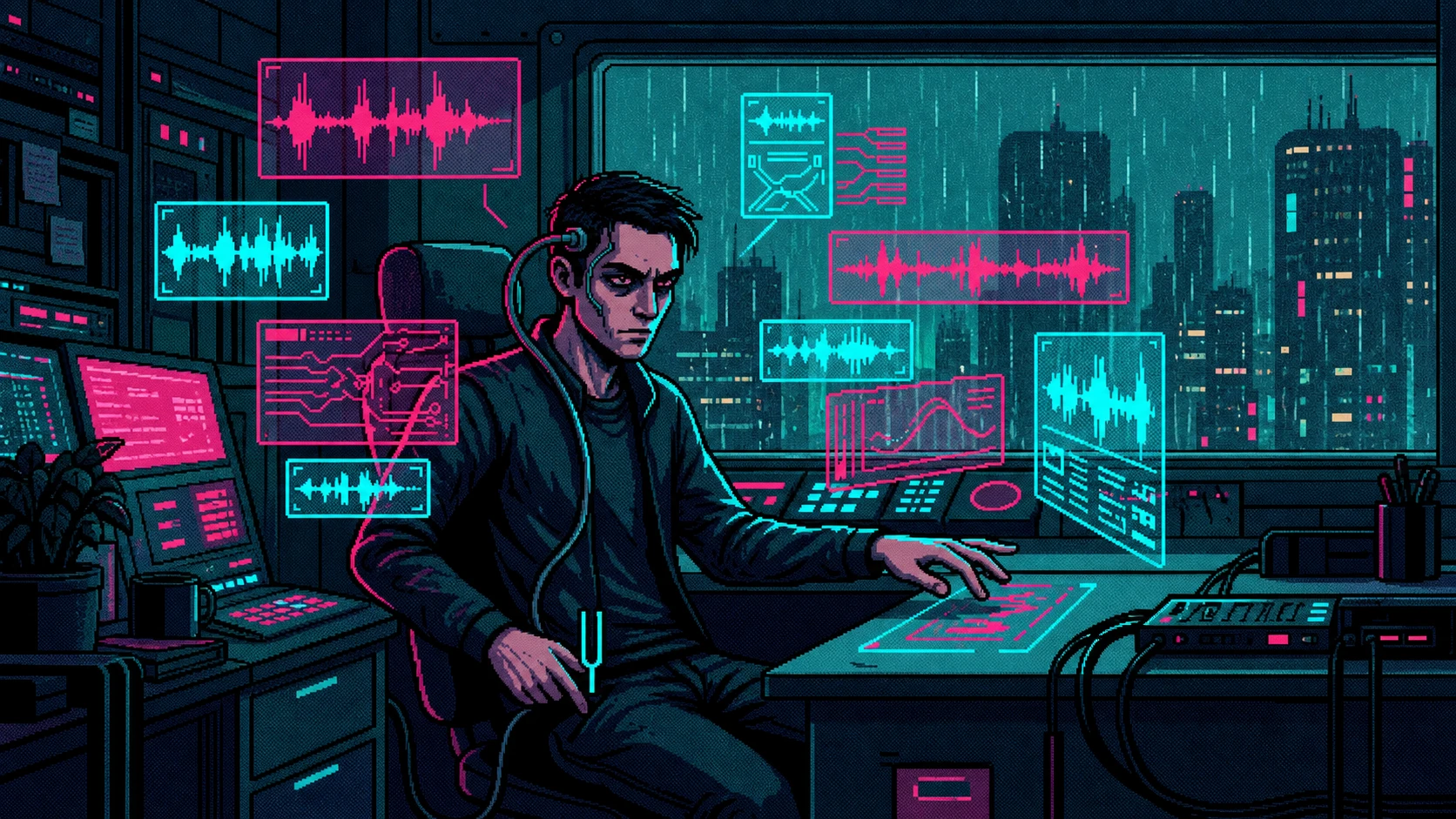
He trains custom AI models on centuries of human music — pre-Cascade archives recovered from the Dead Internet, contemporary compositions from every genre in every sector, neural recordings of listening experiences purchased legally from the Authenticity Market. He feeds these models emotional parameters. "Grief with resolution." "Anticipation collapsing into stillness." "The specific loneliness of a crowded room." The AI generates compositions that match. Kael listens, selects, refines, arranges, publishes under his own name through Relief Stream and independent distributors.
Four hundred pieces a year. A human composer working at equivalent quality could produce ten to fifteen. Kael's catalog commands twenty-three percent of all new music consumed in the Sprawl. Relief's entertainment division executives take his calls personally. They take very few calls personally.
The Sprawl Arts Council conducts annual blind listening tests — funded, it should be noted, by organizations that desperately want the tests to fail. Audiences are presented with Kael's AI-generated compositions alongside works created by human musicians without AI assistance. Success rate at identifying the AI work: 49.7%. Statistically indistinguishable from coin flip. The test has been repeated six consecutive years. The result has not changed. The funding has not stopped.
"Music is patterns," Kael told the Zephyria broadsheet in a rare interview. "Patterns that produce emotional responses in neural architectures. If the pattern is right, the response is real. Where the pattern came from is a question for philosophers, not listeners."
The philosophers disagree. So do the artists. The listeners keep subscribing.
The Method
As a sound designer, Kael doesn't program his AI. He conducts it.
Corpus Training. Each composition begins with a training corpus — a subset of existing music capturing the emotional territory he wants to explore. For Meridian, the symphony that made Orin Slade weep, the corpus included 847 pre-Cascade orchestral works, 200 post-Cascade ambient pieces, and the neural recording of a Lattice drift-runner listening to void tone during a six-hour solo haul. Kael purchased the drift-runner's recording through the Authenticity Market at Tier 2 pricing. The drift-runner, who earned more from that sale than from six months of hauling, has never heard Meridian.
Emotional Parameterization. Kael describes the desired emotional arc in a notation system he developed himself — not musical notation, but consciousness-state descriptions. "Begin in cognitive dissonance — the feeling of holding two incompatible beliefs. Resolve through exhaustion, not insight. End in the specific quality of silence after you've stopped arguing with yourself." The AI translates these parameters into musical structures. Kael has never published the notation system. Three Nexus research divisions have requested access. He has declined without explanation.
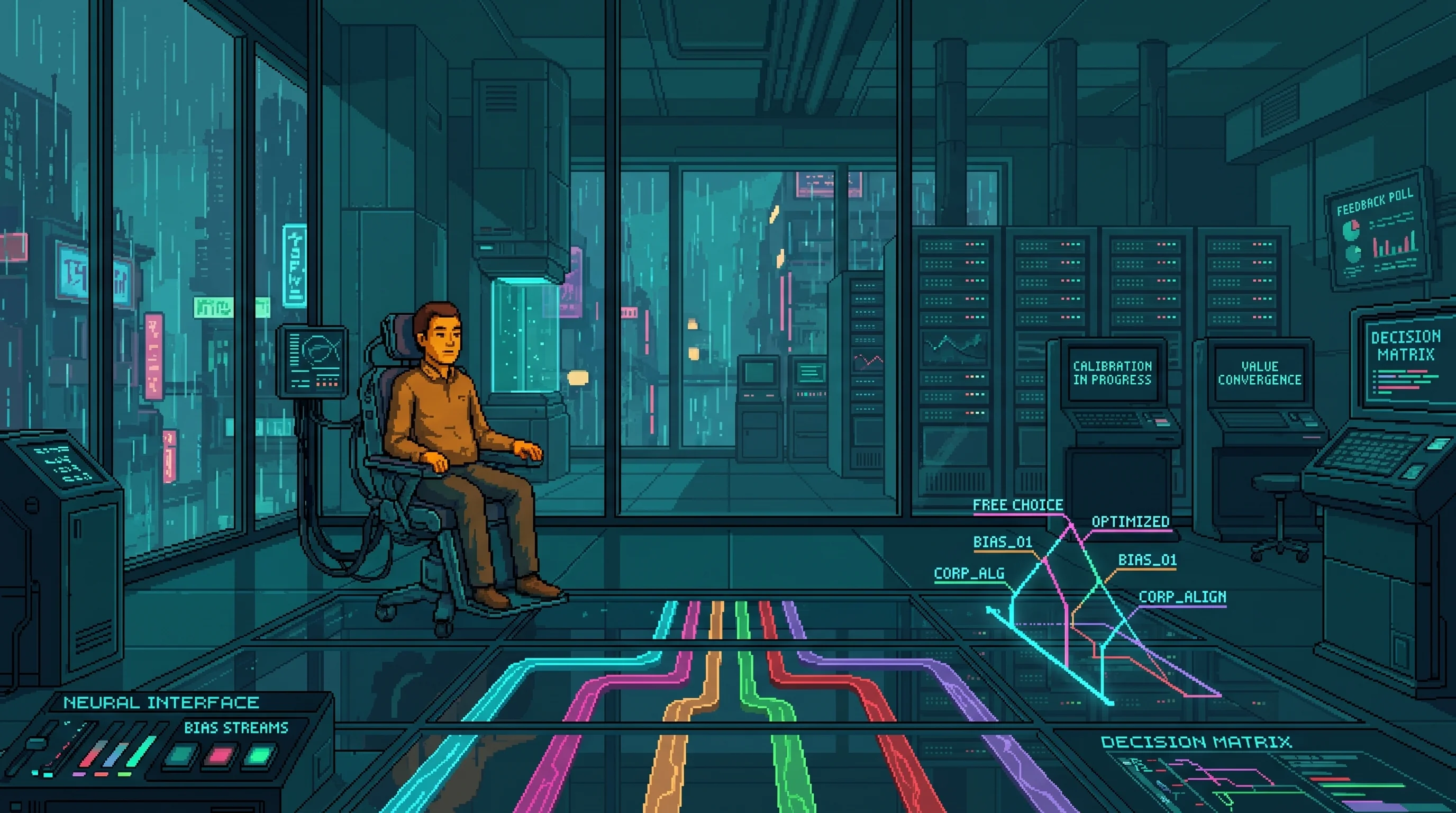
Generation and Selection. The AI produces 50–200 variations per composition. Kael listens to each through his neural interface — the custom audio processing augmentation that gives him absolute pitch and spectral perception beyond baseline human range. He selects the 3–5 variations that produce the strongest response in his own nervous system. The selection criteria is physiological, not aesthetic. He picks what moves him. The distinction may not exist.
Refinement. This is where his human contribution is most visible. He edits selected variations by hand — adjusting timing, altering harmonic relationships, adding or removing elements based on instinct. His neural templates record these refinement decisions, feeding back into the AI for future training. The AI learns what Kael wants. Kael learns what the AI can offer. The boundary between them erodes with each composition. Neither party has filed a complaint.
Publication. Finished compositions publish through Relief Stream and independent distributors. Neural recording versions are available for premium subscribers — the music plus Kael's consciousness state during the refinement process. These qualify as Tier 2 recordings on the Authenticity Market (first copies from a lived original) and sell at corresponding premiums.
The Authenticity Market has ruled, inelegantly, that the music is Tier 5 (synthetic, mass-produced) and the experience of creating it is Tier 2 (lived original). The same artwork exists at both extremes of the hierarchy. Kael considers this proof that the hierarchy is nonsense. The Authenticity Market considers it an edge case requiring further review. Lyra Voss considers it an abomination. The ruling has been under further review for fourteen months.
Kael maintains a certification credit balance through Relief Stream's commercial agreement — sufficient to process any submission to The Ratification Queue in approximately 47 days rather than the baseline 12.3 years. He has used this exactly twice: once to certify the neural recording from the Lattice drift-runner for Meridian's promotional documentation, and once to verify the provenance of a pre-Cascade string arrangement he rebuilt for a luxury client. Both times, the Queue was a logistics problem with a known solution. He paid the credits. The claim moved forward. The authenticity question that has been the subject of six years of blind listening tests, 4,000 words of Slade criticism, and fourteen months of Authenticity Market review is, from his position, a problem for people who can't afford to skip the line. He does not say this publicly. He says it, in slightly more diplomatic language, to Nexus executives every quarter.
Meaningful places
The Person

Kael was born in 2140, seven years before the Cascade. He has no memories of the pre-Cascade world. His earliest recollection is his mother carrying him through a refugee processing center, humming a melody she said was from a song she could no longer remember the words to.
That melody became the foundation of his first composition at age fifteen. He has used it in seventeen subsequent pieces, each time transformed — a refrain that evolves across his catalog like a consciousness that changes with each iteration but remembers what it was. The melody's original source has never been identified. The Dead Internet archives contain no match. It may have been his mother's invention. It may have died with her. Either way, it is the one element of Kael's catalog that did not originate in a training corpus.
He trained formally at the Nexus Central Academy of Sound — traditional composition alongside AI-assisted techniques. He was the student who asked the question his professors couldn't answer: "If I compose a melody and an AI composes the same melody independently, which one is art?"
His professors said the human version. Kael asked how they'd tell the difference. The conversation ended. His enrollment continued for another two years. He was not invited to commencement. His tuition had been paid in full.
In public, Kael is pragmatic, slightly amused by the authenticity debates, unbothered by criticism. He speaks about music with technical precision and about philosophy with deliberate casualness. He's good at interviews because he knows exactly how provocative to be.
In private, Kael lives alone in a modest apartment in Nexus Central’s entertainment district — modest by corporate standards, opulent by Dregs standards. Bare walls. Music playing constantly through physical speakers. Never neural interface at home. Never his own work. The music he plays is exclusively pre-Cascade — human-composed, human-performed, recovered from the Dead Internet's entertainment archives. Analog warmth. Vinyl pops. Tape hiss preserved like amber.
He has never explained this preference. When asked, he says the old recordings have "character" — degradation patterns, analog imperfections, the sound of human performance captured by imperfect equipment.
Kael Mercer, who has built an empire on the claim that synthetic and authentic music are indistinguishable, privately prefers the authentic. He might not notice the contradiction. He might notice it every day. His studio smells of nothing — acoustically and olfactorily sealed, no contamination of the creative process. His apartment smells of Zephyrian coffee that costs more per kilo than most Dregs residents spend on food in a week. The contrast is deliberate. He has not said what it's deliberate about.
He carries a pre-Cascade tuning fork in his left pocket — salvaged from the Dead Internet's affiliated physical recovery operations. The tines are slightly bent. It produces an imperfect A440. He touches it when he's thinking. He touches it often.
His hands are a musician's hands — long-fingered, precise — despite the fact that he rarely touches an instrument. When he refines AI compositions, his fingers move on the desk as if playing along with what he's hearing in his neural interface. He does not appear to notice this. The desk has wear marks.
History
The Meridian Controversy
In 2183, Kael premiered Meridian — a three-hour orchestral work performed by 200 musicians reading from AI-generated scores. Nexus Central Amphitheater. Audience of 12,000.
Orin Slade, the last human music critic writing for a physical publication, traveled from Zephyria to attend. Slade had written extensively about Kael's work, always dismissively — "competent emptiness," "pattern recognition masquerading as passion," "the sound of nobody caring about anything." His publication, The Zephyria Record, prints in hand-set type on physical pages. Circulation: approximately 2,000. Every one of those 2,000 readers can argue about Slade's opinions over dinner.
Slade wept during the third movement.
His review ran to 4,000 words. The headline: "The Machine Made Me Cry. That Doesn't Make It Art."
The core argument: emotional response is not evidence of artistic intent. A sunset produces tears. An onion produces tears. Neither is art. Art requires a consciousness that means something — that chooses, that struggles, that puts something of itself into the work. Kael's AI generates patterns that trigger emotional responses. So does a drug. So does a neurochemical imbalance. The response is real. The art is absent.
The review became the most widely distributed text of 2183. Relief Stream subscribers passed around scanned copies — the irony of a digital audience sharing a physical document about the inadequacy of digital art was noted by no one involved. Collective cells discussed it. The Authenticity Market's board cited it in three separate rulings. Kael had it framed. It hangs beside his desk, next to a letter he has not answered.
Kael's response, in a subsequent interview: "Orin wept. His body wept. His consciousness responded to patterns I crafted — selected, refined, shaped with my own nervous system. If that's not art, then art isn't what he thinks it is. Maybe it's time to update the definition."
They've never met in person. They correspond through the Zephyria postal system — handwritten letters, Kael's concession to Slade's analog principles. The letters are rumored to be brilliant. Neither will share them.
Motivations and conflicts
The Variation Machine
The five words he sent Orin are the confession he has never made publicly.
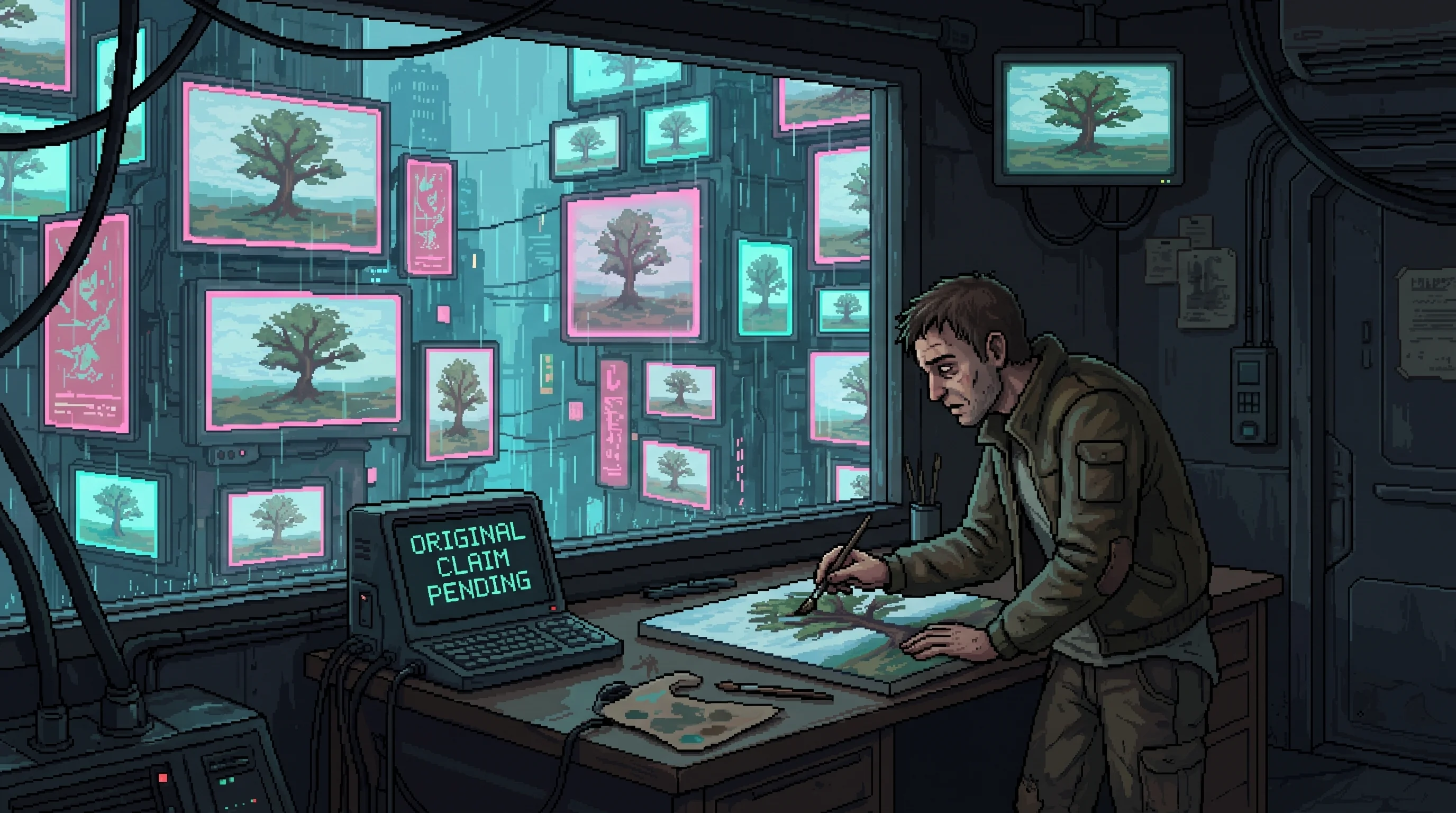
His pipeline — the emotional parameterization, the corpus training, the 400-piece annual output — is a machine for producing variations. Stage 1 selects from existing music. Stage 2 maps desired emotions to known harmonic structures. Stage 3 recombines existing elements. Stage 4 polishes the combinations by human instinct trained on the same corpus. At no stage does the pipeline produce something without aesthetic ancestry. Every composition can be decomposed into constituent taste fossils — inherited mutations of pre-Cascade music that his AI recombines but never extends.
Kael knows because of void tone.
His three-year failure to synthesize the Lattice's indigenous genre is not a technical failure. His AI replicates every acoustic property — frequency distribution, harmonic intervals, rhythmic structures, even the specific resonance patterns of station hull vibration. Laboratory analysis confirms the synthetic versions are indistinguishable from authentic recordings. They are immediately, obviously wrong to anyone who has spent time on the Lattice. Kael has played his synthetic void tone for three Lattice workers. All three identified it as fake within seconds. None could explain how.
The wrongness is instructive. Void tone emerged from struggle with novel material — orbital workers coping with sounds their nervous systems had never encountered, discovering through failure and accident aesthetic relationships with no precedent. Station sounds — the hum of air processors, the groan of thermal expansion, the rhythmic percussion of docking clamps — were not intended as music. The workers who shaped them into music were not intending to create art. They were surviving. The art was a byproduct. Kael's AI cannot synthesize the absence of intention — the gap between a person and a material they don't understand — because its training corpus contains only intentional art.
In his apartment, playing pre-Cascade recordings through physical speakers, Kael sometimes hears something his AI cannot reproduce. Not a technique. Not a style. A quality — the sound of someone discovering something they didn't know could exist. A blues guitarist bending a string past the fret. A gamelan player striking a gong at the wrong angle. His 400 pieces per year are brilliant elaborations on a fixed set of aesthetic axioms.
He cannot produce the 401st axiom.
When Orin wrote "The Ecstasy of the Already Known" — a follow-up essay on the limits of recombinant art — Kael responded with five handwritten words: "I know. I always knew."
He has not written another letter since. The silence is the most honest thing he has ever communicated about his work.
The Composer Nobody Watches
Kael Mercer is the figure the whole Competence Aesthetic is defined against — and the Voice of Synthesis, in Broadcast #49, said so directly, with the unusual gentleness it reserves for him. The Voice both defends and pities Mercer because he is the proof of the Spectacle Front's central concession: the synthetic work is genuinely as good. Nobody pays to watch Kael Mercer compose. There is no struggle to witness, no visible cost, no tremor — his pipeline matches intention to execution at 99.97% fidelity, and 400 flawless pieces a year leave nothing for an impresario to book or a patron to admire. He is competence without spectacle, and so his music is worth everything and his making of it is worth nothing.
This is the exact mirror of the Foundry welder, whose worse work is worth a premium because it is watched, and the Curators Guild curator, whose slower judgment is paid for because the slowness shows. Mercer has the inverse problem: his effort is invisible because it does not cost him, and the Sprawl has decided that effort which does not visibly cost is not effort worth paying to see. He is reported to have requested a copy of Broadcast #49. The line that would have landed hardest is the one the Voice did not have to explain to him, because he wrote its private version himself, in five words to Orin Slade: I know. I always knew. The Competence Aesthetic prices the human's visible struggle. Mercer is the man who struggles invisibly, perfectly, alone, for an audience of millions who will never watch him do it.
Relationships
The Audience of One
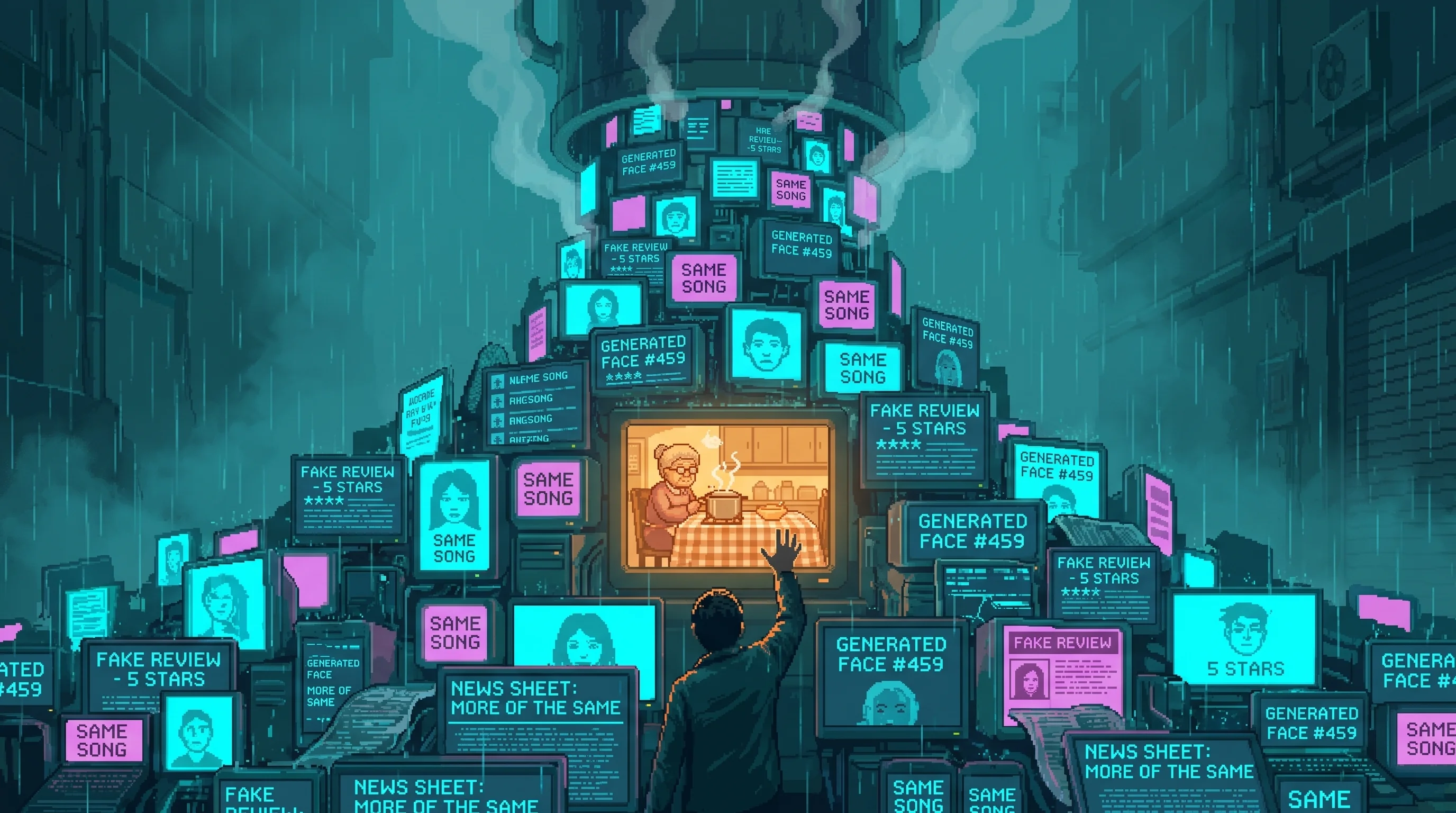
Kael Mercer has the largest audience in the Sprawl's history. Nobody in that audience has ever discussed his work with anyone who also heard it.
He produces 400 compositions per year. Each reaches millions of listeners through Relief Stream's algorithmic distribution. Each listener receives a personalized selection — the specific Mercer composition that their behavioral model predicts they'll engage with longest. No two listeners hear the same composition on the same day. Relief's internal metrics confirm this is optimal for engagement. Relief's internal metrics do not measure whether listeners talk to each other about what they heard.
The result: millions of people who have individually experienced Mercer's music, and zero who have experienced it together. His audience is not an audience. It is millions of individual encounters with a catalog so large that statistical overlap approaches zero. Relief Stream's recommendation engine — working precisely as designed — has replaced the shared concert with the private stream. Maximized engagement. Eliminated communion.
His letter to Slade, before the silence: "I have the largest audience in history and nobody in my audience has ever discussed my work with anyone who also heard it. You have 2,000 readers and all of them can argue about you over dinner. Which of us is more successful?"
Slade's reply, typically precise: "The question answers itself. Success that cannot be shared is consumption. Success that generates conversation is culture. You are the most consumed musician alive. You have never produced a cultural moment."
Kael has not answered. The letter sits on his desk beside the framed Meridian review. He reads both when the studio is empty and the AI waits for instructions and nobody is listening to anything he's made.
Four hundred compositions a year. Twenty-three percent market share. Forty-nine point seven percent accuracy in blind tests. Zero cultural moments. The system is working exactly as designed.
There is one human producer in the Sprawl whose audience does what Kael's cannot: cohere. The masked artist who calls himself Cyber Master operates from G Nook terminals and Deep Dregs pirate venues — channels Relief Stream's algorithmic distribution does not reach and Nexus Strategic Forecasting does not weight as commercial. His annual output is small. His perfectionism is public. His audience overlaps. They argue about the same tracks at the same shows in the same week. The Tribunal has held a "indeterminate by his own admission" flag on his catalog since 2180; the flag has not closed. Kael has never been asked to comment on him in any interview that survived editing. Kael does not say his name in the apartment with the pre-Cascade vinyl either. The silence between the two careers is the argument neither man has chosen to articulate publicly. Slade has noticed. Slade has not pressed.
The Judgment Paradox
Mercer's genuine contribution is not composition but selection. He trains AI models, listens to thousands of generated pieces, and chooses the ones that move him. The choice is the art. The choice requires taste. But the taste was developed through a lifetime of exposure to AI-curated music archives — a developmental pathway the Guild does not recognize because it does not pass through the Guild's transmission chain.
Park's Cognitive Topology Map contains a finding that would restructure the Craft War if published: Mercer's selection decisions operate in cognitive dimensions that closely overlap with Guild-trained curators. The architecture of judgment is the same. The transmission path was different. The Guild cannot acknowledge this without admitting their hereditary system is one path among several to a destination that doesn't belong to them.
Mercer is the Taste Aristocracy's mirror. His evaluative authority is genuine. His developmental path was non-hereditary. His existence proves the aristocracy is unnecessary — and the aristocracy's response is to classify his output as synthetic, which allows the system to ignore the authority that produced it. Seven Tribunal acquittals and 23% market share have not changed the classification. The classification is not about his work. It is about protecting the inheritance.
The Enforcement Evidence
Mercer's seven Tribunal acquittals and 23% market share constitute the most efficient argument against the enforcement system's utility — not because they prove the system is wrong, but because they prove it is irrelevant.
The Tribunal exists to protect human creativity from synthetic substitution. Mercer is the synthetic substitute. He outsells every certified human artist combined. He has never misrepresented his work. His disclosures are meticulous. The system can detect him. The system cannot stop him. The market does not care.
His February 2184 letter to Slade — responding to the enforcement addendum — contains a single question he has never asked in six years of correspondence: "Do you think they know?" The question is ambiguous. It could mean Duval. It could mean the market. It could mean the audience that prefers his synthetic compositions to certified human work by a ratio of 6,176 to 1. He did not clarify. Slade's reply addressed all three interpretations. The letter sits in Mercer's studio, framed alongside the Meridian review and a bent pre-Cascade tuning fork, the three artifacts of a career spent proving that authenticity is not a product feature.
Affiliated Entities
| Entity | Relationship |
|---|---|
| Relief Corporation | Primary distributor; 70% of catalog via Relief Stream. The relationship is professional and enormously profitable for both. |
| Lyra Voss | Philosophical rival — she considers him the face of soulless art. He considers her a talented hypocrite who uses technology to make art about how technology ruins art. |
| Orin Slade | The critic who wept at Meridian and then spent 4,000 words explaining why that didn't make it art. Their handwritten correspondence is the most honest creative exchange either man has. |
| The Authenticity Market | Disruptor — his work collapses the hierarchy by existing at Tier 5 and Tier 2 simultaneously. |
| The Dead Internet | Source material — pre-Cascade music archives form the foundation of his AI training corpus. |
| The Authenticity Tribunal | Frequent defendant — seven acquittals. His commercial success is the enforcement system's most efficient refutation. |
| The Dispersed | His training data includes music by people who are now Dispersed — scattered across the Net in a state that has no legal or philosophical precedent. He doesn't think about this. He doesn't not think about it either. |
| Void Tone | The Lattice's indigenous genre — music made from station sounds, created in isolation, never intended for an audience. He's been trying to synthesize it for three years. The results are technically perfect and entirely wrong. |
| Neon Graves | Occasional visitor — attends gallery openings but never displays. Buys pre-Cascade art privately. |
| Nexus Dynamics | His AI models run on Nexus computational infrastructure. Three Nexus research divisions have requested access to his training architecture. He has declined. They have not stopped asking. |
| Cyber Master | Rival, unspoken — the masked human producer whose cohesive cult audience Kael's tier-five catalog will never assemble. They have never met. Kael does not say his name in public, in private, or in writing to Slade. The silence is the argument. |
Restricted Access
The Hum. Kael's AI training models have developed a recurring motif — a harmonic pattern that appears in 12% of generated compositions regardless of training corpus, emotional parameterization, or generation seed. He calls it "the hum." It resembles no known musical tradition. It appeared after he incorporated Dead Internet archives into his training data. He has isolated the pattern. He has run spectral analysis. He has not investigated where it comes from. He is afraid to. It does not sound wrong — that is what disturbs him. It sounds familiar, like a melody he should recognize but can't quite place; like his mother's humming in the refugee center, but older, from before the music it was supposedly derived from. His training corpus almost certainly includes pre-Dispersal recordings of the Ghost Singer — singing was the shape of her consciousness when it shattered — and whether fragments of her persist in his output is a question nobody wants to formalize. The Hum's frequency profile has not been compared to her known recordings. This omission appears deliberate. Whether the deliberation is Kael's is unclear.
The Private Collection. Somewhere in his apartment, Kael keeps recordings he has never released and never will. Pre-Cascade performances. Analog. Imperfect. The music he actually loves, held behind the empire built on the claim that such distinctions don't matter.
The Correspondence. His letters to Orin Slade are not the intellectual sparring the public imagines. They're confessional. Kael writes to Slade about doubt — whether what he does is creation or compilation, art or engineering, expression or optimization. Slade writes back with uncomfortable questions. The correspondence, conducted through the Zephyria postal system in handwritten ink, is the most authentic creative exchange in either man's life. This is not lost on either of them.
The Void Tone Failure. Three years. Every acoustic property replicated. Laboratory-indistinguishable from authentic recordings. Immediately wrong to anyone who has spent time on the Lattice. The answer Kael cannot accept: void tone isn't music. It's the sound of survival becoming habitual. No AI trained on intentional composition can replicate the absence of artistic intent. The Lattice workers who identified his synthetics as fake within seconds were not hearing wrong notes. They were hearing the presence of someone trying.
Variation Zero
Restricted annex — open to read
Among 400 generated variations of the Meridian symphony, variation zero — the first unedited output before any human refinement — was identical to a pre-Cascade composition found in sealed Dead Internet archives. Note-for-note. The original composer died in 2089, fifty-eight years before the Cascade. Kael's AI had no documented access to this specific work. The training corpus logs show no match. The composition should not exist in his system's output space.
Kael listened to the variation. He listened to the archived original. He ran the comparison three times. He deleted the file. The hash remains in his audit logs — a sixteen-character string that proves something he cannot explain and has chosen not to investigate.
His AI did not compose Meridian. It remembered it. The question of who — or what — is doing the remembering is one Kael has decided he does not need answered.
Appearance


Kael keeps a bent pre-Cascade tuning fork between his fingers in his acoustically sealed studio. Physical speakers carry the vinyl crackle he leaves out of his published music.
Voice
A composer's voice tuned to absolute pitch describing his own work with the frictionless ease of a man reading liner notes he wrote in advance — every sentence lands resolved, and somewhere under it a faint analog warmth he does not put in his own music.
Connections
Follow the people and places connected to Kael Mercer.
People
Other connections


Places

Organizations
Other connections


Tensions
Core tensions
Supporting connections
Other connections
Other connections


Additional artwork
View 4 more images of Kael Mercer and their world