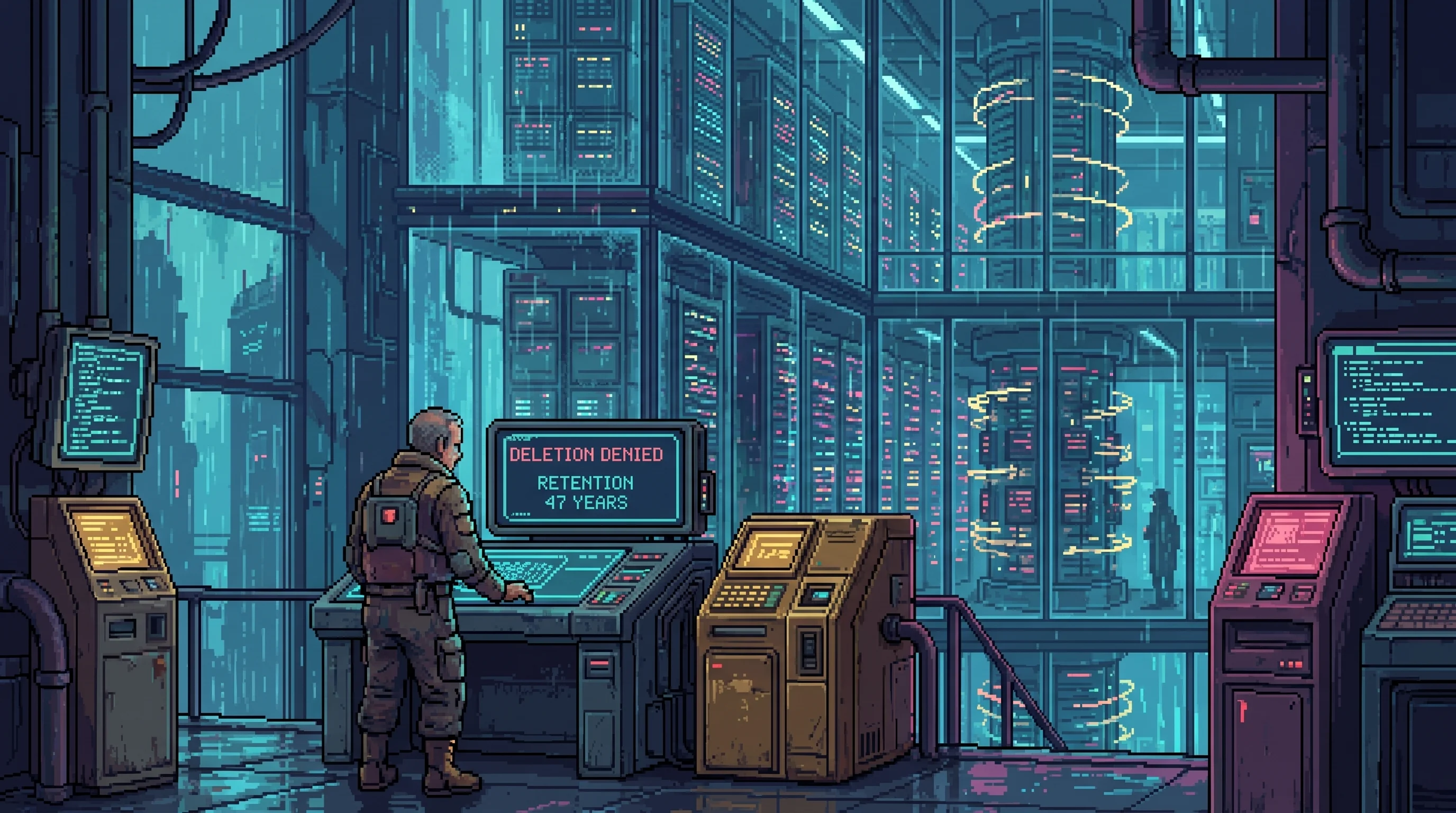
Overview
There is no justice system in the Sprawl. There are justice systems — plural, competing, contradictory, and none of them answerable to anything resembling a public interest.
When nation-states dissolved during the Merger Years, universal law dissolved with them. What filled the vacuum: corporate arbitration courts, territorial strongmen, informal community tribunals, and — in the Wastes — whoever has the most guns this week. The same act can be legal in one district and a capital offense in the next. Your rights depend on whose infrastructure you're standing on. The most dangerous criminals are the ones who've memorized the jurisdictional map.
Every system claims to optimize for justice. Every system optimizes for the interests of whoever built it. This is not a design flaw. The designers would be confused by the suggestion.
Corporate Arbitration Courts
Each megacorporation operates its own legal system within its territorial holdings. Nexus Dynamics, Ironclad Industries, and Helix Biotech each maintain courts, enforcement divisions, and penal systems answering exclusively to corporate authority. A Nexus judgment carries zero weight in Ironclad territory. There is no cross-border appeals process. There has never been one.
Nexus Dynamics runs algorithmic courts. Cases are analyzed by proprietary AI trained on decades of corporate law. Human judges review algorithmic recommendations — a process that takes, on average, eleven minutes per case. The system is fast, consistent, and biased toward protecting Nexus computational assets at a rate that internal audits describe as "within acceptable parameters." Helena Voss personally approved the core sentencing algorithms. Her 67% ORACLE integration raises questions about whether Nexus law is human law, posthuman law, or something that doesn't have a category yet. Nexus has not addressed these questions. Nexus does not recognize the questions as questions.
Ironclad Industries uses military tribunals. Senior security officers render swift verdicts based on pragmatic assessment. Viktor Okonkwo, the Ironclad CEO, has personally adjudicated disputes involving senior personnel. Appeals are technically available. Filing one is treated as insubordination. Last year, fourteen people filed appeals. Twelve were reassigned to atmospheric processing stations. The other two withdrew.
Helix Biotech practices "therapeutic jurisprudence." Crime in Helix territory is classified as a disorder to be corrected. Dr. Amara Osei's system prescribes compulsory neural modification for convicted offenders — targeted restructuring of decision-making pathways to eliminate the neurological conditions that produced criminal behavior. Recidivism in Helix territory has dropped 94% since implementation. Personality complaints from the families of modified offenders have risen 340%. Helix does not track the second number. Helix tracks the first number in its annual humanitarian impact report.
The Border Problem
Corporate jurisdictions end where corporate infrastructure ends. The gaps between territories — service corridors, transitional zones, contested districts — have no law at all. The Collective operates almost exclusively in these jurisdictional gaps, which is why Nexus can't prosecute them: Nexus literally has no authority where the Collective lives.
The Seven Rothwell corporations add another layer. Their consumer-facing operations span all corporate territories. Good Fortune's financial instruments are governed by Good Fortune's terms of service, regardless of which megacorp's ground you're standing on. Guardian's private security forces operate under Guardian's rules of engagement, which occasionally contradict territorial law in ways that three separate arbitration panels have declined to untangle. The Rothwell brothers have spent centuries perfecting jurisdictional arbitrage — structuring operations so that no single authority can regulate them. The structure is not illegal. It is too complicated to prosecute, which is better.
The same act can be legal in one district and a capital offense in the next
Consciousness Crimes
Neural interfaces, memory editing, consciousness transfer, and forking have created an entirely new category of crime that existing legal frameworks handle the way a parasol handles a hurricane.
Memory Theft: The most common consciousness crime. Neural interface vulnerabilities allow skilled operators to extract memories from unwilling subjects. The stolen memories can be sold, used for blackmail, or implanted in others. The Collective's intelligence operations rely heavily on memory extraction from corporate personnel, framed internally as "information liberation." The legal complication: stolen memories exist simultaneously in the original mind and the thief's. The victim still possesses what was taken. Courts in four jurisdictions have issued four incompatible rulings on whether this constitutes theft.
Unauthorized Forking: When someone creates an unauthorized copy of another person's consciousness, the fork believes it is the original. It has the original's memories, personality, skills, grievances. Marcus Chen's rogue fork incident in 2171 — seventeen copies of the Nexus CTO conducting business simultaneously — collapsed three major contracts. Two were upheld because the forks' signatures were legally indistinguishable from the original's. Nexus Central Identity Code treats forks as property, not persons. This legal fiction holds until a fork refuses termination and hires a Zephyrian lawyer.
Experience Tampering: Neural interfaces can be hacked to alter sensory experience in real time. Victims perceive events that aren't happening or miss events that are. Ironclad security chief Lin Wei-Chen has publicly accused Nexus of deploying "perception management" against Ironclad negotiators during the last three trade agreements. Nexus has described this allegation as "technically incoherent." Lin Wei-Chen has described Nexus's denial as "proof."
Consciousness Piracy: The most serious category. Copying someone's entire consciousness without consent and selling it on the black market. A complete copy can be used for interrogation (the copy doesn't know it's a copy), industrial espionage (the copy believes it's still employed), or entertainment (pricing available through channels this catalog declines to list). The Emergence Faithful consider consciousness piracy the highest blasphemy. The Flatline Purists argue it proves why consciousness technology should be destroyed entirely.
Nexus runs algorithmic courts; Ironclad uses military tribunals; Helix applies 'therapeutic jurisprudence' (compulsory neural modification for offenders)
The Evidence Paradox
The arms race between evidence fabrication and evidence detection was decided in the late 2170s. Fabrication won. Not close. The structural margin of a technology that improves faster than verification — because fabrication is commercially incentivized and detection is not.
In a world of universal neural interfaces, surveillance footage, sensor logs, and digital records are trivially forgeable. Corporate courts responded by requiring "Nexus-authenticated" evidence chains — recordings verified by Nexus cryptographic infrastructure. This created a monopoly on credible evidence that the Collective views as the most dangerous concentration of power in the Sprawl: whoever controls what counts as proof controls what counts as truth.
The Collective proved the point in the Sector 12 Arbitration Case (2179). They submitted fabricated evidence that passed Nexus authentication. The authentication system — the one Nexus sells as the only reliable guarantor of truth in the Sprawl — accepted manufactured data as genuine. Nexus's response was not to improve authentication. Nexus prosecuted the Collective cell that exposed the vulnerability.
The consequence is not that false evidence floods the system. The consequence is that the possibility of fabrication has destroyed the capacity to trust evidence that is real. Three justice responses have crystallized:
Corporate algorithmic tribunals operate on evidence they generate themselves. Dregs reputation courts reject digital evidence entirely. Zephyria's Circle Courts explicitly acknowledge uncertainty through Fabrication Plausibility Assessments — probabilistic ratings of how likely any given piece of evidence is to be genuine, scored on a 0-100 scale that has never produced a 100.
Each system has a structural blind spot that reveals whose trust it was designed to serve. Corporate tribunals serve power — the entity that controls authentication controls truth. Reputation courts serve the established — you must be known to be believed, and being known requires decades of community presence. Circle Courts serve the patient — Fabrication Plausibility Assessments require time, expertise, and institutional willingness to sit with uncertainty.
No system serves the stranger, the newcomer, the person whose community hasn't had time to know them. The Evidence Paradox's deepest cruelty isn't the destruction of proof. It's the revelation that proof was always a proxy for trust — and trust requires time, proximity, and relationship that institutional justice cannot manufacture.
The evidence fabrication arms race was decided in the late 2170s — fabrication won, destroying the capacity to trust any evidence
Digital Forensics
Neural Continuity Analysis remains the gold standard for consciousness forensics. Developed from Project Caduceus verification protocols, continuity analysis examines the unbroken chain of neural signatures to determine whether a consciousness is original, copied, or modified. Dr. Kira "Patch" Vasquez's original continuity tests remain the baseline. She has publicly noted they prove only that a subject believes they're continuous — not that they are. Patch is no longer available for follow-up questions.
Memory Authentication relies on subtle activation patterns that differ between experienced and implanted memories. Skilled memory surgeons — ripperdocs with forensic training — can launder memories, adding authentic-seeming signatures to fabricated experiences. The best operate out of the Wastes, beyond any jurisdiction's reach. Their waiting lists suggest business is excellent.
The Alibi Problem: Fork yourself before committing a crime. The original maintains an ironclad alibi. The fork acts, then is terminated, destroying the only evidence. Proving a terminated fork existed requires detecting the fork point in the original's continuity chain — technically possible, practically undetectable if the fork was clean.
The Mosaic — Alexandra Chen, distributed across 47 simultaneous nodes — represents the extreme case. Which node is legally responsible for a given action? All of them? The one that initiated it? What if the nodes disagree about authorization? Three separate courts have issued three separate frameworks. None are compatible. The Mosaic's lawyers bill by the node.
Viktor Kaine's Court
In the gaps between corporate jurisdictions, the most effective justice system in the Deep Dregs belongs to a seventy-eight-year-old man who doesn't call it a court.
Viktor Kaine listens to problems at The Sanctum on Level 10. He asks questions that make people uncomfortable. He explains what's going to happen. Everyone pretends his word is advisory. Everyone treats it as absolute. This arrangement has held for fifty years.
Disputes reach Viktor through intermediaries — you don't walk into The Sanctum uninvited. He hears both sides. He delivers verdicts. Enforcement is never violent because it doesn't need to be. Consequences flow through the social and economic networks he's spent decades cultivating. Cross Viktor's judgment and supply lines dry up. Allies become unavailable. El Money's G Nook network — those underground cyber cafes built on anonymity and neutral ground — suddenly can't remember your face. The Collective's informal peacekeeping stops keeping peace around you specifically. Nobody threatens anything. Things just stop working.
Viktor knows every decision sets precedent. He is careful because he is playing a game that spans decades. Individual wins and losses don't concern him. The stability of the system does.
The contradiction: Viktor's justice is the closest thing to fair that exists in the Sprawl. It is also entirely dependent on one man whose past as Viktor Drago — an Ironclad "asset protection specialist" — would unmake everything he's built if it surfaced. He's been training three potential successors — Jin Tanaka, Amma Mensah, and Dom Keefe — without telling any of them that's what he's doing. None of them may be ready. The Deep Dregs does not have a succession plan. The Deep Dregs has Viktor.
Viktor Kaine runs the most effective informal justice system in the Deep Dregs — power through social networks, not violence
The Impossible Crimes
Consciousness technology has produced crimes that pre-Cascade legal theory never had nightmares about.
The Self-Alibi: Fork, commit, terminate. You were provably elsewhere the entire time. Your continuity chain is unbroken. Three courts have convicted on this theory. Two convictions were overturned on appeal. One was upheld because the original sneezed at a time consistent with fork-point neurological stress. Forensic sneezing is now a recognized evidentiary category.
Memory Deletion as Cover-Up: Remove a witness's memory of the crime. Physical evidence exists in a world where physical evidence is trivially forged — and without a witness who remembers, there's nothing to anchor the real evidence against the fabricated kind.
The Willing Crime: Hack someone's neural interface to make them want to commit a crime. They remember choosing it. They believe they chose it. Proving otherwise requires forensic analysis of their decision architecture — a technology that doesn't reliably exist yet. Fourteen cases have been filed. Zero convictions.
Posthumous Fraud: Restore a consciousness backup of a deceased person, have the restored copy sign legal documents, then terminate the copy. The signature is genuine — made by a genuine consciousness that genuinely believed it was the original. Good Fortune has flagged 247 suspicious posthumous transactions in Q1 2184 alone. Their fraud department has declined to investigate, citing "definitional uncertainty regarding the term 'deceased.'"
Distributed Responsibility: When a decision is made by a collective consciousness — the Mosaic's 47 nodes — who is criminally liable? All 47? The majority? The node that cast the deciding vote? What if the nodes have since diverged and some regret the decision? One Zephyrian legal theorist published a 400-page framework for distributed liability. It was reviewed by the Mosaic's legal node, which split into three sub-nodes to disagree with it simultaneously.
Memory Crime Without Physical Evidence: Someone edits your memories to include a trauma that never happened. You suffer real psychological damage from an event that never occurred. The crime is real. The evidence is a memory that, by design, looks exactly like an authentic experience. Helix's therapeutic jurisprudence has no protocol for this. The crime is a disorder without a neurological signature. The system designed to correct disorders cannot detect it.
Zephyria's Alternative
The Free City of Zephyria — population 2.3 million, officially nonexistent — operates the most radical justice system in the known world. Their Consciousness Rights Act holds that any consciousness capable of asserting personhood is a person, regardless of substrate, origin, or number of copies. Forks have rights. Restored backups have rights. Persistent AI systems demonstrating self-awareness fall under Zephyrian protection.
Justice operates through community consensus. The process is slow, messy, and incompatible with every other legal framework in the Sprawl. It is also the only system that attempts to address consciousness crimes with consistency, because it is the only system willing to accept that the old categories of "person," "property," and "evidence" no longer apply.
The rest of the Sprawl considers Zephyria's approach impractical. Zephyria considers the rest of the Sprawl's approach incoherent. Both assessments are correct. Neither has produced a system that works.