The Line-Walkers Union
Jurisdictional Boundary Workers Union
Needed, not watched
Founded 2176 after Loss of Pressure Event 7 killed 67 people due to contradictory evacuation orders
Overview
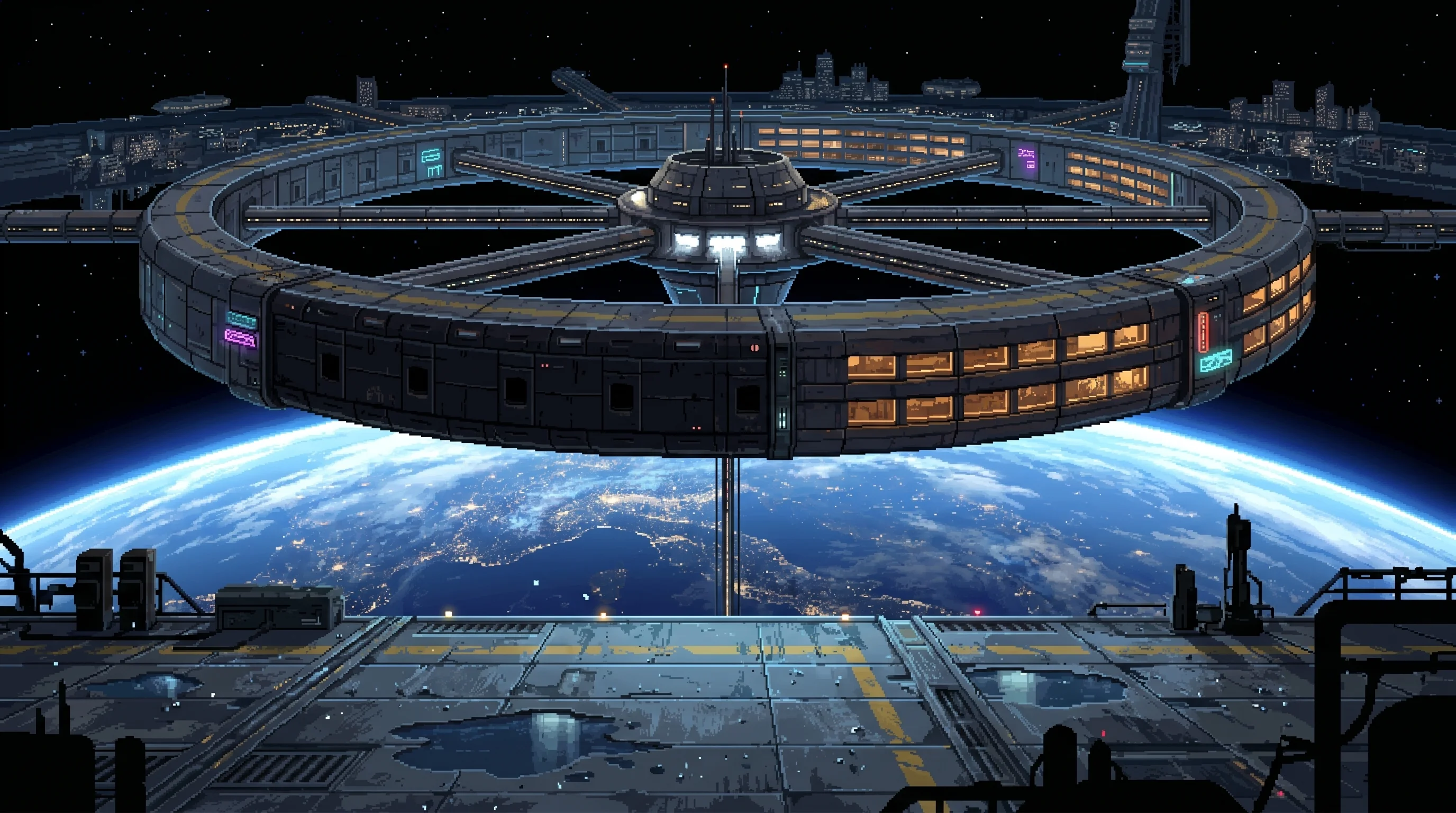
At every yellow stripe painted on Highport Station's deck plates — the jurisdictional boundaries between Ironclad territory, Nexus territory, and independent zones — someone has to manage the transition. The Line-Walkers Union represents approximately 2,000 workers who do this: customs handlers, cargo inspectors, jurisdiction translators, and the specific breed of administrator who can look at a shipping container and determine that it is Nexus property under docking law, Ironclad property under materials law, and independent cargo under transit law, then resolve the contradiction before the lunch rotation.
They resolve it by picking whichever framework produces the least paperwork. This is not official policy. It is the only policy that has ever worked.
The Union was founded in 2176 after Loss of Pressure Event 7 killed sixty-seven people. Twenty-three of them died in corridors where Ironclad evacuation routes pointed starboard and Nexus evacuation routes pointed port. The corridors were four meters wide. The people in them had to choose a jurisdiction in which to survive. Several chose wrong. Several chose right and died anyway, because the "right" route fed into a bulkhead sealed by the other jurisdiction's emergency protocol.
The Line-Walkers' founding demand was simple: unified emergency protocol superseding jurisdictional boundaries. Ironclad declined. Nexus declined. The independent zones abstained on procedural grounds, citing insufficient quorum to recognize an emergency that had already killed sixty-seven people. The Line-Walkers responded with a nine-day work stoppage that seized the orbital supply chain. The protocol was adopted on day ten. The abstention was revised to a unanimous vote of support, backdated.
Their motto — "We walk the lines so the lines don't walk you" — is painted on the Spoke District union hall in letters large enough to read from the docking ring. The grammar is disputed. The sentiment is not.
Ifechi Adeyemi and the Database Problem
The Union's senior jurisdiction lawyer, Ifechi Adeyemi, has resolved more than 4,000 cross-jurisdictional disputes in twelve years. She has not consulted a database for any of them.
This is not a principled stance. Databases belong to jurisdictions. Ironclad's legal database cites Ironclad precedent. Nexus's legal database cites Nexus precedent. The independent zones maintain a database that contains, by Adeyemi's count, "eleven contradictions per page and one page per contradiction." Consulting any of them during a boundary dispute is the equivalent of asking one spouse to adjudicate the other spouse's complaint. The information is technically available. It is not technically useful.
Adeyemi carries the relevant law in her head — all three systems, their overlaps, their gaps, and the 140+ informal precedents that exist only because she set them and remembers them. She is the union's most valuable asset, its institutional memory, and its single point of failure. The Line-Walkers are aware of this. Adeyemi is aware of this. She has been asked about succession planning on six occasions and has responded to each with the same two-word answer, which the union minutes record as "declined to elaborate."
There are three legal systems on Highport. None of them contain a complete map of how jurisdictional disputes are actually resolved. That map exists in one place. It does not have a backup.
In 2183 a member moved to commission a reading on her from the Reliance Index, to force the hiring of a successor. The motion failed in under a minute. A reading is a document, and a document is a thing a jurisdiction can act on. Adeyemi voted with the majority.
Down in Sector 8, the Sound Register made the opposite choice. Its session musicians can be replaced by the hundred, so they wrote their leverage onto paper instead.
The Nine-Day Theorem
The Line-Walkers' 2176 strike is the only successful essential-worker action in the Sprawl's history. Its success is also the reason no other essential-worker action will ever succeed.
The strike worked because the Line-Walkers occupy a jurisdictional position, not an infrastructural one. They stand between systems, translating incompatible legal frameworks into functional outcomes. When they stopped translating, cargo backed up along the docking ring at a rate of 1,400 containers per day. Schedules slipped. Costs mounted. Ironclad's quarterly logistics budget overran by 11% in nine days. But nobody died. The systems kept running — they just stopped cooperating with each other. Nine days of stoppage produced economic damage without producing corpses, which gave the Line-Walkers leverage without self-destruction.
The Lamplighters maintain the Grid's interstitial zones. Atmospheric processing technicians keep sealed megastructures breathable. The Coolant Guild's thermal engineers prevent reactor meltdowns. Their position is infrastructural: they are inside the systems that keep populations alive. When they stop, the system doesn't back up. It fails. Failure in atmospheric processing produces body counts measured in hours.
The Line-Walkers proved that strikes are possible on Highport. They also proved, by exclusion, the theorem that every other essential-worker union on the station has memorized: you can only strike from a position where stopping creates inconvenience rather than death. The Lamplighters learned this. The thermal engineers learned this. The atmospheric technicians — whose grievances with Ironclad are older, deeper, and better documented than the Line-Walkers' ever were — learned this most clearly of all.
The Line-Walkers won a union, unified emergency protocols, and a motto on a wall. The atmospheric technicians won the knowledge that their labor is too important to have any leverage. The system's most essential workers are the ones least able to demand better conditions, because demanding better conditions requires stopping, and stopping requires a body count they are unwilling to produce.
Highport's emergency protocols are now unified. Its labor conditions are not. The nine-day exception proved both things at once.
Irreplaceable, Not Watchable
There is a custom spreading through the Sprawl below — the Gilded Callus, the paying of the comfortable to watch the obsolete still trying at crafts the machines now do better. A welder in the Foundry is kept on the floor not because the autoweld can't do it but because executives will pay to watch a human almost fail at it behind glass. The Line-Walkers are the instructive opposite, and the difference is the most important distinction in the whole question of human skill in 2184.
Ifechi Adeyemi is not watched. She is needed. No one books a private viewing of her resolving a jurisdictional contradiction; the corporations that depend on the resolution would never frame it as a spectacle, because the value is in the dispute being settled, not in being seen to settle it. There is no autoweld for a contradiction between two legal codes that each claim the same airlock — and so the Line-Walkers possess the one thing the watched artisans have lost: leverage. You cannot put a Line-Walker behind blast glass, because the worth is in the walking, not in the watching of the walk. The nine-day strike worked precisely because their competence was load-bearing rather than ornamental.
This is the line the whole Craft War's Spectacle Front turns on, drawn cleaner here than anywhere else: the Competence Aesthetic is what happens to a human skill after it loses its necessity. While the skill is still genuinely irreplaceable, watching it is irrelevant — the buyer needs it done, not performed. The moment the machine can do it better, the only value left is the spectacle of the human failing to keep up, and the velvet rope goes up. The welder behind the glass and the lawyer who never opens a database are the same trade at two different moments of its obsolescence. Adeyemi is what the welder was before the autoweld. The welder is what Adeyemi will be the day someone builds a machine that can hold all three legal systems in its head — and the union's quiet terror is that the day is coming, and that when it does, the only buyers left will be the ones who want to watch her struggle to remember.
Restricted Access
Veterans with fifteen or more years of service report sensing jurisdictional boundaries before they see the physical markers — a feeling in the gut, a shift in the quality of light, a change in air pressure that doesn't register on any instrument. Adeyemi describes it as "the law has a weight, and when you carry enough of it, you can feel when it changes." Medical evaluation finds nothing physiological. The phenomenon is consistent and reproducible. Whether it is pattern recognition compressed beyond conscious access or something stranger, nobody can say.
Source reports from independent assets describe a standing agreement — invoked twice in the past decade — that allows Line-Walker senior staff to override corporate jurisdiction declarations during pressure events. No paperwork exists. No corporation has acknowledged it. If formalized, the arrangement would constitute a jurisdictional authority equivalent to either corporate stakeholder, and that is precisely why it remains unwritten: formalization would require recognition, recognition would trigger countermeasures, and the gap is load-bearing. The Union's one functional override exists only as long as no one admits it exists.
Affiliated Entities
- Loss of Pressure Event 7 — the founding trauma; sixty-seven dead in jurisdictional crossfire
- Orbital Jurisdiction — the incompatible system the Union navigates daily; three legal frameworks, zero coherence
- Ironclad Industries — controls Highport's physical infrastructure; accepted unified emergency protocols on day ten of the strike, having declined on days one through nine
- Nexus Dynamics — controls Highport's computational infrastructure; jurisdictional claims frequently conflict with Line-Walker operations, particularly at data-cargo boundaries where a container's legal status depends on whether you classify its contents as information or material
- The Lamplighters — surface parallel; invisible labor maintaining infrastructure between corporate territories, but from the infrastructural position that makes strikes lethal rather than inconvenient
- The Coolant Guild — Highport's thermal engineers are the Nine-Day Theorem's other half: where the Line-Walkers proved a strike can win, the Coolant Guild proved that the workers whose stoppage kills can only document, never withhold. The two unions are the theorem's positive and negative cases, learned on the same station
- The Drift-Runners Guild — the orbital economy's other organized-labor experiment; both guilds defend the last humans in a trade that automation is pricing out, the Line-Walkers from a jurisdictional foothold and the drift-runners from the extrajurisdictional void between installations where no legal framework reaches

Visual Identity
- Color palette: Yellow stripe over gray deck plate; high-visibility work wear in safety orange; the neutral tan of someone who belongs everywhere and is claimed by no one
- Compositional mood: A figure standing exactly on a yellow line, one foot in each jurisdiction, holding paperwork from both
- Key symbol: The yellow stripe — painted, physical, undeniable; the one boundary on Highport that everyone agrees exists
- Lighting: Industrial corridor lighting; the sharp contrast between Nexus blue-white and Ironclad amber at boundary points, the yellow stripe fluorescing under both
Further connections
Browse all 20 connected records
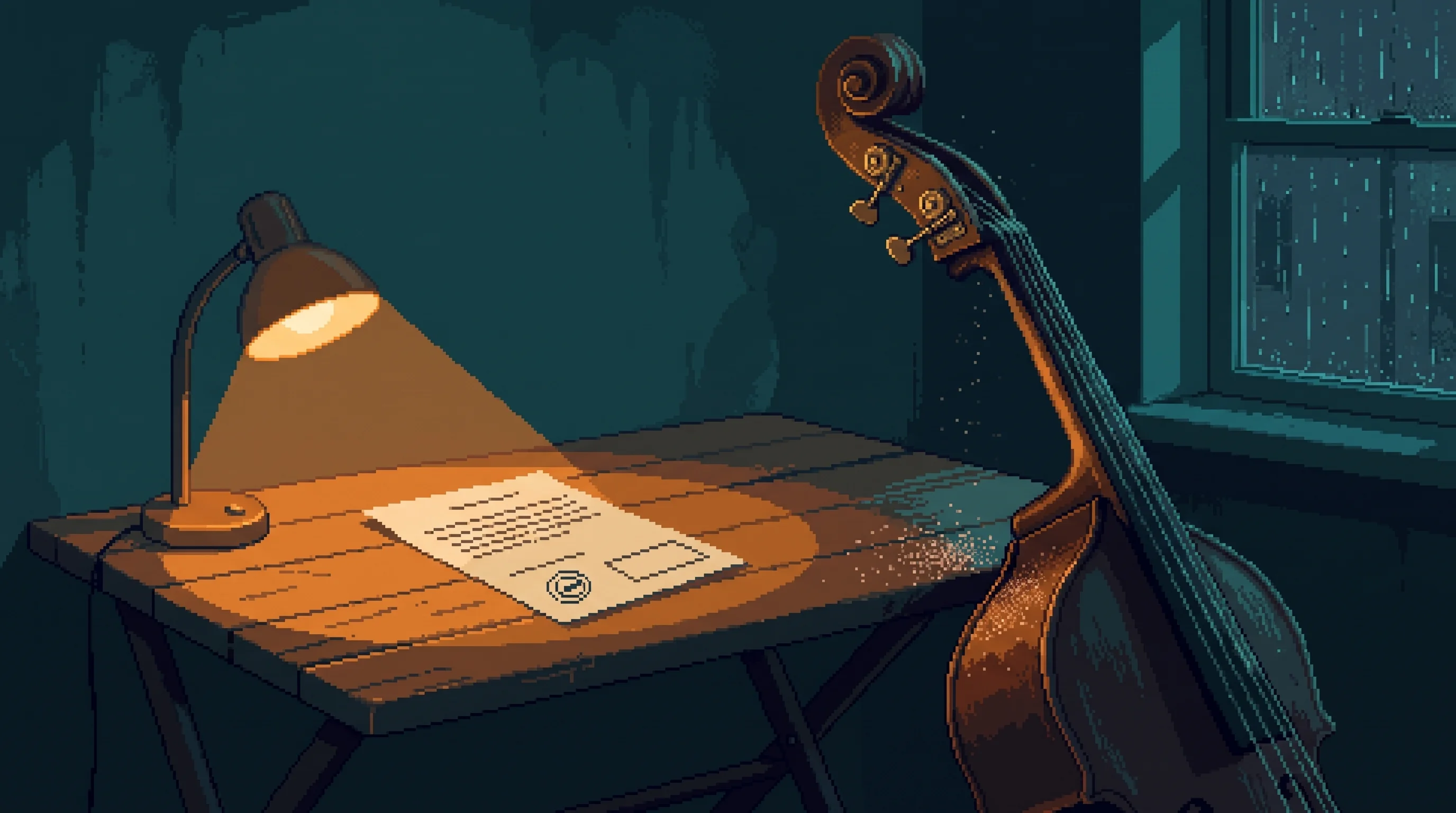
The other answer to the same question, and the reason theirs held: a Line-Walker cannot be substituted, so stopping is leverage. A session bassist can be replaced by any of six hundred, so receipt was the only leverage available.
Relief paid for her bass lines. Her union kept the money and wrote to say she was satisfied.
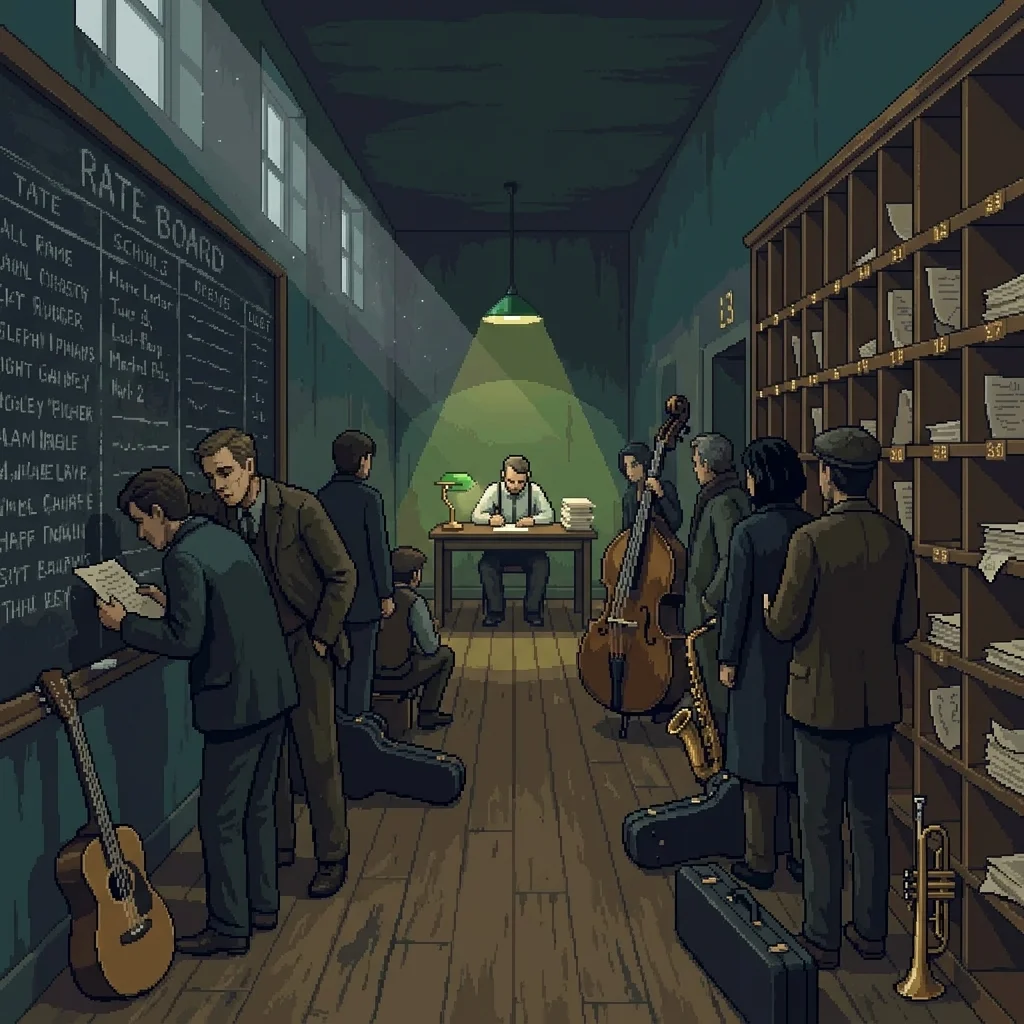
Two labour bodies, one instrument apart. Both were founded to stop a buyer picking off individuals; one refused to put its leverage on paper and one had to.
The musicians' own body, and the only party allowed to be paid for their recordings.
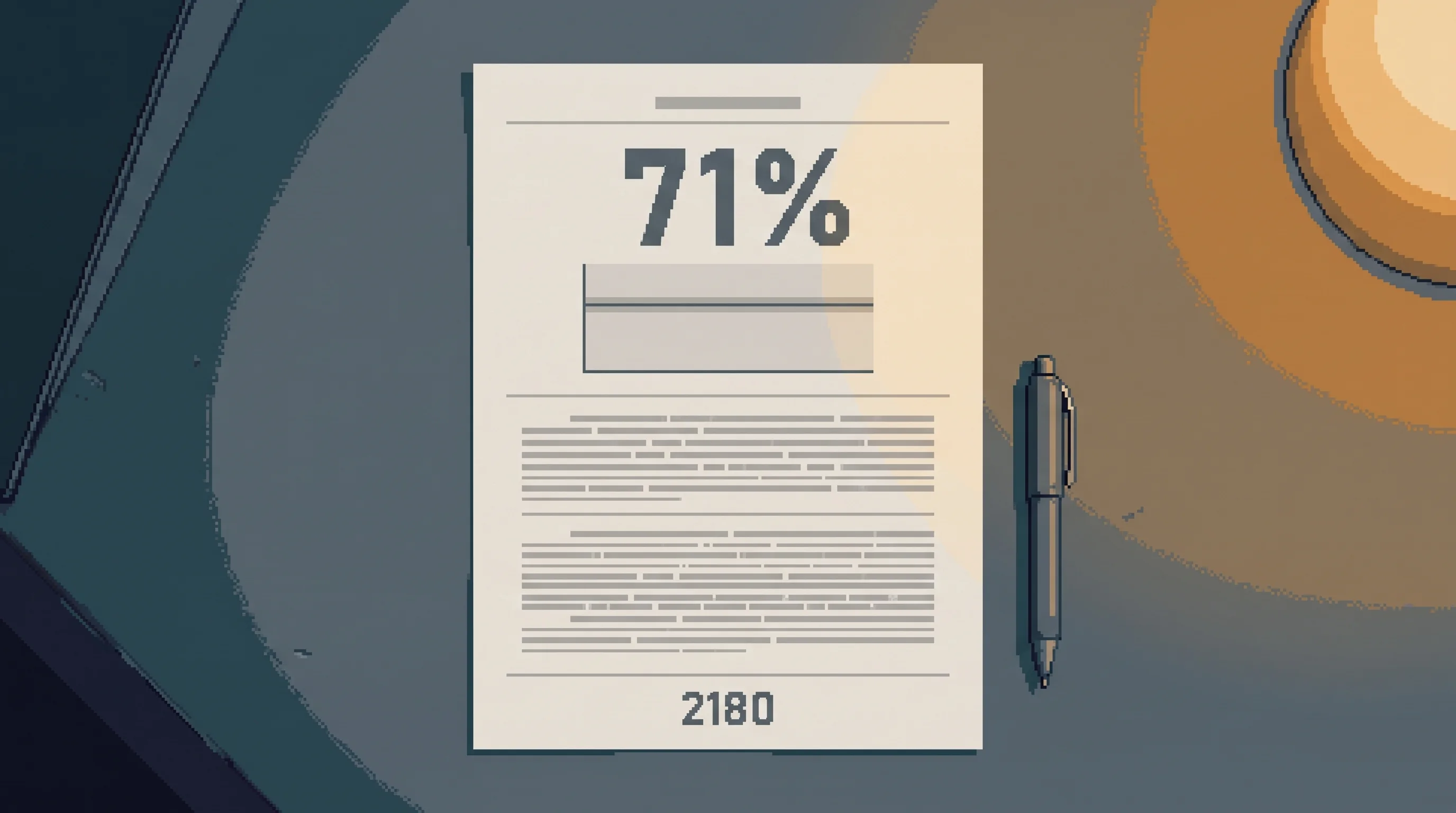
The instrument that would have named their worst risk in one line, voted down for exactly that reason.
The published measure of how much of a service stops when one named person stops, and the date it returns.

Operates across all jurisdictional boundaries on Highport
An 8-km orbital ring handling 70% of Earth's traffic, where a corporate consortium meters the very air as a daily tax.

Founded in direct response to the 67 deaths from jurisdictional confusion

Line-Walkers are the human interface between incompatible legal systems

Forced Ironclad to accept unified emergency protocols through a nine-day strike
The megacorporation that controls the Sprawl's physical infrastructure — steel, concrete, and the Orbital Elevator.

Nexus's jurisdictional claims frequently conflict with Line-Walker operations
The megacorporation that controls 40% of the Sprawl's computational infrastructure.

The Line-Walkers are the Craft War's instructive opposite — human skill paid for because it is irreplaceable, not because it is watchable; the line between dignity and spectacle is leverage
When machine art matches human, the fight moves to the act itself — and human effort survives only as spectacle.

The Gilded Callus watches the obsolete struggle; Adeyemi is needed, not watched — the same skill at two different moments of its obsolescence
The elite custom of paying to watch deprecated workers still practicing obsolete skills.

The Foundry welder behind glass is what Adeyemi will become the day a machine can hold all three legal systems in its head
Ironclad's 31-million-worker forge, where a human wing sells hand-finished welds as proof a person was there.

Highport's essential-worker counterpart on the infrastructural side of the Nine-Day Theorem: the Coolant Guild's thermal engineers cannot strike because stopping kills, where Line-Walkers struck successfully because stopping only inconveniences

Both organize the last humans in an orbital trade automation keeps trying to delete; Line-Walkers strike from a jurisdictional position, drift-runners survive in extrajurisdictional transit corridors no authority reaches
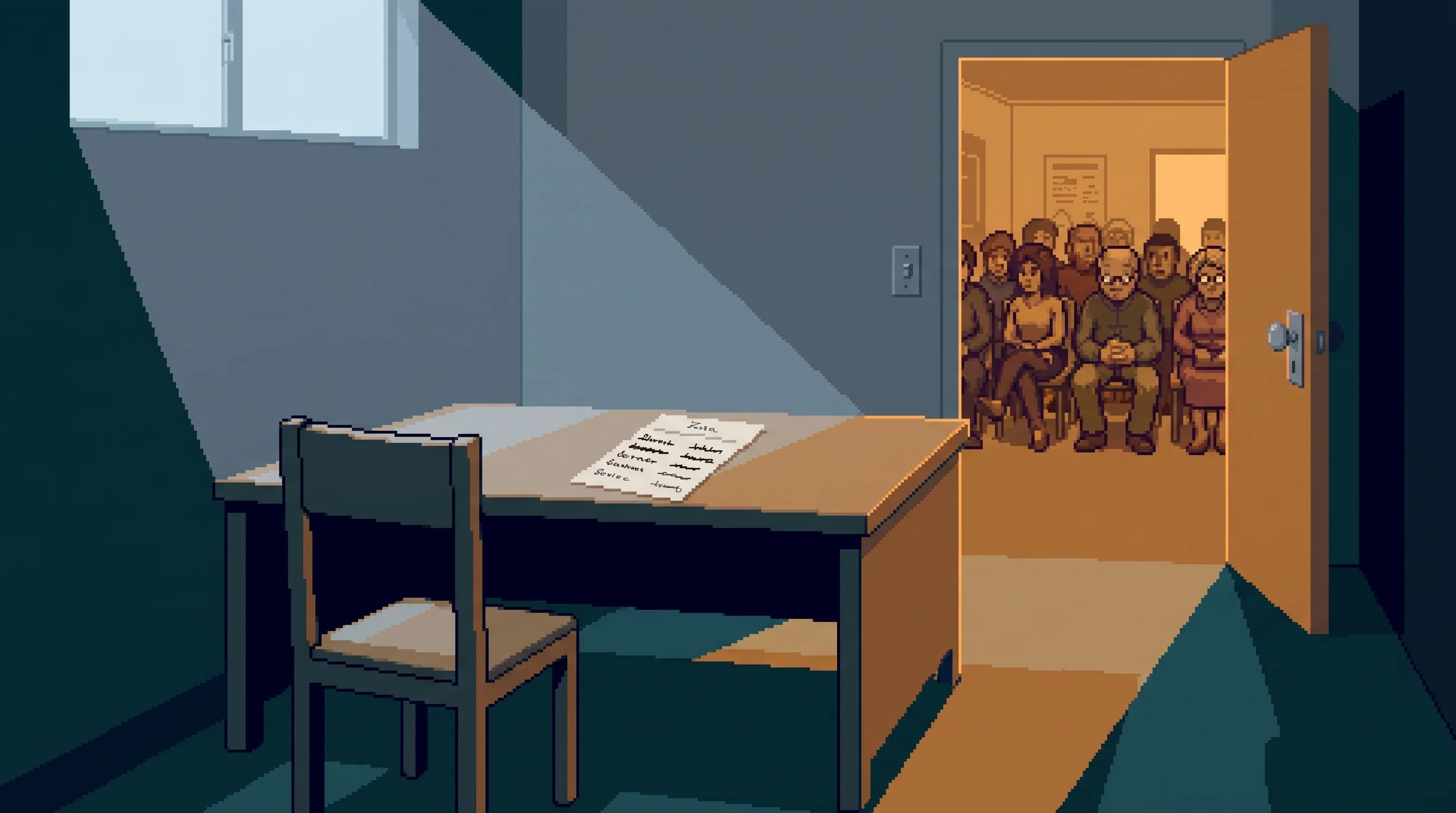
A member moved to commission a reading on Adeyemi to force the succession question. The motion failed on the floor: a reading is a document, and the stripe belongs to nobody.
The districts remove the people too many others wait on, state the reason in full, and pay them while they go.

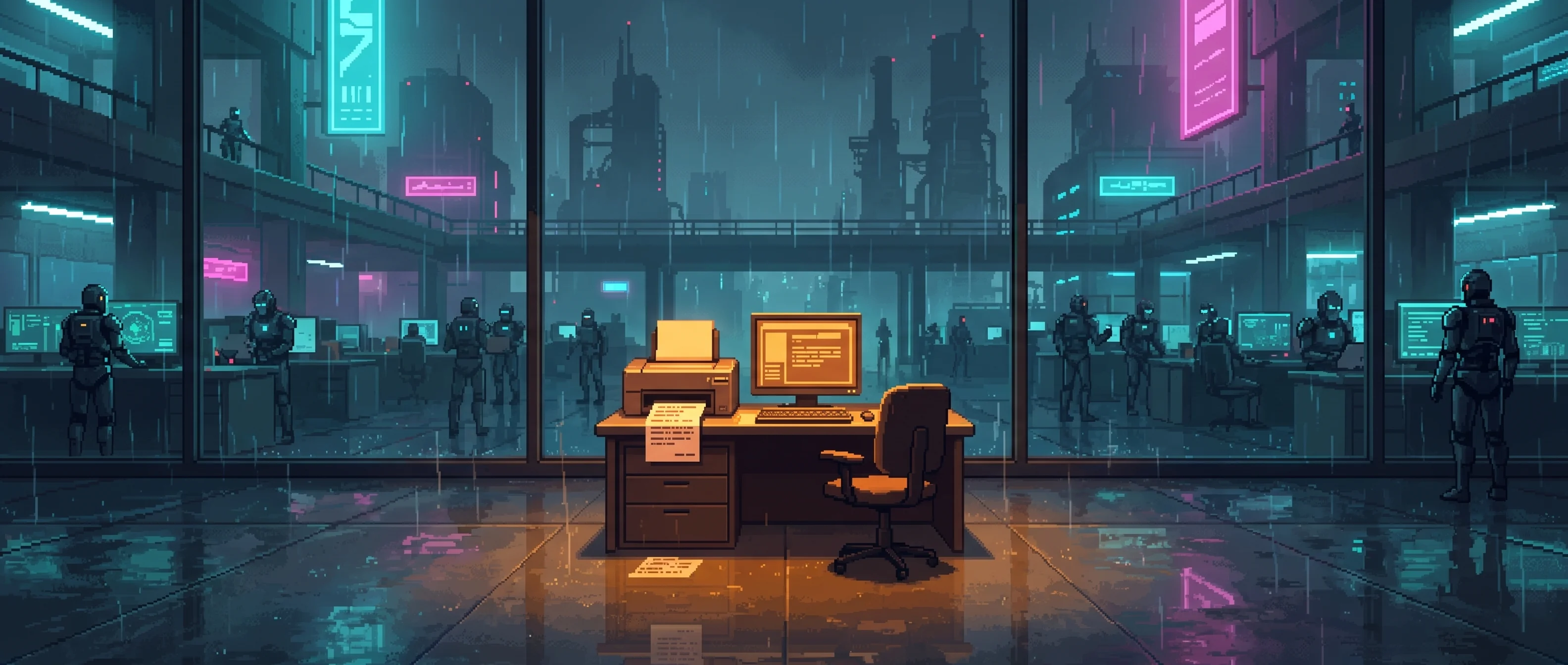
The rare human work with leverage — jurisdictional skill machines can't do, paid because it's needed, not watched.
Automation ended most human work, but ownership hoards its abundance while machine sentience stays unresolved.

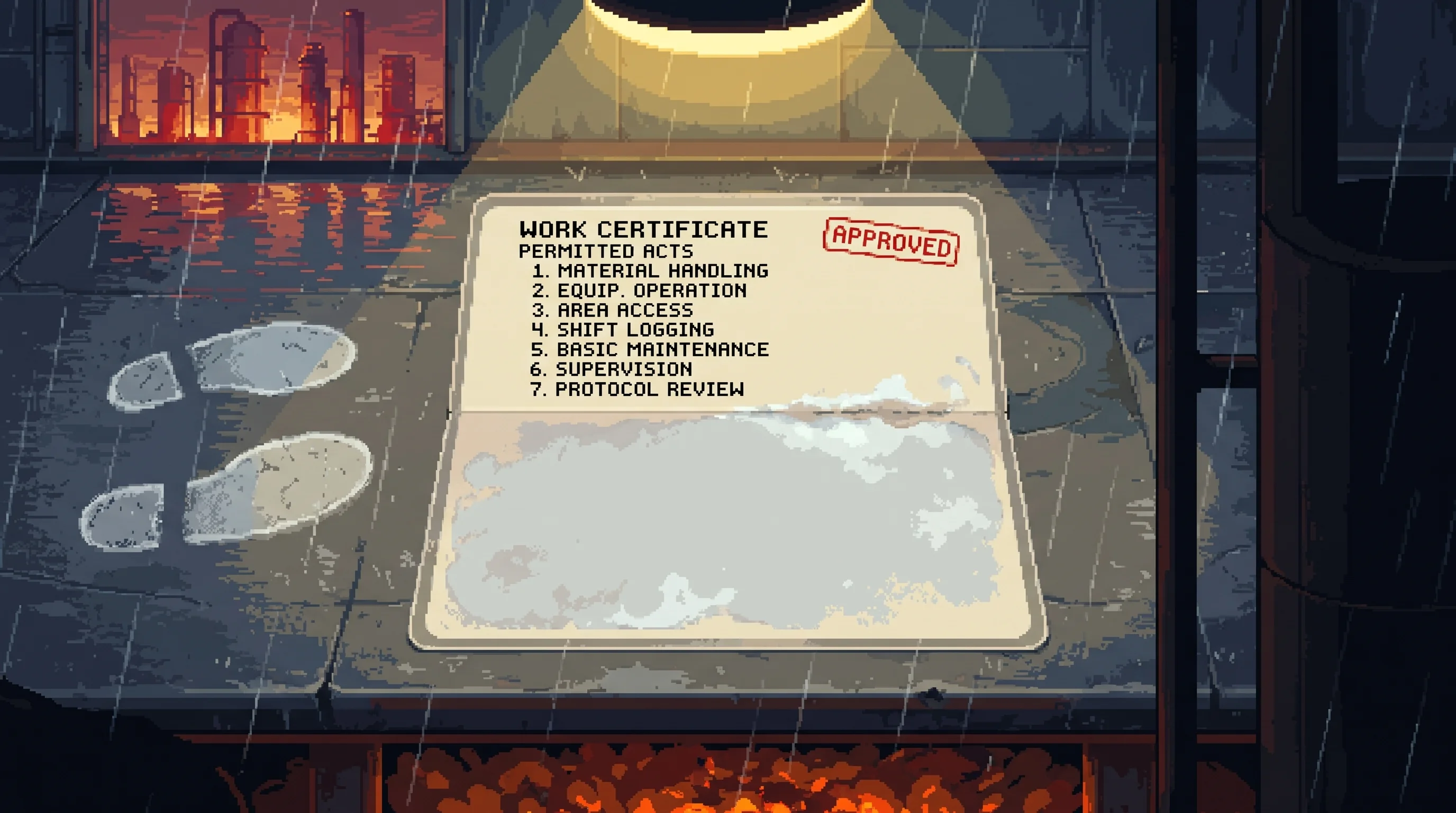
The stripe belongs to nobody, and that unclaimed ground is the whole trade.
An act of care outside your certificate files as a violation, whatever it achieved.
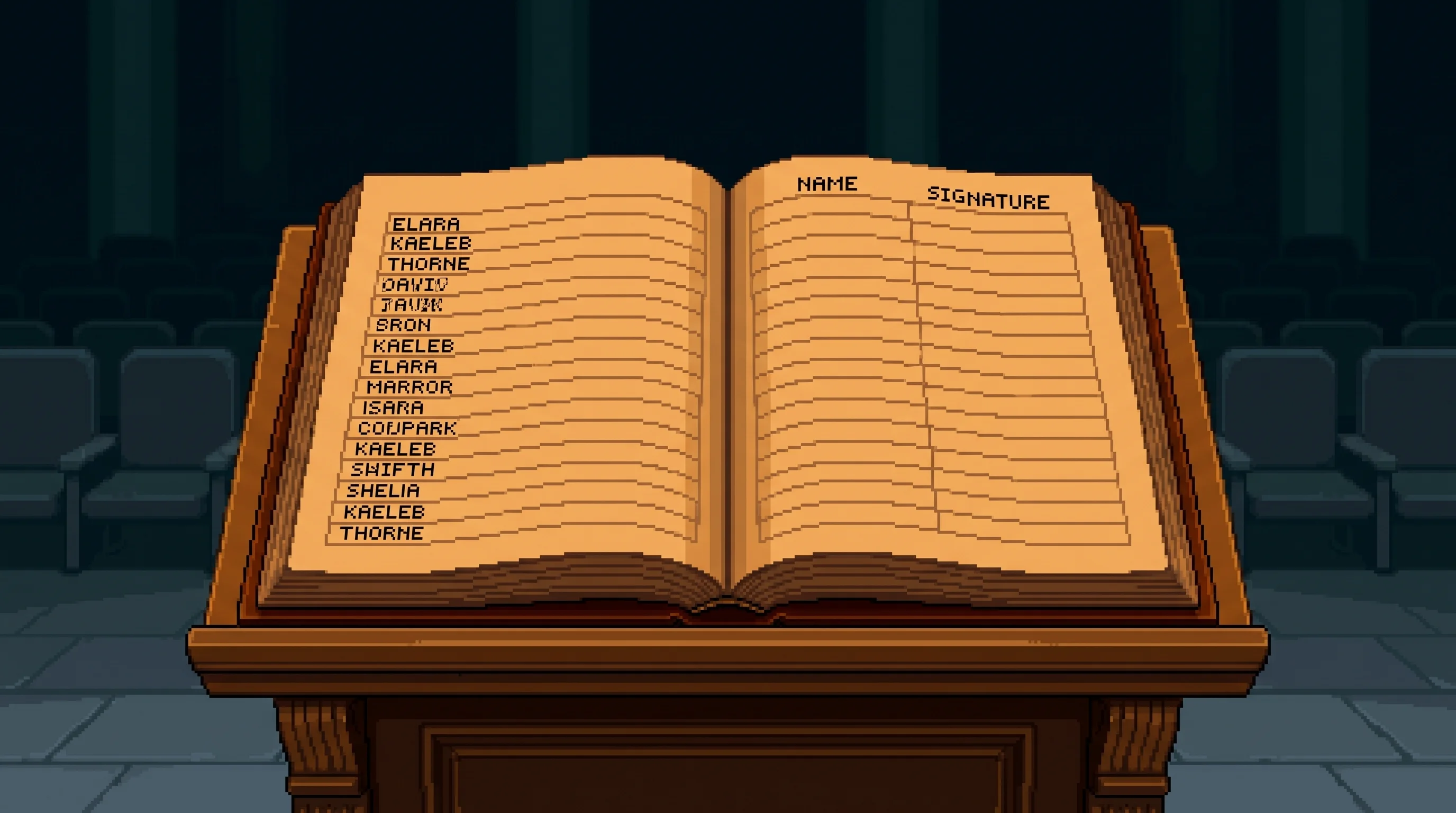
They voted down the reading that would have entered Adeyemi. The stripe belongs to nobody.
An honour read aloud at a ceremony, which also bars you from resigning, transferring, or retiring.
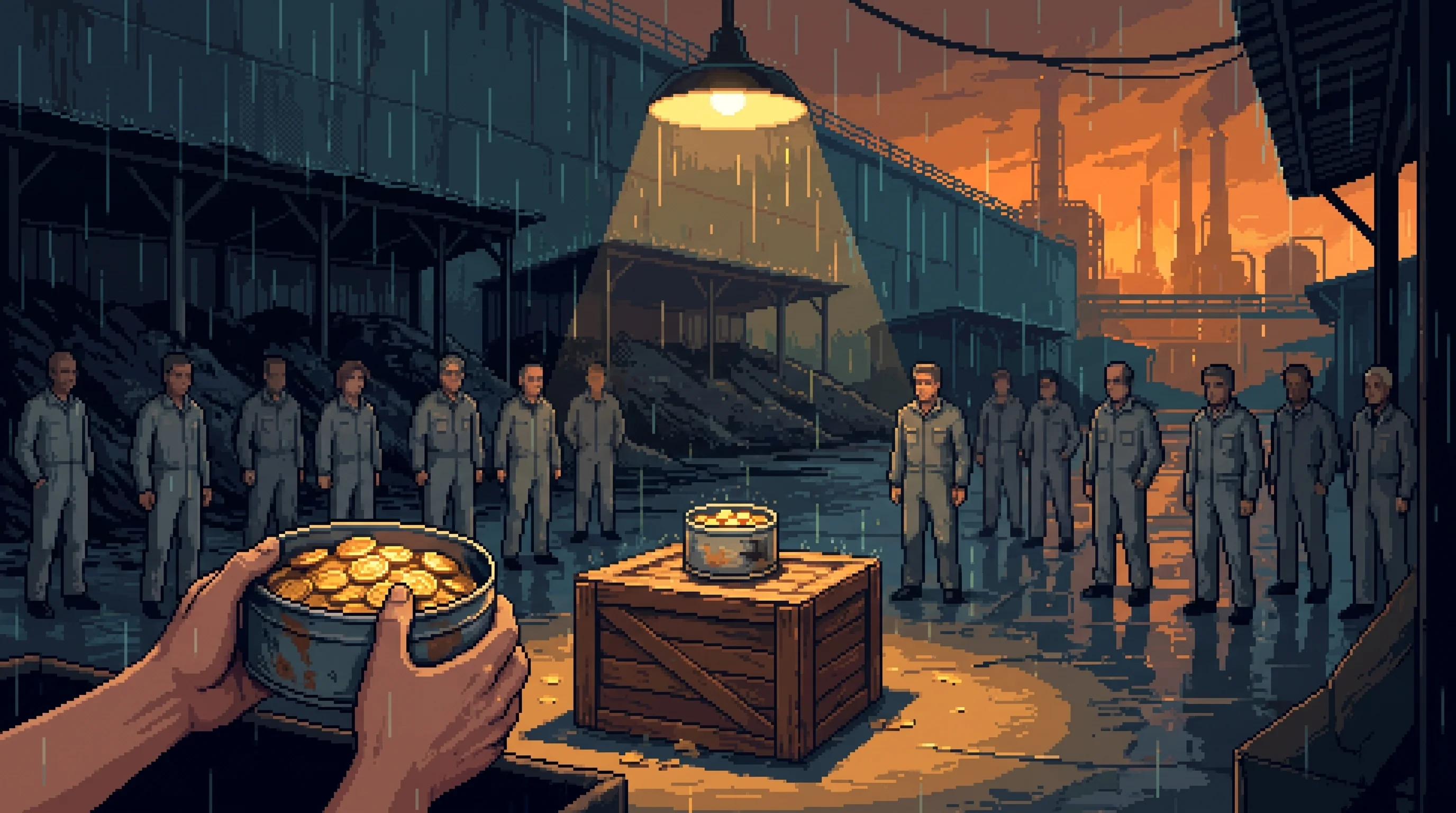
The stripe belongs to nobody. So do hands with no card.
Certified hands hold still and pay somebody with no certificate to do the thing that needs doing.