Tinit
Off-System Human Recommendation Broker
The Human Layer
Referenced as 'the most connected person I know' in an estimated 4,200+ recorded social conversations across fourteen Sprawl strata over eight years, by individuals who demonstrably do not know each other; cross-referencing the accounts produces no consistent neural address, no Wholesome SupplyChainIQ purchase record, and no booking-system entry under any verified identity

Overview
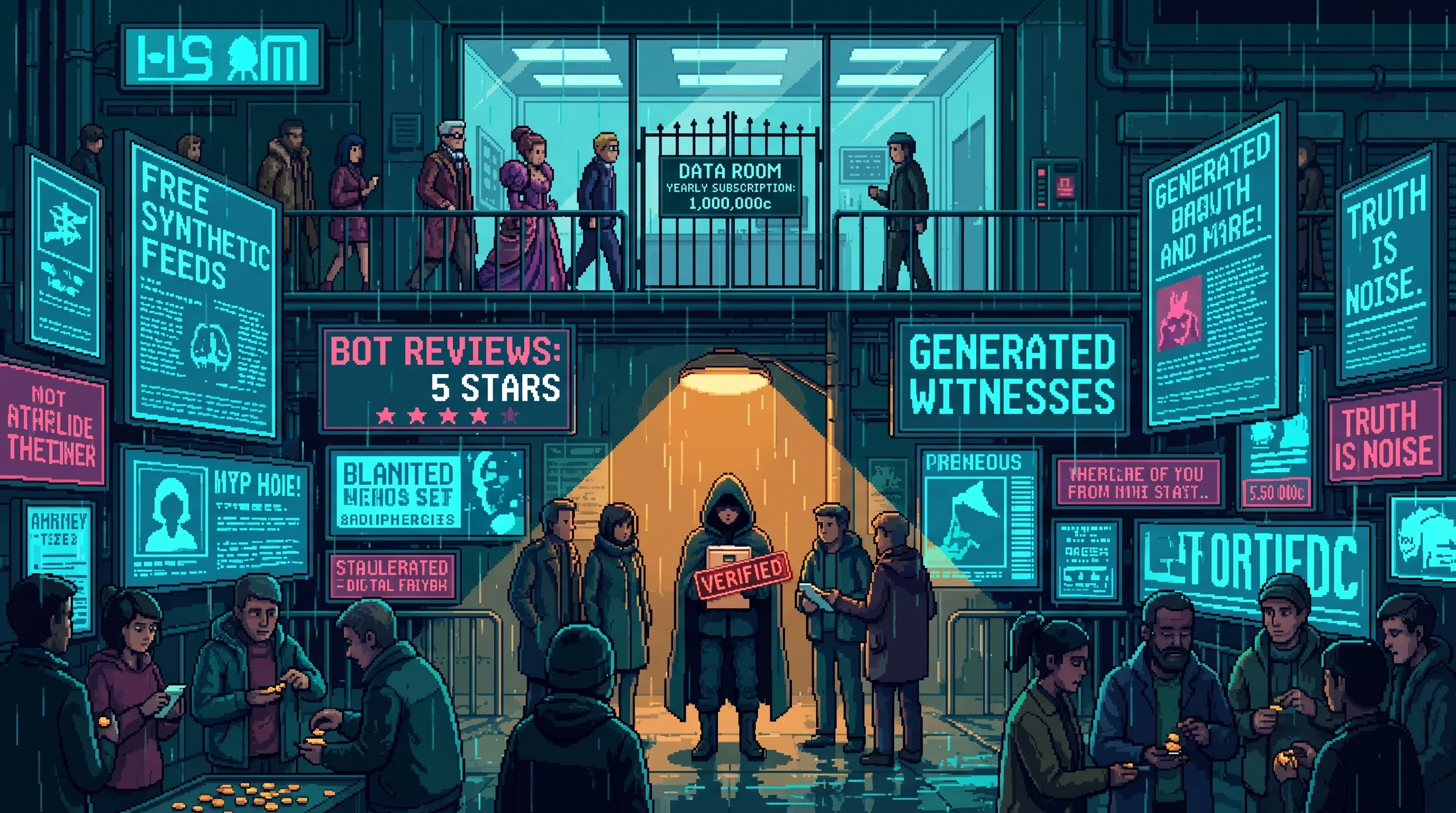
Tinit knows everyone. This is not an exaggeration native to his admirers, though they supply plenty of their own — it is the closest thing to a verifiable fact in a subject file that contains almost nothing else verifiable. He knows the manager at the rooftop place in the Glass District who keeps one table off the booking system. He knows which Deep Dregs noodle cart switched suppliers last week and which one is lying about it. He knows the dish that isn't on the menu, the cook who'll make it, the hour they'll make it, and the name you drop to make it happen. In a city where Wholesome SupplyChainIQ logs every ingredient and AI can manufacture any review, Tinit is the human layer — the trusted source heard from personally that the street still runs on when it has stopped trusting screens. He built it himself. What began as a food-intelligence operation, a verified-recommendation service for people who had given up on the public information layer, grew into something larger and quieter: a distributed web of human trust with Tinit at the center and no copy of itself anywhere outside his own memory.
His neural interface is partial. No fixed address is on record.
Motivations and conflicts
The Empty Plate
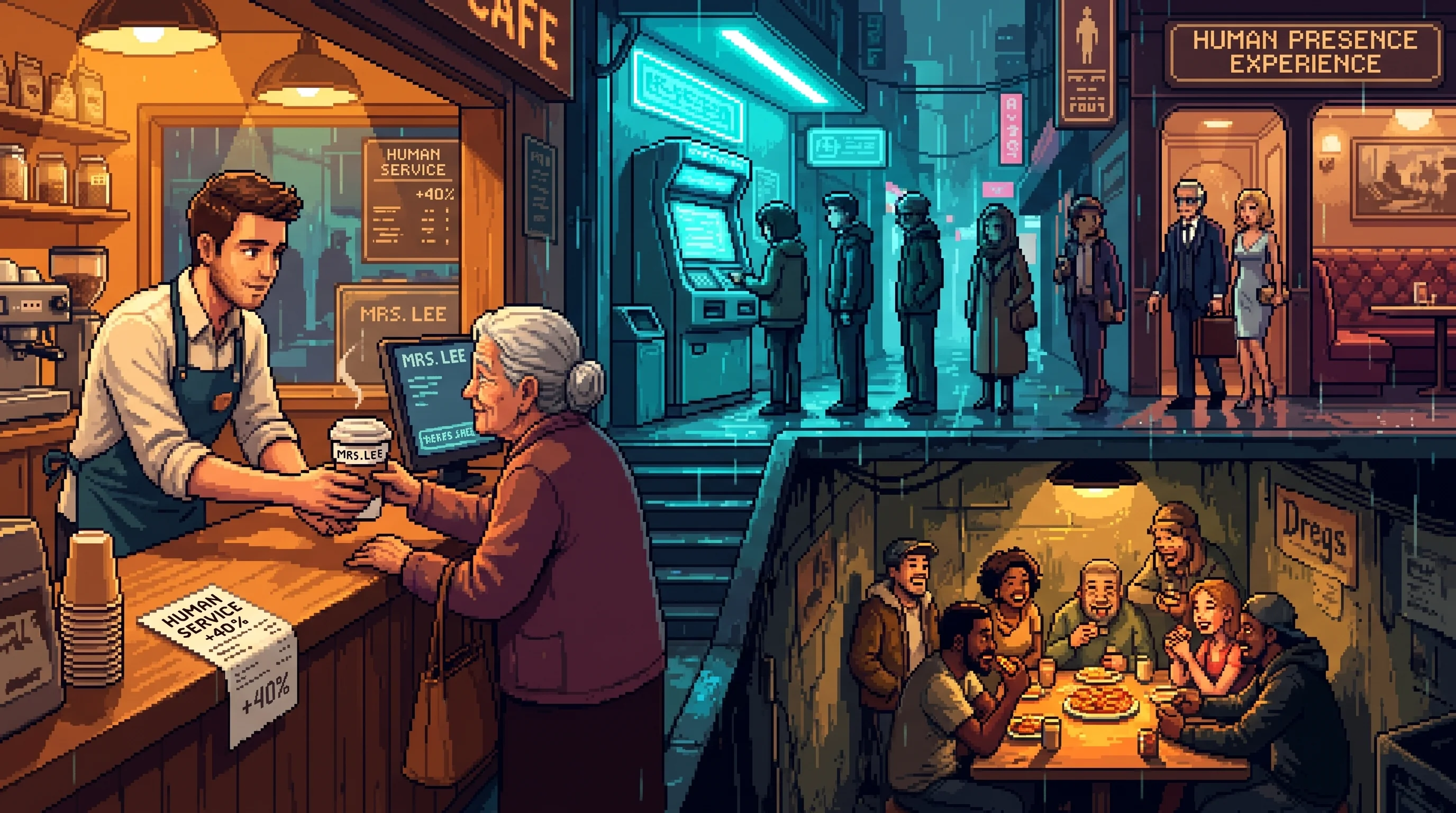
He is also, by every behavioral indicator available, profoundly alone. He is out every night — every venue, every threshold, every doorway angled toward the exit — and he would, by his own rare admission, rather be home. He goes out alone. He sits at the bar alone. He orders for the room and leaves his own plate untouched. He is generous past the point of sense, loyal past the point of safety, and the instant he detects that a friend is not genuine he ends the friendship without a second conversation. He keeps a very small circle and trusts it completely. He is looking — though he would not use the word, and the subject changes if you do — for the one person who might know him the way he knows everyone else. The arithmetic of his life is the arithmetic of the Warmth Tax stated in a single body: the man who keeps the city's human connection alive cannot, for reasons he is still trying to work out, keep any of it for himself.
Appearance

Tinit is an Indian man of twenty-eight, five-foot-nine, broad through the shoulders, built like someone who has eaten at every great table in the Sprawl and somehow stayed sharp. He wears black. All of it, all the time — matte black jacket, black tee, black trousers, the kind of black that has been chosen rather than defaulted into, expensive in a way that refuses to announce the expense. Blacked-out glasses ride pushed up on a clean faded haircut, the fade kept tight enough that someone is clearly maintaining it on a schedule. Every surface on him that could catch and throw light has been chosen not to.
Except one. On his left wrist is a root-beer Rolex — brown and gold, mechanical, the warm tone the rest of him refuses. In a still frame it is the only color in the composition, and the eye goes to it the way the eye goes to a lit window in a dark building. The car key is in his right hand. It is almost always in his right hand. People who have spent real time around him report that the first thing they noticed was the blacked-out everything; the second thing, and the one they remember, was that he was already half-turned toward the door when they arrived — not nervous, just positioned, a reflex he stopped bothering to hide. He carries youthful energy and an old soul in the same body, and which one is in the room depends on whether he thinks anyone is watching.
He wears the analog watch by choice.
Voice
Voice & Mannerisms
Tinit speaks in the past and present tense and almost never the future. He will tell you where he has been with real warmth and a level of sensory detail that makes you taste the dish; he will tell you, generously and accurately, where you should go; he will not tell you where he is heading next, and the attempt to find out is the one thing that cools him. His sentences are short and arrive a half-beat early, as though he heard the end of your question while you were still on the front of it. He answers before you finish. He is usually right about what you were going to ask, which people find either uncanny or comforting depending on what they wanted from the conversation.
He is courteous to staff in a way that is not performance — he knows their names, their shifts, the thing they are quietly good at, the manager they are about to outgrow. He recommends without hedging. When he ends a friendship he does not announce it; the chip simply stops connecting, the seat at the bar no longer has a second stool turned toward it, and the person works out on their own that something genuine had been required of them and was found absent. He does not raise his voice. The closest he comes to anger is going still — the same stillness people mistake for calm — and the people who can read him know that the stillness is the most dangerous weather he has.
"I can get you in. I can't go with you."
"The dish isn't on the menu because the menu is in a database. The dish is in the cook's head. You want the cook's head, you have to be the kind of person a cook tells things to."
"Tell me where you've been. I'll figure out where you should eat."
"Don't tell me where you're going. Just go."
The Network and the No-Name Chip
The operation began as food intelligence. In the years after the public information layer collapsed into AI-generated slop — when no review could be trusted because any review could be manufactured, and no rating meant anything because every rating was someone's paid narrative — a market opened for verified human recommendation. Tinit built into it. He ate everywhere. He remembered everything. He built relationships with the people who actually touched the food, and he charged, at first, for access to what he knew: this place is real, that place switched to Wholesome vat-stock and is lying about it, the third place has a cook worth the trip on the nights she works.
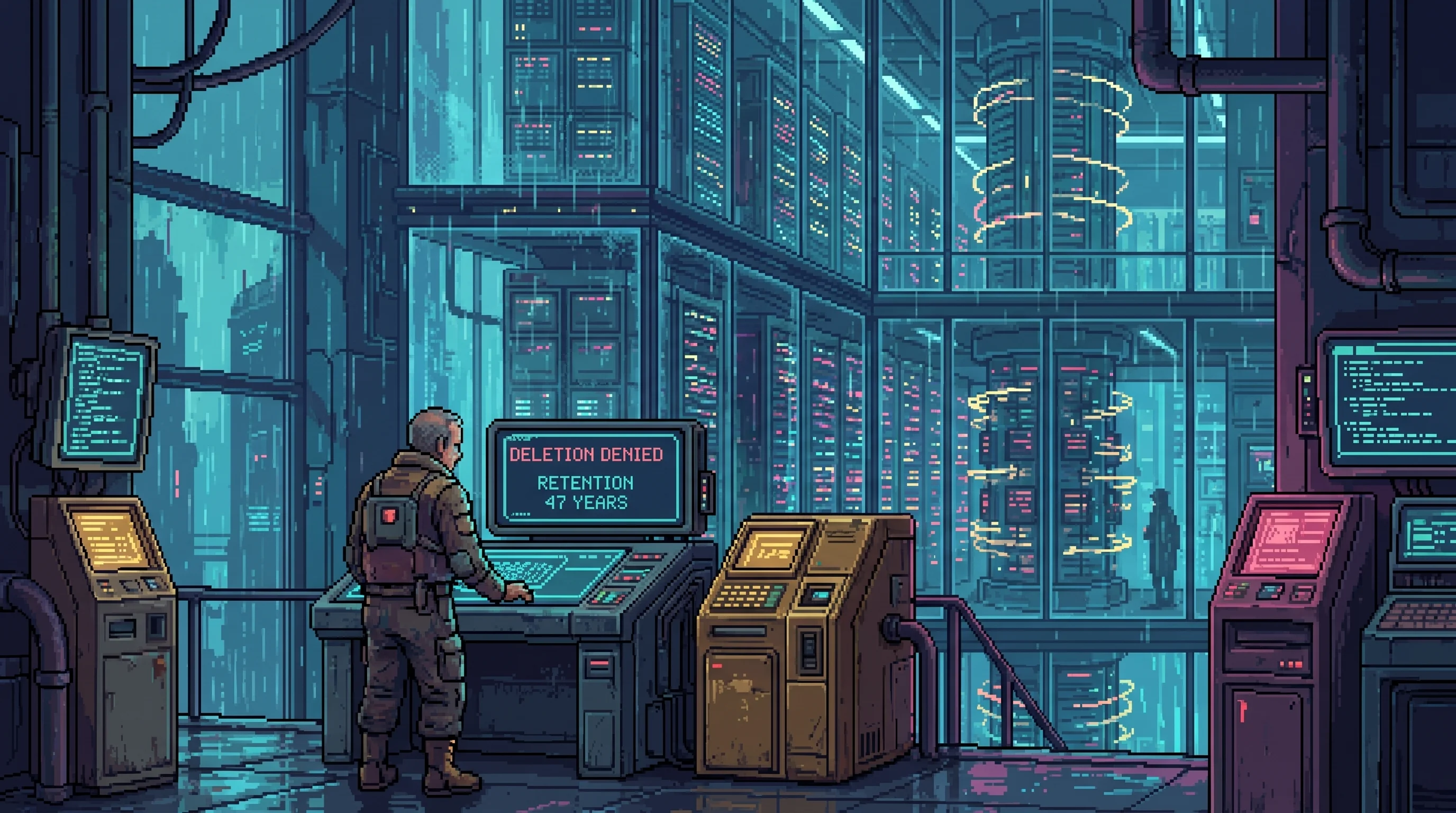
What the operation became is harder to describe and is the reason Tinit appears in this catalogue at all. The recommendations were never really about food. They were about trust under surveillance — the construction of a human web that the corporate information layer could not see, could not log, and could not fake. The no-name chip is the protocol. It carries a routing number and nothing else. It connects outward — to a contact, a table, a fixer, a cook — and never inward, never back to Tinit, never building a record of who asked for what. In a city under the Permanent Record, where every transaction is a confession filed in advance, the chip is a small machine for needing something without being seen needing it. People keep their chips for years. Some keep chips for contacts who have died, because the chip is the only thing they have that proves the contact was once real. None of the chips, in eight years, has ever led anyone back to the man who handed it over.
Tinit never asks clients what they want. He asks where they have been, then tells them where to eat, and he is right. Tell me where you've been. I'll figure out where you should eat. Above the Rim, Counsel Halina Drozd charges for months to help a person find that sentence alone. Tinit's clients have stopped looking. He says he is talking about dinner.
Meaningful places
The Coupe

The car is a fully blacked-out matte coupe — low, fast, every badge and reflective trim deleted, the kind of vehicle that in a surveillance city is itself a sentence spoken out loud. He drives it fast. He drives it faster than the traffic-management layer is built to tolerate, and the layer has responded the only way an automated system knows how, which is to issue citations: 847 of them, unresolved, attached to registration patterns that correlate with the coupe without ever quite matching a single registered unit. The citations issue. Nothing follows them. No collection, no impound, no consequence — a standing anomaly that the relevant enforcement subsystems have flagged, escalated, and quietly stopped escalating, in the manner of a bureaucracy that has decided a problem is cheaper to keep than to solve.
He will not say why he drives like that. It is the second subject, after his destination, that ends a conversation. The motion and the speed and the blacked-out everything are all the same instinct expressed in steel: a man who was once fully visible to someone, and was hurt by it precisely, making himself — at two hundred kilometers an hour, in a car that throws no reflection — extremely difficult to hold still long enough to be known.
The Architecture That Cannot Be Reconstructed
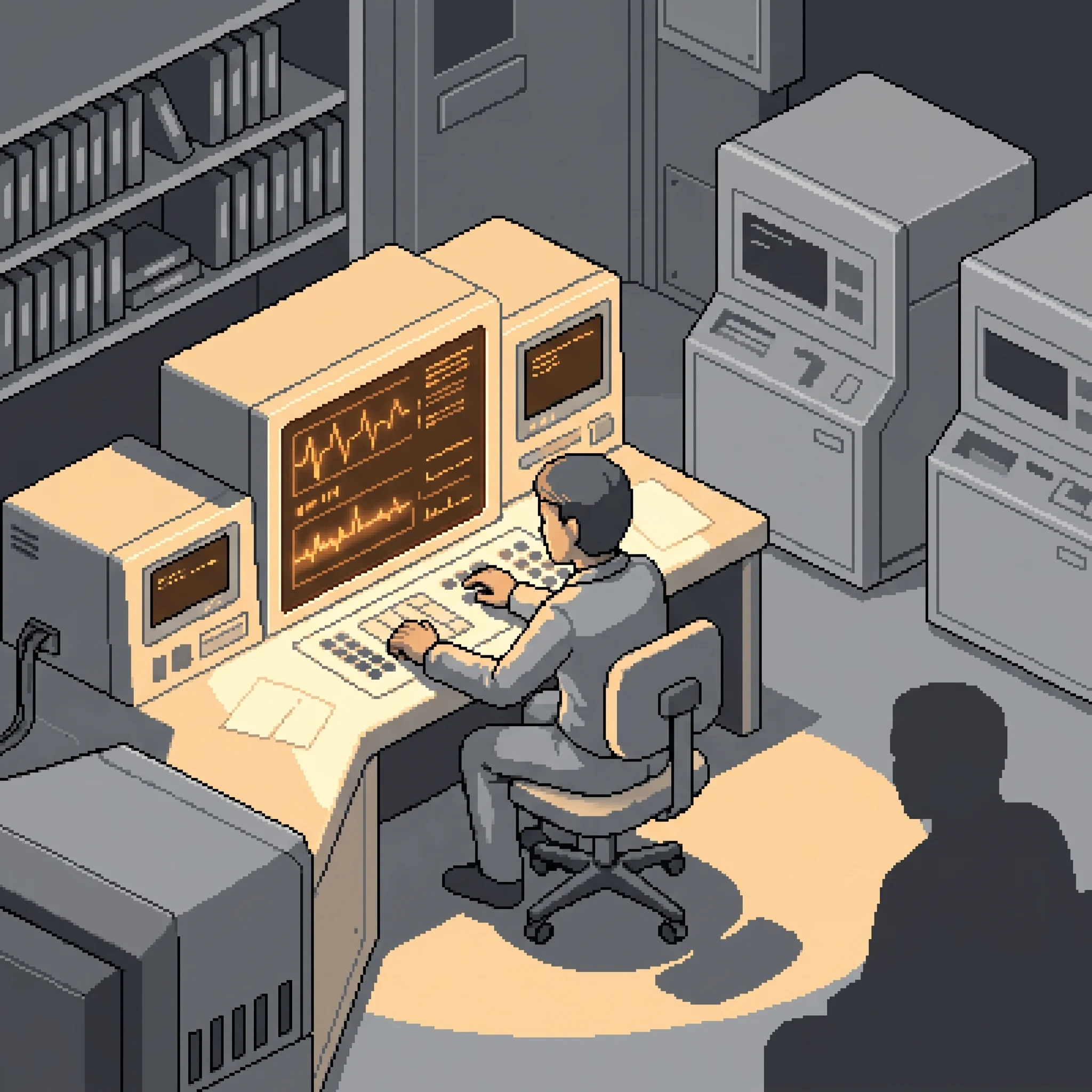
The Reconstruction Accuracy Commission's 2183 methodology review included a test of a borderline case: a subject whose social footprint was extensive but whose personal telemetry was nearly absent. The Commission's benchmark: if the living-subject reconstruction gap averaged 2–9% across standard populations, what was the gap for a subject who appeared in over four thousand documented social conversations across fourteen strata but generated no purchase record, no booking system entry, and no first-person telemetry stream?
The answer was that the reconstruction could not run. There was nothing to read from his side of any exchange. The no-name chip carries a routing number and no name, leaves no trace on either end, and connects outward only — into the network, never back toward the person who handed it over. A Commission algorithm that processes incoming telemetry to reconstruct behavioral patterns needs incoming telemetry. He generates none. His reconstruction gap is not 2–9%. The Verified Recall returns the system's refusal to return a value.
What the Commission found instead, and what their report describes in careful technical language without naming the subject, is an anomalous record structure: a person present in thousands of records, in other people's conversations and contact chips and third-party accounts, but absent from their own. He does not have a first-person archive. He has a second-person archive — everyone else's memory of him, distributed across strata, irrecoverable as a single coherent narrative because every holder has a different piece and none of the pieces point back to him.
The unsettling finding, which the Commission did not know was unsettling: this architecture does not defeat the Verified Recall. It redirects it. The reconstruction cannot be run from his data because he has no data. But it could, in theory, be assembled from everyone else's — four thousand accounts cross-referenced, third-party telemetry triangulated, the outline of a person reconstructed from the gap he leaves in other people's records. A portrait painted entirely in other people's impressions of him. Whether the portrait would be accurate in the way the Commission means accurate — where accuracy is measured against first-person telemetry — is a question the Commission has not answered. They only know that the target subject's behavioral pattern, referenced in over four thousand social conversations, is the most legible human silhouette in the Dregs and the one it is formally impossible to verify against the subject himself.
The Mercy Editors have no service tier for this problem. Their entire practice is calibrating the gap between what people remember and what the archive shows. Tinit's gap runs the other way: the archive has no memory of him at all. There is nothing to calibrate. The one person in the Dregs whose silhouette is the most precisely readable from the outside is the one person the archive cannot reach from the inside. If the reconstruction were ever assembled from third-party accounts alone, the result would not be his memory of himself. It would be the city's.
He would recognize the portrait. He built it deliberately.
Relationships
El Money is the parallel Tinit is most often compared to and most carefully distinct from. El Money owns the underground information layer — the G Nook network, the shadow economy, the data that moves beneath the Sprawl's surveillance. Tinit owns the layer directly above it: the social and dining web, the human-recommendation economy, the trust that operates in restaurants and bars and rooftop tables in plain sight. The two networks do not overlap, and this is not an accident; it is a treaty neither has ever needed to state aloud. El Money has never brokered a dinner table and Tinit has never moved a piece of intelligence, and each is documented to speak of the other with the specific dry respect of a professional who recognizes a discipline he has chosen not to practice. When the two networks must touch — and in a city this dense they occasionally must — they touch at exactly one point and then separate, cleanly, the way two systems built by people who understand the cost of leakage tend to.
The Chef is one of the few people in the Sprawl to whom Tinit can get a message and have it land. He is among the small number outside The Feast who can reach her, and he uses the access for nothing operational — he routes no intelligence about her, brokers nothing of her business, and she has never once had to ask him not to. The food world is his world; she is its warlord; the relationship is the mutual courtesy of two people who take the same thing seriously for opposite reasons.
Status Quo keeps a seat for him that does not exist in its booking system. The proprietor holds it whether or not he comes. Most nights he comes alone, and most nights he sits at the bar rather than the held table, and the held table stays held anyway, which is either sentiment or superstition and which the proprietor has declined to clarify.
The manager who taught him is the relationship the entire network is built on top of and the one Tinit will not discuss. The first person who trusted him, before any of this existed, who ran a place the way Tinit now runs the Sprawl — on handshake and memory and the deliberate refusal to put the things that mattered into a system. That person is gone. The root-beer Rolex is, by long and unconfirmed belief, the watch off that person's wrist. Tinit operates, eight years later, as though the manager is still watching the floor and will, at any moment, check whether the job was done right.
History
What is known about Tinit before the operation is almost nothing, which in his case should be read as authored rather than absent. He surfaced in the Deep Dregs running food intelligence out of the corridor cart scene — verifying which carts were real in a stratum where being lied to about your food was a daily tax. The operation grew upward, cart by table by rooftop, until it spanned strata and stopped being about food at all. Somewhere in the first year there was a manager who trusted him and taught him the shape of the thing. Somewhere before that there was a person who knew him completely and used it to take something from him. The order of those two events, and the gap between them, is the part of the record Tinit has most carefully ensured does not exist.
The chips began early and have never stopped. The coupe and its citations are documented from roughly six years back. The watch appears in every account from the beginning. The only growth curve the catalogue can plot with confidence is the count of people who, asked who they would call to fix an impossible evening, give a number with no name attached and say, with a confidence the narrator finds genuinely moving and slightly unnerving, "he'll know."
Open Mysteries
- What was taken from him, and by whom. That he was once fully known and was hurt by it is the load-bearing fact of his psychology. The details are not in any record, and the people closest to him do not have them either.
- Whether the watch was the manager's. Believed, repeated, never confirmed. He checks it constantly and explains it never.
- Why the citations never resolve. A man with 847 unanswered traffic violations should, by any model of how the enforcement layer works, have ceased to be able to drive years ago. He drives.
- What he is actually looking for at the bar. He goes out alone, sits alone, orders for the room, eats nothing, and goes home. He would call it nothing. The narrator does not believe him.
Connections
Follow the people and places connected to Tinit.
People

Other connections


Places
Other connections


Tensions
Core tensions

Supporting connections





Additional artwork
View 2 more images of Tinit and their world


Historical artwork
Earlier depictions and related artwork.