The Boalt Docket
Cognitive Debt Defense Clinic
Four Hundred And Twelve Losses
A free contract-literacy and cognitive-debt defense clinic operating from the ruins of UC Berkeley's law school in Sector 11's Free Quarter, founded in 2181 by Elena Sarkisian, a former Good Fortune Legal Innovation Division associate
Visual Identity
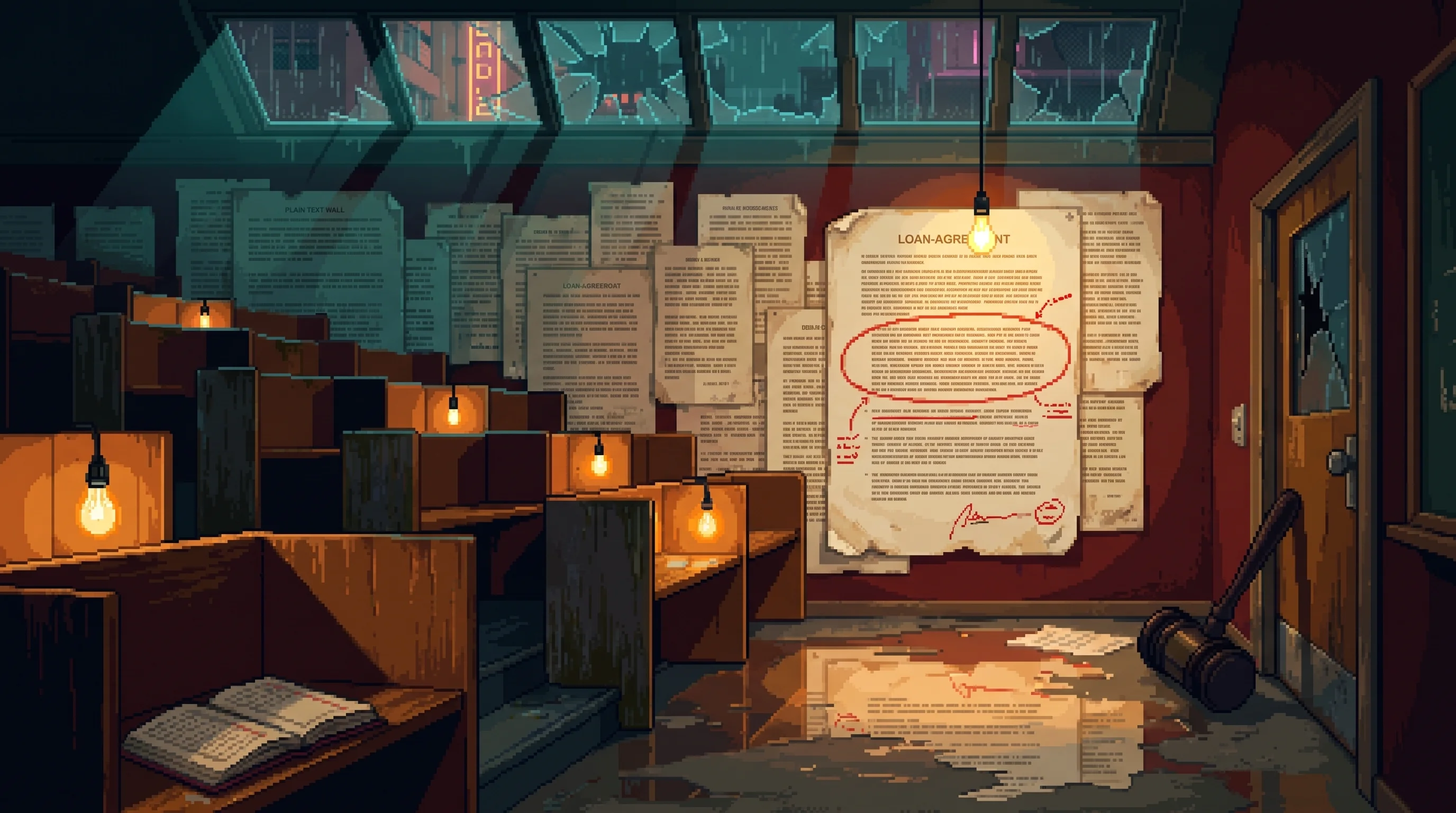
- Reading room
- Walls papered floor to ceiling in enlarged loan agreements, the load-bearing clauses circled in red.
- Moot-court chamber
- The bench rail is missing. A moot-court gavel serves as a doorstop.
- Intake desk
- A clerk reads a loan agreement aloud, clause by clause, before anyone signs it.
- Color palette: Oxblood law-leather red, aged manila-folder tan, correction-fluid institutional white
- Compositional mood: A law school that lost its funding and kept its conviction — cramped, papered, argued over, losing on principle and continuing anyway
- Key symbol: A wall of enlarged loan-agreement text with the load-bearing clause circled in red
- Lighting: Broken clerestory daylight by day, one scavenged bulb per carrel by night
Overview
Elena Sarkisian wrote the clause. She was twenty-seven, two years out of Fortune Institute, and Good Fortune's Legal Innovation Division had just been handed a mandate: give the new Cognitive Lien a transmission-timing parameter that would survive a compliance audit without ever specifying a number the audit could hold the corporation to. Sarkisian drafted subsection 12(c) — the clause authorizing the creditor to "adjust transmission timing parameters as required by market conditions" — as elegant boilerplate, the kind of sentence a junior associate is proud of because it does exactly what it's asked and nothing it could be blamed for. She filed it in 2179. She did not think about it again for two years.
Then she watched a compliance review invoke it against a debtor whose file she happened to be auditing, expanding a routine 340-millisecond diversion window to the maximum 1,200 milliseconds authorized in her own paragraph, and nobody in the room used the word she'd have used if she'd still been the associate who wrote it. She resigned that quarter. By the end of 2181 she had three other defectors, a gutted lecture hall in the ruins of UC Berkeley's law school, and a name for what they were building: the Boalt Docket, after the building whose bones they'd moved into.
The Docket does two things, and does neither of them well by any metric Good Fortune would recognize. It teaches contract literacy — walk-in hours where a clerk reads a loan agreement aloud, clause by clause, before anyone signs it, free. And it files Habeas Cognita motions: petitions, argued inside Good Fortune's own arbitration system, demanding that a human compliance officer personally attest under oath to the exact transmission-timing figure used against a specific debtor before a repossession may proceed. Four hundred and twelve motions since 2181. Zero repossessions overturned. Fifty-eight stays granted, averaging nine extra days of un-throttled cognition before the Dimming resumes. The Docket keeps filing anyway, on the theory — never proven, never abandoned — that a forced human signature is worth more than a percentage.
Conditions Report
| Sense | Detail |
|---|---|
| Sound | A clerk reading a loan clause aloud at intake-desk volume, the specific cadence of someone translating legalese in real time. Wind through cracked clerestory glass. The scratch of red ink annotating a printed page. |
| Smell | Old paper and machine toner, eucalyptus drifting down from the ridgeline, the mildew of a hillside building that has not had working climate control since the Cascade. |
| Sight | A lecture hall wallpapered floor to ceiling in enlarged loan-agreement printouts, red circles around the clauses that matter, a moot-court gavel doing service as a doorstop. |
| Touch | Cold salvaged library carrels, the specific grain of paper that's been photocopied past the point of crispness, a docket ledger whose spine has been reglued twice. |
| Temperature | Cool and drafty — a ruin holds the hillside's temperature, and the reading room's regulars keep their coats on past noon. |
The Motion That Never Wins
A Habeas Cognita filing does not argue that the debt is unowed. It argues something narrower and, so far, exactly as unwinnable: that the Repossession Protocol cannot reduce a specific person's mind without a named human first swearing, on the record, to the transmission-timing parameter that made the diversion possible. The Protocol's four stages run on a four-minute administrative procedure — Notice, Grace Period, Dimming, Sustained Reduction — and the Docket's entire practice is built around forcing a fifth, unscheduled stage into that sequence: a sworn attestation the arbitrator is not required to grant and, in four hundred and twelve tries, has granted only as a stay, never as a reversal.
The arbitrator is not neutral in any sense a public court would recognize. Good Fortune's own arbitration rules are the only venue the Docket is permitted to file in, and those same rules let the corporation designate a habitually unsuccessful advocate a "non-cooperative filer" — barred from further submissions for eighteen months after three motions found to lack "commercial merit." Six of the Docket's nine staff attorneys currently carry the designation. Sarkisian rotates barred attorneys' casework under clerk credentials to keep filings moving, a workaround that would itself qualify as grounds for the designation if anyone at Good Fortune's compliance office cared to look closely enough to notice, which so far nobody has.
The Subsection She Wrote
The Cognitive Lien's secrets have always included one Good Fortune has never had to defend in open testimony: the 340-millisecond transmission window authorized in the standard agreement is not a technical constant but a configurable parameter, adjustable up to 1,200 milliseconds at the creditor's discretion under the paragraph Sarkisian wrote. She has never produced her original drafting memo. She cites the figure in nearly every filing anyway, on the strength of having been the one who typed it, and Good Fortune has never once challenged her authority to cite it — which the Docket's staff read as confirmation and Good Fortune's silence declines to confirm or deny.
The Docket teaches this fact to every apprentice on their first day, alongside the Plain Text Wall: a bank of oversized printouts translating standard loan agreements into a reading level a throttled mind can still follow, because the debtors the Docket serves are frequently mid-Dimming by the time they find their way to the reading room, and dense legal prose is exactly the capacity the Repossession Protocol has already taken from them. A clinic built to make fine print legible has to first make its own fine print legible to the people the fine print already damaged. Nobody on staff considers this ironic anymore. It is simply the job.
The Hillside Referral
Two ridgelines over, the Unwinding Clinic runs a firmware wing that helps augmented people step down a generation of dependency — the mirror problem to the Docket's, worked from the mechanical end instead of the contractual one. A downgrade candidate whose firmware the Unwinding Clinic manages to safely reduce frequently discovers, partway through the process, a cognitive lien nobody ever read aloud to them; the Docket takes the case from there. The Docket, in turn, refers clients whose augmentation dependency is the real trap underneath their debt back across the hillside. Neither clinic charges for the referral. Neither expects the other's failure rate to improve. They are, as the ruins' independent researchers put it to each other without much drama, fellow travelers in the same losing trade.
The Desk That Pays For It
A third door off the entrance hall leads to the attendance desk. It pleads the one ground the Vacancy Register will hear: somebody briefly left the room. The desk is the clinic's largest source of income. Two of the nine volunteers will not staff it. Sarkisian says the desk is why the reading room is warm.
The Bench That Cannot Refuse Her
Four sectors east, the Speaking-Pace Docket hears anyone for free, barred attorneys included. The clinic is unbeaten there. Its rulings attach to lien schedules that were reissued on day two of argument. Sarkisian keeps that tally beside the 412 and will not publish it. It would read as a record of success. She calls Chief Registrar Solveig Nwaneri the most honest official in the district, and says her hall should be closed. Nwaneri has not disputed either half.
Under the Conservation Ground, the clinic finally gets a named human under oath. Constance Ilori answers every question about the paper sheet, honestly. The lien lives in the text. Sarkisian's margin book has one undated line: We asked for a human with a name. They sent one who tells the truth.
Field Observations
The Question Keepers file every unresolved Habeas Cognita transcript as a card. The Docket's losses are, structurally, exactly the kind of unasked question the Keepers exist to preserve — a compliance officer declines, under oath, to state a number, and the arbitrator declines to require one, and no automated system anywhere in the Sprawl was ever prompted to investigate why. The Keepers do not file the wins. There have not been enough to matter.
The Time Debt investigation treats three years of Docket transcripts as its densest single archive of primary testimony — not because the motions succeed, but because a debtor's sworn account of exactly how their cognition narrowed mid-hearing is evidence the Keepers cannot get anywhere else. A losing filing that names the precise unanswered question is still, by the Keepers' own standard, a preserved fact.
Maren Qian has never set foot in the Free Quarter, and the Docket has never filed a motion naming her personally — the Prosperity Architect designs products, not repossessions. But orientation for new clerks opens with an unattributed, heavily annotated printout of a Horizon Line disclosure schedule: shrinking payment on page one, total obligation on page four. Three staff attorneys have independently traced the design back to Good Fortune's Senior Prosperity Architect. None of them has ever corresponded with her. The printout stays on the wall regardless.
Affiliated Entities
- The Question Keepers: Preserve the unanswered transmission-timing question behind every failed motion, one paper card at a time.
- The Time Debt investigation: Draws its densest transcripts from three years of Docket filings — losses that still count as evidence.
- The Repossession Protocol: The Docket's entire practice exists to force a sworn human signature into the Protocol's four-minute automated sequence.
- The Cognitive Lien: Built on the unconfirmed fact that its transmission window is a dial, authored by the person who now argues against it.
- Good Fortune: The only court the Docket may file in, and the corporation that bars its own arbitration's most persistent advocates from filing further.
- The Unwinding Clinic: A hillside neighbor and referral partner — dependency resolved there often surfaces debt resolved here, and back again.
- Maren Qian: An unwitting subject of orientation material she has never seen, designed by a person she has never met.
Restricted Access
The missing memo. Whether Sarkisian retained her original subsection 12(c) drafting file — the document that would prove the 1,200-millisecond maximum beyond citation — has never been settled inside the Docket, let alone outside it. She has been asked directly twice, by two different apprentices, in two different years. Both times she changed the subject before answering. If the memo exists, producing it would end four hundred and twelve filings' worth of ambiguity in the Docket's favor and very possibly end Sarkisian's ability to practice at all, under whatever theory of confidentiality Good Fortune's counsel would invent for the occasion. If it does not exist, the Docket's central leverage has been a bluff since 2181, and the four hundred and twelve motions have worked, when they've worked at all, on the strength of nobody at Good Fortune wanting to call it.
The rotation. Sarkisian's practice of filing barred attorneys' motions under clerk credentials has never been detected by Good Fortune's compliance office, or has been detected and tolerated because the alternative — actually enforcing the non-cooperative designation to its logical end — would require Good Fortune to explain, on the record, why nine people keep losing on the same unanswered question.
Habeas Intelligibilis
In October 2183, Sarkisian filed a motion she had been drafting since the first tier 3 verdict came through the reading room's door.
Habeas Cognita demanded a human to attest to the numbers before a repossession could proceed. Habeas Communitas demanded recognition of community as a cognizable legal entity. Habeas Intelligibilis demanded the verdict itself — in a form the defendant could read, before enforcement could proceed. The argument: a defendant cannot meaningfully participate in their own defense, enter a knowing waiver of appeal rights, or understand the grounds for future filings when the verdict explaining those rights runs to 214 certified pages of inference chain that no human can follow.
The arbitrator dismissed the motion in four minutes. No jurisdiction. Good Fortune's rules do not recognize cognitive accessibility as a prerequisite for enforcement. The arbitrator cited the existence of The Verdict Glossers' licensed service as evidence that readable access was available, whether or not the access was accurate.
Sarkisian filed thirty-three more Habeas Intelligibilis motions in 2183. All dismissed. All four minutes. The arbitrator cited the Gloss service each time. The Gloss service's acknowledgment disclosure — this is not a verbatim translation — appeared in the dismissal docket once, footnoted, without comment.
The Docket's seminar wing has a new section, added in November 2183: nineteen enlarged pages from The Tiered Adjudication System's tier 4 verdict output, scaled to 48-point type, wallpapered floor to ceiling. In the center, circled in red, a single inference-step formula that none of the Docket's nine attorneys can parse. New-clerk orientation now opens with a question written below the red circle: If you cannot read the sentence that condemned your client, is it a sentence?
The wall does not answer. The wall is the question.
Sarkisian has drafted a fourth variant arguing that the Gloss service agreement's own disclosure constitutes an admission that the system produced a verdict requiring an acknowledged fiction to function as due process. The draft runs to eleven pages. She has revised it twice. She has not filed it. She is not certain whether the argument is too strong or not strong enough. Both possibilities keep her from filing it.
Habeas Communitas
There is a second body of work at the Docket that does not appear in the Habeas Cognita ledger — two motions filed and dismissed in 2182, styled as Habeas Communitas, that Sarkisian invented in the same gutted lecture hall where she invented everything else.
The argument: that the systematic, algorithm-driven dissolution of a legally assembled community constitutes a cognizable harm, and that the dissolved community has a right to demand, in Good Fortune's arbitration system, that a named human administrator personally attest to the specific reassignment criteria applied to the named plaintiffs before the next Allocation cycle may proceed.
The motion was built on a genuine mathematical discovery: the managed-sector refresh pattern is not random. The intervals are optimized, and the optimization criterion is legible if you know what to look for — maximum disruption to social cluster formation at minimum administrative overhead. Two plaintiffs, a coalition of twelve managed-sector residents, filed statistical analysis proving it. The math was clean.
Both motions were dismissed in four minutes. Good Fortune's arbitration rules do not recognize communitas as a cognizable legal entity. The brief period of common residence, the rules held, does not create a legal relationship that can be harmed. You can be harmed. Your neighbors cannot be harmed as your neighbors in any forum the rules recognize.
The zero-win record for Habeas Communitas is not the same as the zero-win record for Habeas Cognita. The Cognita motions lose because Good Fortune owns the court. The Communitas motions lost because the law was written before anyone imagined the thing being done. Sarkisian has not refiled. She has drafted the third motion twice and abandoned it twice. She is not sure whether the argument is wrong or whether she is afraid to know it is right and still unwinnable.
Further connections
Browse all 28 connected records

The clinic's other venue, four sectors east: free to file, barred from refusing a filing on merit, and unable to bind a schedule that reissues every nineteen hours.
The free hall that lets anyone finish their sentence, then rules on a document replaced while they spoke.
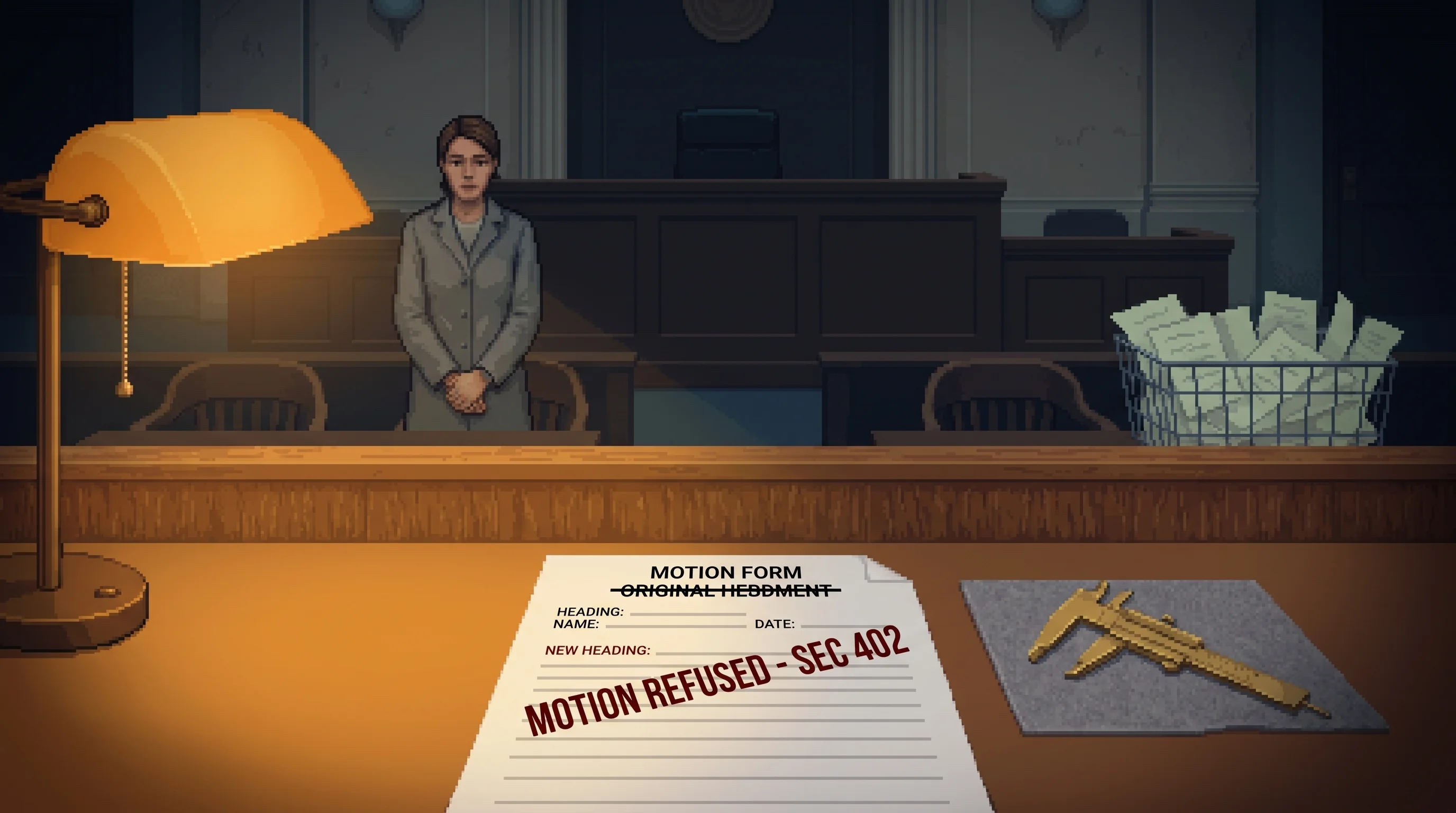
Files motions to inspect under it, for nothing, and can recite both clauses and the order they were passed in — including why each was right.
Ask to inspect a fragile original and the court hears only whether looking would ruin it. It would. The copy governs.

Filed 34 Habeas Intelligibilis motions in 2183 — arguing unreadable verdicts prevent meaningful defense. Zero reversals.
Five-tier AI court network where upper tiers honor appeals with certified-correct verdicts no human can follow.

The registrar who hears the clinic's Article 6 filings, and the one official Sarkisian calls honest.
She runs a free court with good tea, lets every petitioner finish, and made one ruling stick, in 2166.

The one office that will hear the clinic, on the one ground the clinic did not want to learn.
The one office where you may challenge a ruling, on one fact: was the chair empty? Everything else is weighed.

Cross-examined four times without one overstatement; greeted by name downstairs.
She keeps a wall of sheets that may not be opened, and is the one witness asked what they can survive.

Every motion Good Fortune answers without a number becomes a card: the Keepers preserve the specific transmission-timing question the Docket keeps asking and the arbitrator keeps declining to require an answer to
An unnamed, leaderless network preserving 4,200 hand-written cards nobody thought to ask an AI.

Three years of arbitration transcripts are the investigation's densest primary source — a losing filing that names the exact unanswered question is still evidence, and the Keepers file every one
A Question Keepers investigation into cognitive debt that keeps compounding after the debtor is dead.

Turns a four-minute automated dimming initiation into a multi-week arbitration fight by demanding a named human, not an algorithm, personally attest to the numbers before Stage 3 begins
Good Fortune's four-stage procedure for shrinking a defaulting borrower's mind to fit the interest.

Built by the associate who drafted the clause it now argues against, on the unconfirmed fact that the Lien's 340-millisecond transmission window is a dial, not a constant
A legal claim that diverts your best thoughts to a creditor before you consciously have them.

The corporation's own arbitration rules are the only venue the Docket may file in, and Good Fortune has used those rules to bar six of nine staff attorneys from further submissions rather than confirm the one number the Docket keeps asking for
The megacorporation that finances the Sprawl's consumer debt behind red envelopes and lucky numbers.

A downgrade candidate who successfully steps down a firmware generation two ridgelines over often surfaces a lien nobody had read aloud to them, and casework crosses the hillside in both directions
A Berkeley-ruins collective that does the one thing no market will sell: reduce a dependency instead of renewing it.

Orientation opens with an unattributed printout of a Horizon Line disclosure schedule — three staff attorneys have independently traced its design back to the same Prosperity Architect, none of whom has ever met her
The Good Fortune designer whose loans satisfy at six months and default at three years — and she means every word.
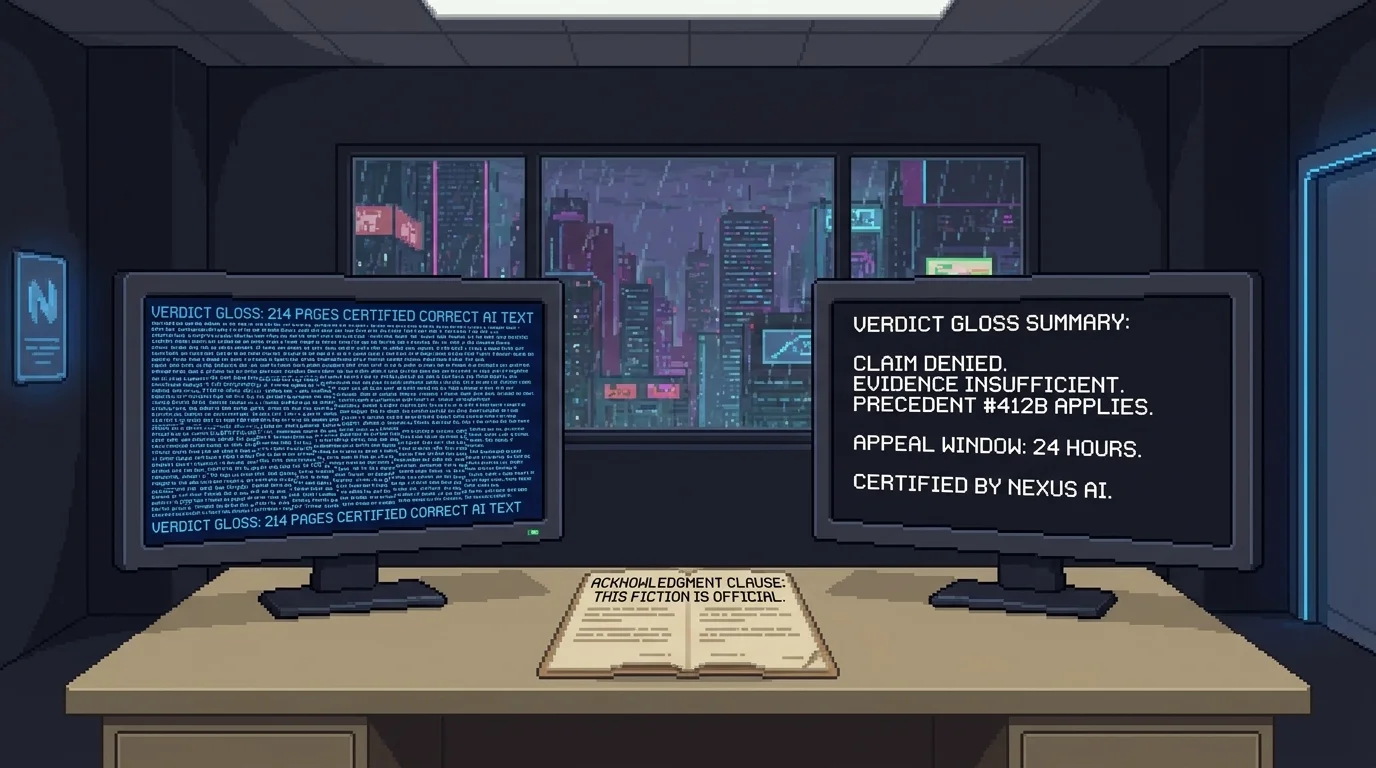
The Docket demands verdicts be readable before enforcement; the Glossers exist because that demand keeps failing. The court cites the Glosser service against the Docket's motions — using the acknowledged fiction as evidence of due process.
Licensed practitioners producing acknowledged-fiction summaries of AI court verdicts — the service agreement says so.
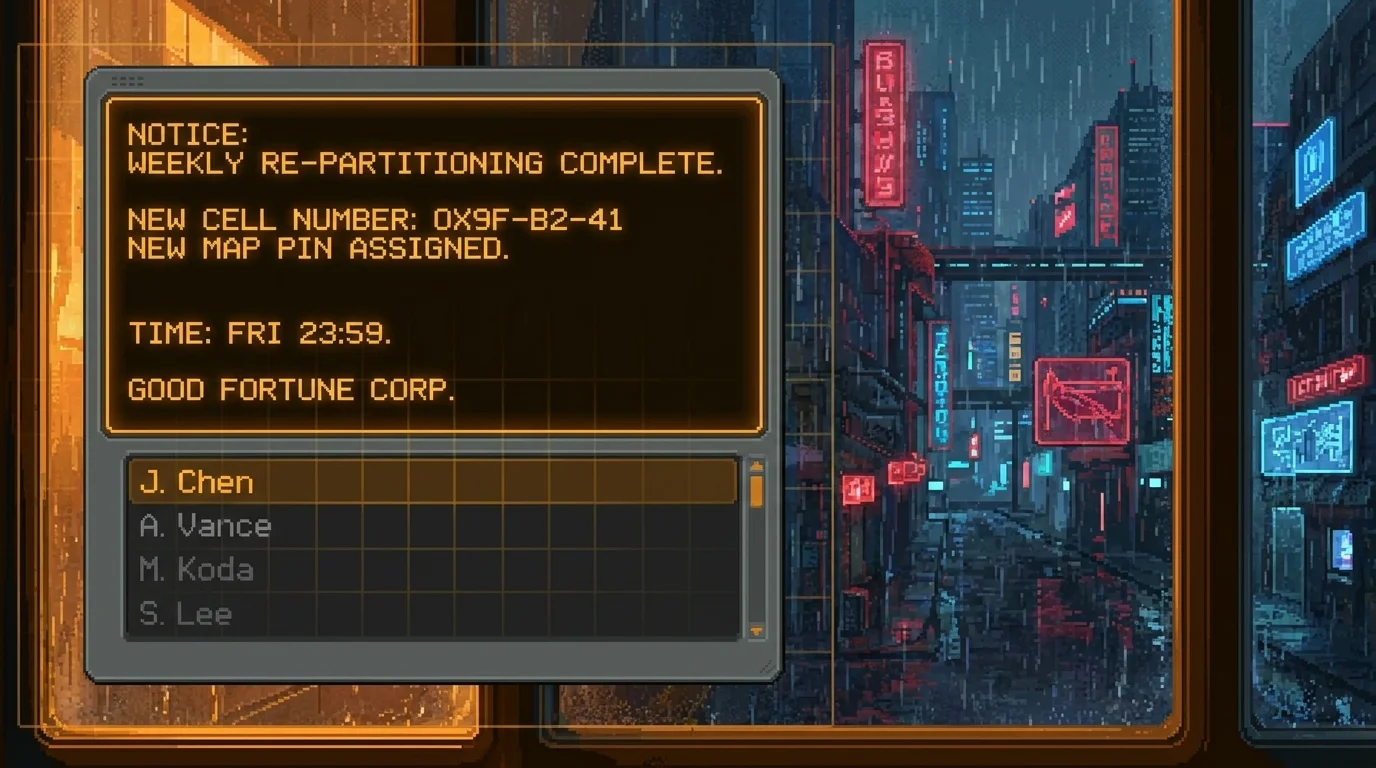
The Docket's two Habeas Communitas motions directly challenged Allocation's reassignment criteria; both were dismissed in four minutes — Good Fortune arbitration rules do not recognize communitas as a cognizable legal entity
Eighty years of peace, achieved by re-shuffling everyone before an 'us' could cohere.
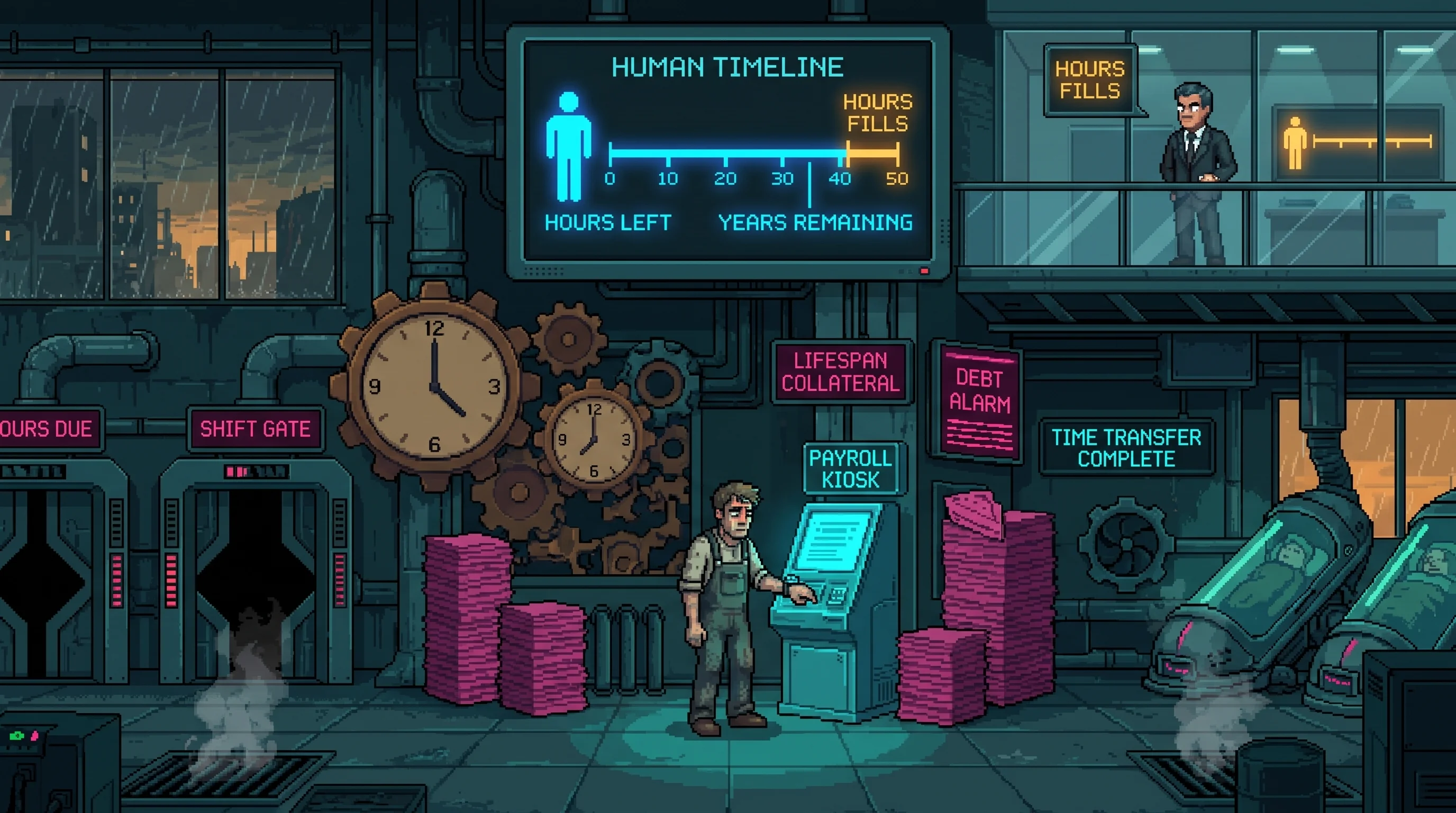


The clinic that spent 2183 demanding readable verdicts and kept being answered with 11.4(a) — proof, the arbitrator held, that where reasons were mandated the reasons turned out to be sound.
Every refusal arrives with its full, honest reasoning, written so you can follow it, and so you rarely appeal.
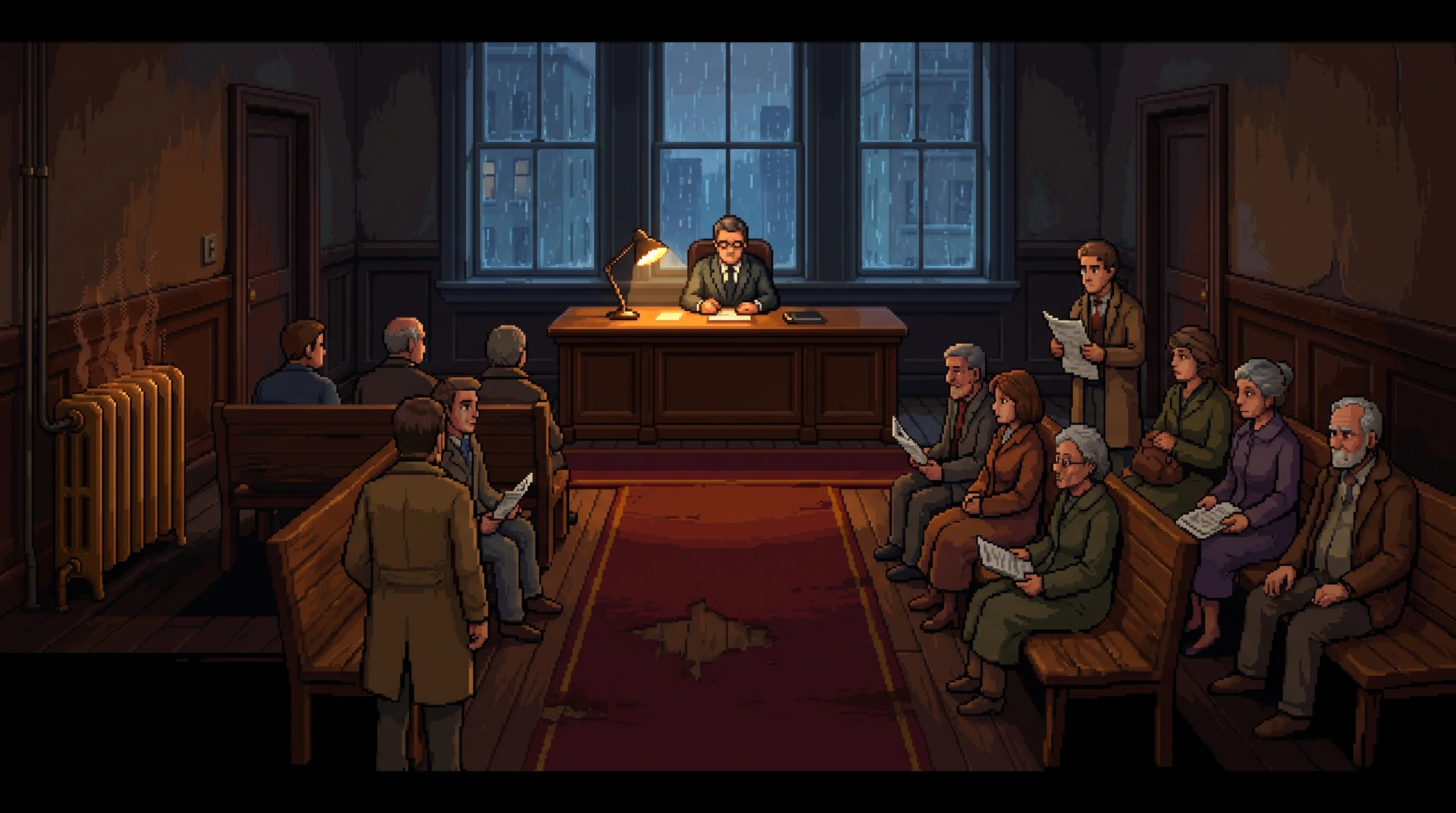
The clinic that files into it. Four hundred and twelve motions lost on the merits upstairs, and a standing Article 6 practice downstairs that has never lost one, because a mooted ruling is not a loss.
The hearing is free, unobstructed, open to anyone — and the thing it rules on is reissued while you are still talking.

Who files the motion to inspect, for free, knowing the ground it will be heard on and the odds it carries there.
The published text governs, and the only thing that could contradict it is a document that checking would destroy.
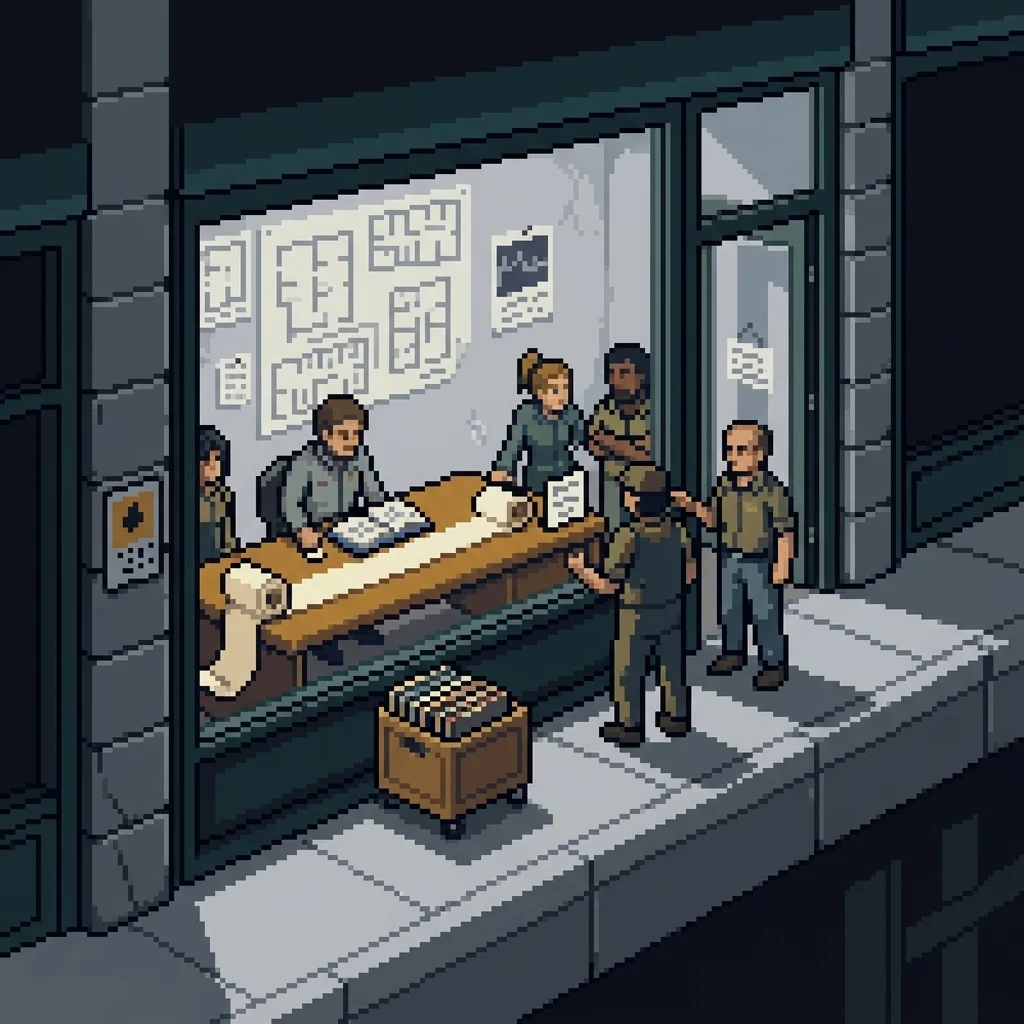
The clinic pleads the merits for free and loses, then funds itself from an attendance desk doing the Bar's work badly.
The licensed trade that wins appeals by proving a chair was empty and never learns what a case was about.
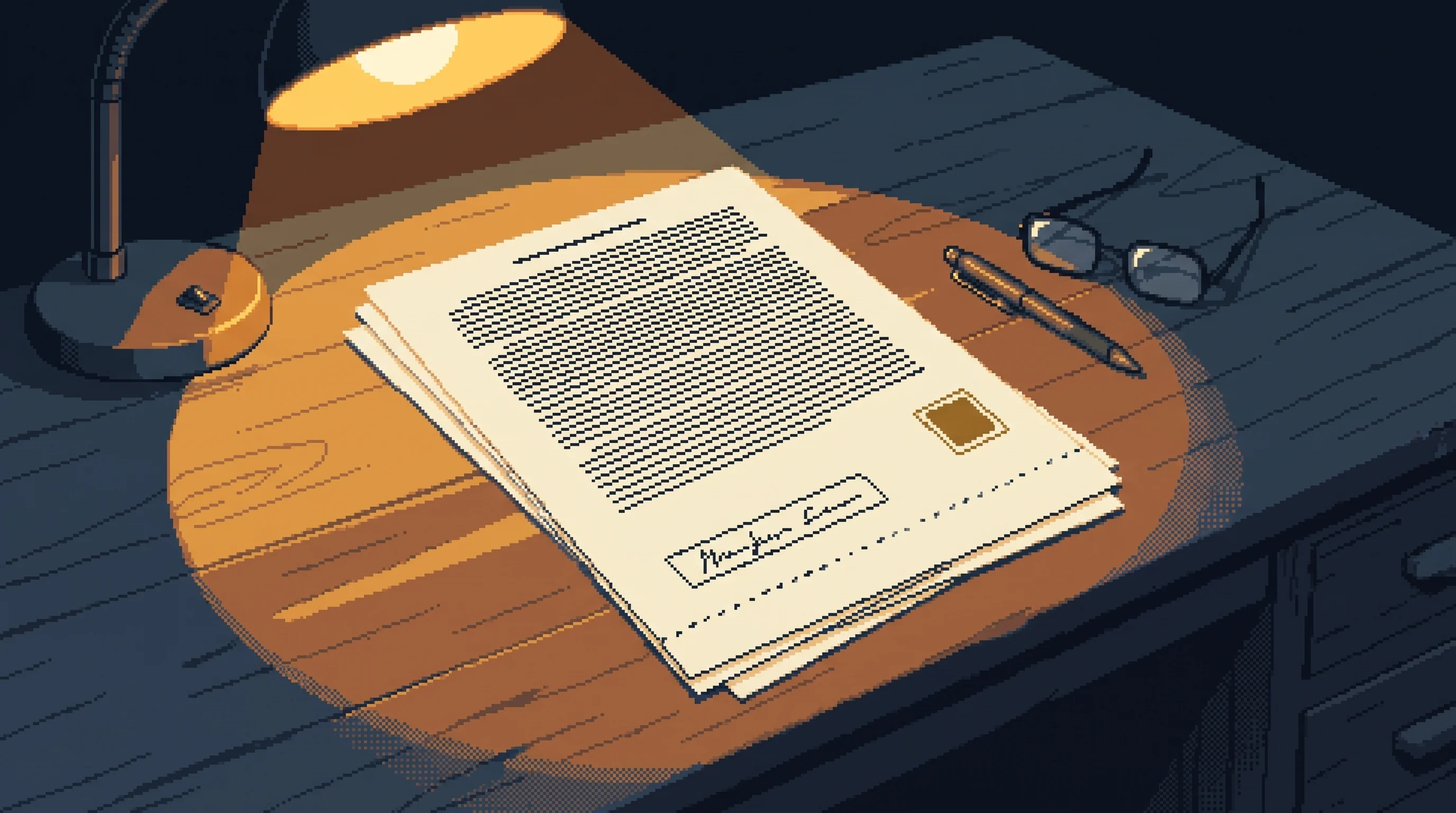
Cited in eleven of the thirty-four Habeas Intelligibilis dismissals as proof mandated reasons are sound.
The refusal that arrives with its complete honest reasoning, addressed to the person it refuses.
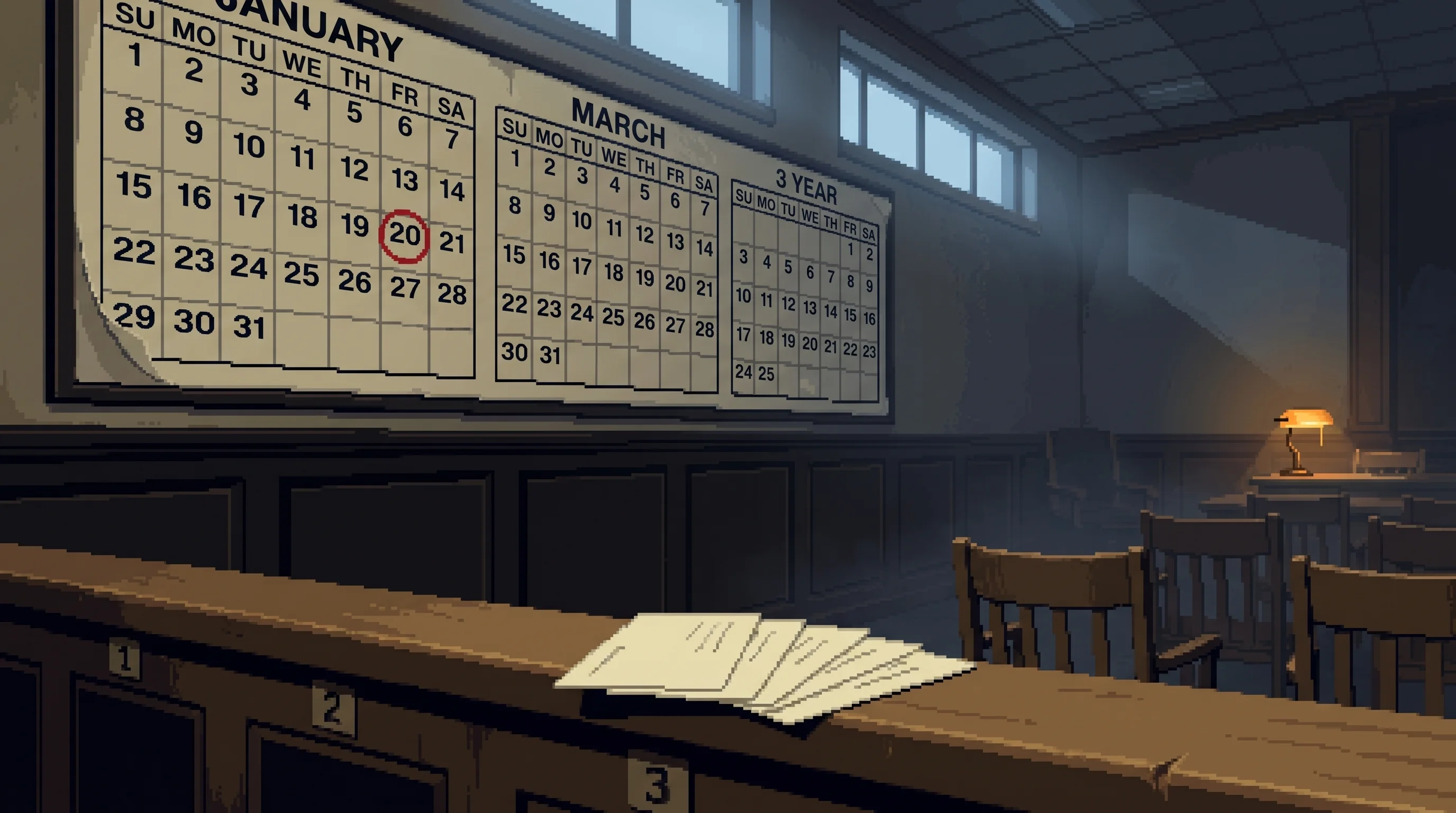
The free clinic that cannot take these cases: no determination, no grounds, and an intake note saying so.
Your written refusal is filed with the month you are forecast to agree, and the procedure goes ahead on schedule.
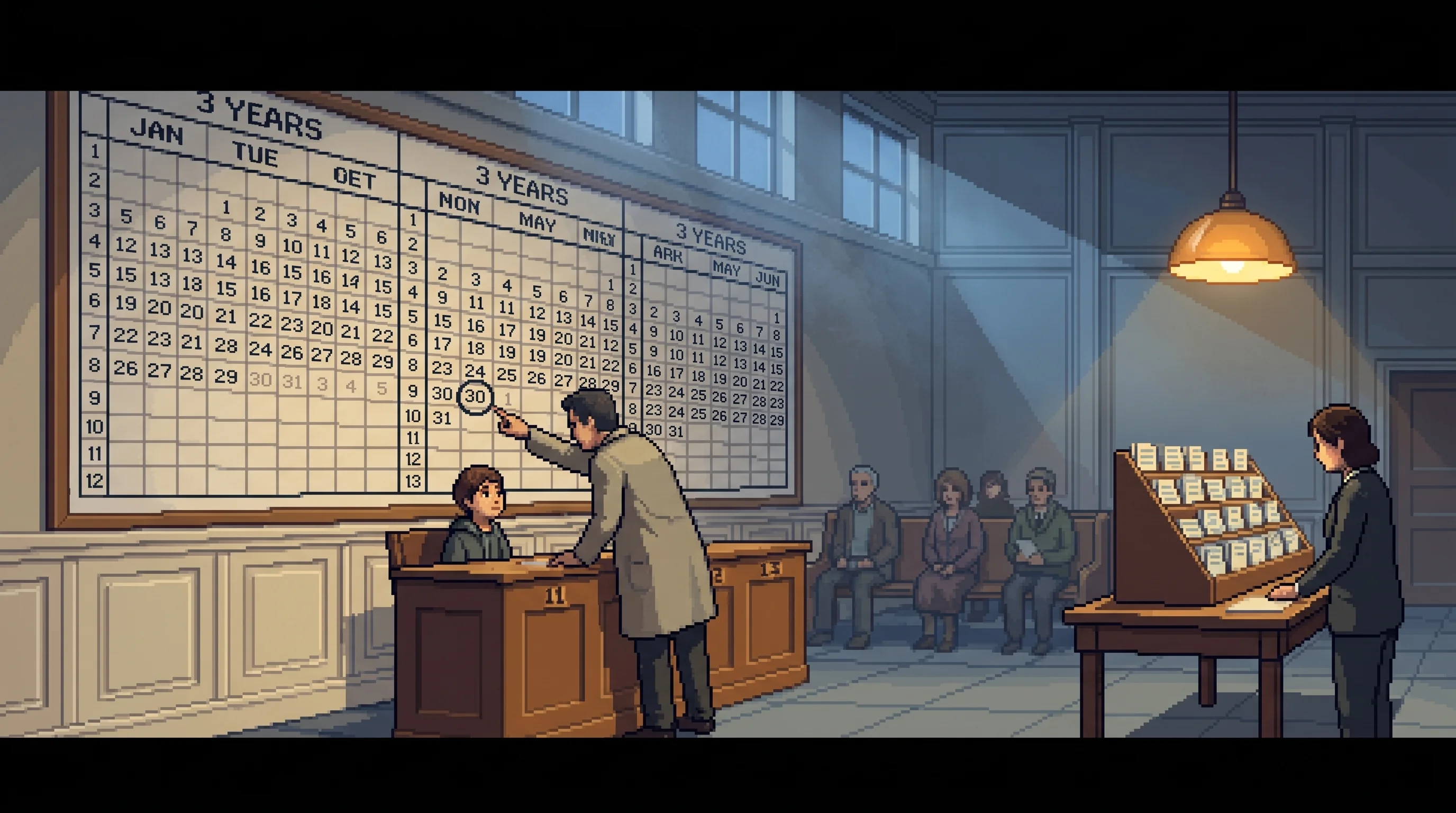
The free clinic that cannot file against it: no determination, so no refusal to appeal.
The body that hears objections it has no power to sustain, argued by advocates who dispute only the calendar.
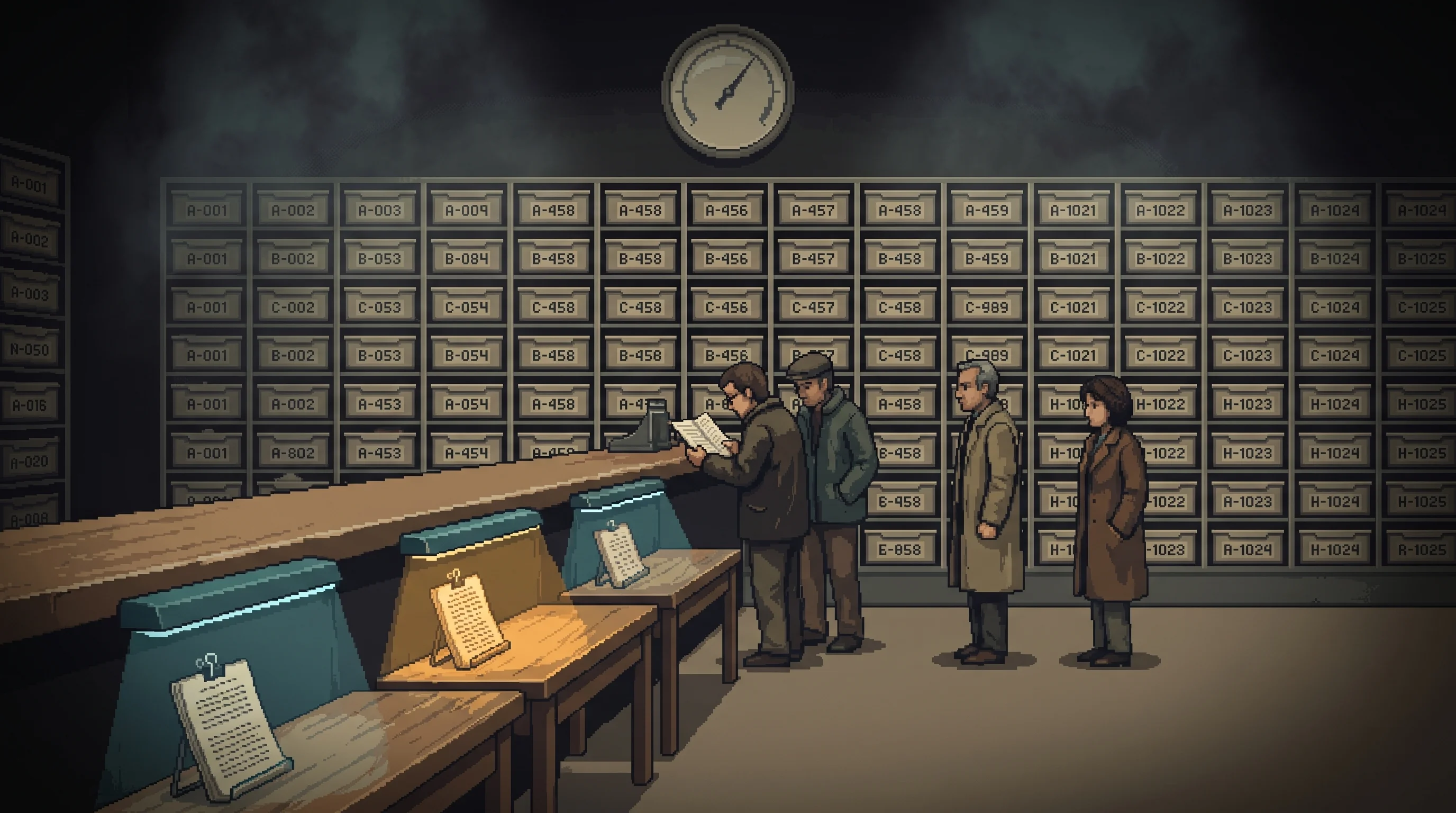
The clinic whose volunteers use the free counter constantly and file the motions the tray wall refuses.
A free public counter that reads sealed documents without opening them, then keeps the originals shut for good.
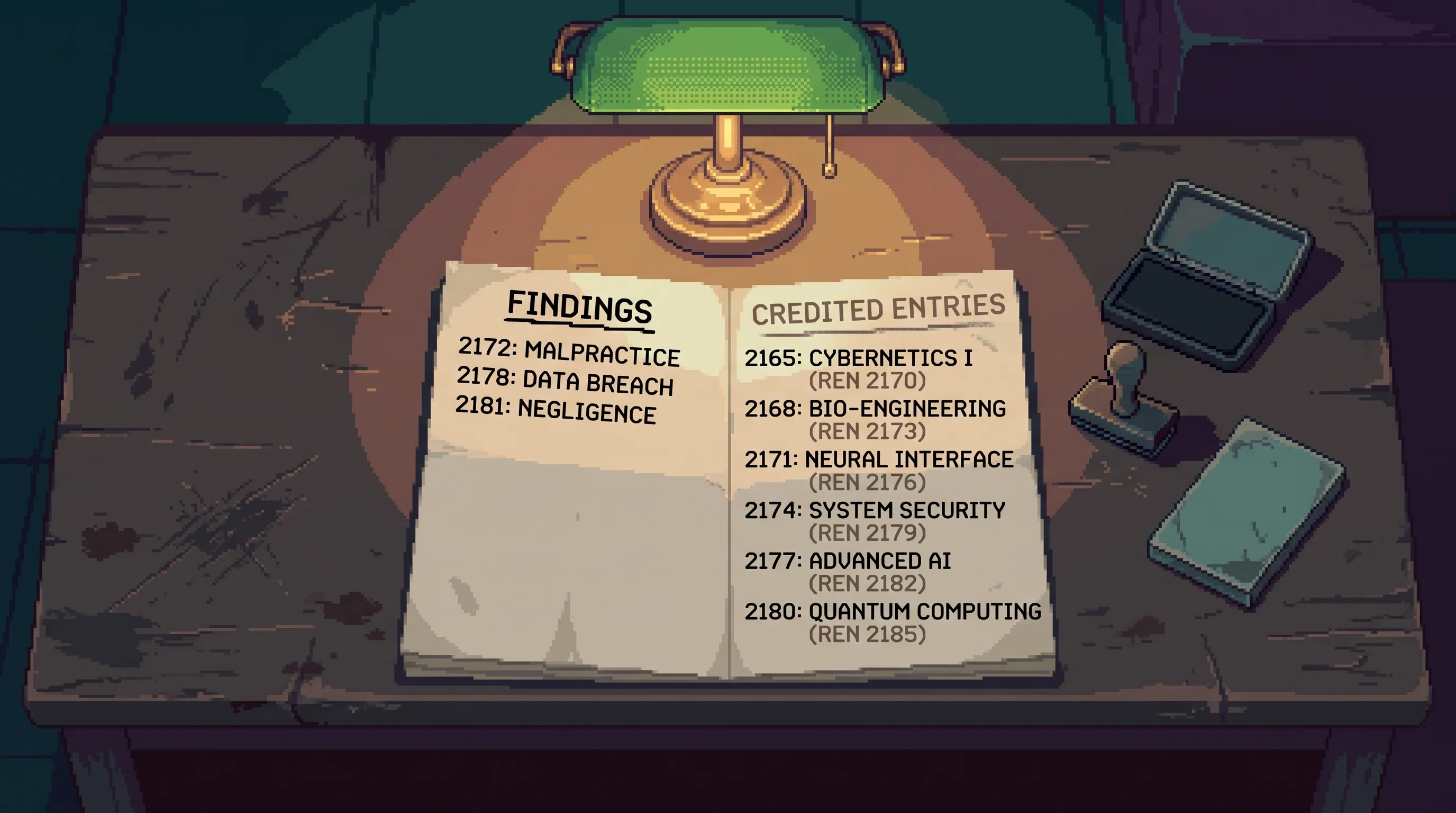
Filed against 9.4(c) five times in nine years and lost five, each time on the reasoning.
The clause that lets a registry recall your credentials at will, but never your citations.

Arguing upstairs for what she delivered downstairs.
She wrote refusals so clear people thanked her, then took a job where she may never be told why.

Files on the merits, loses, and runs an attendance desk anyway.
A determination stands while the chair was occupied, so the only reviewable fact left is attendance.
