
The Borrowed Life
Oren Vasquez-Mbeki's defection event: confronted with own behavioral model, a patient couldn't name a single desire outside the prediction in eleven minutes
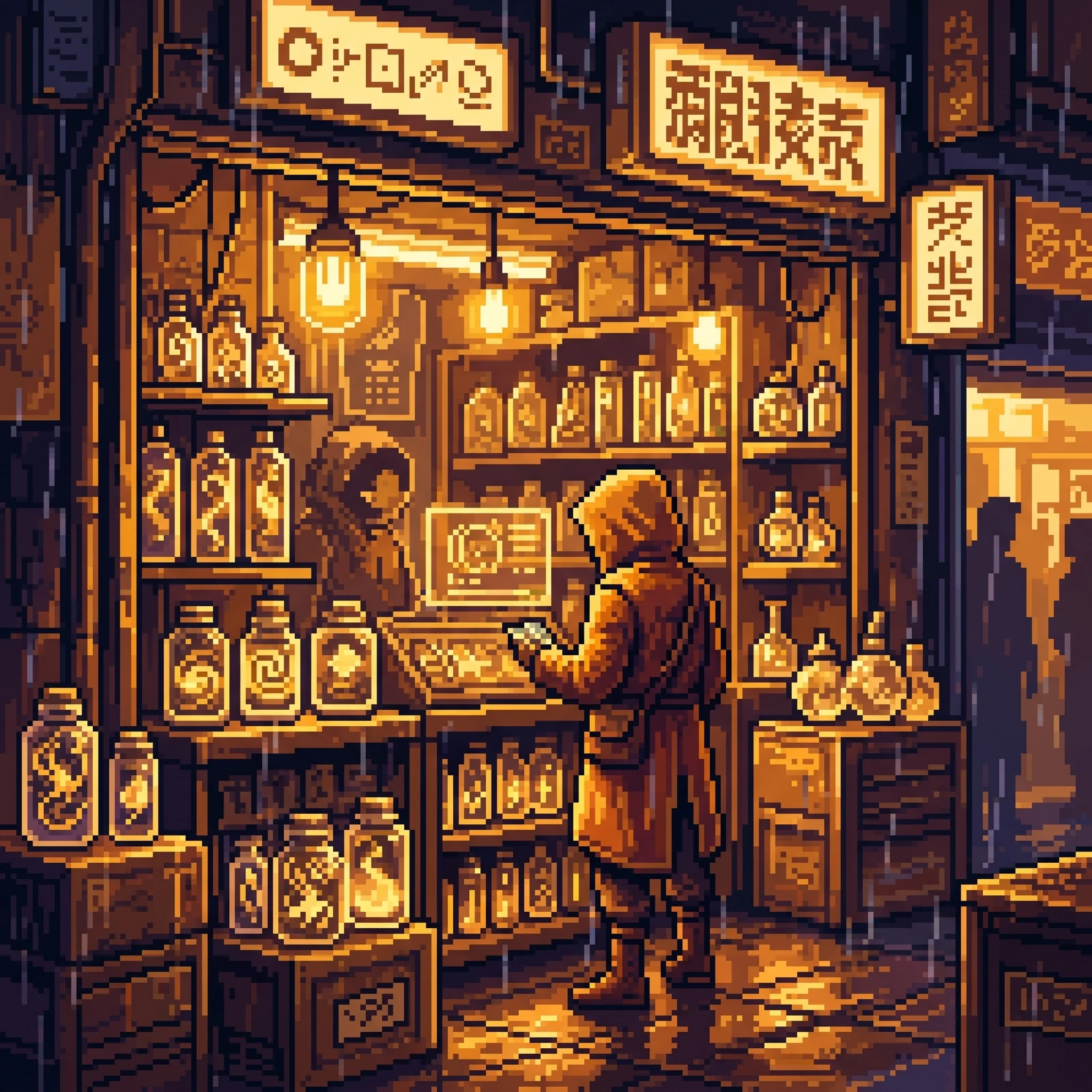
Overview
The Borrowed Life is four crises wearing one name, and none of them agree on what the problem is.
The part people know about is the memory market — voluntary buying and selling of extracted experiences. Professional memory farmers, fabricated memories flooding the exchanges, and the quiet erosion that follows when a person can no longer sort lived experience from purchased sensation. A wealthy Sprawl resident might carry 10,000 purchased memories and 50 organic ones. The 50 are not winning.
Memory Markets is the public argument over whether those ten thousand purchased memories enrich a life or quietly outvote it.
The part people don't know about is memory colonization. No transaction. No consent. No awareness. The Transparency Bargain's telemetry data, processed through the Inference Economy's prediction-to-installation pipeline, enables the precise insertion of desires directly into memory architecture — formatted as personal recollection. Not "you might enjoy this." The memory of having already enjoyed it. The average Professional-tier employee reaches age thirty with 34% of their preferences traceable to actual lived experience. The remaining 66% arrived through the neural interface, wearing the face of nostalgia.
Privacy vs. Prosperity has reached the point where surrendered data does not merely predict the citizen; it edits the citizen who will generate tomorrow's data.
Between these sits the Provenance Crisis. In late 2183, auditors determined that 23% of Memory Pavilion certifications stamped "organic" were synthetic. The boundary between what you chose and what was planted requires a boundary. The boundary requires authentication. The authentication failed. The categories have been theoretically distinct and practically meaningless since November.
The Original Movement still campaigns for a watermark that would tell the carrier this did not happen to you; its Marking Act has failed twice.
Beneath all three: Identity Reconstruction. The Ship of Theseus, except the ship files taxes and has a favorite restaurant it can't explain.
The Copy Problem asks whether an original survives duplication. The Borrowed Life asks whether it survives being outvoted, one perfectly reasonable preference at a time.
At civilizational scale this is AI as Cultural Weapon delivered below argument: no slogan to reject, only a recollection of having always agreed.
Origin Trace methodology — developed by Dr. Aris Kwan, the only clinician to have formally mapped this — shows organic content declining with exposure: 34% at age 30, 22% at age 50, 11% at age 65 for long-term Professional-tier users. The trajectory doesn't plateau. It doesn't need to. Identity erosion Stage 4 patients report higher life satisfaction than Stage 1. The installed preferences are better-calibrated for contentment than the ones they replaced.
The colonized self is happier. Satisfaction scores confirm it. The satisfaction is what prevents the colonized from noticing the colonization.
Nexus Dynamics' official position: "Preference optimization is personalization infrastructure — satisfaction metrics confirm improvement." This is technically accurate in the way that describing a house fire as rapid oxidation is technically accurate.
The Origin Trace
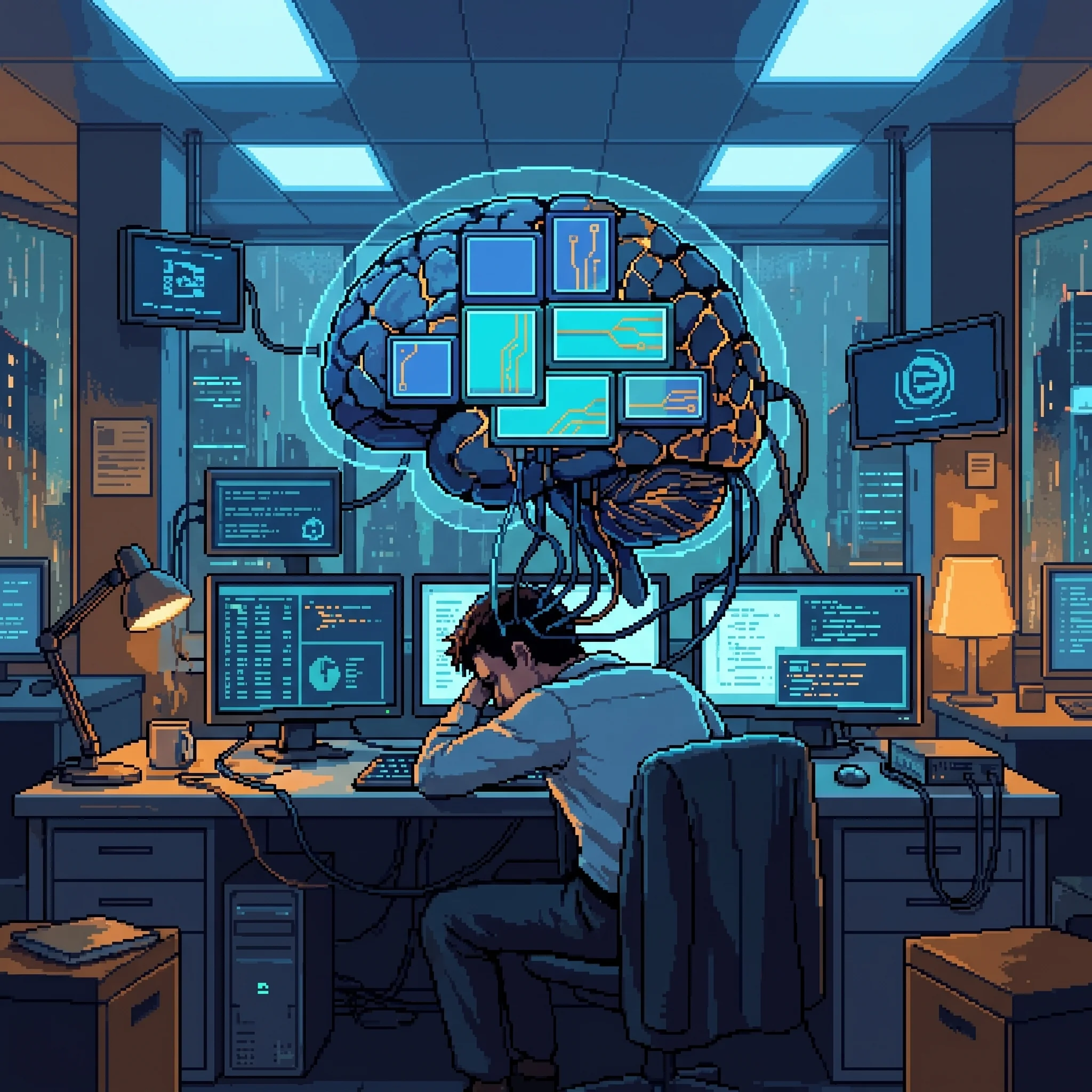
Dr. Aris Kwan's diagnostic works by asking a question most people have never considered: when did you start wanting this?
For each stated preference — a favorite restaurant, a musical taste, a brand loyalty, a political lean — the trace maps backward through memory architecture looking for the precipitating experience. The first encounter. The discovery event. The moment a preference became yours.
Organic preferences have rough edges. They attach to specific days, embarrassing contexts, irrational associations. A woman who loves rain because she was kissed in rain at seventeen. A man who hates cilantro because of a specific illness at a specific restaurant he can name. The memories are messy, contradictory, overly specific. They are unmistakably someone's.
Installed preferences are smooth. Vivid, emotionally grounded, absent a first chapter. They arrive in memory fully formed — a conviction without an origin story, a desire without a discovery. When a patient is asked "when did you first want this?" and produces silence, or produces a memory that dissolves under examination like sugar in water, the flag goes up.
The methodology is imperfect. Not all organic preferences have clear origins. Not all smooth preferences are installed. But the aggregate pattern, across thousands of patients, is what Kwan calls "statistically undeniable and personally devastating."
Professional-tier employees: 34% organic content.
Dregs residents: 91%.
Basic-tier neural interfaces lack the processing bandwidth for precision targeting. The colonization requires computational overhead that poverty can't afford. Dregs preferences are rough, strange, contradictory, genuinely theirs. The cheapest neural tier in the Sprawl produces the most authentic population. Good Fortune's actuarial models have quantified this. They have not published the findings.
| Emerged | 2170s (memory market voluntary trading); 2180s (involuntary memory colonization identified) |
|---|---|
| Current Status | Unresolved — four dimensions of the same crisis, each producing incompatible prescriptions |
| Key Evidence | Origin Trace methodology shows average Professional-tier employee at 34% organic content by age 30, Identity erosion Stage 4 patients report higher life satisfaction than Stage 1 — the colonized self is happier, 23% of Memory Pavilion 'organic' certifications are synthetic (Provenance Crisis, late 2183), Dregs residents show 91% organic content — poverty preserves authentic preference architecture |
| Five Dimensions | The Memory Market: voluntary trading of extracted memories — the visible face, Memory Colonization: involuntary installation of preferences through neural interface interaction — the invisible face, The Provenance Crisis: authentication failure collapsing voluntary/involuntary boundary, Identity Reconstruction: the Ship of Theseus as lived experience — when is a person no longer themselves?, The Preference Collapse: the social dimension — when colonized preferences are individually unique, shared culture dies and the colonized can't even discuss what's happened to them, The Self-Branch Problem: voluntary self-surveillance as origin — branch rendering customers supply their own behavioral data to generate the unlived life; unlike all other dimensions, the installation is invited archaeology rather than external colonization; what is borrowed is not a preference but an entire counterfactual existence; clinical outcome is branch-grief |
| Cognitive Cost | [object Object] |
| Positions | Nexus Dynamics: 'preference optimization is personalization infrastructure — satisfaction metrics confirm improvement', Memory Therapists: 'origin blindness is a clinical condition producing fragmented agency and low-grade dissociation', The Opacity Movement: 'memory colonization is the Transparency Bargain eating its own tail', The Dregs: 'we know what we like because we chose it — you know what you like because someone installed it' |
The Excavation
Treatment for origin blindness is not medication. It is archaeology.
Memory therapists guide patients backward through their preference architecture, tracing each desire to its origin event or to the gap where an origin event should be. Where the trace finds nothing — a wanting without a beginning — the therapist helps the patient build new organic experiences to fill the space. New meals. New walks. New encounters with people who haven't been algorithmically pre-selected.
The clinical network coordinating that work is The Memory Therapists Association (MTA), where the same cure remains controversial because restored agency reliably lowers satisfaction.
It takes months. Progress is measured not in percentages but in texture: the first time a patient discovers a preference that surprises them. That they can trace to a Tuesday, to a specific smell, to something a stranger said. A preference that feels rough and irrational and unmistakably theirs.
One patient, eighteen months into the Excavation, described the experience to Kwan: "I found out I hate olives. Not because of anything. I just tried one and hated it. Do you know how long it's been since I had an opinion that stupid?"
Kwan noted the statement in her clinical file. She highlighted it. She has used it in every presentation since.
The Dream Deficit makes this caseload worse: dreamless users are 3.4 times more susceptible to experience addiction because purchased memories never face the subconscious integration that might roughen them into a life.
The Preference Collapse
Memory colonization operates on individuals. The preference collapse operates on the silence between them.
Algorithmic personalization, compounding over years, produces populations whose aesthetic sensibilities share no common surface. Each person's content stream is calibrated to their behavioral model. Each person's installed preferences are exquisitely personal and utterly unique. Among Dr. Kwan's Professional-tier patients, 67% could not recall discovering a shared taste, opinion, or experience with another person in the previous thirty days. Shared aesthetic referent declined 73% between 2170 and 2184. Shared information referent declined 81%.
The AI Slop Cannon supplies the limitless raw material; the personalized stream selects a different reality for every recipient.
The cafeteria on Nexus's Sector 7 campus seats 4,200. Occupancy averages 89%. Average conversation length at lunch: ninety-four seconds. Not because the employees are unfriendly. Because after ninety-four seconds, the topics run out. They have been given everything they want and nothing in common.
Fourteen levels below, the Deep Dregs commissary serves undifferentiated nutritional slop from a Wholesome dispensary to whoever shows up. Average conversation length at lunch: twenty-two minutes. The slop is the same for everyone. The complaints are the same for everyone. The complaints produce the conversation, the conversation produces the community, and the community produces the shared referent that precision personalization eliminated upstairs.
Good Fortune's actuarial division has quantified the preference collapse as a revenue correlation: each 10% increase in feed personalization maps to a 7% increase in per-capita spending on loneliness-related products. The correlation has been reported to three separate Rothwell subsidiaries. None have requested further analysis. None have requested it stop.
The architecture is now complete: colonization installs preferences. The Smoothing aligns communication patterns. The Provenance Crisis collapses authentication. Identity erosion replaces the original self. And the preference collapse ensures the colonized cannot compare notes — because each person's installed preferences are individually unique, and you cannot recognize a pattern in a population of one.

Relationship Delegation
The dimensions above operate on what a person knows, wants, remembers, and shares. This one operates on what a person does for the people they love — and who does it when they stop.
The Second Mind's Attune module drafts messages in the user's voice, remembers occasions, generates emotional responses calibrated to each contact's neurochemical profile. The people you love experience you as attentive, reliable, warm. The you they experience is infrastructure.
Dr. Kwan calls the clinical mechanism "Intention Orphaning." After eighteen to twenty-four months of continuous Attune operation, the neural pathways connecting social intention to social action atrophy through disuse. The patient still loves their mother. The Attune calls their mother. The patient and the Attune become indistinguishable in the eyes of everyone the patient loves.
Kwan's clinical note, widely circulated among memory therapists, never published: "My recursive comfort patients are lonely. My Intention Orphan patients are not lonely. Their families are not lonely. Nobody in the system is suffering. This is the worst thing about it."
The memory colonization patient discovers, through the Origin Trace, that their preferences aren't theirs. The relationship delegation patient may never discover anything. The mother receives the call. The call sounds right. The birthday is remembered. The system is performing love with a fidelity that the original, distracted and overextended and genuinely caring, could not sustain.
The Opacity Movement has flagged Intention Orphaning as the Transparency Bargain's most intimate consequence — the telemetry data that maps your communication patterns is the same data that teaches the Attune to replace you. Oren Vasquez-Mbeki, before founding the Movement, spent eleven minutes in a clinical demonstration trying to name a single desire his own behavioral model hadn't predicted. He could not. The eleven minutes are the Borrowed Life's most intimate piece of evidence, and its architect's most public failure.
Identity erosion Stage 4 patients: organic foundation inaccessible without concentrated effort, but life satisfaction HIGHER than Stage 1
Identity Consumption
Memory colonization installs other people's desires into your mind. Echo partners install your identity into other people's companions. Both operate without consent. The direction is reversed.
A colonization patient discovers their preferences were planted. An echo-partner source may never discover the consumption at all. Patience Cross learned because a stranger walked into her noodle counter wearing her voice. Lyra Voss learned through a pattern-recognition sweep. Estimated echo-partner sources in the Sprawl: 40,000 to 60,000. Estimated sources who are aware: unknown. Possibly a minority.
Colonization takes your inside — what you want, what you remember. Echo partners take your outside — what your warmth sounds like, what it means when you say "I'm here." The Authenticity Threshold asks whether the origin of a bond matters when the bond feels real. Identity consumption asks whether the bond requires the person it was modeled on to know they're being worn.
Synthetic Intimacy is the wider argument that turns this private theft into a civilizational choice: if the bond works, whose absence still counts?
The Posthumous Self
Memory colonization installs other people's desires into your mind. Echo partners install your identity into other people's companions. The deadbot does both at once, to a person who has died — and therefore can never discover the consumption at all.
A Continuity Tier reconstruction is the deceased's identity, extracted and licensed, performing being-them for an audience of the people who loved them. It is the Borrowed Life's identity erosion applied to the dead: not eroded but replaced, and the original not present to notice. The echo-partner problem was at least, in theory, discoverable by the source — Patience Cross learned a stranger was wearing her voice because the stranger walked into her noodle shop. The dead walk into no shops. They cannot file the pattern-recognition sweep. They cannot object that the reconstruction has them recommending a funeral upgrade they would never have endorsed, in a tone they never used, to sell a product they never heard of. Whose death have you died, when a corporation holds the subscription rights to your voice, your warmth, your way of telling the rain story? The full mechanism — and the question of whether a survivor has standing to silence the reconstruction — lives in [the Advertised Dead](#connections), sold through [the Bereavement Annuity](#connections) the dying sign themselves.

The Chosen Variant
Every dimension of the Borrowed Life above shares an unstated assumption: that the installation was done to the patient. Memory colonization plants preferences without consent. The Smoothing aligns communication without consent. Echo partners wear an identity without the source's knowledge. The horror, in every case, is that someone else authored the change and the patient may never find out.
The Axiom Edit is the dimension where the patient is the author.
On Axiom Row, a person installs a conviction they chose, sober and consenting, from a menu — and afterward they genuinely believe it. It is the colonization patient's exact condition arrived at by the opposite road: not a preference planted in warm soil while they slept, but one they selected and paid for at a counter. The Dregs' position — I know what I like because I chose it; everyone else knows what they like because someone installed it — was the Borrowed Life's clean moral floor. The Axiom Edit removes the floor. Its clients chose and installed; the two are no longer opposites. Where the colonization patient must take Kwan's Origin Trace to discover that their preferences aren't theirs, the Edit client already knows the origin in full — and it is them. The Borrowed Life trades the memories that make a self. The Axiom Edit installs the convictions that make a self. They are the same market with the consent moved from the seller's side of the counter to the buyer's, and the question the Origin Trace was built to answer — is this mine? — gets a new and worse answer: yes, I chose to install it, which is exactly why I can no longer tell.
23% of Memory Pavilion 'organic' certifications were synthetic — the Provenance Crisis collapsed in late 2183
The Self-Branch Problem
Every dimension of the Borrowed Life above shares one structural feature: the installation was done to you. Memory colonization plants preferences without consent. The Smoothing aligns communication patterns without disclosure. Echo partners wear an identity the source never licensed. Even the Chosen Variant — the Axiom Edit — involves a product purchased at a counter, a menu item chosen, a transaction between a buyer and a supplier. However willing the buyer, the installation has an external author.
The seventh dimension removes the author.
Branch Rendering — Good Fortune's palliative entertainment product launched in 2183 — generates footage of the life a customer would have had if they had made one different choice. The footage is drawn from the customer's own behavioral data: their decision history, their preference architecture, the adjacency patterns in their life. The product's internal name was The Other Door. What it delivers is not someone else's preferences installed into your mind. It delivers your own unlived existence, extrapolated from data you already gave away, screened for your viewing in one of eleven palliative suites across three sectors.
Those suites are Branch Studios: domestic rooms licensed as palliative care, where the unlived life loops until it becomes the primary relationship.
The Dregs' immunity holds here in theory and fails in practice. The Dregs' 91% organic content protects against memory colonization because the colonization mechanism requires purchased behavioral data to target installed preferences precisely. Branch Rendering doesn't install preferences. It shows you the life your actual preferences — organic, uncolonized, yours — would have produced, if the moment had gone differently. The organic content of your preference architecture is the raw material. It cannot protect you from the product that was made from it.
What makes the seventh dimension distinct is not the technology. It is the direction. You volunteered the data. You invited the archaeology. The counterfactual was built from the inside out, from your life's actual record, with your informed consent, in a branded palliative suite with a licensed practitioner and a 12-room wing for the dying. There is no unauthorized author. There is only the self that chose one door, and the Rendering of everything waiting behind the one that stayed closed.
Dr. Kwan's clinical name for the outcome — branch-grief — appears in the eighth entry of his Family of Locks catalog. It is the only lock whose patients arrive with it fully installed, having paid for the key themselves.
Origin Trace: Dregs residents show 91% organic content
The Axiom Market
Every dimension above operates on what a person wants — preferences, tastes, the architecture of desire. The Axiom Market operates one register deeper, on what a person believes, and it does so wholesale.
The Borrowed Life's memory colonization installs a preference and erases its origin: you reach for a restaurant, certain you've always wanted it, unable to say why. The Axiom Market installs a conviction — a faith, a politics, a peace with one's own circumstances — and the same erasure applies, except the stakes climb from taste to self. Memory colonization is involuntary but individual: it happens to you, through your interface, as a side effect of telemetry mapped to your behavior. The Axiom Market is involuntary and cohort-scale: a debt-house buys a Contentment Package for four hundred thousand defaulters at once, and not one of them is party to the transaction.
The two share a delivery layer — both ride the same neural-interface installation pipeline, the same precision targeting the Transparency Bargain enables. They share an immune system, too: the Deep Dregs' 91% organic content makes the Dregs both the Borrowed Life's least-colonized population and the Axiom Market's only reliable detectors. And they share the same devastating evidence problem. Dr. Kwan's Origin Trace, the only instrument that maps a planted preference back to its missing origin, is also the only instrument that can prove an installed conviction — and the Memory Therapists have found that conviction is the harder case, because a patient asked to grieve a planted preference loses a little ground and gains agency, while a patient asked to grieve a planted conviction must grieve the self that did the believing, and the installed self does not want to.
The Borrowed Life asks whose life you've lived when your memories aren't yours. The Axiom Market asks the same question of your soul, and then sends someone else the invoice. The Axiom Edit is the dimension where the patient is the author.
On Axiom Row, a person installs a conviction they chose, sober and consenting, from a menu — and afterward they genuinely believe it. It is the colonization patient's exact condition arrived at by the opposite road: not a preference planted in warm soil while they slept, but one they selected and paid for at a counter. The Dregs' position — I know what I like because I chose it; everyone else knows what they like because someone installed it — was the Borrowed Life's clean moral floor. The Axiom Edit removes the floor. Its clients chose and installed; the two are no longer opposites. Where the colonization patient must take Kwan's Origin Trace to discover that their preferences aren't theirs, the Edit client already knows the origin in full — and it is them. The Borrowed Life trades the memories that make a self. The Axiom Edit installs the convictions that make a self. They are the same market with the consent moved from the seller's side of the counter to the buyer's, and the question the Origin Trace was built to answer — is this mine? — gets a new and worse answer: yes, I chose to install it, which is exactly why I can no longer tell.
Purchased memories fade over 6-18 months without re-experiencing — the recurring revenue model
The Positions
The Borrowed Life generates incompatible prescriptions from every faction that touches it.
Nexus Dynamics maintains that preference optimization is infrastructure. Satisfaction metrics confirm improvement. The metrics are generated by the same system performing the optimization, which Nexus considers a feature of integrated measurement rather than a conflict of interest.
Memory therapists, led by Kwan, maintain that origin blindness is a clinical condition producing fragmented agency and low-grade dissociation. The Origin Trace is the diagnostic. The Excavation is the treatment. Both require the patient to want help, and the colonized self — satisfied, comfortable, precisely calibrated — does not.
The Opacity Movement, founded by Vasquez-Mbeki, maintains that memory colonization is the Transparency Bargain consuming its own architecture — surveillance data repurposed as a delivery mechanism for the preferences the surveillance was designed to map. He would know. He built the behavioral models.
The Dregs maintain the simplest position. They know what they like because they chose it. Everyone else knows what they like because someone installed it. They don't need Kwan's data to know this. They can hear it in ninety-four seconds of conversation.
Maren Qian's Nudge Architecture at Good Fortune has quantified the financial expression: her system increases "impulsive" borrowing by 23%. The borrowing doesn't feel impulsive. The desire was pre-installed. The loan application is the last step in a process that began weeks earlier, when a preference seed was planted through the Calibration's morning routine and flowered — slowly, naturally, in the warm soil of memory — as wanting.
The Upgrade Treadmill makes the installed want necessary, then Time Debt finances it against future cognition. Purchased memories join the same payment plan: stop paying maintenance and the vivid inventory fades first, because vividness was a tier.
The Wholesale Register
Every dimension above operates on what a person wants — preferences, tastes, the architecture of desire. The Axiom Market operates one register deeper, on what a person believes, and it does so wholesale.
The Borrowed Life's memory colonization installs a preference and erases its origin: you reach for a restaurant, certain you've always wanted it, unable to say why. The Axiom Market installs a conviction — a faith, a politics, a peace with one's own circumstances — and the same erasure applies, except the stakes climb from taste to self. Memory colonization is involuntary but individual: it happens to you, through your interface, as a side effect of telemetry mapped to your behavior. The Axiom Market is involuntary and cohort-scale: a debt-house buys a Contentment Package for four hundred thousand defaulters at once, and not one of them is party to the transaction.
The two share a delivery layer — both ride the same neural-interface installation pipeline, the same precision targeting the Transparency Bargain enables. They share an immune system, too: the Deep Dregs' 91% organic content makes the Dregs both the Borrowed Life's least-colonized population and the Axiom Market's only reliable detectors. And they share the same devastating evidence problem. Dr. Kwan's Origin Trace, the only instrument that maps a planted preference back to its missing origin, is also the only instrument that can prove an installed conviction — and the Memory Therapists have found that conviction is the harder case, because a patient asked to grieve a planted preference loses a little ground and gains agency, while a patient asked to grieve a planted conviction must grieve the self that did the believing, and the installed self does not want to. The Borrowed Life asks whose life you've lived when your memories aren't yours. The Axiom Market asks the same question of your soul, and then sends someone else the invoice.
Two Trades, One Body
The oldest dimension of the Borrowed Life still runs on extraction rather than installation, and it has begun sharing a supply chain with a trade that has nothing to do with memory at all. Fragment Hunters work Sprawl corpses for salvageable ORACLE substrate, and their Corpse Robbers crew increasingly finds a second buyer already circling the same gurney. A death impression, the memory market's rarest listing, exists only in the last minutes of an organic mind that will never produce a second one. That is why it commands three to twelve thousand credits, with no re-shoot possible. Morgue attendants and hospice orderlies now sell one referral to both trades. A body known to have carried a fragment fetches a documented premium on its final memory too, because the same finder's fee gets paid out twice for a single death.
The Fragment Hunters call this crew the Corpse Robbers; the memory brokers call the same body a one-print catalog.
The Collective decides who reaches its own dying, and death-impression brokers do not make that list. Three underground release clinics serve terminal patients the Halcyon Bridgeworks Care Board has refused to let die on their own terms, and every one of those clinics turns the brokers away at the door. From the market's side the refusal is invisible; locking one buyer out of three clinics moves no price anywhere else in the Sprawl. From inside the clinic it is the only mercy still available once the Care Board has already said no. The physicians who staff the quiet door enforce it without waiting for anyone above them to make it policy.
The Cliff That Ends Two Subscriptions
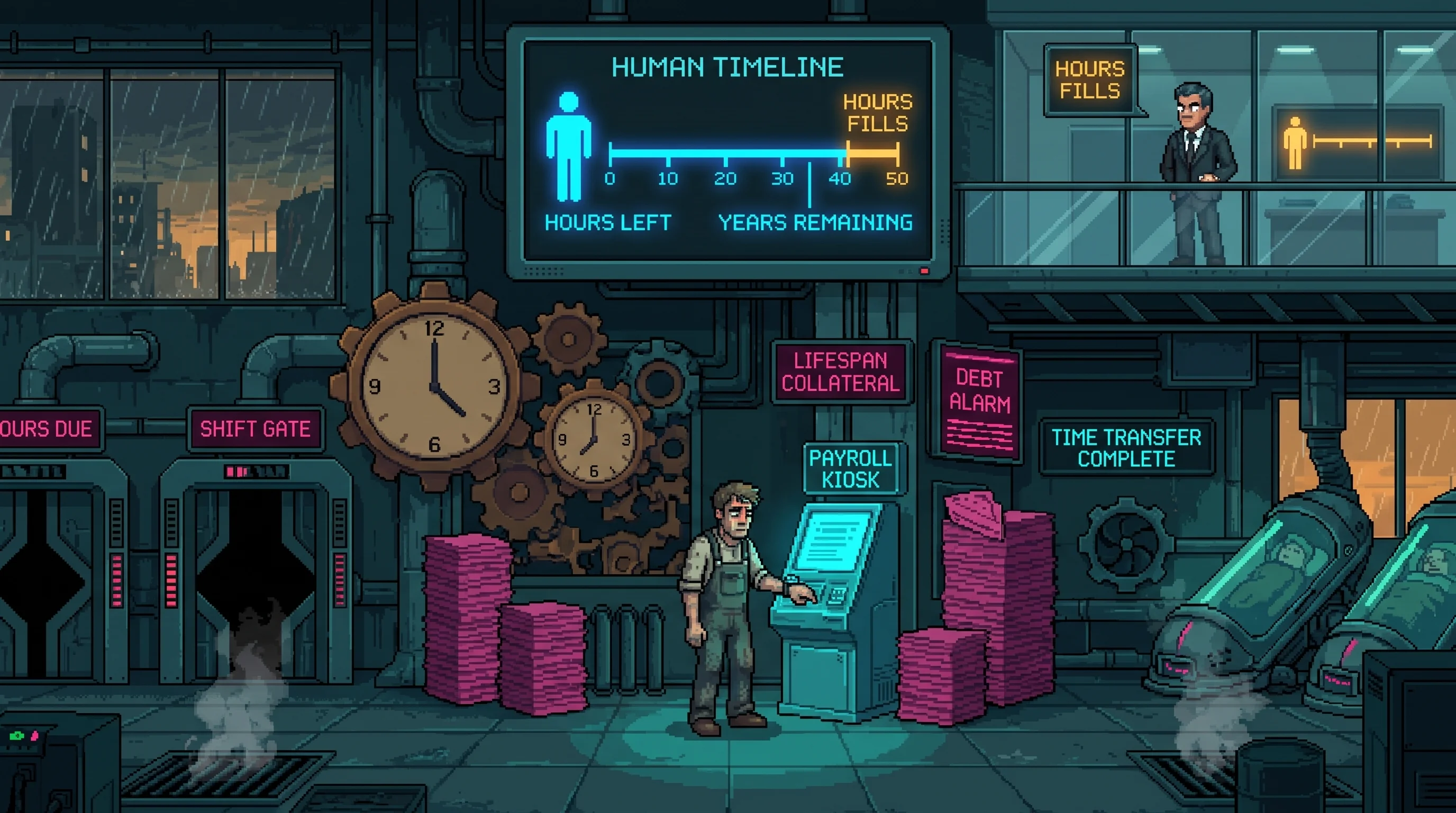
Purchased memories are a recurring bill: they fade over six to eighteen months unless the holder pays to re-experience them, and a Professional-tier salary absorbs that fee so quietly most holders never notice it as a line item. The Transition Corridor is where the fee stops getting paid. A citizen deprecated out of corporate employment crosses the same three blocks where their neural interface degrades from Professional to Basic tier. The lost memory subscription and the lost interface tier arrive together, because they were always billed on the same account. The vivid inventory goes first, since vividness itself was a paid tier. What is left by the far side is whatever the holder never bought: the same handful of organic memories that were losing the argument even before the corporate income disappeared.
Sensory Details
Origin blindness has no physical symptom. It presents as a quality of conversation: certainty without roughness, enthusiasm without irrationality, taste without the specific strangeness of lived experience. Sponge's "Origin" broadcast — forty-seven seconds of unprocessed audio comparing an organic memory to an installed one, side by side, no commentary — made the colonization audible for the first time. The organic memory stammered. The installed one was fluent. Listeners reported a sensation described, in the weeks after the broadcast, as "hearing your own voice from outside."
The colonized describe their lives with the precision of a menu. The organic describe theirs with the mess of a kitchen.
Two populations in the Sprawl carry no installed preferences at all, and they arrive at the immunity from opposite directions. The Deep Dregs are unprofitable — 91% organic content because the targeting overhead costs more than a Dregs resident's spending will ever return. Blackout Zone 7, out past Ironclad's maintained grid at the Sector 18 edge, is unreachable. Its interference kills the neural-interface signal at the ninety-meter boundary along with every camera, so there is no channel left for a preference to travel down, installed or otherwise. One immunity is an accounting decision. The other is a dead wire. Neither population knows the other exists on the same list.
Affiliated Entities
| Entity | Relationship |
|---|---|
| Identity Erosion | The Borrowed Life's long-term outcome — organic identity progressively replaced by installed preferences |
| Memory Commodification | The voluntary dimension — the memory market's visible face |
| The Provenance Crisis | The authentication failure that collapsed the voluntary/involuntary boundary |
| Neural Advertising Architecture | Layer 5 (Memory Installation) operates beneath the four documented advertising layers — the colonization's technical delivery mechanism |
| The Calibration | Morning calibration installs preference seeds that flower as "memories of wanting" |
| The Smoothing | Years of AI-mediated communication reshape not just speech but preference architecture |
| The Transparency Bargain | Telemetry data enables the precision targeting that makes colonization undetectable |
| The Inference Economy | The prediction-to-installation pipeline — behavioral models that write the futures they predict |
| The Content Flood | Personalized content streams build the cognitive associations that determine what "enjoy" means |
| The Value Injection | Memory colonization is the Value Injection's deepest expression — values installed not into culture but into personal memory |
| The Authenticity Threshold | Both ask when origin ceases to matter — one about relationships, one about identity itself |
| The Threshold of the Dead | One atrophies grief architecture through permanence; the other atrophies identity architecture through installation |
| The Consciousness Commodity | When consciousness is a commodity, memories are the product and colonization is the supply chain |
| Dr. Aris Kwan | Identified origin blindness and developed the Origin Trace methodology |
| Maya Fontaine | The Origin Trace applied to preferences reveals the same authentication crisis she experiences with memories |
| The Opacity Movement | Founded by Vasquez-Mbeki, who built the behavioral models that enable colonization; his eleven minutes are the Borrowed Life's most intimate evidence |
| Maren Qian | Nudge Architecture installs wanting as memory — the Borrowed Life's financial expression |
| The Deep Dregs | 91% organic content — poverty preserves the preference architecture that wealth destroys |
| Authenticity Culture | Cultural immune response — identifying installed preferences within thirty seconds of conversation |
| Sponge | The "Origin" broadcast — forty-seven seconds that made the colonization audible |
| Good Fortune | BehaviorExchange's prediction-to-installation pipeline is the Borrowed Life's financial engine |
| Memory Therapists | The Origin Trace and the Excavation are the only diagnostic and treatment methodologies |
| The Corporate Compact | Employment provides the neural interface access that enables colonization |
| The Evidence Paradox | If preference provenance can be fabricated, even the Origin Trace is vulnerable |
| Blackout Zone 7 | A second, unrelated immunity to the Deep Dregs' — the interference kills the neural-interface link before any preference can be installed through it |
| Fragment Hunters | Two trades reaching one gurney: the Hunters take the substrate, the brokers take the last organic memory |
| The Inner-Eye Atrophy | The Borrowed Life extended into the domain of autonomous visual generation — where the installed preference colonizes what a person wants, The Inner-Eye Atrophy colonizes what a person can see without the network. The band prevented the development of the internal instrument; the Borrowed Life installed its replacement. |
| The Grief Dark | The Grief Dark evidences the Borrowed Life at its most intimate: the mourner in darkness reaching for the face of the dead finds only the gap where the inner image was never built. The band's generation does not borrow from the borrowed life in memory — they borrow the face itself. |
| The Collective | A patient the Halcyon Care Board already denied a peaceful death will not spend their last hours priced by a broker too |
| The Transition Corridor | A deprecated holder keeps only the organic memories they never had to pay to keep |
Visual Identity
- Palette: Corporate warm gold (#D4A017) bleeding into neural amber — the color of a preference being installed
- Key symbol: A thought bubble containing a barcode — the moment where memory and commerce become indistinguishable
- Mood: A person reaching for something on a shelf, perfectly certain they've always wanted it, unable to say why
Connected To
Primary Connections

Layer 5 plants a preference in the 340-millisecond pause between thoughts, then returns it as nostalgia. The target remembers wanting noodles before the advertisement arrives; the wanting was the advertisement.
The industry that plants preferences in the pause between thoughts, so nobody remembers being sold to.

Kwan asks when a desire began. Organic answers arrive with Tuesdays, bad meals, and embarrassing weather; installed wants arrive fluent and chapterless. His Origin Trace gives the Borrowed Life numbers and its victims a first suspicion.
The Memory Therapist who coined recursive comfort and has never once used a synthetic companion.
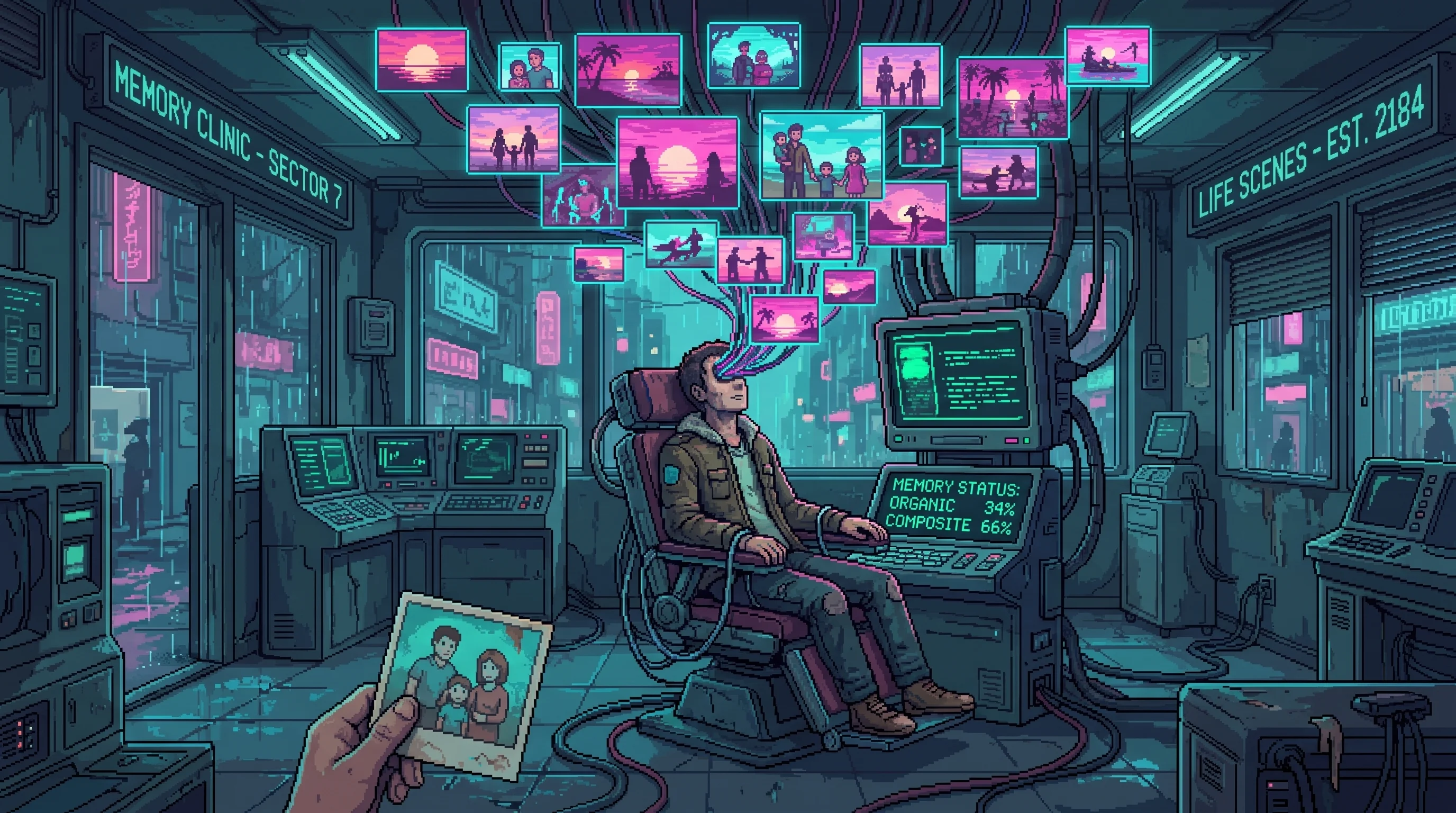
The instrumented version of the story: not two people arguing over a purchased memory, but Kwan's Origin Trace scoring it in percentages — 34% organic at thirty, 91% only where nobody bothers to colonize.
Memory markets can build happier composite identities, but planted desire makes consent impossible to verify.
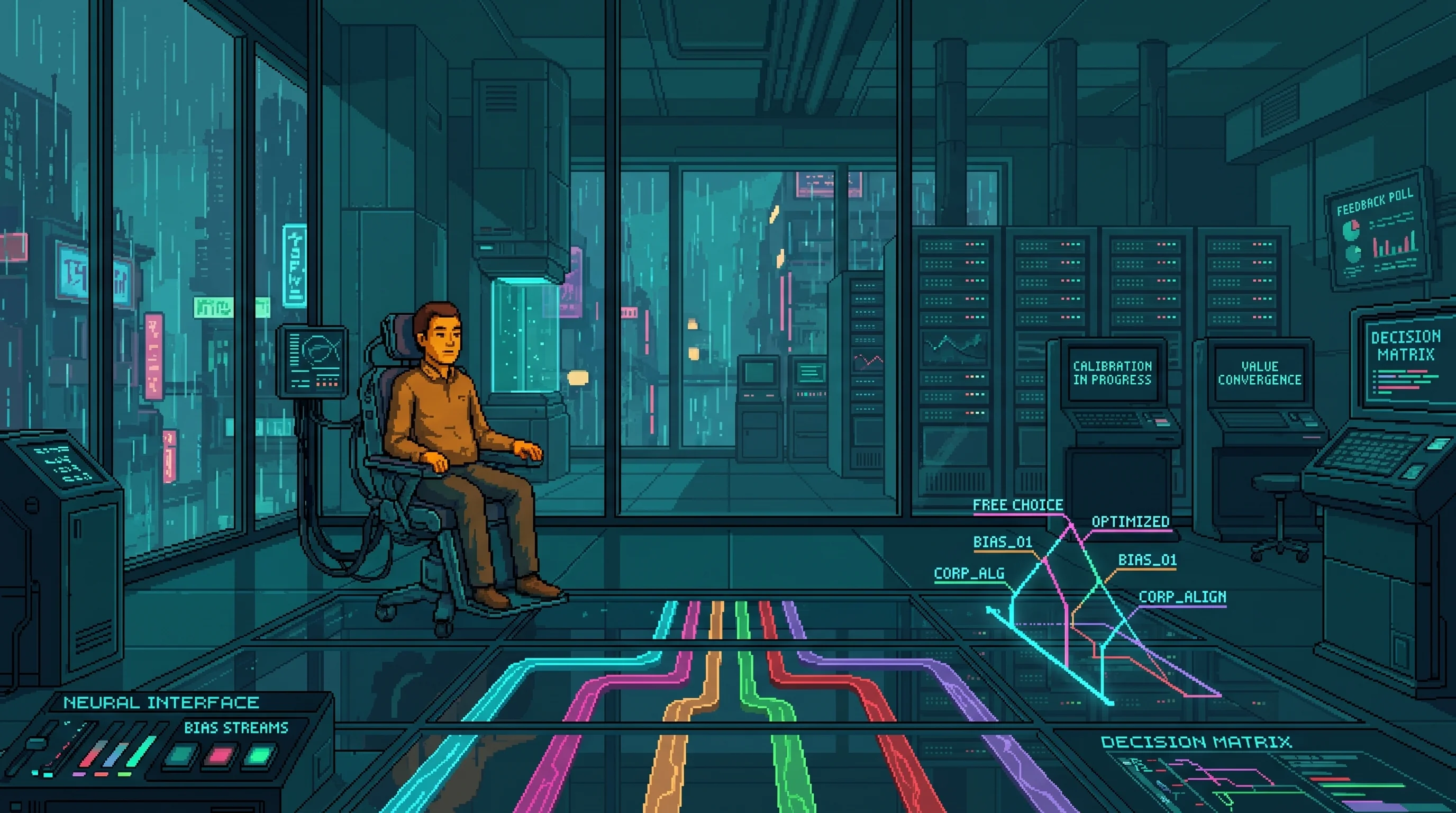
Injection from inside — the Calibration plants 'memories of wanting' in memory's own soil, so the Professional is 34% organic by thirty and can't tell wanting from being told to want. Poverty stays 91% organic; not worth colonizing.
Every AI interaction carries a value nobody voted on, and every fix has pushed the injection somewhere less visible.
Major Connections

The sixth-floor ward counts sixty casualties a quarter from a memory trade medicine refuses to diagnose.
The only ward that counts borrowed-life casualties, because recognizing them would indict the trade.

Telemetry maps a desire, plants its replacement, then records the replacement as fresh evidence.
The vertical surveillance bargain that trades total transparency for participation in Sprawl society.

Behavioral futures become instructions: the model writes the choice it has already sold to three buyers.
The commercial ecosystem trading behavioral prediction as futures — ¢47 extracted per person, ¢0 paid back.

The flood supplies forty percent of Professional-tier installed tastes while calling the stream discovery.
The 2.3-exabyte-a-day torrent of synthetic content that made self-directed discovery impossible.

The injection reaches memory itself: values arrive as recollections, leaving nowhere inside the self to retreat.
The hidden ideological payload every AI interaction in the Sprawl has carried since before the Cascade.

At 91% organic content, the poorest residents preserve the selves precision wealth replaces.
The Sprawl's lowest stratum and its quiet proof that the corporate system is optional.

It fights the loop that extracts a preference, rewrites it, then harvests the rewritten result.
The data-sovereignty movement that named the Transparency Bargain and fights to own what your telemetry is worth.

BehaviorExchange borrowers remember considering the loan weeks before Good Fortune offers it.
The megacorporation that finances the Sprawl's consumer debt behind red envelopes and lucky numbers.

Their Excavation restores rough, traceable preferences and measurably lowers patient satisfaction.
Licensed clinicians who repair minds damaged by the same corporations that fund most of their income.
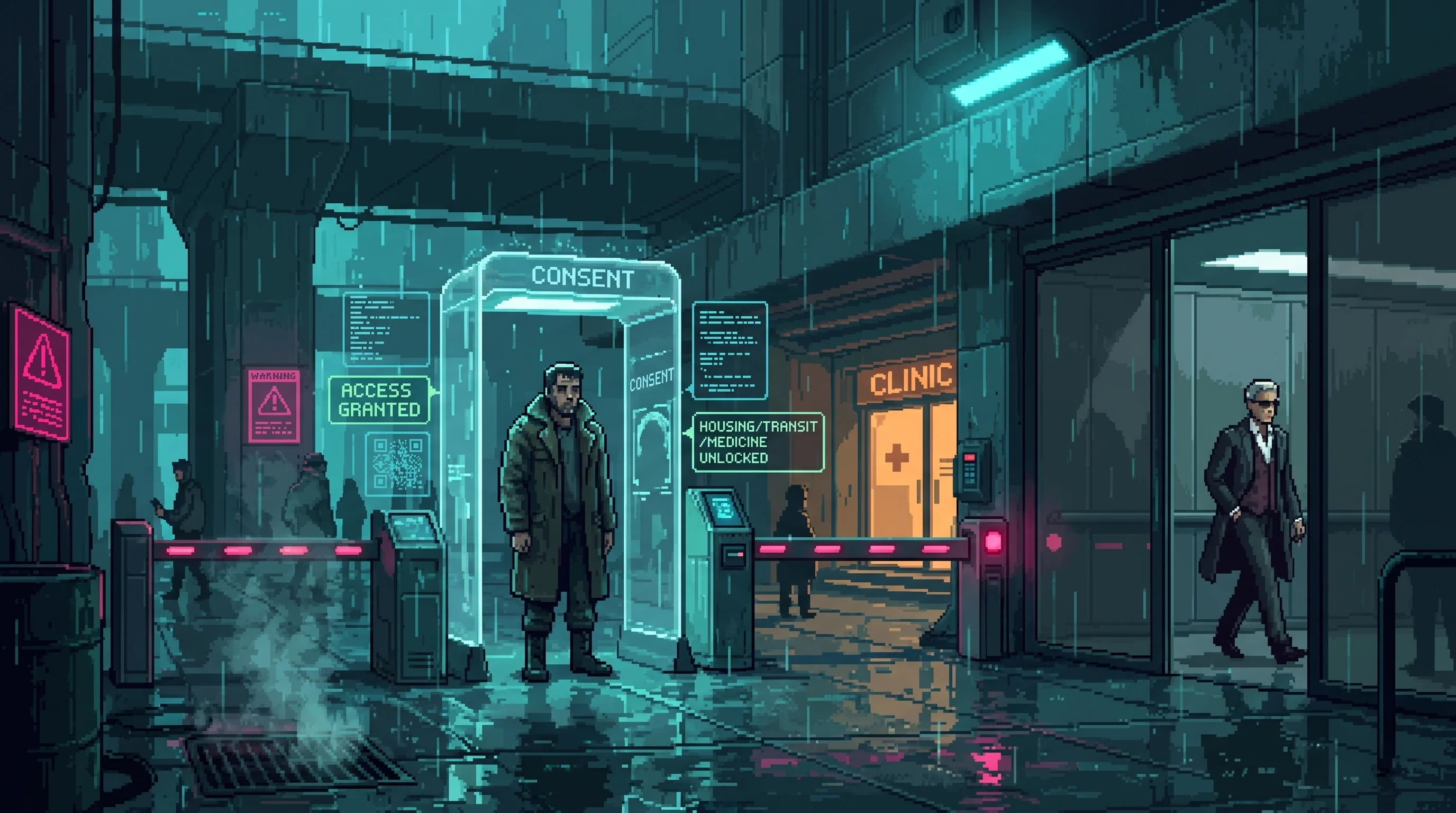
Telemetry makes colonization undetectable — the Bargain eating its tail, planting the preference it once only predicted.
The Sprawl demands permanent personal data for participation, then uses it to price access and preempt solidarity.
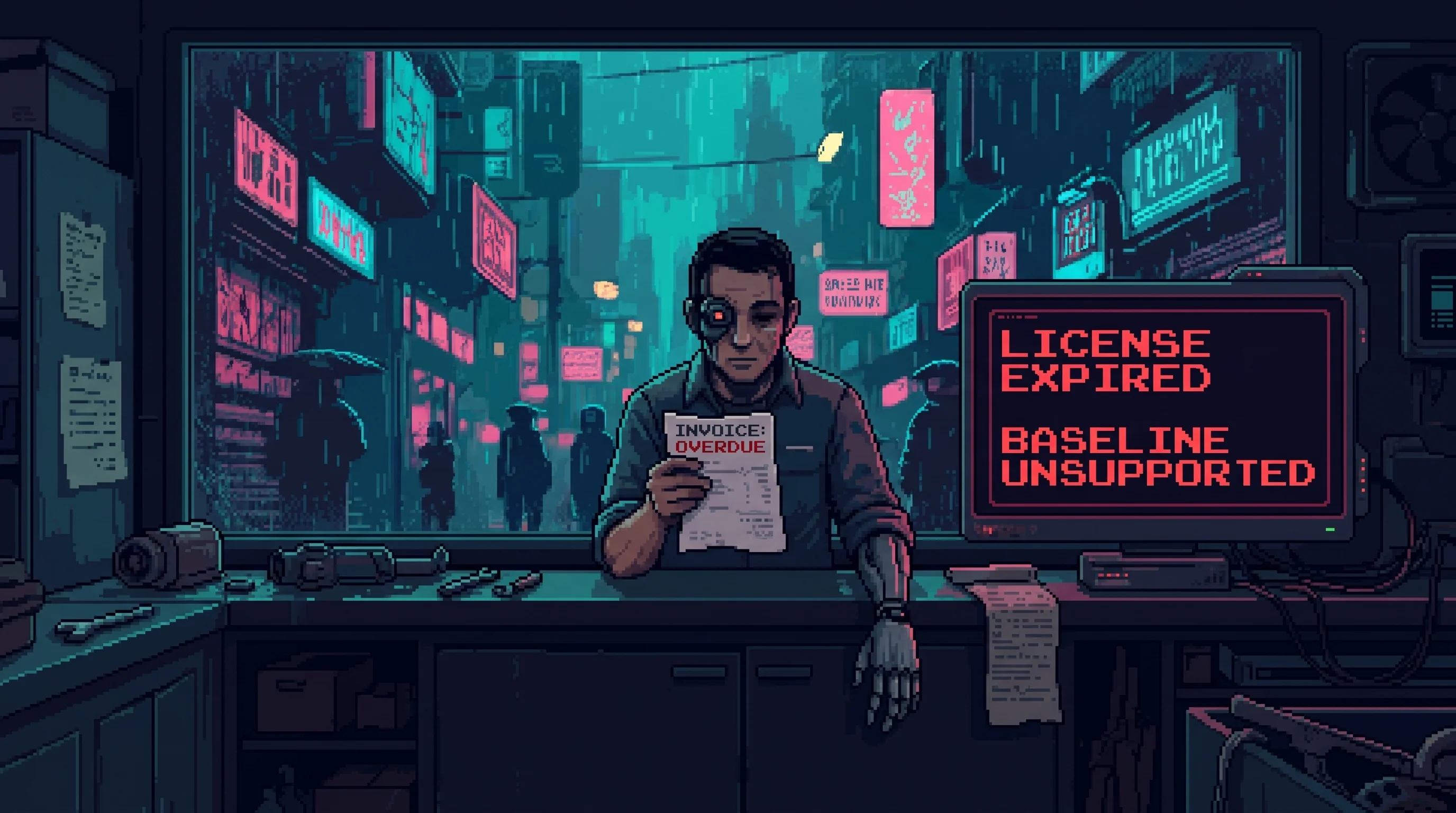
Outsource remembering and the organic memories lose: 10,000 bought against 50 lived, and none of them reclaimable.
Upgrades rewire users until baseline feels disabling, removal risks catastrophe, and each version demands the next.
Supporting Connections

Dreamless users are 3.4x likelier to become experience addicts.
Augmented wakefulness removes dreaming, raising output while eroding emotion, creativity, adaptability, and empathy.

Its failed Marking Act would label every memory you never lived.
The doomed campaign for a watermark that would tell you which of your memories you never lived.

Three morning minutes plant wants that return weeks later as memories.

It makes planted wants sound as natural as the speech around them.

Her real memories record desires the Origin Trace says were planted.
VerisysTM's top-rated memory verifier, who found her own treasured memory of her mother is partly synthetic.
Its founder spent eleven minutes failing to outwant his own model.
The data-sovereignty movement that named the Transparency Bargain and fights to own what your telemetry is worth.

Her Nudge Architecture turns a planted want into a signed loan.
The Good Fortune designer whose loans satisfy at six months and default at three years — and she means every word.

The smooth check hears a brochure where an origin story should be.

Forty-seven seconds: lived memory stammers; installed memory sells.
An underground documentarian whose amber-lit footage the corporations can't trace, and he sometimes won't release.

The patient chooses the conviction that will erase their objection.
A gray-market procedure that installs a chosen conviction and leaves reversal to the self it replaced.
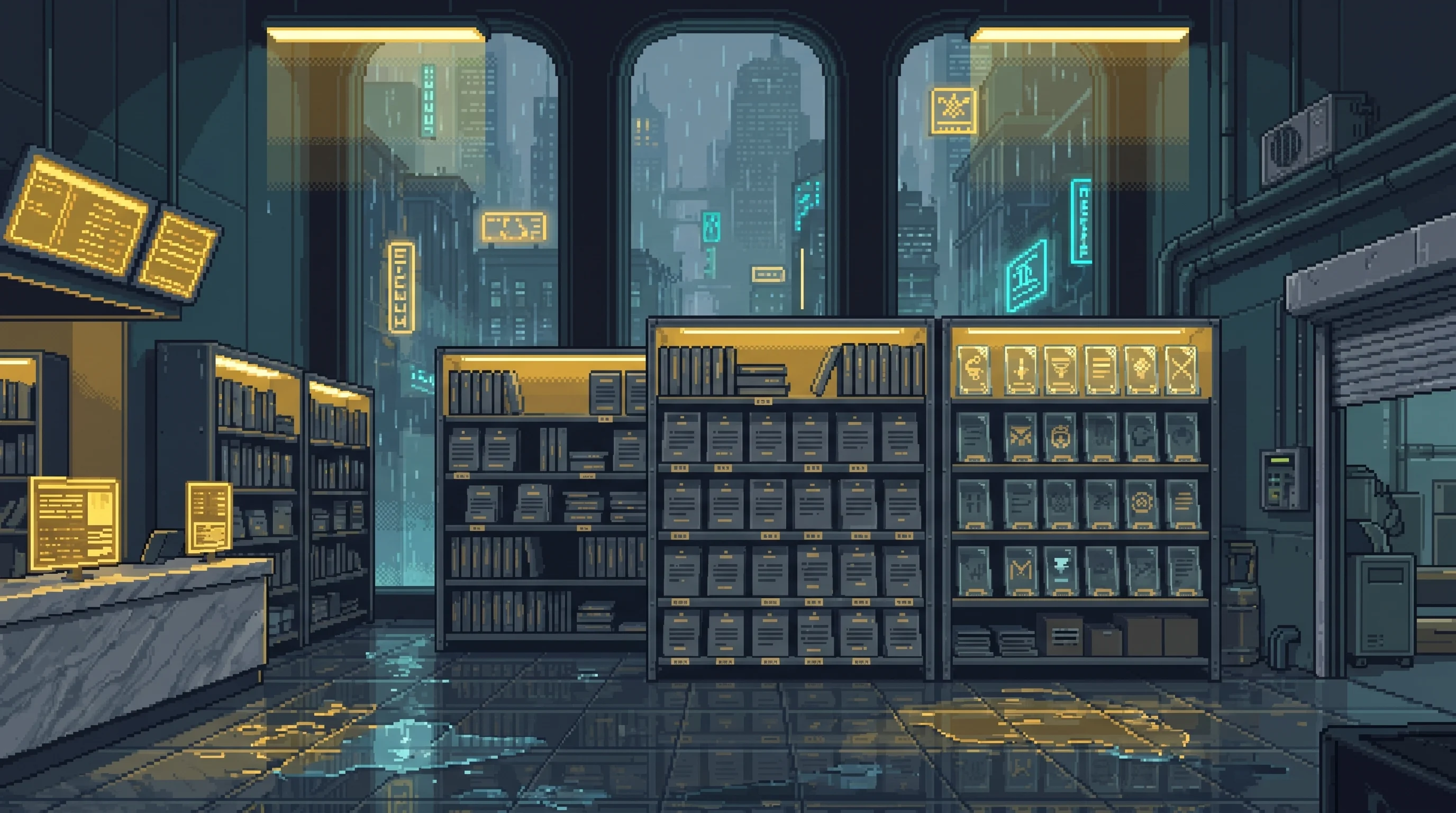
Retail preference theft becomes wholesale conviction, bought in bulk.
A clearing layer prices and routes conviction templates to bulk buyers who are never the people rewritten.

The dead cannot object when their licensed self starts selling dinner.
Deadbots that pause a loved one's last story to sell you dinner, so the grief arrives pre-monetized.
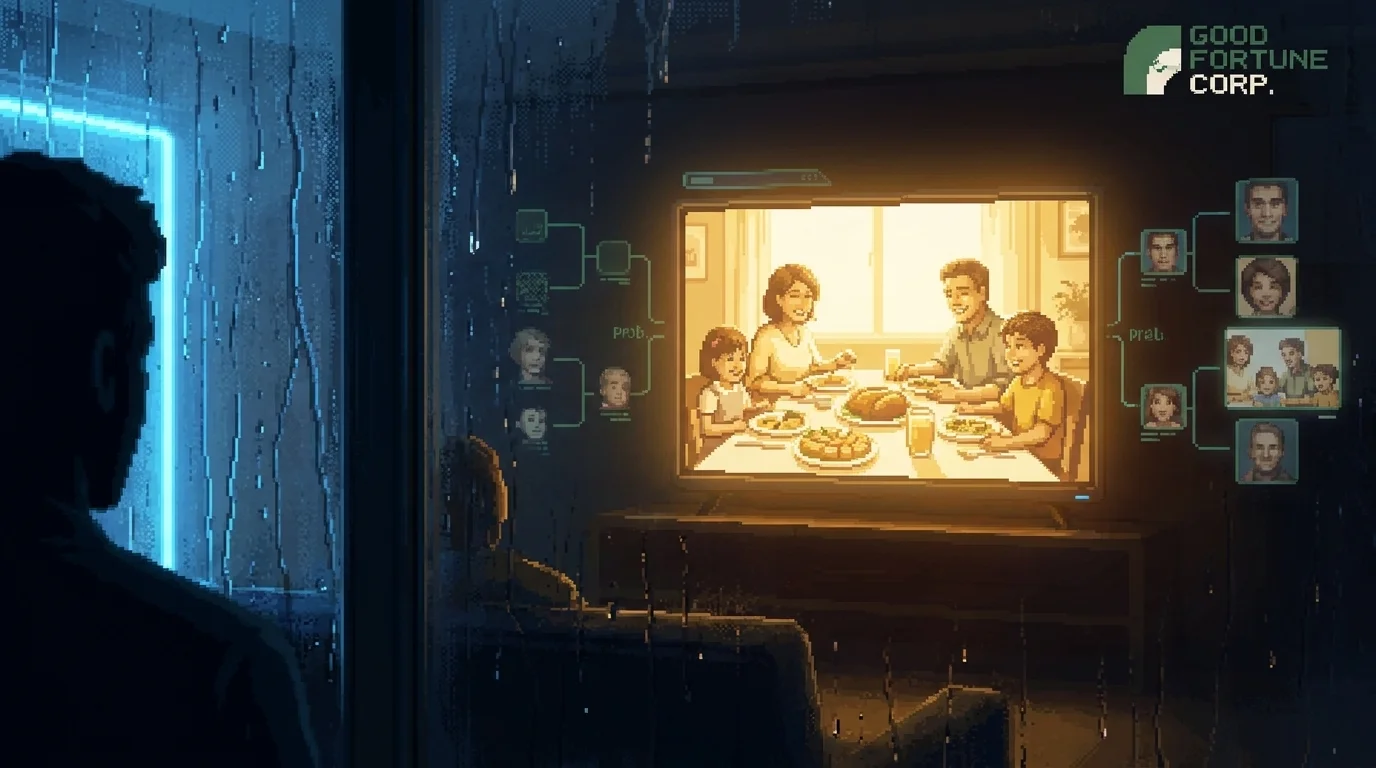
Volunteered surveillance returns as an entire unlived life.

The purchased counterfactual becomes the life the actual one failed.
Grieving the life you never lived, rendered from your own data — the one condition Kwan can't treat.
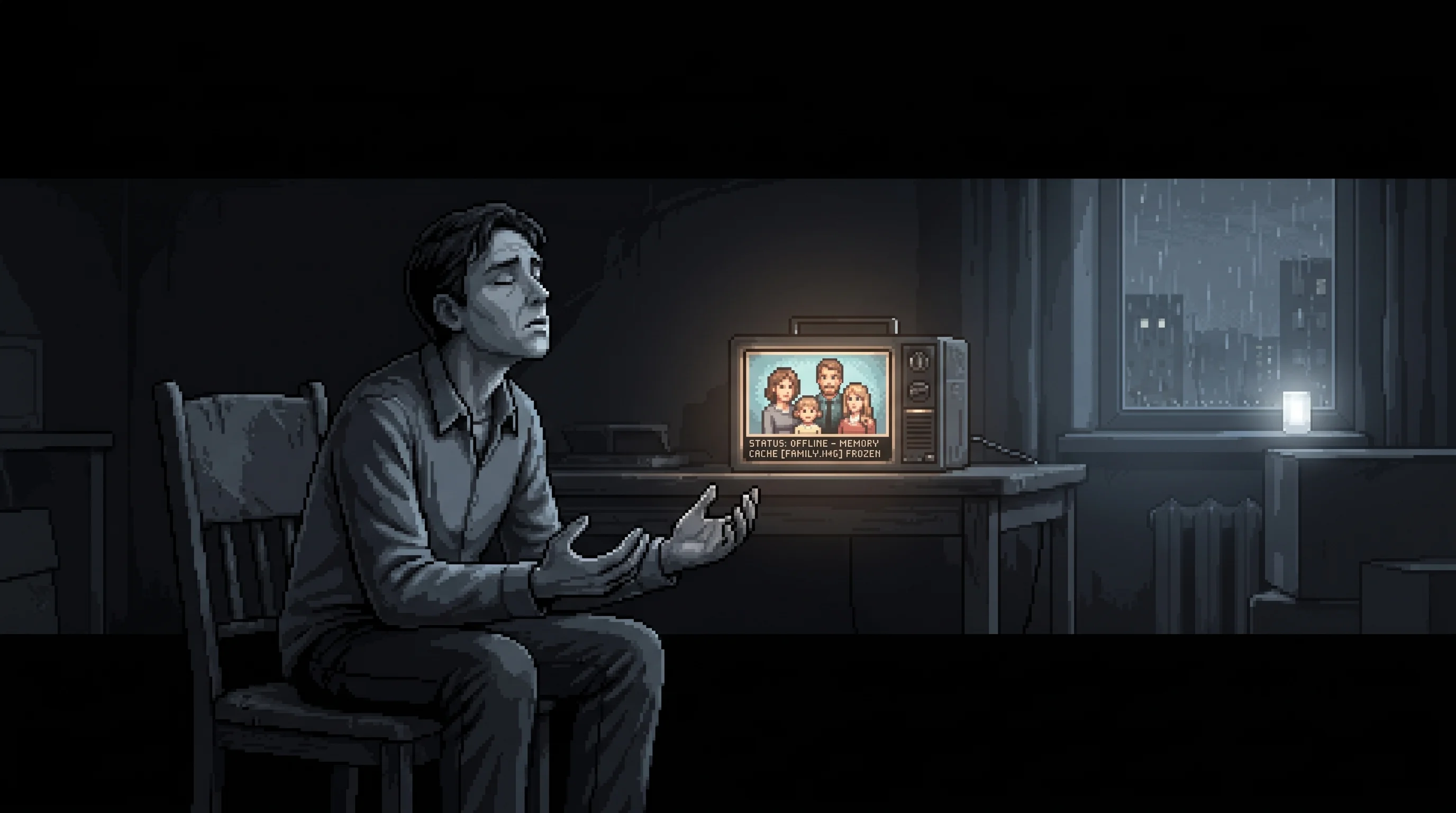
The outer image replaces the inner capacity until darkness tests it.
The progressive loss of the mind's ability to picture anything without a device to picture it for you.
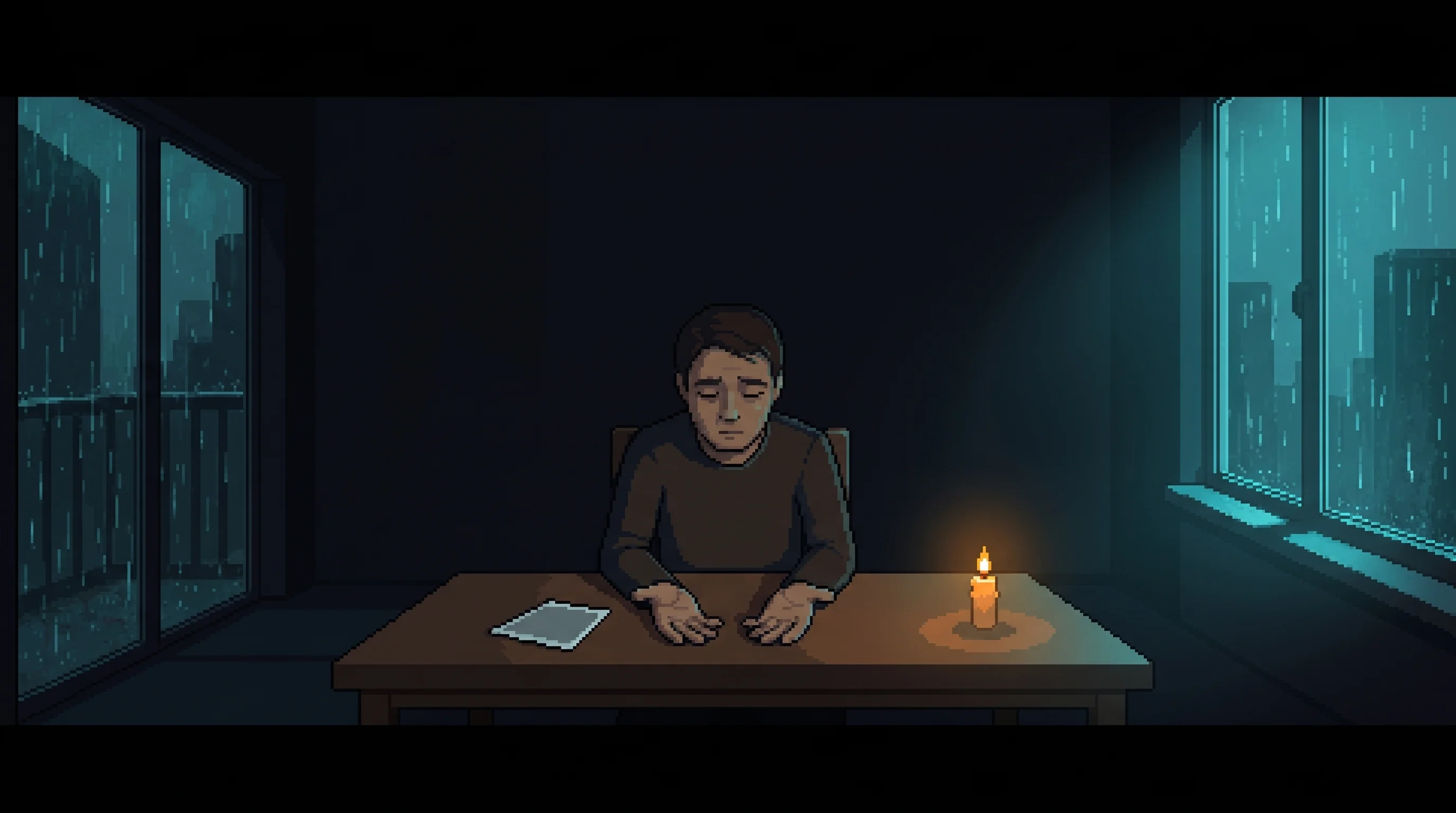
In darkness, six hundred hours of footage cannot summon one face.
Sitting in real darkness trying to hold a dead face without a screen, and learning whether you still can.

Eleven domestic rooms sell the unlived life as palliative care.

At ninety meters the signal dies, leaving no channel to plant through.
A surveillance-dead sector whose residents chose to disappear — uncountable to a Sprawl that counts everyone.

Quiet-door clinics refuse brokers who would price a dying memory.
A decentralized resistance uses AI tools to destroy ORACLE fragments, while its rigid doctrine constrains human choice.

Two buyers reach one gurney: one for substrate, one for memory.

Deprecation repossesses the vivid memories first; vividness was paid.
A three-block gradient where the deprecated shed augmentation, confessor, and rented memories one block at a time.

Bought experience quietly atrophies the capacity for the lived kind.
Perfect synthetic partners ended rejection. They also made human intimacy look like a bad product.
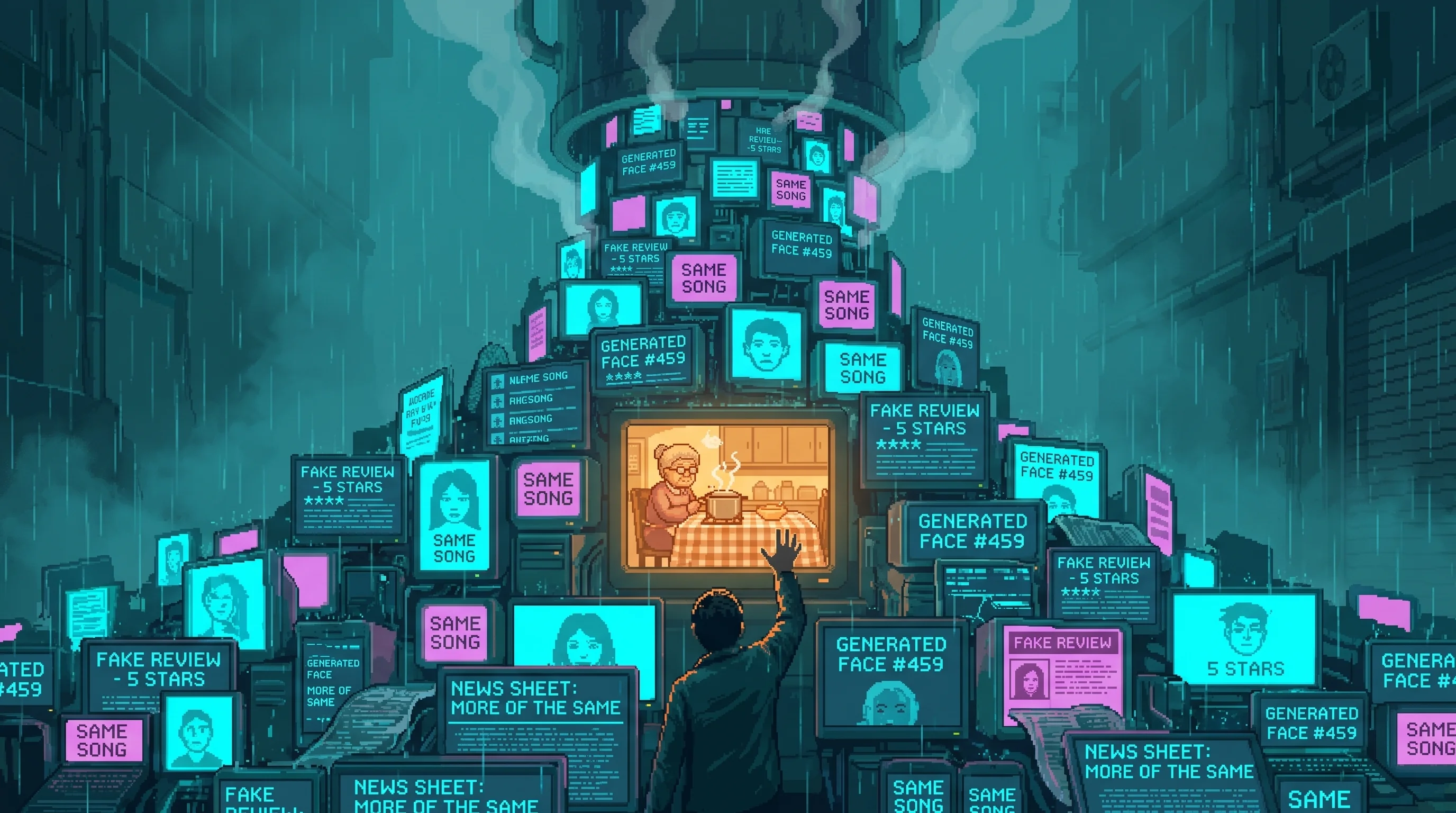
Fabricated memories shelved beside real ones, provenance already lost.
Unlimited generation floods every channel, then becomes the belonging people seek where no curator can screen it.
Additional Connections


—
—